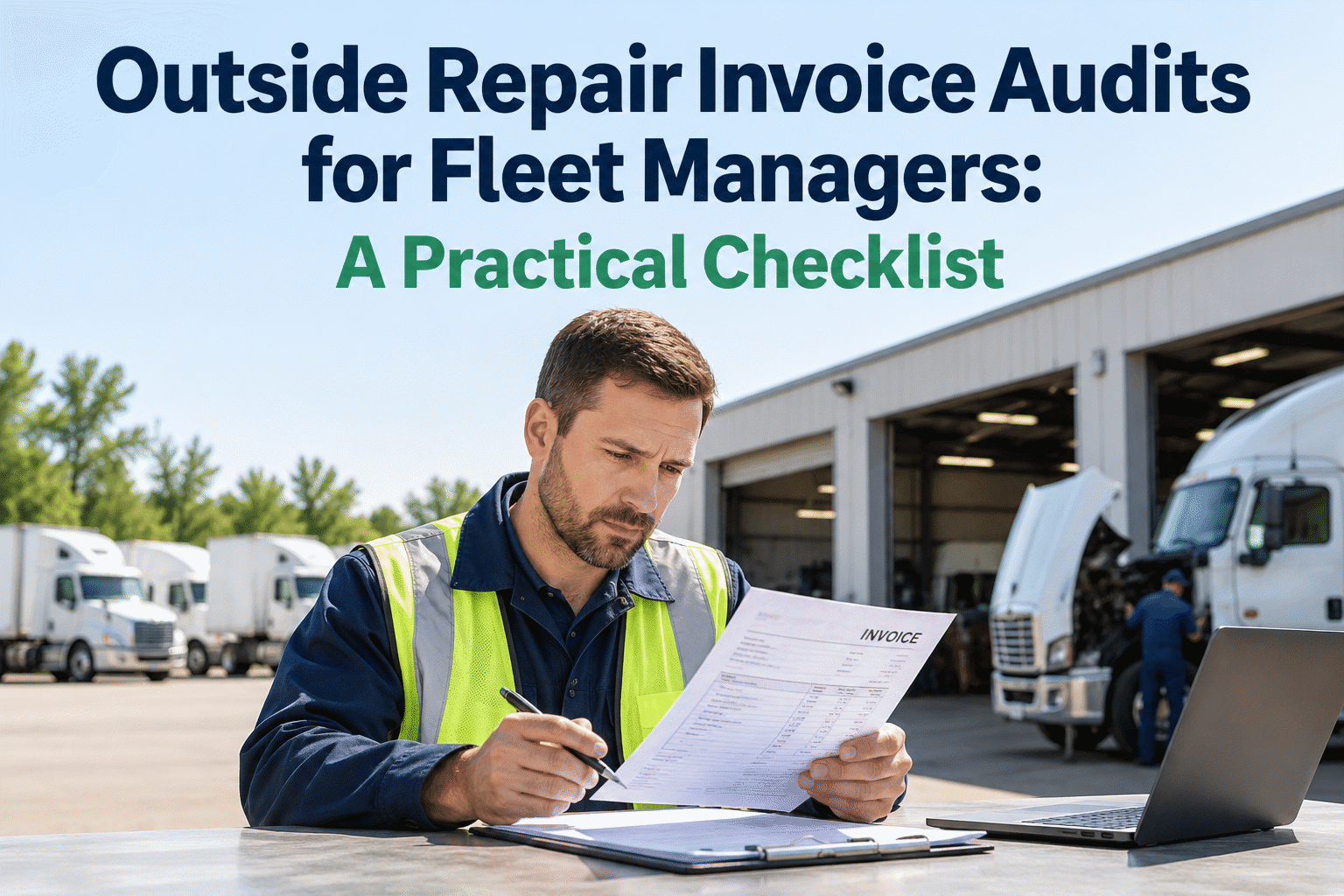
A repair invoice lands from the shop that fixed your box truck, and the pressure is to approve it and move on. But it has three hours of labor on a two-hour job, parts marked up past your agreed rate, and a shop fee your contract waives. An outside repair invoice audit is the ten-minute habit that catches exactly this, before the payment clears. Skip it across a year of outsourced repairs and the overbilling adds up. Start a free trial and match every invoice to its work order.
Outside Repair Invoice Audit: Catch the Overcharge Before It Clears
Most padded repair invoices aren't fraud — they're small, routine overcharges nobody checks. Here's what a two-minute scan flags on a typical one.
That invoice isn't unusual — it's typical. The overcharges are small enough to slip through and routine enough that nobody flags them. An outside repair invoice audit turns "approve and pay" into a quick, repeatable check. Below are the lines that leak money, the checklist to run on every invoice, and what to do when a line doesn't hold up.
Seven lines that leakwhere outside repair invoices quietly overcharge
A good outside repair invoice audit is a scan for the same handful of soft spots every time. Learn these seven and you'll catch the overwhelming majority of overbilling — most of it honest error, some of it not.
A two-hour job billed as three. Compare billed hours to standard repair time and the authorization — watch for rounded or overlapping tech time.
A rate above your signed agreement, buried in a single labor total. Rate errors hide when the invoice shows only a lump sum, not hours × rate.
Retail pricing instead of your fleet rate, or markup above the agreed margin — 15% agreed, 25% billed. Demand part numbers and unit costs.
Disposal fees applied per tire, per axle and per vehicle at once — or fees your contract waives entirely. Confirm the basis against the agreement.
A revised invoice that never cancelled the first, one authorization number on several invoices, or the same work across two billing periods.
Lines that never appeared on the approved estimate. Compare the final invoice to the repair authorization and flag anything added without sign-off.
A repair that should have been covered under a part, component or vehicle warranty — billed to the fleet instead. Check warranty terms before you pay, not after.
Each one is only catchable if you can hold the invoice next to the approved work order, the agreed rates and the parts actually used. That matching is exactly what HVI's purchase management and work-order records are built to do. Book a walkthrough to see invoice-to-work-order matching on a real repair.
The audit checklistrun this on every outside repair invoice before approval
This is the whole discipline in one page. Work top to bottom on each invoice — match it, verify the charges, then approve or dispute. Anything you can't tick is a line to question before the payment goes out.
- Invoice ties to one approved work order / PO
- Vehicle unit, date and mileage all match
- Authorization number present and unique
- Not already billed in a prior period
- Labor hours match book time & authorization
- Labor rate matches the signed agreement
- Parts show number, qty, unit cost & agreed margin
- Shop / enviro fees allowed by contract, not stacked
- Diagnostic fee was authorized
- No warranty-covered work billed to the fleet
- Every line authorized & proof of completion on file
- Flagged lines raised with the vendor in writing
- Credit or corrected invoice tracked to resolution
- Final approved cost posted to the vehicle record
Keep this checklist attached to the invoice itself, not in someone's head — that way the audit survives staff turnover and stands up if finance or an external auditor asks how a repair cost was approved. Book a walkthrough to see this checklist built into invoice approval.
When a line failsthe dispute-and-recover flow
Flagging an overcharge is only half the job — the other half is getting the money back and closing the loop. A flagged line that never gets resolved is the same as not catching it. Here's the short path from flag to credit.
-
1
Hold payment on the flagged line
Approve the clean lines if you can, and hold only the disputed amount — don't pay the whole invoice to keep the peace.
-
2
Raise it in writing with evidence
Cite the authorization, the agreed rate or the book time. A specific, documented challenge gets corrected far faster than a phone complaint.
-
3
Track the credit to resolution
Log the expected credit or corrected invoice and chase it until it lands — unresolved credits are where recovered money quietly disappears.
-
4
Score the vendor over time
Repeated flags from the same shop are a pattern, not bad luck. A record of disputes is leverage at contract-renewal time.
The vendor-scoring step is the one that changes behaviour. When a shop knows you check every invoice and keep a record, the "mistakes" tend to stop. HVI keeps that dispute and credit history against the vendor automatically. Book a walkthrough to see vendor dispute tracking from the first flagged invoice.
Where HVI fitsthe record that makes the audit fast
An invoice audit is only as quick as your ability to pull the matching record. When the approved work order, agreed rates and parts list sit beside the invoice, the whole checklist takes minutes — and nothing gets approved on trust alone.
Every outside repair ties to its approved work order, so billed hours, rate and parts check against what you authorized — not the shop's word.
Labor rate and parts margin per vendor live in purchase management, so drift above the contract is obvious at a glance.
Repeated authorization numbers and repair cost trends surface in analytics & reporting before they're paid twice.
The final approved cost lands on the vehicle record alongside its PM history, so true cost of ownership stays accurate.
Put it together and the audit stops depending on who's at the desk that day — the record does the remembering. Book a walkthrough to see a flagged invoice end to end, from mismatch to recovered credit.
From a fleet maintenance coordinator
We outsource a lot of heavy repairs, and I used to just approve the invoices — the trucks were fixed, who had time to argue line items? Then I started matching each one to our work order. In the first month I caught labor hours that didn't match the job and a parts margin double what we'd agreed. It wasn't one bad shop; it was a habit across several. Now every invoice gets the same two-minute check, and the shops know it.
Outside repair invoice audit — FAQs
What should I check on an outside repair invoice?
Match the invoice to one approved work order, then verify each line: labor hours against book time, labor rate against your agreement, parts with numbers and agreed margin, shop and environmental fees against the contract, no duplicate billing, no unauthorized work, and no warranty-covered repairs billed to you. Flag anything you can't confirm before paying.
How do I catch duplicate repair billing?
Tie every invoice to a single approved work order using the vehicle, date, mileage, PO and authorization number. Watch for a revised invoice that never cancelled the original, one authorization number appearing on several invoices, or the same work showing up in two billing periods. One-invoice-per-authorization is the rule.
How do I verify billed labor hours and parts markup?
Compare billed labor hours to the standard book time for the job and to what you authorized — a two-hour job billed as three is a red flag. For parts, insist on part numbers, quantities and unit costs, then check the markup against your agreed margin. A single lump labor or parts total with no breakdown is itself a warning sign.
What do I do when an invoice line is wrong?
Hold payment on the disputed amount (pay the clean lines if you can), raise it in writing citing the authorization, agreed rate or book time, then track the credit or corrected invoice until it's resolved. Log repeated issues against the vendor — that record is leverage at renewal.
How does HVI help audit repair invoices?
HVI keeps the approved work order, agreed labor rate, parts margin and authorization right beside the invoice, so billed hours, rates, parts and fees check against what you authorized in seconds. It flags duplicates, tracks disputes and credits, and posts the final approved cost to the vehicle record for accurate cost of ownership.
Make the invoice audit a habit, not a year-end surprise
HVI matches every outside repair invoice to its approved work order and agreed rates, flags the lines that don't add up, and tracks disputes to credit — so overbilling gets caught before you pay. Set up on your fleet in under two weeks.
No credit card · No hardware · Invoice matching ready on day one