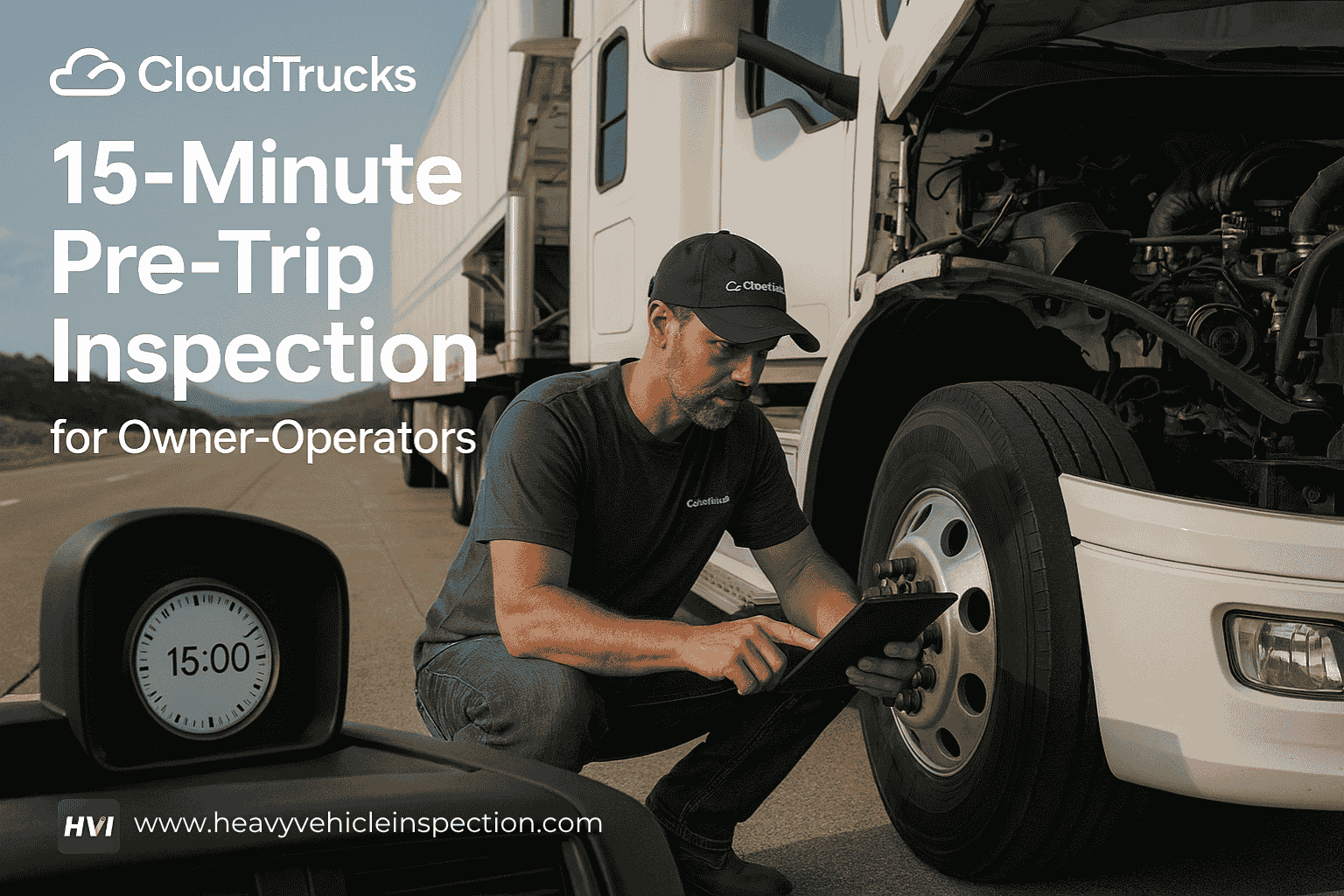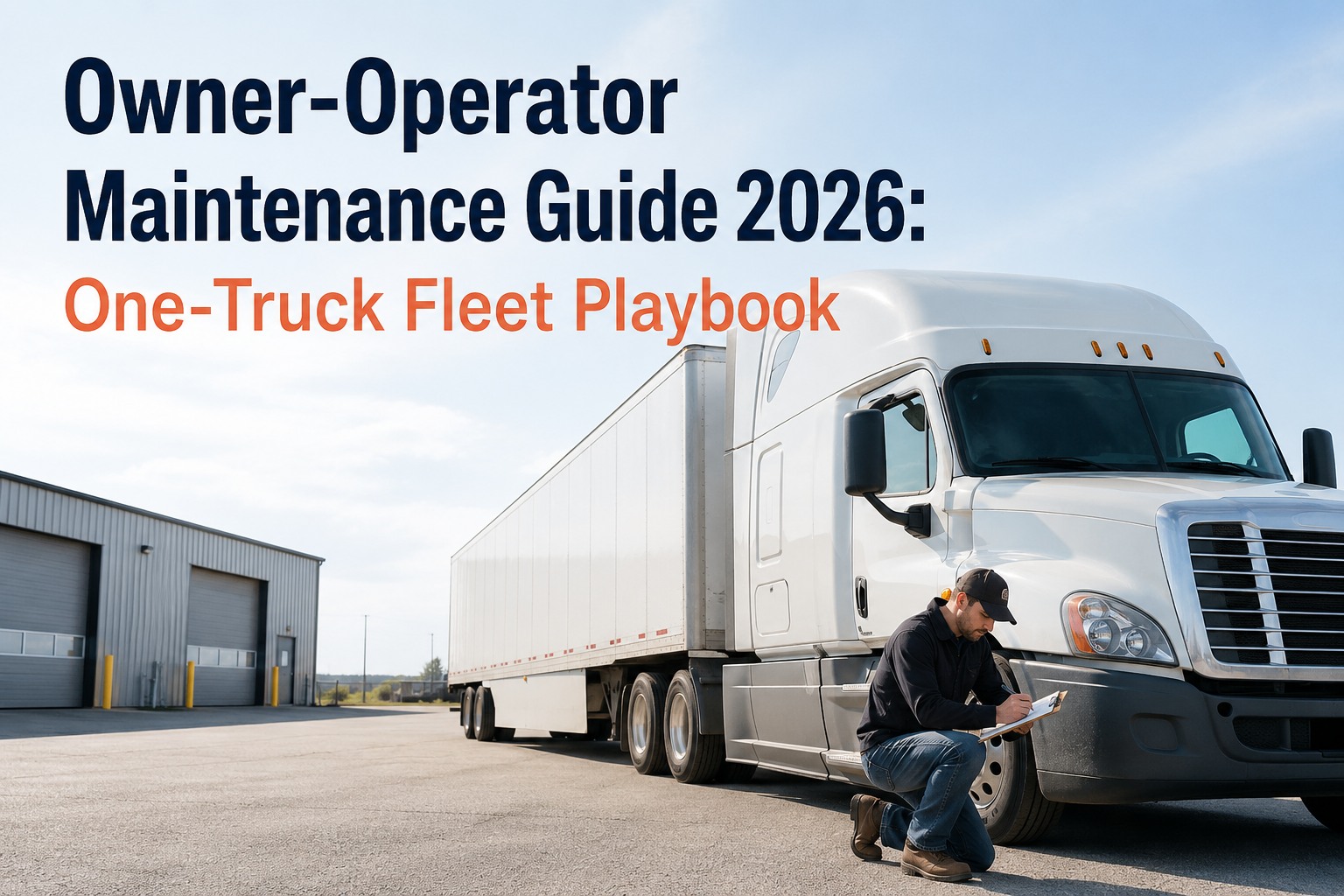
Every owner-operator runs a one-truck fleet whether they think of it that way. Same DOT rules as a 500-truck carrier. Same 7-day pre-trip, same 90-day PM, same tire wear. The difference is you're the driver, the safety manager, the maintenance scheduler, and the CFO all at once — and one $1,200 PM bill lands on your bank account. This owner operator maintenance guide walks the PM schedule, the cost math, and the discipline that separates top-third earners from the 85% who fold in year two. Book a demo
The truck doesn't care that you're independent. The math doesn't either.
$14,000 a year. That's the ATBS 2025 average maintenance spend for a full-time owner-operator running around 94,000 miles. 14-15 cents of every mile driven. Skip the discipline and the number climbs; run the discipline and it stays predictable. Either way, it's coming out of your account.
The maintenance line item on your P&L — and what it competes with
ATBS puts the 2025 average owner-op net income at $71,808. To get there from ~$200K-$350K gross, every operating dollar has to be tracked, and maintenance is one of the four biggest chunks after fuel, truck payment, and insurance. Miss the maintenance number and the net income number goes with it — often on the same day, when the breakdown happens.
The maintenance line isn't the biggest number on the P&L. It's the most volatile one. Fuel is what it is; the truck note is what you signed; maintenance is the one line where discipline this week determines what next quarter's number looks like. Book a demo to see per-mile cost tracking built for one-truck operations
The PM schedule — A / B / C intervals every owner-op should run
Manufacturer schedules vary by engine and duty cycle, but the industry-standard PM tiering for Class 8 tractors runs on a three-level ladder. Each tier includes everything from the tier below plus more. Run this ladder consistently and the 14-15¢/mile maintenance number holds; skip levels and it climbs.
The ladder is deceptively simple. What trips up owner-ops isn't the schedule — it's tracking it. On a mixed load calendar with variable weekly mileage, "next PM at 350,000 mi" turns into "when was that again?" fast. Digital tracking removes the question. Start free and get PM-A/B/C intervals tracked on odometer or calendar this week
The repair fund — what to set aside per week to survive year two
The 85% year-two failure rate for new owner-ops isn't caused by low rates. It's caused by no reserve when the DEF system fails in month 11. ATBS recommends setting aside 7-15 cents per mile for general upkeep and repairs. On a typical 94K-mile year, that's $6,500-$14,000. The high end covers the average maintenance number; the low end is the emergency reserve on top of it.
| Weekly miles | Annual miles | Weekly set-aside @ 10¢ | Annual fund built |
|---|---|---|---|
| 1,500Regional / hub-and-spoke | ~78,000 | $150/wk | $7,800 |
| 2,000OTR standard week | ~104,000 | $200/wk | $10,400 |
| 2,500OTR hard-running | ~130,000 | $250/wk | $13,000 |
| 3,000Team or high-mile solo | ~156,000 | $300/wk | $15,600 |
Diesel mechanic labor is running around $190/hour in 2026. A DEF system repair is $2,800. A DPF replacement is $3,500-$5,000. A blown turbo is $4,000-$8,000. None of these are optional when they happen; the fund is what makes them survivable. Book a demo to see repair-fund tracking tied to every mile driven
Resale documentation — why your maintenance log is worth $8K-$15K at trade-in
The truck you're driving now is also the truck you'll sell in 4-7 years. Two identical 2023 tractors with the same miles: one has 4 years of documented PM history with signed shop invoices, oil-change records, and a clean roadside inspection log. The other has a truck payment and a memory. The first sells for $8K-$15K more — because the buyer isn't guessing what's been done. The documentation is the differentiator.
The maintenance log isn't paperwork — it's future asset value. Every entry today becomes documentation that lifts the resale price at trade-in. Owner-ops running clean digital records routinely sell $8K-$15K above the "no documentation" comparable. Start free and start building your resale documentation from mile zero
From an owner-op who moved from paper to digital in year three
First two years running my own truck I did what everybody does — paper receipts in the glovebox, PM tracking on my phone's calendar, cost-per-mile as a guess. Made it through, barely. Year two I had a DEF sensor go on a Sunday night in a truck stop and the emergency reserve was $1,100 when the repair came to $2,900. Had to take three straight cheap loads to catch up. Never want to be in that spot again.
Year three I moved everything into HVI — PM intervals set on odometer thresholds, every repair receipt photographed and attached to the truck record, weekly maintenance set-aside tracked against actual spend, cost-per-mile updated automatically. Two years of that now. Emergency reserve stays around $9,000. When the water pump went last fall the repair cost $1,650 and it never felt like a crisis. And when I traded up to a 2025 Freightliner last month, my clean four-year history added roughly $12,000 to what the dealer offered for the trade — because they could see exactly what had been done and when. Same truck. Different paperwork.
Frequently asked questions
How much do owner-operators spend on maintenance per year?
The 2025 ATBS average for owner-operator clients was upward of $14,000 in annual maintenance and repair spend, which works out to roughly 14-15 cents per mile on typical mileage of around 94,000 miles per year. The number has been rising through 2025 and 2026 as parts inflation persists (roughly +3.2% in 2026), technician labor rates climb (currently around $190/hour for a diesel mechanic in most US markets), and tire costs continue to increase. That $14,000 figure typically includes $1,000 to $4,000 a year for tires depending on axle count and miles run. Owner-operators with disciplined PM programs tend to hit the low end of the range and see less variance year-to-year; those running reactively (fixing things when they break rather than servicing on schedule) typically see spend climb to 20-25 cents per mile or higher, which can add $6,000-$10,000 in unnecessary annual cost. On top of the routine spend, most experienced owner-ops recommend maintaining a separate emergency repair reserve of $8,000-$15,000 for the major unscheduled events (DEF system failure, DPF replacement, turbocharger, transmission service) that fall outside the PM budget and can otherwise force the operator to take cheap loads to cover a single bill.
What preventive maintenance schedule should an owner-operator follow?
The industry-standard PM tiering for Class 8 tractors runs on a three-level ladder that most manufacturers, fleet service centers, and owner-operator groups follow. PM-A (dry PM) runs every 10,000-25,000 miles depending on engine and duty cycle and typically costs around $100 — it covers a grease job, fluid level check, tire pressure and tread, component visual inspection (brakes, belts, lights, wipers), and air system quick check. PM-B (wet PM) runs every 25,000-50,000 miles and typically costs $450-$900 — it includes everything in PM-A plus engine oil and filter change, fuel filters, air filter, coolant top-off, and more detailed brake and DEF system check. PM-C (major service) runs annually or every 100,000 miles and typically costs $1,200-$2,500+ — it includes everything in PM-A and PM-B plus DOT annual inspection, full brake inspection with drums pulled where required, valve adjustment on schedule, coolant flush and refill, transmission and differential service, and aftertreatment deep service. Manufacturer schedules vary; the exact intervals should be confirmed against your specific engine (Cummins, Detroit, PACCAR) and truck manual. What matters more than picking the exact interval is running whichever schedule you pick consistently — consistent PM at 30K intervals beats aggressive PM at 15K intervals with occasional skips.
How much should I set aside per mile for maintenance and repairs?
The ATBS recommendation is to set aside between 7 and 15 cents per mile for general upkeep and repairs, with 10 cents per mile being a solid rule of thumb for most owner-operators. On typical annual mileage of 94,000 miles, that produces a repair fund of $9,400 per year, or about $200 per week for a driver running 2,000 miles per week. The set-aside runs whether or not you spend it — some weeks you'll add to the fund without withdrawing, some months you'll draw the fund down significantly for a major repair. Over a full year, the fund and the actual spend tend to converge. The critical function of the fund isn't the average; it's the ability to pay for a $2,800 DEF system repair or a $4,000 turbocharger replacement the day it happens without having to take three cheap loads back-to-back to cover the bill. That's the difference between a repair being expensive and a repair being a business-ending event. For newer owner-operators in year one and two, some financial advisors recommend the higher end of the range (12-15 cents per mile) specifically to build the reserve fast — because the 85-90% first-two-year failure rate for owner-op businesses correlates strongly with running without a reserve when the first big repair hits.
Why do maintenance records matter for owner-operator resale value?
The truck you're driving now is also the truck you'll sell or trade in 4-7 years. Documented maintenance history is one of the largest single factors in the price difference between two otherwise-identical tractors at trade-in or private sale. A buyer looking at a 2022 Freightliner with 640,000 miles has two questions: what's been done, and what's coming due. A truck with signed shop invoices for every PM-A/B/C, receipts for every repair with parts and labor detail, tire and DPF history, and a clean roadside inspection record answers both questions and reduces the buyer's risk premium. A truck with no documentation forces the buyer to price in the worst-case assumption about deferred maintenance — typically knocking $8,000 to $15,000 off the offer. On a $60,000-$80,000 trade-in value, that's roughly 10-20% of the asset value determined entirely by paperwork. Digital maintenance records make this documentation trivial to produce: every PM entry, every repair, every inspection tied to the odometer reading of the day it happened, exportable as a signed PDF at trade-in time. The same records also protect against warranty disputes with the OEM and against liability disputes in the event of an incident.
How does HVI work for a one-truck owner-operator?
HVI's owner-operator setup runs on the driver's phone and is designed specifically for one-truck operations — no fleet-management complexity, no team-of-mechanics assumption, no per-seat pricing that only makes sense for a 50-truck carrier. The PM engine runs the three-tier PM-A/B/C schedule on odometer or calendar with alerts firing at 90/60/30 days or 5,000/2,000/500 miles before each service due. Daily DVIR runs in the mobile app with a Class 8 tractor template covering all standard DOT items plus what the driver actually cares about. Every repair records to the truck's file with parts, labor cost, shop name, and photo attachment. Cost-per-mile calculates automatically from mileage and spend, updating in real time so the driver knows their number without spreadsheet work. Weekly repair-fund tracking shows the target set-aside against actual reserve. And the whole maintenance history exports as a signed PDF document at trade-in or sale time — the paperwork that lifts the resale value $8K-$15K above the "no documentation" comparable. For owner-operators like Carl B. running OTR reefer on his own authority, the shift from paper to digital tracking typically cuts unplanned-repair stress in half within the first year and delivers a meaningful trade-in premium at the next truck upgrade. Book a demo to see the owner-operator setup running live.
One truck, one operator, one clean maintenance record — the discipline that separates the top third from the bottom 85%.
HVI runs the PM ladder, tracks cost-per-mile automatically, monitors the repair fund against your set-aside target, and builds resale documentation from every entry. Live in under a day on a single truck. Free tier available for owner-ops starting out.