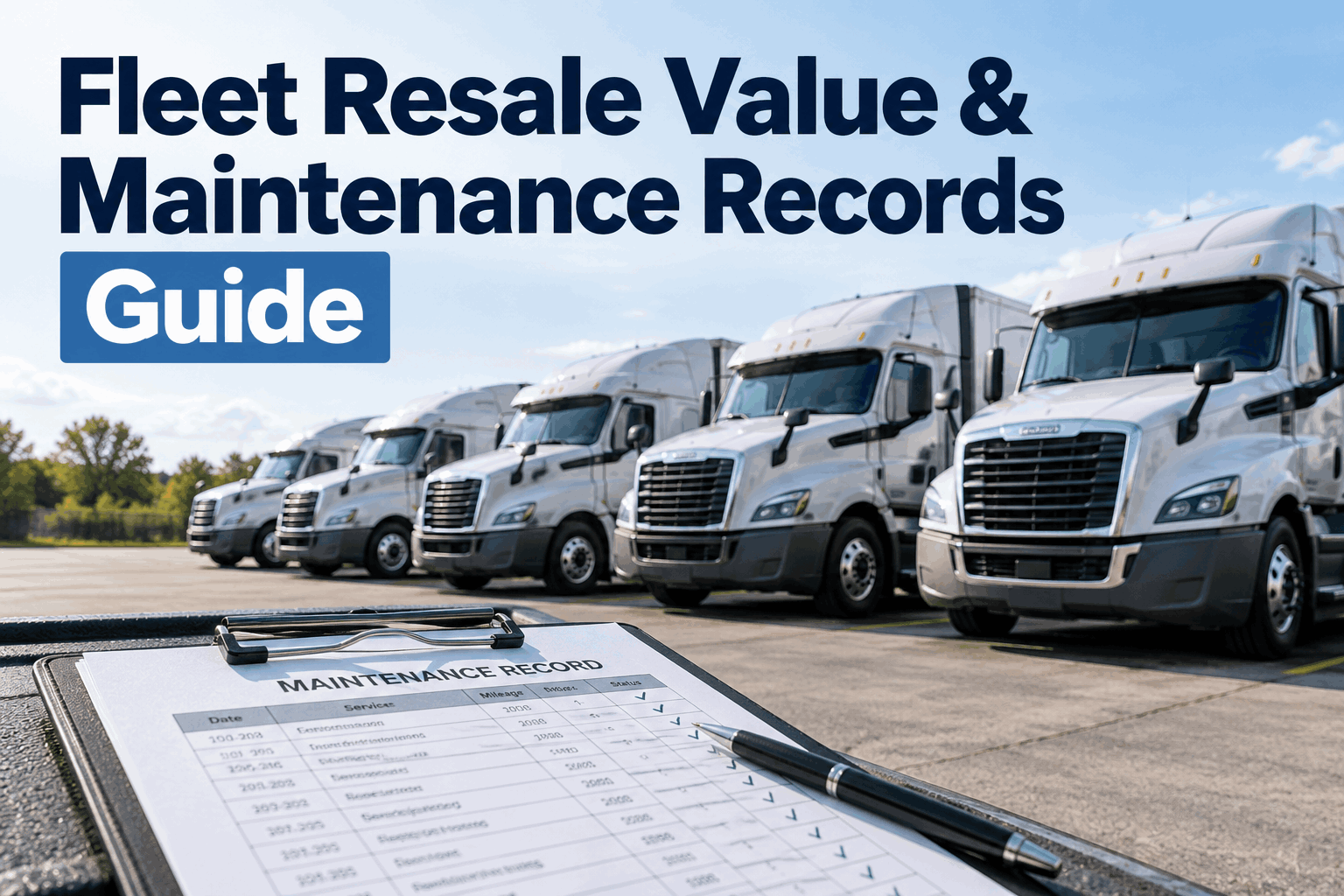
Two identical trucks cross the same auction block the same week — same model, same age, within a few thousand miles of each other. One sells for noticeably more. The difference wasn't the paint job or a sharper sales pitch. It was a binder of service records the other seller couldn't produce. Fleet resale value is decided as much by what you can prove as by what the vehicle actually is.
The Service History Evidence That Moves the Price
This guide covers why maintenance records move resale price independent of a vehicle's age or mileage, the specific service history buyers and appraisers actually review, how to prepare an asset for disposal, why timing the sale against a rising maintenance-cost curve matters, and why digital, instantly retrievable records outperform a box of paper receipts at the exact moment a buyer is deciding how much to offer.
Why Maintenance Records Move Fleet Resale Valueit's not sentimental — it's risk pricing
A buyer or appraiser without service records has to assume the worst plausible maintenance history, because they have no way to rule it out. That assumption gets priced in as a discount, not a guess — dealers routinely value undocumented vehicles more cautiously because they're pricing in the reconditioning risk they can't see. Multiple industry sources, from consumer valuation research to fleet remarketing guides, converge on a similar range: a documented service history is commonly associated with a 10% to 20% premium over a comparable asset with missing or incomplete records. On a vehicle or piece of equipment worth tens of thousands of dollars, that gap is rarely small change — and it's a gap created entirely by paperwork, not by the mechanical condition of the asset itself.
The Service History Buyers Actually Reviewsix categories, each answering a different buyer question
Preventive maintenance history
Proof the asset was serviced on schedule, not just when something broke — the clearest signal of how it was actually treated.
Repair records
What went wrong and how it was fixed — a repair history with no repeat issues reads very differently than one with the same complaint logged three times.
Major component replacements
A documented engine, transmission, or major system replacement often adds more value than it cost, because it resets the buyer's expectation of remaining life.
Inspection history
Routine and periodic inspection records show problems were being actively looked for, not just addressed once they became unavoidable.
Mileage & meter readings
Consistent, verifiable readings over time confirm the odometer or hour meter story matches the maintenance story — a mismatch is one of the fastest ways to lose buyer trust entirely.
Total maintenance cost
A cost history that's trending up sharply tells a buyer something about what they're about to inherit — and tells you something about whether it's the right time to sell at all.
Book a demo to see all six categories pulled together into one asset history, ready to hand a buyer or appraiser on request.
Preparing an Asset for Disposalthe paperwork step most sellers rush
None of these four steps take long once the underlying records already exist in one place — the work is in the three years before disposal, not the three days before it. Sign up free to have this checklist ready to run the moment an asset is flagged for disposal.
Timing the Sale Against the Maintenance Cost Curveresale value and replacement timing are the same decision, viewed from two sides
Every asset eventually reaches a point where ongoing maintenance cost rises faster than its market value holds up — and that crossing point, not a fixed age or mileage number, is the real signal for when to sell. Selling too early leaves useful service life and resale value on the table; selling too late means absorbing a steeper repair curve while the asset's value is already declining. Tracking cumulative maintenance cost per asset over its life is what turns that decision from a guess into a chart — the month cost acceleration starts outpacing the asset's remaining value is the month disposal planning should start in earnest, not after the next major failure forces the question. Book a demo to see that crossing point plotted automatically against each asset's maintenance cost history.
Digital vs. Paper Records at the Point of Saleretrieval speed matters as much as completeness
- Takes days to compile when a buyer asks for the full history
- Gaps are easy to miss until a buyer finds them first
- Hard to verify mileage consistency across years of receipts
- Credibility rests on the seller's word as much as the paperwork
- Complete history available in seconds, mid-conversation with a buyer
- Gaps are visible to the seller before a buyer ever finds them
- Mileage and meter trends verified automatically against the log
- A system-generated record carries more credibility than a seller's claim alone
The records themselves don't have to be more complete to make this difference — they just have to be retrievable the moment a buyer is actually deciding whether to trust what you're telling them. A negotiation that pauses for two days while someone digs through a filing cabinet rarely ends better than one where the full history is pulled up on a phone mid-conversation.
From a fleet director who stopped losing resale value to missing paperwork
We sold a batch of vans at auction and two of them, mechanically identical to the rest, came in noticeably lower. When I asked why, the buyer's rep said simply that those two didn't have a clean service history attached — nothing wrong was found, there just wasn't proof nothing was wrong. That was the moment I stopped treating maintenance records as a filing-cabinet afterthought. Now every asset has a complete digital history ready before it's even scheduled for disposal, and our average sale price per unit noticeably improved without changing a single thing about how we maintain the vehicles.
How HVI Protects Fleet Resale Value
HVI builds a complete, searchable maintenance history for every asset automatically — preventive maintenance, repairs, major component replacements, inspections, and meter readings all tied to the same record instead of scattered across systems and paper. Sign up free to start building that history today, well before any asset is scheduled for disposal.
Cost analysis tracks cumulative maintenance spend per asset over time, so the point where cost starts outpacing value shows up as a trend line, not a surprise. When it's time to sell, trade in, or remarket, reporting makes the full history retrievable in seconds — not a scramble through old invoices — giving buyers and appraisers exactly the evidence that reduces uncertainty and protects your price. Book a demo — Protect Fleet Asset Value with HVI to see maintenance history, cost analysis, and reporting working together across your fleet.
Frequently Asked Questions
How much do maintenance records actually affect fleet resale value?
Industry sources, including consumer valuation research and fleet remarketing guides, commonly cite a 10% to 20% premium for assets with complete, documented service history compared to similar assets with missing or incomplete records. The exact figure varies by vehicle type, market, and buyer, but the direction is consistent: documentation reduces buyer uncertainty, and reduced uncertainty shows up directly in the offer.
What maintenance records should I keep for resale purposes?
Buyers and appraisers typically want to see preventive maintenance history, repair records, documentation of any major component replacements, inspection history, consistent mileage or meter readings over time, and total maintenance cost. Together these answer the questions a buyer can't otherwise verify: was it serviced on schedule, what went wrong and how was it fixed, and does the usage story add up.
When is the right time to sell a fleet vehicle or piece of equipment?
The strongest signal is the point where cumulative maintenance cost starts rising faster than the asset's market value holds up, rather than a fixed age or mileage threshold. Tracking maintenance cost per asset over its life turns that decision into a visible trend, letting a fleet plan disposal before a major failure forces the timing.
Do digital maintenance records sell better than paper records?
Digital records aren't inherently more complete, but they're far faster to retrieve and verify at the exact moment a buyer is deciding how much to offer — a complete history available in seconds carries more credibility than a seller's claim backed by a folder of receipts that takes days to compile. Consistency checks, like matching mileage trends against service dates, are also easier to verify in a digital record.
How should a fleet prepare a vehicle for disposal or remarketing?
Compile the complete maintenance and repair history into one reviewable record, resolve or clearly disclose any outstanding defects, verify that current mileage or meter readings match the most recent log entry, and complete a current condition inspection so the asset's actual state is documented alongside its history. Undisclosed issues found later by a buyer cost more in lost trust and renegotiated price than addressing them upfront ever would.
The Takeaway
Fleet resale value is decided at the intersection of condition and proof — a well-maintained asset that can't demonstrate its own history gets priced like a risk, not like what it actually is. Keeping preventive maintenance, repair, component replacement, inspection, and cost records organized and retrievable throughout an asset's life does more for its eventual sale price than almost anything done in the final weeks before disposal. None of this changes how the asset is actually maintained — it changes whether that maintenance ever gets paid for at the point of sale. Build that record continuously, and the premium buyers pay for documented history stops being a one-time negotiation and becomes a predictable part of how your fleet recovers its own capital.
Protect the resale value you're already earning through good maintenance
HVI keeps a complete, searchable maintenance history and cost trend for every asset, so you can prove condition and justify your price the moment a buyer asks.