A broken drive belt is the most common reason a Thermo King unit quits on the road — no belt, no compressor, no cooling, and a warm trailer before anyone knows. Thermo King maintenance software puts the unit on its own hour-based schedule, turns every pretrip-test fault and alarm code into a work order, and keeps the cold-chain record that holds up when a load is questioned.
Your reefer's hour meter should run your maintenance — not your odometer
HVI puts your Thermo King units on an hour-based PM schedule, captures every pretrip-test result and numbered alarm code, and turns each fault into a tracked work order with a claim-ready record.
- PM stacked by engine hours — belt, oil, coils, full service
- Pretrip-test CHECK/FAIL & alarm codes logged per unit
- Cold-chain proof that defends a disputed load
A Thermo King reefer doesn't wear the way a tractor does. Its diesel engine keeps running at a dock or a drop lot while the truck sits still, and a unit on temperature-sensitive freight can rack up roughly 720 hours in a single month. Service it on the truck's mileage and you're always behind — the belt that fails on route almost always had a few hundred hours of warning that nobody was counting. The fix is a schedule built on the unit's own hour meter, backed by digital inspections that actually fire the reminder in time — you can book a demo to see it set up for your Thermo King units.
The stacked hour schedule a reefer actually needsnothing waits 1,500 hours for its first look
The power of a good Thermo King PM schedule is that it's a stack of milestones, not one big annual service. A belt gets eyes on it every few hundred hours while the compressor test runs on its own longer cycle. Here's the rhythm, drawn from Thermo King's own hour-based intervals.
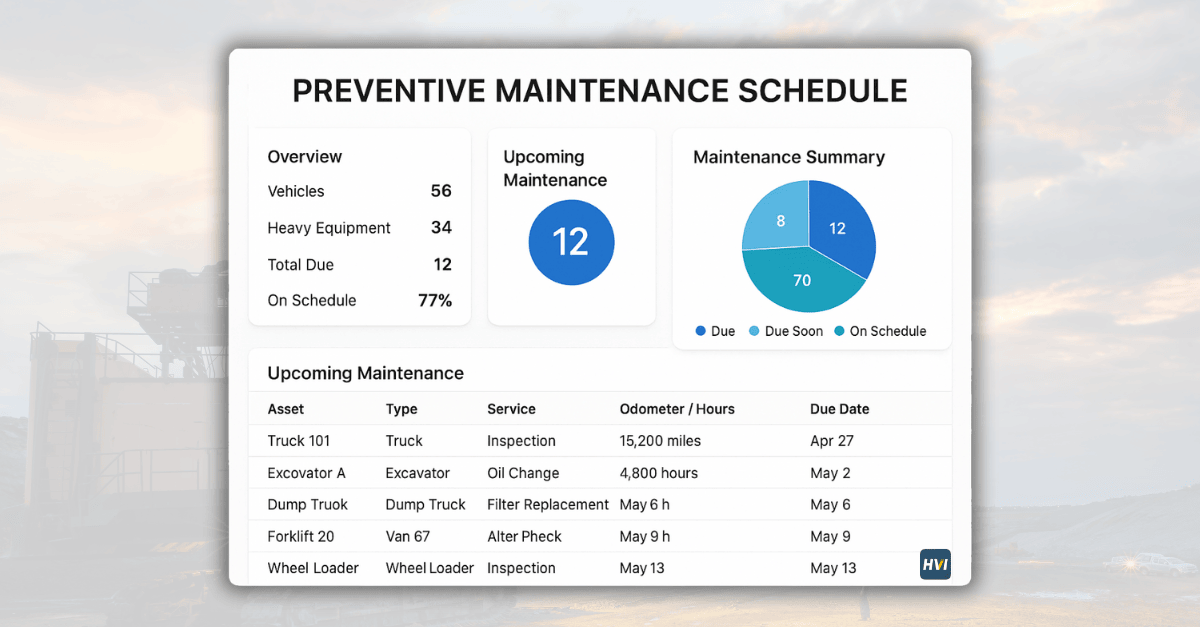
An hour-based stack only works if something reads the hour meter and fires the reminder in time — which most mileage-based systems can't do. HVI schedules preventive maintenance on each unit's real run hours, so the belt check lands before the belt lets go. You can start free and load your Thermo King intervals today .
The belt goes first — then everything elsewhy the cheapest part on the unit causes the most expensive failure
Ask any reefer tech what strands a Thermo King unit most often and you'll hear the same answer: the drive belt. It powers the compressor and the alternator, so when it snaps you lose cooling and charging at the same time — and the load starts warming immediately. It's a part you can catch glazing or fraying on a walkaround, long before it fails.
The whole argument for tracking belt hours is right there: a part that costs almost nothing becomes a spoiled load when it's the thing nobody was watching. Logging the belt check against the unit's hours in connected maintenance management is how you stop the chain at the walkaround. Book a demo to see belt and PM hours tracked per reefer
What the numbered alarm code is telling youreading the SR-4 display to the right root cause
Thermo King units speak in numbered alarm codes, and the ones that put a load at risk cluster around the engine and the refrigeration cycle. A driver who knows what the number means flags the real fault at pretrip instead of clearing it and rolling. Here are the codes that matter most.
Capturing the code and the pretrip-test result together in analytics and reporting is how the repeat units and recurring codes surface — so you fix the alternator once instead of clearing code 25 every week. Book a demo to see Thermo King alarm codes tracked per unit
CYCLE-SENTRY saves fuel — and adds wear to watchthe trade-off only usage-based tracking catches
Thermo King's CYCLE-SENTRY mode stops and starts the engine to hold setpoint instead of running continuously, which cuts fuel burn — a real win. The catch is that every stop-start is an engine cycle, and the mode has to be right for the cargo: continuous run for sensitive loads, CYCLE-SENTRY where the product can tolerate it. Getting the mode wrong, or missing the extra start-cycle wear, is exactly the kind of thing a fuel-aware maintenance record is built to catch.
Engine runs non-stop for tight, steady temps. More fuel, fewer start cycles. Right for sensitive produce, pharma and protein.
Engine cycles on demand to save fuel. More start-stops to track, so belt, battery and starter wear deserve closer PM attention.
Either way, the setpoint and mode belong on the inspection record so the right choice is provable per load. Book a demo to see mode and setpoint logged on every pretrip
The Thermo King pre-trip checklistthe recurring check that keeps the box at setpoint
Build this once as a preventive maintenance template, trigger it by engine hours, and it auto-assigns to every reefer. For the hour-by-hour service structure, see the reefer maintenance schedule guide.
On paper, this is only as good as the last person who filed it. In HVI, every failed line becomes a tracked defect, a work order and a documented repair — automatically.
Build This Checklist Free in HVIFrom a reefer fleet maintenance manager
We were running Thermo King PM off the tractor's mileage, which made no sense once I thought about it — our busiest units sit and run for hours at DCs without adding a mile. We lost a load to a belt that had been glazed for who knows how long.
Switching PM to engine hours and logging the pretrip test on every unit changed everything. Belts and oil get done on the unit's real clock now, and when a receiver questioned a load last month, the hour log and repair history closed it out fast.
Frequently asked questions
What does Thermo King maintenance software do?
It schedules Thermo King PM by engine hours, captures pretrip-test results and numbered alarm codes during digital inspections, and turns each fault into a work order. The result is fewer on-route failures and a claim-ready record per unit.
Does it work with Thermo King alarm codes and the SR-4 pretrip test?
Yes. HVI captures the numbered alarm codes and the pretrip-test CHECK/FAIL result your Thermo King units display, so recurring codes on a specific unit surface instead of getting cleared and forgotten.
Why schedule reefer PM by engine hours instead of mileage?
Because the reefer runs at docks and drop lots while the truck sits still, accumulating up to 720 hours a month. It wears by run hours, so an hour-based schedule catches belt, oil and coil issues before they strand a load.
Does it handle CYCLE-SENTRY and Continuous run modes?
Yes. The run mode and setpoint are logged on every pre-trip, so the right mode for the cargo is provable, and the extra start-cycle wear from CYCLE-SENTRY gets the PM attention it needs.
How long does it take to get set up in HVI?
Most fleets are live across their reefers in under two weeks, with no new hardware. You load your Thermo King hour intervals and build the pretrip checklist once, and it auto-assigns to every unit.