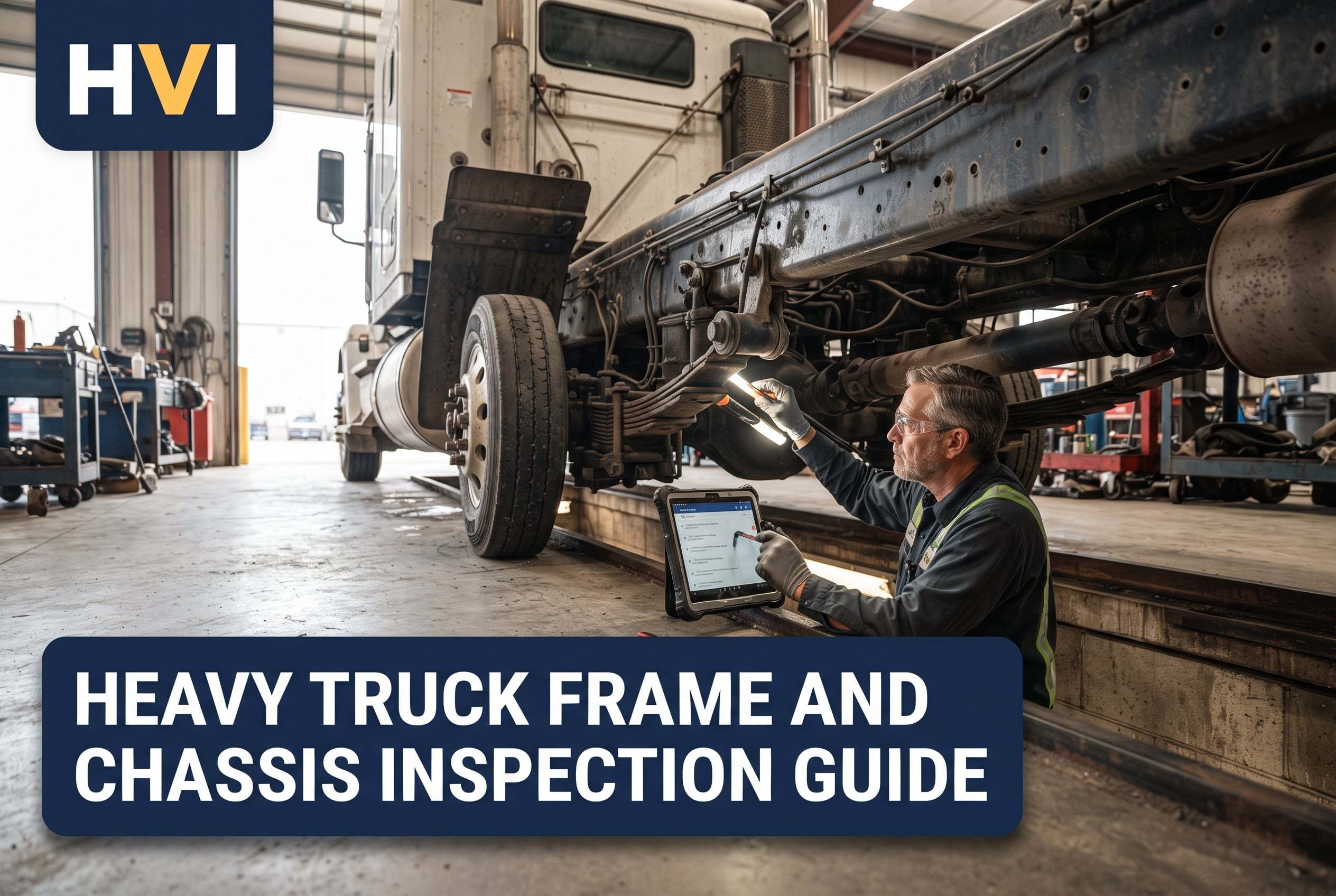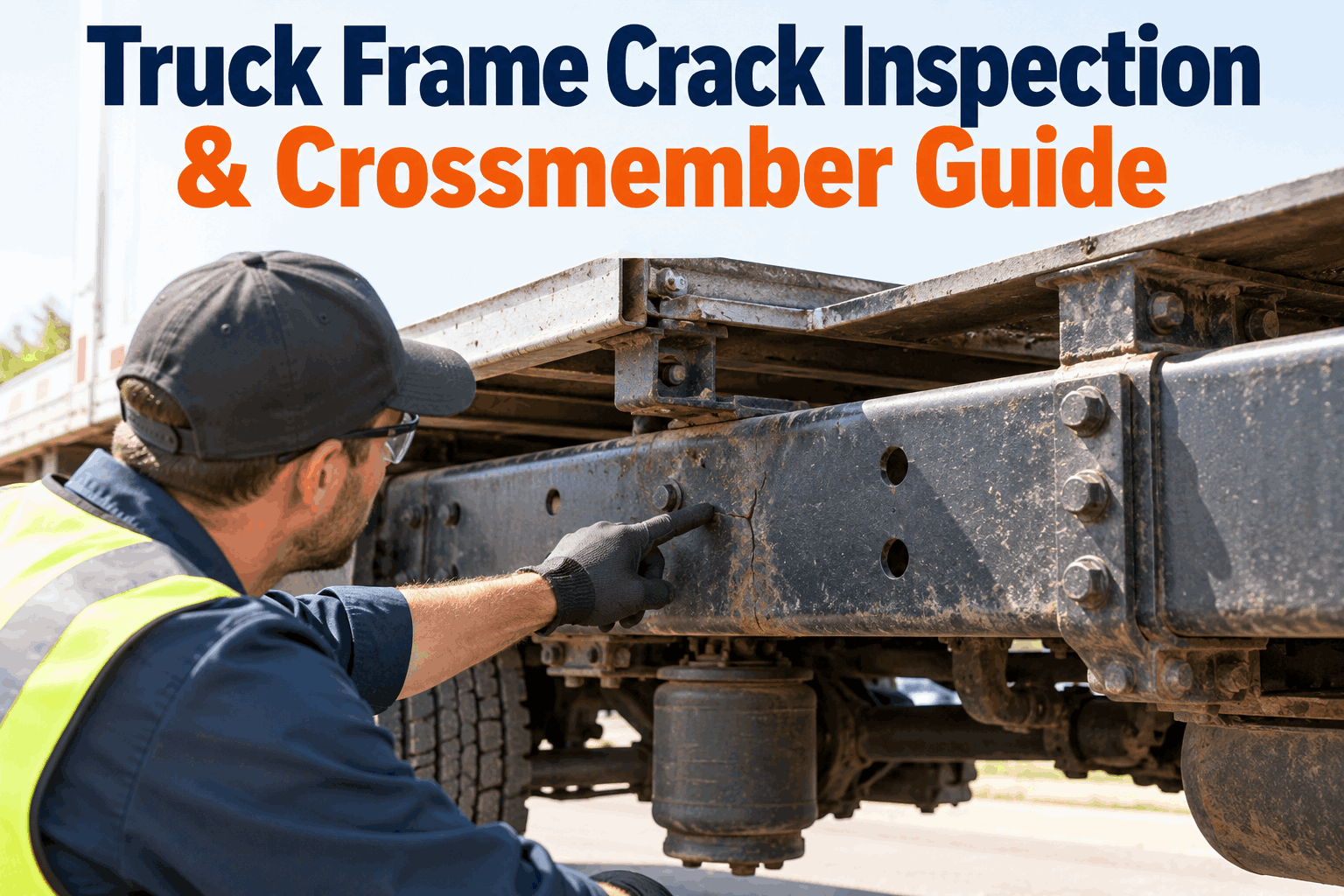
A frame crack almost never starts where you'd think to look, and it almost never announces itself. It begins as a hairline at a high-stress point — a suspension hanger, a crossmember joint, a fastener hole — hidden under paint and road grime, and it grows every mile until the day the rail lets go. A truck frame crack inspection is really a hunt: you go to the places cracks are known to start and you look before they find you. Book a demo to standardize that hunt across your fleet.
Cracks start where the stress concentrates
Frame cracks don't appear at random — they cluster at a handful of high-stress points on the rail. Know the hot spots, inspect them on a schedule, and you catch the hairline instead of the failure.
A truck frame looks like the one part that can't fail — a pair of massive steel rails. But those rails flex millions of times over their life, and metal fatigue concentrates that flexing at specific points: where a crossmember bolts in, where a suspension hanger pulls, where a hole was drilled or a bracket was welded on. That's where a truck frame crack inspection earns its keep. Maintenance guidance is blunt that these cracks "can be hard to spot" and that small ones become serious fast — the frame gives you warning in the form of a hairline, if someone is looking in the right place.
The five places most frame cracks begin
Nearly every frame crack starts at a stress riser — a point where load concentrates. Check these first, every time, and you've covered where the vast majority of cracks appear.
Suspension & spring hangers
The suspension pulls on these brackets every bump and brake. Cracks radiate from the mounting holes and along the rail flange right behind the hanger — the single busiest stress point on the frame.
Crossmember-to-rail joints
Where a crossmember ties the two rails together, the joint carries twist and shear. Cracks start at the gusset corners and the rivets or bolts — check the lower flange here especially.
Fastener & drilled holes
Every hole in a rail is a stress riser. Cracks run from bolt and rivet holes outward — and a hole drilled aftermarket for a bracket or body is a prime starting point.
Fifth-wheel & heavy mounts
The fifth wheel and other heavy mounts dump concentrated load into the rail. Inspect the mounting plate edges and the fasteners for cracks and for the shiny fretting that signals movement.
Prior welds & modifications
Any spot that was welded, heated or modified has altered metal around it. Repairs and aftermarket mods are repeat offenders — a re-cracked weld is a known pattern, which is why repair history matters.
A standardized inspection means every tech checks the same five points the same way, so a crack isn't missed because someone looked somewhere else. Book a demo to standardize the hot-spot check.
A field guide to frame crack types
Not every crack means the same thing. Reading the type tells you the cause — and whether it's a monitor, a repair or a pull-from-service.
Stress / fatigue crack
A clean hairline spreading from a stress point, often at a 45° or vertical angle off a hole or flange. The classic fatigue crack — it grows with every load cycle.
Corrosion crack
Rust gets under the surface, the metal thins, and cracks follow the pitting. Look for rust streaks and scaling — the corrosion is the cause, not just a cosmetic.
Fastener-hole crack
Radiating out of a bolt or rivet hole, often with shiny fretting or bare metal around the fastener from movement. A loose fastener is frequently the trigger.
Weld / modification crack
Cracking at or beside a weld or a modified area, where the metal's properties changed. Often a repeat of a prior repair — the reason per-vehicle history is worth keeping.
In HVI each crack is a photo pinned to the location with a note on type and severity, so the next tech and the shop see exactly what you saw. Start free and build the crack field guide in.
How to spot a crack before it's obvious
A frame rarely shows you a gaping crack first. It shows you these small tells — learn them and you catch the problem months early.
A hairline fracture in the paint, often straight or at an angle off a hole — the paint cracks before you see bare steel.
A tear-shaped rust stain running down from a single spot signals a crack weeping oxide — a damaged component, not surface rust.
Bare metal that looks sanded or polished around a fastener is fretting from movement — the fastener is loose and the hole may be cracking.
Missing or broken paint under a nut or washer means it's been working loose — retighten and inspect the hole for a starting crack.
These are easy to miss on a rushed walkaround and easy to catch on a standardized one — especially when the last inspection's photos are right there to compare against. Book a demo to put the tells in every tech's checklist.
Truck frame crack inspection checklist
The structural walkaround as a pass/fail sheet. Run it per vehicle and log it with the inspection record so every crack and fastener ties to that unit's history.
On paper a crack is a scribble nobody can locate later. In HVI it's a photo pinned to the spot, a work order, and a line in that truck's structural history. Book a demo to see the sheet on a device.
The repair history is the real asset
With structural defects, the single inspection matters less than the trail. A crack you repaired last year is the one most likely to come back — and only a record tells you that.
- No idea which rail was repaired before
- Re-cracked welds look like new problems
- No photo to compare growth against
- Each inspection starts from zero
- Every past crack and repair on file
- A re-crack flagged against its own history
- Dated photos show whether it's growing
- The shop and the next tech see it all
A frame's story is written over years and many techs. HVI keeps that story in one place per vehicle, so a pattern is obvious instead of invisible. Start free and keep a structural history per truck.
A frame inspection rhythm
Structural checks layer onto the inspections you already run. These are typical US rhythms — the walkaround feeds the DVIR and the deep check lines up with the FMCSA annual periodic inspection. Confirm against OEM and your engineering guidance.
Quick look at visible rail sections and mounts for obvious cracks, rust streaks or loose hardware — on the DVIR.
At each PM, work the five hot spots closely — hangers, crossmembers, holes, mounts, prior welds — with photos on anything flagged.
After an overload, hard impact, or any frame modification or welding, inspect the affected area before the truck goes back out.
Thorough frame inspection with the FMCSA annual periodic inspection; use NDT on suspect areas where warranted.
HVI schedules the deep check at your PM interval and triggers a post-event inspection when one's logged — see how it fits your broader truck frame and chassis inspection. Book a demo to automate the structural cadence.
A heavy-duty tech on reading the frame
People think a frame crack is dramatic, but it starts as a line in the paint you'd wipe past. The ones that get you are always at the same spots — behind a spring hanger, off a crossmember rivet, around a bracket somebody added. Once we standardized the check to those points and started photographing every one against the truck's history, we stopped finding cracks the hard way. A repaired rail that cracks again tells you something, but only if you kept the first photo.
Carlos V.Heavy-Duty Technician · Mixed highway fleet · 220 power units
Run frame inspections on HVI
Standardized structural template
Build a frame-specific inspection template so every tech checks the same hot spots the same way, every time.
Photo-pinned crack locations
Each crack is captured with a photo tied to its exact location and severity — no more scribbles nobody can find later.
Defects routed for review
A flagged crack becomes a tracked item in maintenance management, routed for engineering or shop review before the truck runs.
Per-vehicle repair history
Every crack and repair stays on that truck's record, so a re-crack is flagged against its own maintenance history.
One structural record per truck, built on the walkaround your techs already do — so a frame crack is caught as a hairline, not discovered as a failure. Start free and put frames on a program.
Truck frame crack inspection questions
Q1Where do truck frame cracks usually start?
At stress concentration points: suspension and spring hangers, crossmember-to-rail joints, fastener and drilled holes, the fifth-wheel and other heavy mounts, and anywhere the frame was previously welded or modified. The lower flange of the rail behind these points is especially crack-prone. Check the inside and outside of the rails, not just the visible face.
Q2How do you spot a frame crack early?
Look for the tells before the crack is obvious: a hairline fracture in the paint, a tear-shaped rust streak weeping from one point, shiny buffed-looking metal from fretting around a fastener, and bare metal under a nut or washer that signals it's working loose. These small signs show up months before a visible crack.
Q3Are all frame cracks the same?
No. A stress or fatigue crack is a clean hairline off a stress point; a corrosion crack follows rust pitting; a fastener-hole crack radiates from a bolt or rivet hole, often with fretting; and a weld or modification crack appears where the metal's properties were changed. Reading the type points to the cause and the right response.
Q4Can a cracked truck frame be repaired?
Often yes, but frame repair is specialized — it depends on the crack's location, length and type, and some locations or severities mean the frame must be replaced or professionally re-engineered. A repaired area is also more likely to crack again, which is exactly why keeping dated photos and a per-vehicle repair history matters. Always follow OEM and qualified structural guidance.
Q5How does HVI help with frame crack inspection?
HVI lets you standardize a frame inspection template around the known hot spots, capture each crack with a photo pinned to its location and severity, route defects for review, and keep a per-vehicle structural repair history so re-cracks are caught against their own record. It's an inspection and documentation layer, not a replacement for qualified structural assessment or a required inspection.
Put your frame inspections and history on HVI
Standardize the hot-spot check, pin every crack to a photo, route defects for review, and keep a structural repair history per truck — so a frame crack is caught early and never comes back as a surprise. Live in weeks, not quarters.
No credit card · Photo-pinned cracks · Per-vehicle structural history