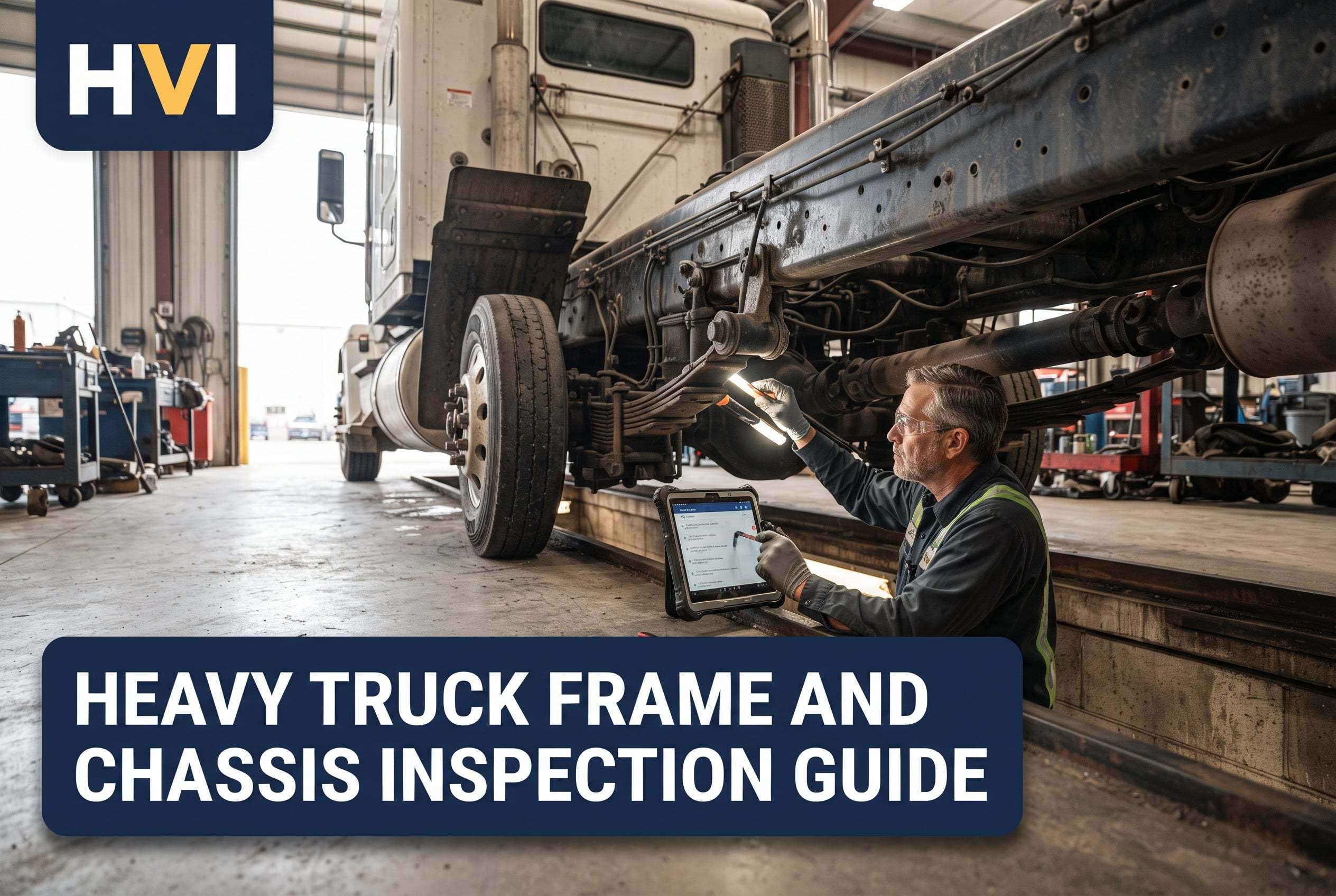
A hairline crack near the rear suspension crossmember might look harmless during a quick walkaround, but under cyclic loading that two-inch fracture can split a frame rail down its length before the next PM cycle. The chassis is the backbone of the truck — the engine mounts to it, the cab rests on it, and every payload runs straight through it. Under FMCSA 49 CFR 393.201, a cracked, loose, or sagging frame is an immediate out-of-service condition, meaning the truck cannot even be driven to the repair shop. A thorough truck frame inspection catches these structural failures, crossmember damage, and rust before they turn into a catastrophic roadside event. Start free with HVI to run structured chassis inspections from any mobile device.
Heavy Truck Frame & Chassis Inspection Guide
The complete zone-by-zone methodology for identifying frame cracks, structural fatigue, and corrosion on heavy trucks before they trigger an immediate DOT out-of-service order.
- ConditionCracked Frame
- StatusOOS
- ConditionSagging Rail
- StatusOOS
- ConditionLoose Crossmember
- StatusOOS
- ConditionUnauthorized Weld
- StatusOOS
- ~20%
of CVSA Level I failures involve frame, coupling, or suspension structural defects
CVSA Roadcheck historical data - 2 in → 2 ft
propagation rate of an unrepaired hairline crack under standard cyclic loading
Industry engineering fatigue data - 393.201
FMCSA regulation mandating frames be free of cracks or unauthorized modifications
FMCSA Regulations - Quarterly
recommended detailed inspection interval for high-vibration vocational chassis
Industry best practice
Why truck chassis inspection starts with stress points
The frame rail is not a passive piece of steel; it is a constantly flexing spring. Every pothole, hard brake, and uneven dump site twists the chassis. Over millions of cycles, metal fatigue concentrates at specific geometric changes — where a crossmember bolts to the web, where a suspension hanger rivets to the flange, and at any drilled hole for wiring or plumbing. A proper structural inspection does not just look at the flat center of the rail; it targets these high-stress intersections where 90 percent of fractures originate.
Corrosion accelerates the problem exponentially. Road de-icing salts, calcium chloride dust suppressants, and agricultural chemicals trap moisture against the web and flanges. Once rust breaches the protective coating, it delaminates the steel. In severe cases, an inspector can crumble a rust-weakened flange between their fingers — a terrifying discovery on a truck hauling 80,000 pounds down the highway. You can map out your structural inspection zones and standardize the process across your entire fleet by using a dedicated fleet maintenance software demo tailored for heavy vehicles.
The zone-by-zone frame inspection workflow
A disorganized walkaround misses defects. The most effective maintenance teams run a front-to-rear, left-to-right, top-to-bottom grid. You can replicate this methodology using a digital chassis check on a tablet, ensuring every technician follows the exact same path and documents conditions with mandatory photos. Here is how the zones break down:
Inspect the front frame horns, radiator core support mounts, and steering gear attachment points. Look for hairline cracks radiating from bolt holes. Check that the front spring hanger rivets are tight and show no rust jacking.
Examine the web of the frame rail directly above and below the engine motor mounts. The massive torque of heavy diesel engines fractures rails right at the mount pad. Check cab isolators for compression wear and verify the cab mounting bolts are not elongated.
This is the highest risk zone. Inspect every crossmember-to-rail joint. Look closely at the torque rod mounts, air ride suspension hangers, and walking beam brackets. Clean away road grime — cracks hide under grease. Tap test suspicious areas with a ball-peen hammer; a solid ring indicates good metal, a dull thud suggests a fracture.
Check the rear suspension crossmembers for twisting or bowing. Inspect the frame rail flanges just forward of the drive axles, where maximum torsional stress occurs during unloaded tight turns. Look for rust scaling pushing suspension brackets away from the rail web.
Inspect the rear frame crossmember and the DOT underride bumper mounts. Verify that body mounting bolts (for dump bodies, flatbeds, or van boxes) are torqued and that no unauthorized holes have been drilled in the rear flange to accommodate liftgate hydraulics or lighting.
Run a flathead screwdriver along the bottom of the frame flanges. If the tool easily pushes through scale or leaves a deep gouge, the rail has lost structural thickness. Document the exact location and severity to track propagation over time.
Common frame defects and how to spot them
Not all structural damage looks like a gaping hole. Some of the most dangerous defects are nearly invisible to the naked eye without proper lighting and cleaning. Use this reference grid to train your technicians on exactly what to look for during a truck frame inspection.
Hairline Stress Cracks
Usually originate at the base of suspension hanger brackets or crossmember welds. They appear as faint, rust-stained lines less than 1mm wide. If left unchecked, they propagate rapidly through the rail web under cyclic loading.
Detection: Dye penetrant or magnetic particle testingCorrosion & Flange Thinning
Road salt and chemicals eat away the bottom flange of the rail. The steel delaminates, losing load-bearing capacity. In advanced stages, the metal crumbles under light hand pressure.
Detection: Screwdriver prod test & visual scalingLoose Rivets & Fasteners
Loose Rivets & Fasteners
Crossmembers and suspension brackets rely on high-strength rivets or bolts. When these fasteners loosen, the bracket shifts under load, enlarging the holes and grinding away rail material. Look for rust streaks radiating from fastener heads.
Detection: Hammer tap test & visual rust tracksUnauthorized Modifications
Drilling extra holes for aftermarket wiring, welding unapproved brackets to the flange, or torch-cutting the rail voids the manufacturer's engineering. Under 393.201, any frame modification not approved by the OEM is an out-of-service violation.
Detection: Compare to OEM frame schematicsRail Sag & Bending
A frame that has been overloaded or subjected to a severe impact may permanently bend or sag. This alters driveline angles, causes premature U-joint failure, and makes the truck wander. Check by stretching a string line along the web.
Detection: String line measurementWeld Joint Failures
Factory welds on crossmembers can crack over time, especially on vocational trucks. Look for tiny fissures in the weld bead itself or at the heat-affected zone where the weld meets the parent metal.
Detection: Magnifying glass & dye penetrantVocational vs. Highway trucks: Inspection frequency comparison
Not every truck takes the same beating. A long-haul highway tractor operating on smooth interstates experiences vastly different frame stresses than a refuse truck doing 500 tight turns a day on potholed city streets. Your preventive maintenance schedule must reflect this reality. A modern CMMS for fleet maintenance allows you to trigger different inspection checklists based on asset type, ensuring vocational trucks get the structural scrutiny they require.
| Inspection Factor | Highway Tractor | Vocational Truck (Dump/Mixer/Refuse) |
|---|---|---|
| Primary Stress Type | Longitudinal flex & steady vibration | High torsional twist & impact loading |
| Crack Risk Zone | Mid-ship cab mounts & fifth wheel | Suspension hangers & body mounts |
| Corrosion Exposure | Moderate (winter road salt) | Extreme (chemicals, mud, moisture trap) |
| Detailed Frame Inspection | Bi-annually (during PM B & C) | Quarterly (every 90 days) |
| Crossmember Bolt Torque | Check annually | Check quarterly |
| Required Cleaning Before Check | Visual wipe down | High-pressure wash required |
Vocational trucks in high-vibration environments — like refuse packers, concrete mixers, and dump trucks — act as their own frame stress-test machines. The continuous shock loading from dumping, packing garbage, or mixing concrete transmits directly into the chassis rails. If you are managing a mixed fleet, it is critical to configure digital inspection forms that automatically apply these stricter criteria to the right assets, preventing technicians from applying a highway standard to a vocational workhorse.
Expert view from the shop floor
"The worst frame cracks I see don't happen on the open highway. They happen right behind the front steer axle on our refuse trucks. Every time that packer cycles, it torques the frame. We used to miss them because the rails were caked in grime. Now, we pressure wash first, and we make the tech take a photo of every crossmember joint with their tablet. You can't argue with a time-stamped picture of a hairline crack.
-- Marcus T., Maintenance Director, regional refuse fleet
Frequently asked questions
Can a truck with a cracked frame be driven to the repair shop?
No. Under FMCSA 49 CFR 393.201, a cracked, loose, sagging, or broken frame is an immediate out-of-service condition. The vehicle must be towed. Driving a truck with a known structural defect to a repair facility is a violation of federal safety regulations and poses a severe risk of catastrophic failure on the road.
How often should I perform a detailed truck frame inspection?
Highway tractors should receive a detailed structural inspection during major PM intervals (typically twice a year). Vocational trucks operating in high-vibration, high-corrosion environments — such as dump, mixer, and refuse applications — should be inspected quarterly. All trucks should receive a visual pre-trip frame check daily.
Where do frame cracks most commonly originate?
Frame cracks almost always originate at points of stress concentration. This includes crossmember weld joints, suspension mounting brackets, rivet and bolt holes, and the heat-affected zones around factory welds. The mid-ship area near the engine and cab mounts is particularly prone to fatigue cracking.
Is it legal to drill holes or weld brackets to a truck frame?
Generally, no. Any drilling, welding, or modification to the frame rail that is not explicitly approved by the truck manufacturer voids the engineering integrity of the chassis and is a violation under FMCSA 393.201. If aftermarket equipment must be mounted, it must use OEM-approved locations and clamping methods rather than drilling into the rail flange.
How do inspectors check for frame corrosion?
Inspectors look for scaling, rust delamination, and thinning of the lower frame flanges. A common field test is using a flathead screwdriver to prod the rusted area; if the metal gives way or crumbles under light pressure, the rail has lost structural integrity. Measuring flange thickness with calipers can also track metal loss over time.
Conclusion: Stop frame defects before they spread
A cracked or corroded chassis is more than a maintenance issue; it is a catastrophic safety hazard waiting to happen. The difference between a two-inch hairline crack and a split frame rail is often just a few thousand miles of cyclic loading. By implementing a systematic, zone-by-zone truck frame inspection methodology, you catch structural fatigue at the crossmember joints and suspension mounts while the truck is still safely in your yard. Vocational trucks demand quarterly scrutiny, while highway tractors need rigorous bi-annual deep dives. Don't rely on a greasy clipboard and a flashlight. Digitize your structural inspections to enforce mandatory photo documentation, standardize your technician workflow, and maintain bulletproof compliance records for every DOT audit.
Put the complete chassis inspection guide on every technician's phone
HVI enforces your zone-by-zone frame inspection workflow with mandatory defect photos, automatic out-of-service flagging, and complete audit trails for FMCSA compliance.
No credit card · No hardware · Live on your fleet in under two weeks