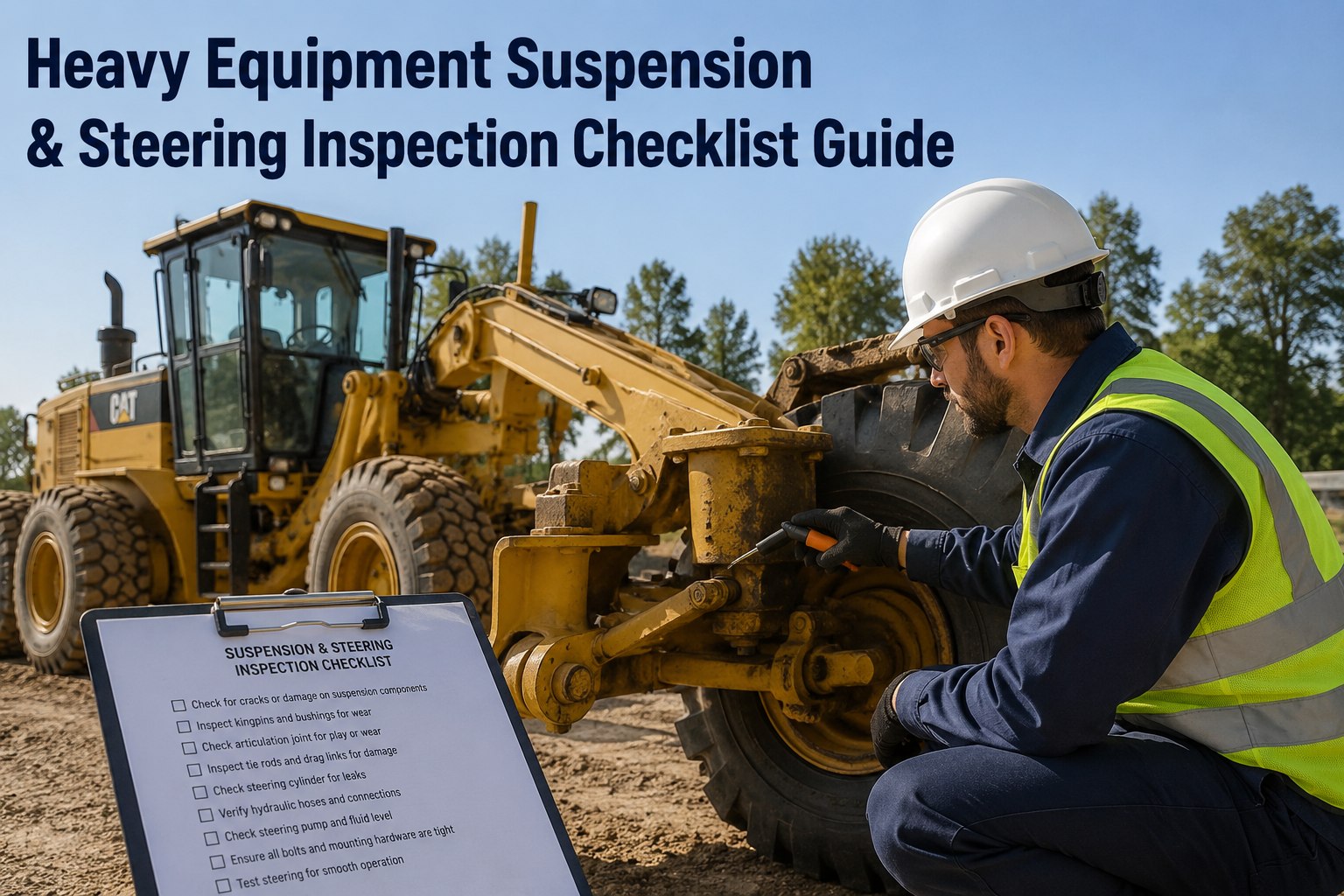
Suspension and steering are the two systems on a heavy machine that fail quietly — right up until they fail loudly. A kingpin wears a few thousandths at a time and hides its condition inside the axle; a steering cylinder seal weeps for weeks before the machine starts wandering; a wheel bearing runs with play long before it howls. By the time an operator reports "loose steering" or "it's bouncing," the wear that caused it has usually already spread to the parts around it — worn bearings accelerate kingpin wear, a bent tie rod scrubs tires, and a drifting alignment quietly eats rubber on every shift. That's why this is a workshop job, not a walkaround: it takes the machine off the ground, a dial indicator, and a technician who knows the wear limits. This checklist covers every suspension and steering component on a heavy machine — kingpins and articulation joints, steering cylinders and hydraulic lines, tie rods and ball joints, bushings, axles, wheel bearings, and springs — grouped the way you actually work the bay, with the measurable limits that decide go or no-go. HVI's workshop inspection & maintenance software captures every measurement per component, trends wear across PM cycles, and turns a failed limit into a work order. Book a 30-minute walkthrough to see it on your fleet.
A kingpin wears a few thousandths at a time — and hides it inside the axle until the steering lets go.
A workshop inspection checklist for heavy equipment suspension & steering — kingpins, articulation joints, steering cylinders, hydraulic hoses, tie rods, ball joints, bushings, axles, wheel bearings, and springs, with the measurable wear limits. HVI inspection & maintenance software logs every measurement per component, trends wear across PM cycles, flags a part crossing its limit, and raises the work order — for every machine in the yard.
Read the symptom, find the component
Most suspension and steering jobs start with an operator complaint. Each symptom points to a short list of usual suspects — so a smart inspection starts with the report and works toward the part.
Alignment is the tell that ties it all together: it's the measurable output of every other suspension component's condition. When springs, kingpins, tie rods, and bushings are all in spec, alignment holds. When any one wears, alignment drifts — so measuring alignment at every PM both verifies the work and catches developing wear before the operator ever feels it.
The workshop inspection checklist
Get the machine off the ground, chock it, and work each system in the bay. The starred sections carry the measurable limits — where a reading past spec means the part comes off, not a note for next time.
Kingpins & articulation joints
- Lift axle, tighten bearing to remove end play, rock wheel at 12 & 6
- Dial indicator on the knuckle — over 0.010" bushing movement, replace
- Check play against OOS limits by wheel size
- No clunk or grind through the turn or on bounce
- Articulation/center-pivot pins and bearings free of play
- Grease fittings present; recent grease didn't just mask wear
Wheel bearings & hubs
- Lift wheel; check end play — over 0.030" on tapered rollers is OOS
- Rock at 12 & 6 for looseness; spin for roughness or growl
- No bearing noise that changes with speed on road test
- Races free of scoring, pitting, or corrosion
- Seals intact; no grease leakage or contamination
- Hub/axle nut torque correct where accessible
Steering cylinders & hydraulics
- Cylinder rods not scored, bent, or weeping at the seals
- No drift or creep in the steering under load
- Hoses and lines free of leaks, cracks, and chafing
- Full system pressure; no hard or lagging steering
- Fittings tight; no missing hose guards or clamps
- Reservoir level and fluid condition correct
Tie rods, ball joints & linkage
- Tie rod ends: no up/down or lateral play at the stud
- Ball joints rock-tested — little to no movement
- Protective boots intact — torn boots destroy the socket
- Rods and arms free of bends, twists, or cracks
- Steering shaft U-joints tight, no binding or dead spot
- Adjustment sleeves and clamps secure and undamaged
Springs, shocks & bushings
- Leaf and coil springs free of cracks or sag; ride height correct
- Shocks/dampers not leaking; rebound test passes
- Control-arm and pivot bushings free of play or delamination
- Sway bar, links, and bushings sound
- Shock mounts, grommets, and bump stops present
- U-bolts, hangers, and shackles tight and uncracked
Axles, frame & alignment
- Axle housing and beam free of cracks, bends, or leaks
- Frame rails and mounts free of cracks or weld separation
- Cab and component mounts not collapsed or delaminated
- Compare side-to-side arm measurements for a bent part
- Measure and record alignment (toe, camber, caster)
- Log alignment against prior PM to catch drift early
A dial-indicator reading only protects the machine if it's captured and trended — 0.008" today and 0.011" next PM is a kingpin you replace on schedule, not one that lets go in the yard. sign up free and log every measurement per component in HVI, or book a demo to see wear trended across PM cycles and flagged before it crosses the limit.
Wear limits that decide go or no-go
Suspension and steering is one of the few inspections with hard numbers. When a measurement crosses these, the part is out of service — no judgment call required.
Greasing a worn joint can silence the noise for a shift, but it doesn't fix the wear — it just fills the gap. That's why the numbers matter: a dial indicator doesn't care how fresh the grease is. Record the reading, and let the measurement decide.
Paper checklist vs. HVI inspection & maintenance software
Both record the same checks. Only one captures the actual measurement, trends it across PM cycles, and flags the component the shift before it crosses its limit.
Paper / clipboard
- "Pass/fail" ticked, actual reading never recorded
- No trend, so a slow-wearing kingpin surprises you
- Alignment drift invisible between services
- Fresh grease hides wear the next tech can't see
- No photo of a torn boot or scored rod
- Repair history scattered across job cards
With HVI software
- Exact measurement logged per component
- Wear trended across PM cycles, flagged near limit
- Alignment tracked service-over-service for drift
- Out-of-limit reading auto-raises a work order
- Mandatory photos on boots, seals, and damage
- Full component history per machine, audit-ready
Catch the kingpin before the steering does.
Log every dial-indicator reading, trend wear across PM cycles, track alignment drift, and let an out-of-limit measurement raise the work order — so a worn joint gets replaced on schedule, not after it fails.
Frequently asked questions
What does a heavy equipment suspension & steering inspection cover?
A full workshop inspection takes the machine off the ground and works through six systems: kingpins and articulation joints (rock test and dial-indicator measurement, plus center-pivot pins on articulated machines); wheel bearings and hubs (end play, roughness, races, seals, torque); steering cylinders and hydraulics (rod condition, leaks, drift, hose chafing, system pressure); tie rods, ball joints, and linkage (stud play, boot condition, bends, U-joints); springs, shocks, and bushings (cracks, sag, ride height, rebound, mounts); and axles, frame, and alignment (housing and frame cracks, mount condition, and recorded toe/camber/caster). The kingpins, wheel bearings, and steering hydraulics carry measurable limits where a reading past spec pulls the part from service. HVI delivers all six as a bay checklist where the actual measurement is logged, not just a pass/fail tick.
How do you check kingpins for wear?
Kingpin wear is checked with no weight on the axle, so the front end is jacked and supported first. With the wheel lifted, tighten the wheel bearing to remove any bearing end play (so you're measuring the kingpin, not the bearing), then place your hands at the top and bottom of the tire — 12 and 6 o'clock — and rock it, watching for movement at the steering knuckle. For a precise reading, mount a dial indicator against the knuckle: total movement of 0.010" or more at the upper or lower bushing means the kingpins and bushings need replacement. Rejection thresholds for the rock test also scale with wheel size. One caution: fresh grease can quiet a worn kingpin temporarily, so noise disappearing after greasing doesn't mean the wear is gone — trust the measurement, not the sound. HVI records the dial reading per unit so you can trend it and replace on schedule.
What are the out-of-service limits for steering and suspension?
Several components have hard numbers. Kingpin bushing movement of 0.010" or more on a dial indicator calls for replacement, and rock-test rejection thresholds scale with wheel size. Steer-axle wheel bearing end play above 0.030" on tapered roller bearings is out of service — excessive bearing play also causes steering wander and accelerates kingpin wear by letting the wheel oscillate. Tie rod ends and ball joints come out for any detectable play at the stud, and a torn protective boot is itself a defect because it lets in dirt that destroys the socket. Cracked axle housings or frame rails, collapsed cab or component mounts, leaking shocks, and cracked or sagging springs are all defects. And significant kingpin play means removing the machine from service until repaired, since it risks loss of steering control. HVI flags each reading against its limit automatically.
Why does alignment matter so much in this inspection?
Because alignment is the single measurement that reflects the health of every other component. When the springs, kingpins, tie rods, bushings, and bearings are all within spec, the alignment holds; the moment any one of them wears, the alignment drifts. That makes measuring toe, camber, and caster at every PM do double duty — it verifies the suspension work you just did and acts as the earliest detector of developing wear, often well before the operator feels anything. Uneven or one-sided tire wear is that drift made visible: feathering points to a toe fault, one-sided shoulder wear to a camber fault, and cupping to worn shocks. Tracking alignment service-over-service lets you calculate the drift rate and predict a realignment weeks ahead. HVI stores alignment readings across PM cycles so the trend, not just the snapshot, drives the schedule.
How does HVI's inspection & maintenance software help a workshop?
HVI turns suspension and steering inspection from a pass/fail tick into a measured, trended program. Technicians log the actual reading for each component on a phone or tablet — the dial-indicator movement, the bearing end play, the alignment values — with mandatory photo capture on torn boots, scored rods, and leaks. Because the numbers are stored per component per machine, the software trends wear across PM cycles and flags a kingpin or bearing the shift before it crosses its limit, rather than letting a slow-wearing part surprise you. Any out-of-limit reading automatically raises a tracked work order, alignment drift is followed service-over-service to predict a realignment ahead of time, and every component carries a full, audit-ready history. It works offline in the bay and syncs when back in range. The result is fewer surprise steering failures, parts replaced on schedule instead of after they let go, and a documented record for every machine. book a demo and we'll set it up around your specific fleet and workshop on the call.
Measure it, trend it, replace it on schedule — not after it fails.
HVI inspection & maintenance software turns suspension and steering inspection into a measured record — dial-indicator readings, bearing play, and alignment logged per component, trended across PM cycles, with out-of-limit findings raising work orders and photo-documented damage, all working offline in the bay. Stop letting a hidden kingpin or a worn bearing turn into a steering failure.
No credit card required · Live in under two weeks · Per-component measurements + wear trending + alignment tracking + work orders, fully offline