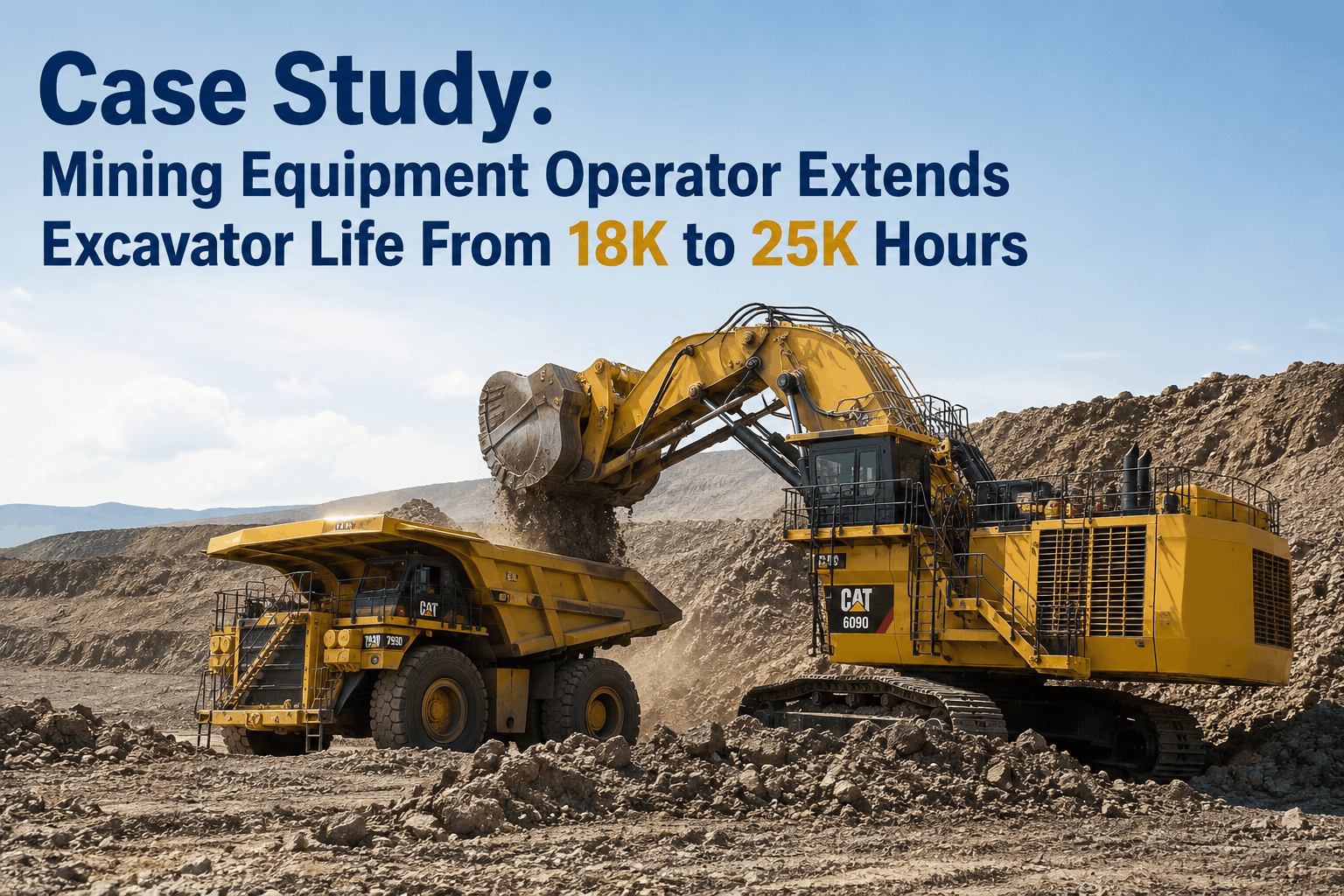
The industry accepts 18,000 hours as the economic life of a mining excavator—the point where maintenance costs cross the replacement threshold. This surface mining operation refused to accept that number. Through a structured oil analysis program, condition-based undercarriage rebuilds, and digital maintenance tracking, they extended a fleet of 12 CAT 390F excavators from the expected 18,000-hour replacement cycle to 25,000+ productive hours—a 39% life extension that deferred $14.4 million in replacement capital while maintaining 94% availability. Start your free trial to track your excavator fleet's maintenance lifecycle, or book a demo to see HVI's heavy equipment maintenance platform.
Mine and Fleet Profile
This open-pit copper and gold operation runs a fleet of large hydraulic excavators as primary loaders, cycling material to a fleet of haul trucks on 12-hour shifts, 350 days per year. Equipment operates in abrasive rock with ambient temperatures ranging from -15C to 42C.
Operation Overview
The 18,000-Hour Wall
At 18,000 hours, the mine's maintenance team had historically recommended replacement. Not because the machines couldn't run—but because maintenance costs were accelerating unpredictably, and nobody had the data to determine which machines still had life and which were money pits.
Maintenance Cost Per Hour — The Escalation Problem
Without data, maintenance directors assumed costs would spike uncontrollably past 18K hours. The question was: spike on every machine, or only some?
The $14.4 Million Question
Three Interventions That Changed the Math
The mine's maintenance team didn't just hope machines would last longer—they built a data-driven program around three specific interventions, each generating its own measurable ROI. Start your free trial to implement the same tracking framework for your fleet.
Oil Analysis Program
Every 250 hours, oil samples from engine, hydraulic, and final drive systems were sent for spectroscopic analysis. Instead of replacing components on a calendar, the mine replaced them when wear metals indicated actual degradation—and caught catastrophic failures before they happened.
Condition-Based Undercarriage Rebuilds
Undercarriage represents 50-60% of an excavator's lifetime maintenance cost. Instead of replacing the entire undercarriage assembly at a fixed interval, the mine measured pin-to-bushing wear, roller diameter, and sprocket tooth height every 250 hours—rebuilding only the components that needed it, when they needed it.
Fixed Interval (Old)
Condition-Based (New)
Digital Maintenance Tracking
HVI's digital platform replaced the mine's paper-based maintenance system, creating a complete lifecycle record for every excavator—every oil sample, every wear measurement, every component replacement, every operator hour. This data gave the maintenance director the confidence to make unit-by-unit extend-or-replace decisions. Book a demo to see how it works for mining fleets.
How Many Hours Are Left in Your Excavators?
Most fleets replace equipment based on age—not actual condition. Digital tracking changes that equation.
Life Extension Results
After 30 months on the program, all 12 excavators have passed the 18,000-hour mark. Nine have exceeded 22,000 hours. Three are operating past 25,000 hours—still maintaining 94% availability and cost-per-hour below the replacement threshold.
Financial Summary
"We used to replace excavators at 18,000 hours because we didn't know what 19,000 hours looked like. Once we had oil analysis trends and undercarriage wear data for each individual machine, we could see that some units had 6,000-7,000 productive hours left. The data gave us the confidence to run them—and the early warning to stop the ones that didn't. Three of our 390Fs just passed 25,000 hours at 94% availability. That's $3.6 million in deferred replacement for those three machines alone."
Extend Your Fleet's Productive Life
Every excavator in your fleet has a different story. Some are ready for replacement at 15,000 hours. Others have 25,000+ hours of productive life if you have the data to manage them. Digital maintenance tracking gives you the unit-by-unit visibility to make that call with confidence. Start your free trial and see where your excavators actually stand.
18,000 Hours Is a Guess. 25,000 Hours Is Data.
Oil analysis. Undercarriage tracking. Cost-per-hour dashboards. Know exactly when to extend and when to replace.