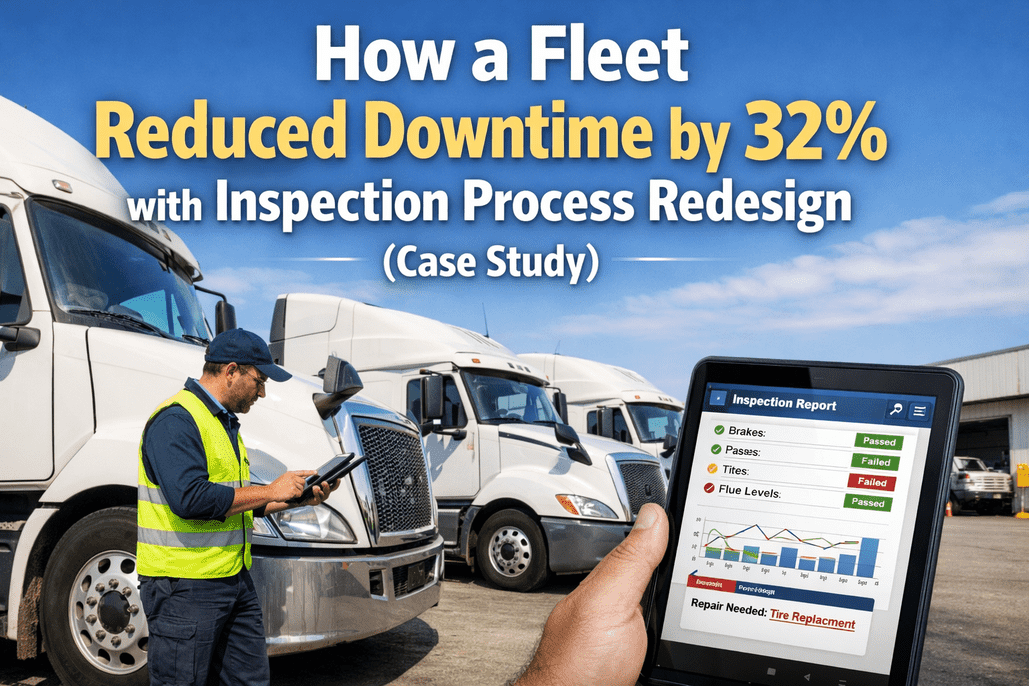
A mid-size logistics fleet grew from 74 to 163 vehicles in 22 months — and its inspection process nearly broke under the pressure. What started as manageable inefficiencies at 74 vehicles became operational liabilities at scale: paper DVIRs piling up unprocessed, defect reports lost between drivers and mechanics, vehicles sitting idle for days waiting on repairs that should have taken hours, and compliance gaps widening with every new terminal added. Unplanned downtime was costing the fleet an estimated $760 per vehicle per day, and the inspection workflow that once worked "well enough" was now the single biggest bottleneck to continued growth. After a complete inspection process redesign — replacing paper with digital workflows, automating defect routing, implementing predictive scheduling, and building scalable templates across all locations — the fleet reduced unplanned downtime by 32%, cut inspection processing time by 67%, and onboarded 3 new terminals in 4 months without adding compliance staff. Fleet operations directors, maintenance managers, and growing fleet operators will find a practical framework for redesigning inspection processes that scale with the business instead of against it.
Fleet Background & Growth Challenges
Growth was the goal — and the problem. Every new vehicle, terminal, and driver multiplied the volume of inspection data flowing through a system designed for a fleet half its size. The fleet didn't need minor adjustments; it needed an entirely new approach to inspection operations that could absorb growth without creating proportional increases in administrative burden, compliance risk, or downtime. Schedule a consultation to assess whether your inspection process can handle your fleet's next phase of growth, or start your free trial to experience scalable digital inspections.
Fleet Growth Timeline: 22-Month Expansion
Fleet Size Growth
74 to 163 vehicles in 22 months
Admin Workload Growth
Inspection paperwork grew faster than fleet size
Compliance Staff Growth
Same 2-person team managing 2.2x the fleet
Process Investment
Zero upgrades to inspection workflow during growth
Inspection Bottlenecks & Operational Risks
The inspection workflow had five critical failure points — each one a place where time, data, or accountability leaked out of the system. A defect reported by a driver on Monday morning might not reach a mechanic until Wednesday. A completed repair might not be signed off for another two days. The result: vehicles sat idle not because repairs were complex, but because the process connecting inspection to repair to return-to-service was broken. Learn how structured inspection workflows eliminate these bottlenecks.
The Bottleneck Pipeline: Where Time Was Lost
How Much Is Your Inspection Bottleneck Costing You?
Digital inspection workflows cut the inspection-to-return cycle from days to hours. See how it works for your fleet.
Digital Inspection Workflow Redesign
The fleet didn't just digitize its paper forms — it redesigned the entire flow of information from driver to shop to dispatch to management. Every handoff point that previously relied on physical paper, verbal communication, or manual data entry was replaced with an automated digital connection. Try the platform that powers this kind of workflow transformation.
The Redesigned Inspection Pipeline
Digital Pre-Trip DVIR
3-5 minVehicle-specific checklist on driver's mobile device. Mandatory photo upload for 6 critical components. GPS and timestamp verification. Defect flagged in real time — not at end of shift.
Instant Defect Alert
0 sec delayDefect submitted? Maintenance supervisor receives push notification immediately. No drop-boxes. No waiting. Photo evidence included for accurate triage.
Priority Work Order
Auto-createdSeverity-based prioritization: safety-critical defects jump the queue. Work order includes defect photos, vehicle history, and parts availability check.
Tracked Repair
TimestampedMechanic logs repair start, parts used, and completion time. Supervisor sign-off required. Full repair record linked to original inspection.
Auto Return-to-Service
InstantRepair completed and signed off? Vehicle status updates automatically. Driver notified. Dispatch sees vehicle available in real time. Zero idle gap.
Template Library
Vehicle-class-specific inspection templates (Class 7 tractors, Class 8 day cabs, reefer trailers) deployed across all 6 terminals. Same checklist, every driver, every location.
Predictive Scheduling
Vehicles flagged for proactive inspection based on mileage intervals, defect history, and seasonal patterns. High-risk units inspected before problems surface.
Dashboard Rollup
Fleet-wide inspection completion rates, defect trends, repair cycle times, and downtime metrics — all visible on a single management dashboard across all terminals.
Compliance & Downtime Improvements
The redesigned workflow attacked downtime at its root: the gap between defect detection and repair completion. By compressing every handoff in the inspection pipeline, vehicles that previously sat idle for days were back on the road in hours. Compliance improved not because drivers were inspecting more — but because every inspection now produced actionable, trackable, verifiable data. Book a demo to see these workflow improvements in action.
Where the Time Was Recovered
Scalability & Business Impact
The real test of the redesigned process wasn't the initial results — it was whether those results held when the fleet kept growing. During the 12 months after implementation, the fleet added 3 new terminals and 45 vehicles. Inspection completion rates, defect resolution times, and downtime metrics held steady or improved. The process scaled because it was designed to scale. Explore the HVI Learning Center for more on building inspection programs that grow with your fleet.
Scalability Proof: Growth Without Regression
Process Redesign Investment vs. Return (Year 1)
Key Results & Lessons Learned
Lessons for Growing Fleets
How HVI Powers Scalable Inspection Workflows
The bottlenecks in this case study — slow paper handoffs, lost defect reports, idle vehicles, and processes that broke at scale — are exactly what HVI's digital inspection platform is built to eliminate. Here's how HVI turns inspection workflows into a growth enabler instead of a growth constraint.
Mobile Digital DVIRs
Drivers complete vehicle-specific inspections on their phone in 3-5 minutes. Mandatory photos, GPS verification, and minimum time thresholds ensure every inspection is thorough, verifiable, and audit-ready from day one.
Instant Defect-to-Shop Routing
The moment a driver flags a defect, HVI creates a prioritized work order and pushes it to the maintenance team — with photos, severity rating, and vehicle history. No handoff delays. No information loss.
Real-Time Fleet Status Dashboard
See which vehicles are inspected, which have open defects, which are in repair, and which are ready for dispatch — across every terminal, in real time. No phone calls. No spreadsheet reconciliation.
Scalable Template System
Create inspection templates by vehicle class and deploy them across unlimited terminals instantly. Onboard a new location in days, not weeks. Every driver gets the same checklist regardless of where they're based.
Predictive Maintenance Integration
HVI flags vehicles for proactive inspection based on mileage, defect patterns, and component age — catching problems before they cause downtime. Shift from "fix it when it breaks" to "inspect it before it fails."
Complete Audit Trail
Every inspection, defect, repair, and return-to-service — timestamped, photo-documented, and stored in a searchable cloud archive. Audit-ready records generated automatically with every workflow cycle.
Stop Letting Inspection Bottlenecks Drive Your Downtime
Redesign your workflow with digital inspections that compress cycles from days to hours — and scale to any fleet size.
Free 14-day trial. No credit card required.