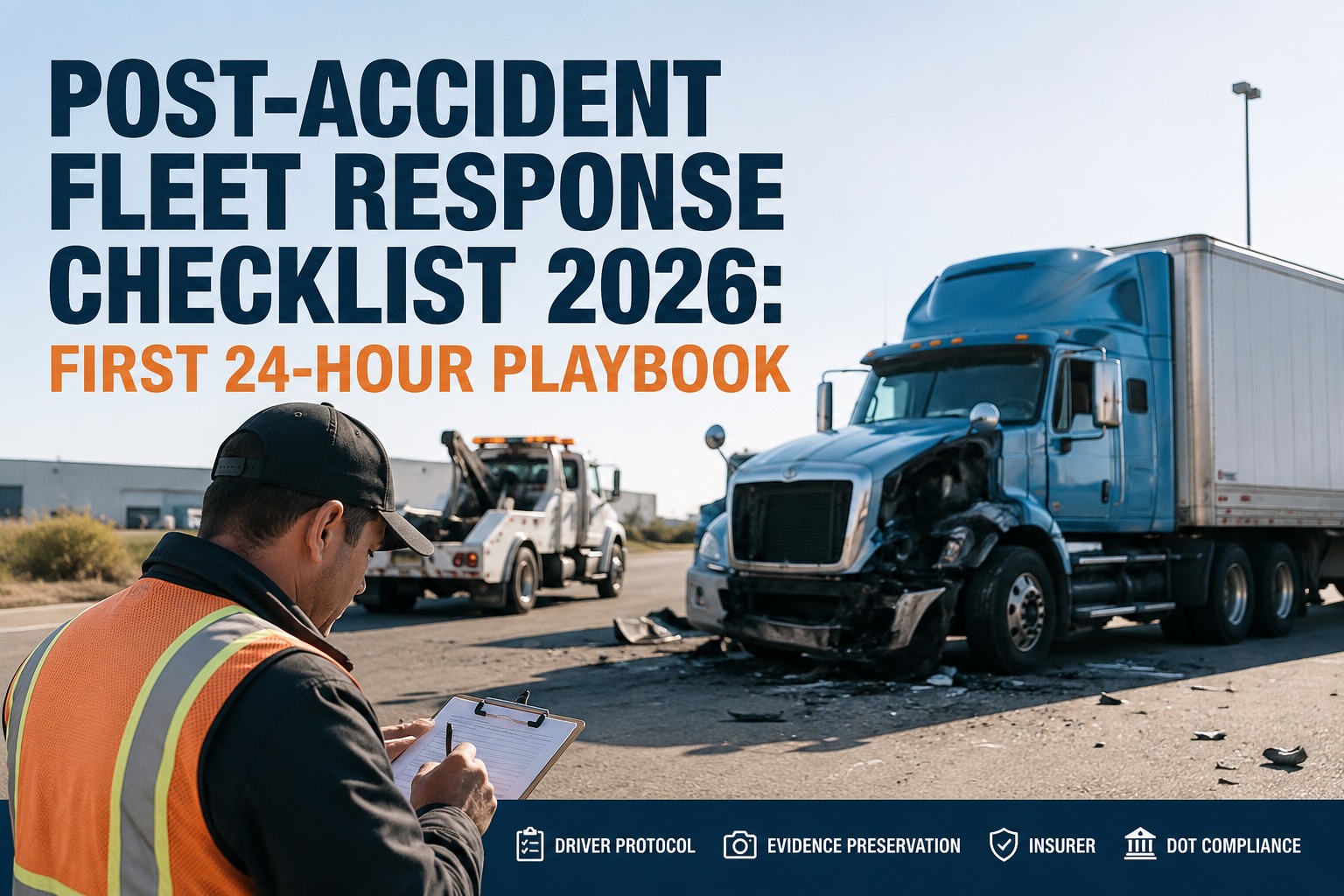
The 24-Hour Compliance Countdown
Six timing windows. Miss one and the case theory shifts from "incident" to "corporate negligence."
Why the First 24 Hours Decide the Outcome
Regulatory Windows
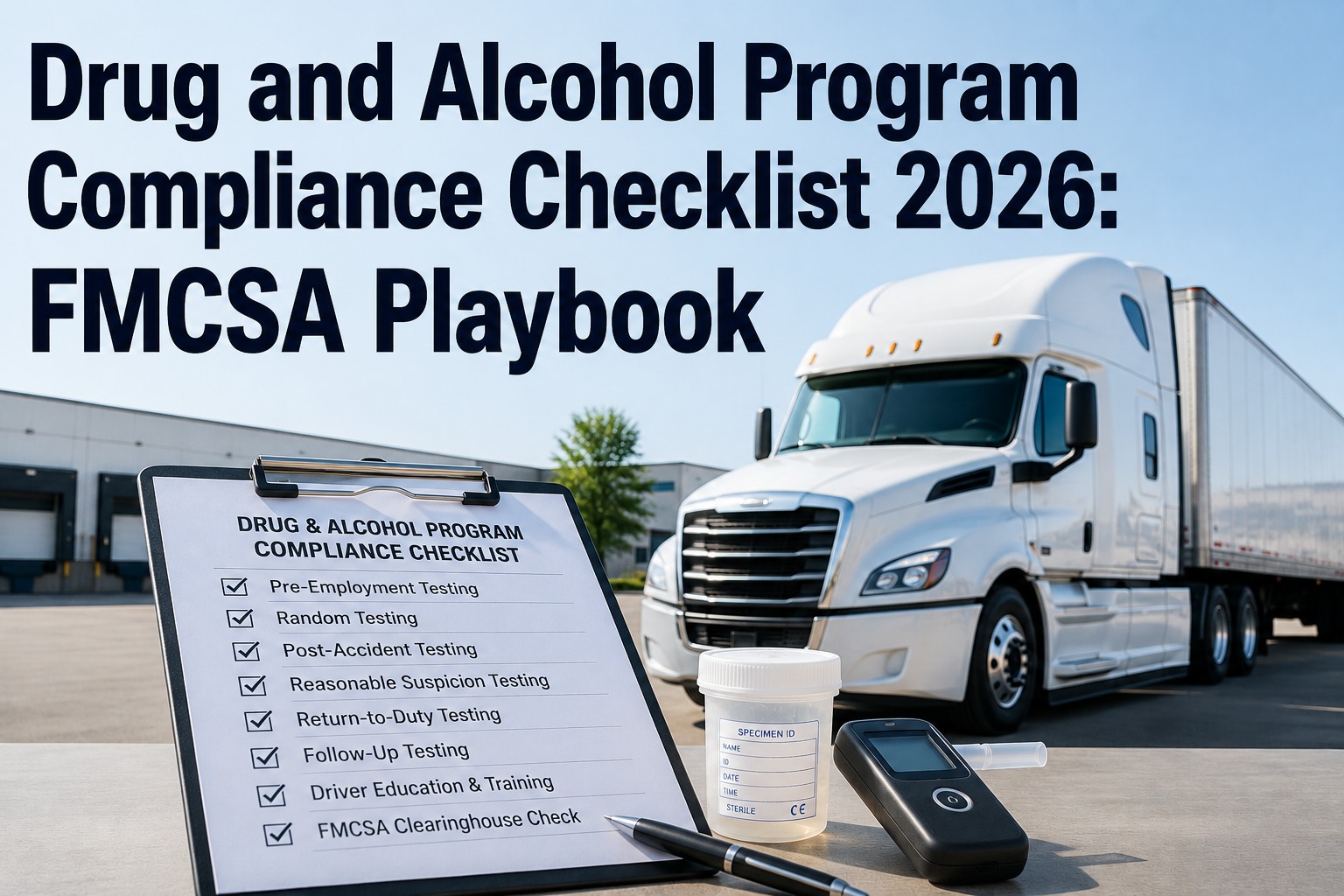
- FMCSA §382.303 requires post-accident alcohol testing within 2 hours (8-hour hard stop) and drug testing within 32 hours when the incident meets the trigger criteria: fatality, injury requiring transport plus citation, or disabling tow plus citation. Miss the window and the fine range runs $8,000–$15,000+ per missed test.
Evidence Half-Life
- Dashcam loops overwrite. ECM data ages. Witness memory fades. Skid marks wash away. Physical and digital evidence has a shelf life measured in hours — and a defense strategy built on evidence you preserved is very different from one built on evidence you're trying to reconstruct.
Nuclear Verdict Exposure
- The median trucking nuclear verdict hit $51 million in 2024 per Marathon Strategies data. Plaintiff counsel argue "corporate negligence" the moment gaps appear in the post-incident record — missed testing, lost dashcam footage, undocumented decisions. The 24-hour file is the evidence stack that closes those arguments.
Insurance Position
- Insurers assess the response in the first 24 hours before setting reserves. A documented, on-time response signals a defensible claim. A disorganized response signals a claim to settle fast. The difference in reserves alone can move a claim by six figures.
Ready to digitize the entire crash-response protocol? Start your free trial or book a live demo.
1. At the Scene (0–30 minutes) — Driver Protocol
The driver runs the first thirty minutes solo. Every action — and every non-action — either strengthens or weakens the file that gets built for the next three years. Book a demo to see this exact protocol running as guided mobile prompts.
Safety & Emergency
Documentation
Do NOT
2. Notification Chain (First 60 minutes)
Every notification made in the first hour becomes a timestamp on the file. Every one skipped becomes a plaintiff exhibit.
Internal
External
Regulatory Assessment
3. Alcohol Testing Window (2–8 hours) — §382.303
FMCSA §382.303 requires post-accident alcohol testing when the incident meets the trigger criteria. Target: within 2 hours. Hard stop: 8 hours. Documented failure to test after 8 hours must be recorded.
Trigger Assessment
Execution
If Missed Windows
4. Evidence Preservation (First 8 hours)
Every piece of evidence has a decay curve. This is the block that determines whether defense counsel builds from data or from reconstruction.
Digital Evidence
Vehicle Records
Driver Records
5. Insurance & Legal (First 8 hours)
The insurer's early involvement shapes reserves. Counsel's early involvement shapes strategy. Both windows are hour-sensitive.
Insurance
Legal
Communication Discipline
6. Drug Testing Window (up to 32 hours) — §382.303
Post-accident drug testing has a longer window than alcohol but a stricter documentation requirement. Test triggered by the same criteria; must complete inside 32 hours. Documented failure to test is not neutral — it's a compliance finding.
Trigger & Execution
Chain of Custody
Missed-Window Protocol
7. Investigation File (First 24 hours)
The investigation file becomes the operational record on Day 1 and the exhibit binder on Day 730. Both audiences read the same document.
Statements
Official Reports
Timeline & Analysis
8. Compliance & Litigation Close-Out (24 hours)
By hour 24, the file has to satisfy two audiences: the FMCSA auditor who could inspect this next year, and the plaintiff's counsel who might depose your safety manager three years from now. Both are reading the same record.
FMCSA Compliance
Litigation Hold
Driver & Team Care
How HVI Runs the Entire 24-Hour Response
The compliance countdown, automated end-to-end:
- ✓ Guided mobile prompts for the driver at the scene — photo capture, witness collection, safety flags
- ✓ Automatic incident record creation with timestamps on every action
- ✓ Real-time notification chain: dispatch → safety manager → insurer, all logged
- ✓ Post-accident test workflow linked to §382.303 trigger criteria, timing windows tracked
- ✓ One-click evidence bundle: DVIR history, PM log, DQ file, MVR, coaching record all pulled
- ✓ Litigation hold workflow with custodian tracking and acknowledgment
- ✓ Accident register entry auto-populated per §390.15(b) retention rules
- ✓ Audit-ready file export for FMCSA review, insurer submission, or defense counsel
Ready to digitize your crash-response protocol? Start your free HVI trial or book a live demo.
Post-Accident Fleet Response FAQ
1. Is post-accident drug and alcohol testing always required after a fleet accident?
No. FMCSA §382.303 requires testing only when the incident meets specific trigger criteria: (a) any fatality, regardless of citation, (b) a bodily injury requiring immediate medical transport combined with a citation issued to the CMV driver, or (c) a disabling tow-away of any vehicle combined with a citation issued to the CMV driver. If none of these apply, post-accident testing under §382.303 is not required — though the fleet's own policy or state law may still call for it. When testing IS required, alcohol testing has a 2-hour target and 8-hour hard stop; drug testing must occur within 32 hours. Missed windows require documented written explanation retained in the driver's DER file.
2. Why does the first 24 hours matter so much?
Evidence has a decay curve. Dashcam loops overwrite after a defined interval. ECM data can age or be overwritten by subsequent driving events. Witness memory sharpens then fades within days. Skid marks wash away with the next rain. Physical damage patterns change once the vehicle moves. Beyond evidence, insurers set claim reserves in the first 24-48 hours based on the response quality — a documented, on-time response signals a defensible claim; a disorganized response signals a claim to settle fast. And plaintiff counsel later reads the 24-hour file as the barometer of "corporate care" — gaps become the negligence narrative that drives nuclear verdict awards.
3. What happens if the alcohol or drug test is missed within the required window?
Missing the window is not, by itself, a violation — but failure to document the reason is. FMCSA requires the fleet's Designated Employer Representative (DER) to prepare and retain a written statement explaining why the required test was not administered inside the required window. Common valid reasons: driver medically incapacitated, law enforcement custody, or logistical impossibility. The written record must be kept alongside standard §382.401 testing documentation. Fines for undocumented missed tests typically run $8,000 to $15,000+ per instance and can compound if part of a pattern found during an FMCSA audit.
4. What evidence should be preserved in the first 8 hours?
Three categories. Digital evidence: dashcam footage (before loop overwrite), ECM download (speed, brake, throttle at moment of impact), telematics event export, and HOS/ELD logs. Vehicle records: most recent DVIR, PM history for the involved unit, recent work orders, and defect-resolution records. Driver records: current DQ file, refreshed MVR, training and coaching history, and recent HOS compliance. This evidence stack directly addresses the four plaintiff attack vectors in a nuclear-verdict case — negligent maintenance, negligent hiring, negligent supervision, and policy-vs-practice divergence.
5. When should defense counsel be engaged?
For any fatality, immediately — ideally inside the first 60 minutes. For serious injury cases with likely litigation potential, within the first 8 hours. For property-damage-only incidents, defense counsel is usually not engaged pre-suit — but the insurer's claims-defense attorney may still guide the response. Early counsel engagement protects the litigation hold, ensures preservation letters go to the right third parties, and structures the internal investigation under attorney-client privilege. Waiting on counsel engagement is one of the most common ways a defensible file becomes an indefensible one. Start your free trial or book a demo.
6. How long does the accident record need to be retained?
Multiple overlapping retention windows apply. The accident register per §390.15(b) requires 3-year retention on all DOT-recordable accidents. Post-accident testing records per §382.401 require 5-year retention on positive results, 1-year on negatives. Litigation-hold periods can extend well beyond either regulatory window — typically until the statute of limitations expires (often 2-3 years post-incident) or, if litigation is filed, until final resolution plus appeal windows. For fatality cases, retention is often indefinite. Digital record systems make multi-window retention straightforward; paper systems make it a compliance risk.
Turn the Playbook Into a Digital Workflow
Every timestamp matters. Every checkbox is evidence. HVI runs the entire post-accident response as guided, timestamped, audit-ready workflow — from the driver's mobile prompts at the scene through the litigation hold and accident register entry. Start your free trial now (no credit card required) or book a 15-minute demo.
Build a Litigation-Ready Crash Response in Under 10 Minutes
Join fleets running the 24-hour response protocol as a guided digital workflow — timestamped evidence, automated §382.303 timing, litigation-hold tracking, and audit-ready file export. Set up in minutes. Live before your next incident.