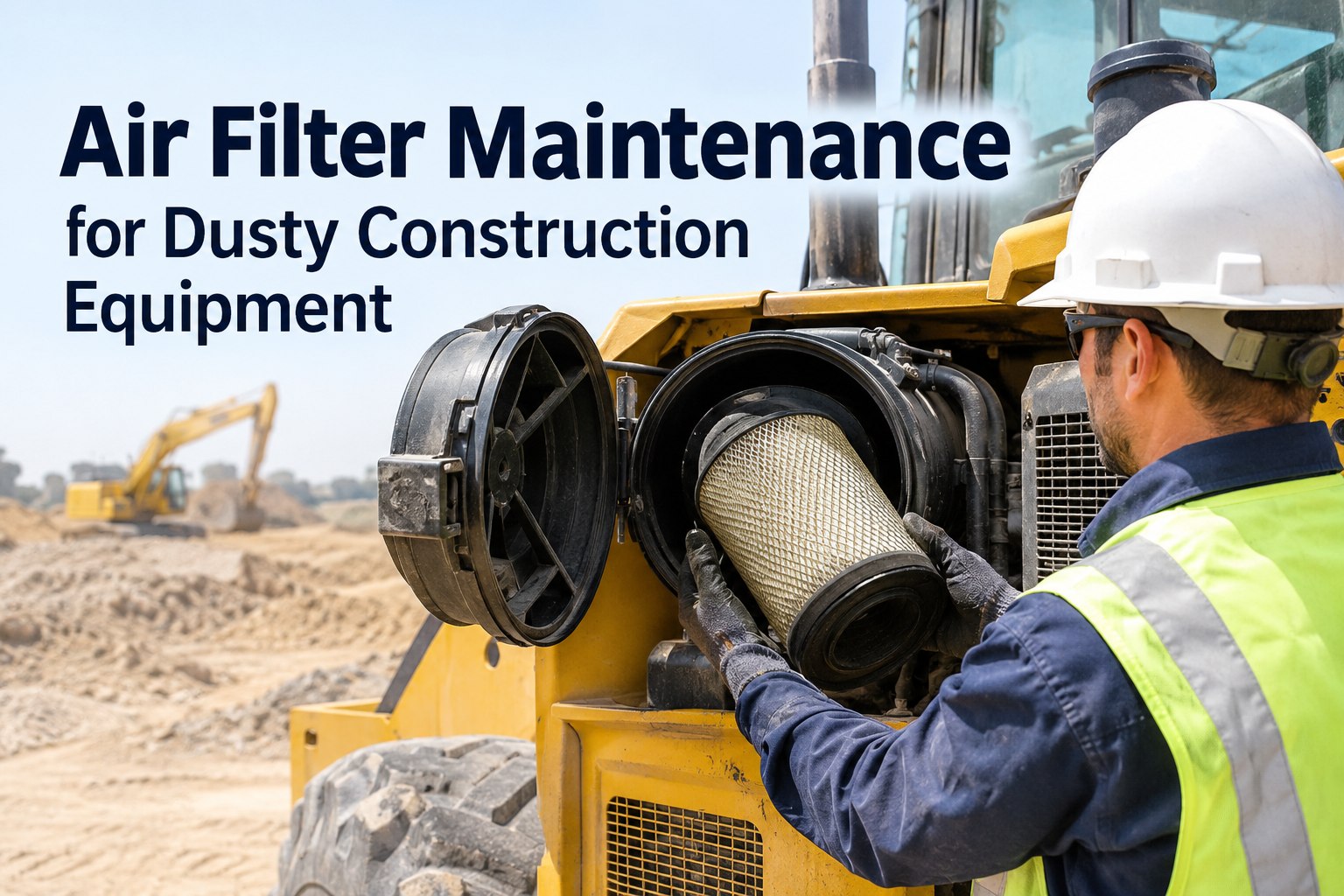
You pulled the air filter, saw it caked grey with dust, and swapped it for a fresh one. Good maintenance? Not quite — that filter likely had hundreds of hours left, and the new one is briefly worse at catching fine dust. Engine air filter maintenance and air cleaner maintenance in dust run on one counterintuitive rule: service by restriction, not by the calendar or by looks. Book a demo to track it right.
Engine Air Filter Maintenance Runs on the Restriction Gauge — Not Your Eyes
A filter that looks filthy can have most of its life left; one that looks fine can be maxed out. The service indicator reads what your eyes can't — and it's the only honest trigger.
On a dusty jobsite, the air filter is the thin line between clean combustion air and an engine eating abrasive grit — and you can get it wrong in both directions. Run a filter to full restriction and the engine chokes; change it too often and you waste money, briefly weaken filtration, and risk contaminating the intake every time you open it. This guide covers why a dirty filter is a good filter, the three failure modes that really damage engines, how to change one cleanly, and how to tune it all for severe dust.
A dirty filter is a good filterwhy the air filter restriction indicator beats appearance and the calendar
This is the fact that surprises most operators: an air filter gets better at its job as it gets dirtier, up to a point. A brand-new filter has relatively large openings in the media. As dust cakes onto the surface, those openings shrink and the filter captures finer particles more effectively than when it was new. That dust layer is doing useful work — which is exactly why judging a filter by how filthy it looks gets it backwards.
"It looks dirty / it's been 250 hours — change it."
Visual inspection can't tell you remaining life, and a fixed schedule ignores actual dust load. Both lead to changing filters that had plenty left — wasting money and money aside, over-servicing invites its own damage."The restriction indicator locked in the red — now change it."
The indicator reads the vacuum the filter creates as it loads with dust. It's the one measurement that reflects real remaining life, in real conditions, whatever the filter looks like.Filter manufacturers are blunt: visual inspection is not adequate and should not dictate service life, because a filter that looks very dirty may still hold plenty of life. Servicing on restriction readings gets the longest safe life from each filter and the best engine protection — while cutting the spend from changing good filters early. Book a demo to log restriction readings against every machine
Dust ingestion prevention: 3 real failure modeswhat actually damages engines — and it isn't a dirty-looking filter
If a dirty filter is fine, what actually causes engine damage? Three specific failures — and none is "the filter looked dirty." Knowing which you're guarding against changes how you inspect.
Running past maximum restriction
Ignore the indicator and the filter chokes airflow. You may not feel it at first, but a modern engine will start to derate to protect itself, then eventually force you to limp it back. The fix isn't dramatic — just service when the indicator says so, not after.
Unfiltered air bypassing the filter
The dangerous one. A torn element, a poor seal, a cracked intake tube or a loose air-box clamp lets dust bypass the filter entirely and go straight into the engine. It's invisible from the cab, and a tablespoon of abrasive grit reaching the cylinders can cause overhaul-level wear.
Contaminating the intake during service
The self-inflicted one. Every time you open the housing you risk dropping dust onto the clean side or dislodging debris into the intake. Over-servicing multiplies this risk — each unnecessary change is another chance to put dirt exactly where the filter was keeping it out.
Notice that two of the three failures come from handling the filter, not from the filter getting dirty. That's the whole case against over-servicing: opening the intake more often than restriction requires doesn't protect the engine — it exposes it. Fewer, restriction-driven changes done cleanly beat frequent changes done anxiously.
The bypass failure is the one that does its damage silently — which is why intake-system integrity, not just the filter, belongs on the inspection. Start free and add an intake-integrity check to your daily walk-around
Servicing without self-harmthe engine air filter service procedure that doesn't contaminate the intake
When the indicator finally calls for a change, how you do it matters as much as when — a careless change is one of the three failure modes, undoing 500 hours of protection in thirty seconds. The clean-change sequence prevents that.
- 1Clean the outside of the housing firstBefore opening anything, wipe or vacuum the exterior of the filter housing so no accumulated dirt falls in when you open it.
- 2Remove the primary element carefullySlide it out without bumping or tapping it against the housing — a knock dislodges trapped dust onto the clean side you're trying to protect.
- 3Wipe the inside and seal surfacesClean the internal surfaces and sealing tubes with a shop rag — extract the dust before you expose the engine side, never blow it deeper in.
- 4Leave the safety (secondary) filter unless dueThe inner safety element is the last line of defence. Don't disturb it every time; if you do change it, cover the intake opening until the new one's in.
- 5Inspect, seat and seal the new elementCheck the new filter for shipping damage, seat it so the seal grips fully, confirm the housing latches true, and reset the restriction indicator.
For cleanable elements, use compressed air from the inside out at no more than 30 PSI, working each pleat to push dust back out, not through. But hold any element to a light first: a tear, crushed pleat, or wet or oil-soaked section means replace, not clean. Book a demo to build the clean-change steps into a guided workflow
Severe-duty tuning & intake system inspectionadjusting for real dust, plus the oil-sample early warning
OEM intervals assume moderate conditions. A machine grinding through a quarry, a demolition site, or dry earthmoving in summer is not in moderate conditions — and its air-intake maintenance has to bend to the reality of the dust it's actually breathing.
Check restriction more often
In heavy dust, read the indicator daily rather than at scheduled service. Some OEMs advise checking as often as every two weeks or a few hundred hours in extreme conditions — the dust load, not the calendar, sets the pace.
Add a pre-cleaner
A pre-cleaner on the intake removes a large share of incoming dust before it reaches the filter — often the majority of it — which can multiply primary-filter life several-fold. For off-road equipment in dust, it's one of the highest-value additions you can make.
Watch the oil sample for silicon
Routine oil analysis is your bypass detector. Elevated silicon in the engine oil means dirt is getting past the filter — a torn element or bad seal — often the first hard evidence of a leak the eye can't see. Rising Si is a signal to inspect the whole intake, now.
That ties the system together: the restriction indicator tells you when the filter is full; the oil sample tells you when it's being bypassed — two failures, two instruments. Track both and you've covered the filter doing its job and the leak that isn't. Start free and trend restriction and oil-analysis results per machine
From a fleet mechanic on a demolition crew
For years our rule was change the air filters every service, no questions. Dusty site, seemed sensible. Then we had an engine start burning oil and the analysis came back with high silicon — dirt was getting in. Turned out one of our guys had nicked a filter seal during one of those routine changes, and we'd been feeding it grit ever since.
That flipped my whole approach. Now nobody touches a filter until the indicator says so, and every change is done clean and logged with a photo of the seal seated. We change filters way less often, we spend less on them, and — the part I didn't expect — the oil samples got cleaner because we stopped opening the intake for no reason. A dirty filter really is a good filter. I wish I'd believed that ten years ago.
The takeaway
Engine air filter maintenance runs on restriction, not looks or the calendar — a dirty filter is a good filter, and the service indicator is the only honest trigger for a change.
The engine-damaging failures are running past max restriction, unfiltered air bypassing a bad seal or torn element, and contaminating the intake during a change — two of three come from handling, not dirt.
In real dust, check restriction more often, add a pre-cleaner, and watch the oil sample for silicon — the indicator catches a full filter, the oil sample catches a bypass.
The instinct to change a filthy-looking filter feels like diligence, but in dust it's often the opposite — wasting filters, weakening filtration, and handing the engine a fresh chance to swallow dust every time the housing comes off. Trust the restriction indicator for when, follow the clean-change sequence for how, guard the intake against bypass, and let the oil sample watch your back. Do that, and dust stops being a threat and becomes just another variable the data handles. Book a demo to improve equipment maintenance with HVI
Frequently asked questions
How often should you change an engine air filter in dusty conditions?
There's no fixed hour or mileage interval that's correct — you change an air filter when its restriction indicator reaches maximum restriction, not on a schedule and not because it looks dirty. In dust a filter loads much faster, so the right move is to check the indicator more frequently, not assume a shorter fixed interval. In heavy dust that can mean reading it daily; some manufacturers suggest as often as every couple of weeks or a few hundred hours in extreme conditions. Remaining life is impossible to judge by eye, and dust load varies so much by site that any fixed interval is guessing. Servicing on restriction gives the longest safe life, the best engine protection, and lower filter costs. The manufacturer's interval is a starting reference; the restriction reading is the decision.
Is it bad to change an air filter too early?
Yes, more than most people realise. Changing an air filter before it's genuinely restricted carries three costs. It wastes money on filters that still had useful life. It briefly reduces filtration, because a broken-in filter with a light dust cake captures fine particles better than a brand-new one — so a fresh filter is momentarily less effective at trapping the finest, most abrasive dust. And most importantly, every time you open the housing you risk contaminating the clean side of the system: dropping ambient dust onto the outlet, dislodging debris, damaging the element, or disturbing the seal. Over-servicing multiplies that risk with every unnecessary change, which is why filter manufacturers explicitly warn that over-servicing and excessive handling can cause filter damage, improper installation and intake contamination. The disciplined approach is fewer changes, driven by the restriction indicator and done with a clean procedure.
What does an air filter restriction indicator do?
A restriction indicator measures the vacuum on the clean side of the air filter — the suction the engine pulls to draw air through the element. As the filter loads with dust, that vacuum rises; when it reaches the point corresponding to maximum safe restriction, the indicator signals it. It takes a few forms: a mechanical pop-up gauge on the housing that locks a coloured band when maximum restriction is hit, an in-cab warning fed by a pressure sensor, or a sensor tied into telematics for remote monitoring. Its value is that it reads what visual inspection can't: the filter's actual condition in service. Because you can't tell remaining life by looking, the indicator is the only reliable trigger for when to service, letting you run each filter to the end of its safe life and no further. Most mechanical indicators need resetting after a change, and a faulty one that never moves removes your main signal, so it's worth verifying it works.
How does dust get past the air filter into the engine?
Not through a properly sealed, intact filter doing its job — dust bypasses the filter, and that's the failure that causes serious engine wear. The common paths are a torn or perforated filter element, a damaged or improperly seated sealing surface (often from a rushed change), a cracked or loose intake tube or duct downstream of the filter, or a loose air-box clamp. Any of these lets unfiltered, dust-laden air travel straight into the engine while the filter looks fine and the machine runs normally. The danger is both that it's invisible from the cab and that the amount needed to do damage is tiny — as little as a tablespoon of abrasive dirt reaching the cylinders can cause enough piston, ring and cylinder wear to require an overhaul. Because you can't see a bypass directly, the earliest hard evidence usually comes from routine oil analysis: elevated silicon levels in the engine oil indicate dirt ingress and point to a leak somewhere in the intake system. This is why intake-system integrity — seals, tubes, clamps and element condition — belongs on the inspection alongside the filter itself, and why an oil-sample program is such a valuable early-warning system in dusty operations.
Should you clean or replace a heavy equipment air filter?
It depends on the filter type and condition, but the safe default in dusty heavy-equipment operations leans toward replacement over aggressive cleaning. Some primary elements are designed to be cleaned and reused; if so, use compressed air from the inside out at no more than about 30 PSI, working along each pleat to push trapped dust back out rather than driving it deeper — never exceed the pressure limit, as that can rupture the media. Before reinstalling any element, hold it to a light: tears, holes, crushed pleats, damaged end caps or sealing surfaces, water damage, or oil saturation all mean replace, not clean. The inner safety filter is generally not cleaned; it's replaced on its own schedule and left undisturbed as the last line of defence. Each cleaning is another handling event with contamination risk, so it should be deliberate, not routine. When in doubt, replacing a filter is far cheaper than the engine wear a marginal one can cause.
Stop guessing at air filters. Let the data call the change.
HVI puts the air-intake check on every operator's guided daily inspection — log the restriction indicator, confirm the seal and intake integrity, photograph anything off. Restriction and oil-analysis trends per machine catch a full filter and a silent bypass before either becomes engine wear, and a genuine change fires a work order that pulls the right filter from inventory. Service on data, not on looks. Live on your fleet in under two weeks.
No hardware · Restriction & oil-analysis trending · Severe-duty PM built in