A cable skidder carries everything a grapple machine does, then adds a wire rope system that can kill someone when it lets go. That is why cable skidder inspection is not a paperwork exercise — the mainline, chokers, fairlead and winch drum take abuse no other component on the machine ever sees, and a parted line under tension is a struck-by event, not a downtime line item. If you are running skidders on a logging side and your line condition still lives in the operator's head, on a grease-stained card or in a text message photo, you are one dropped turn away from a conversation nobody wants to have. This page walks through what to inspect, what to measure instead of judge, and the removal criteria that take the guesswork out of retirement — plus how fleets are digitising the whole loop, and you can see it running on your own machines in a 30-minute demo.
When did you last measure the mainline — not just look at it?
Wire rope fails by degrees: broken wires, diameter loss, corrosion, kinks, crushed strands. Every one of those is measurable, and every one has a retirement threshold. The gap between "looked fine at walkaround" and "parted under load" is almost always a measurement nobody took.
The numbers behind winch line maintenance
A skidder that cannot winch is a very expensive log arch. These four figures are what fleet and safety managers put in front of ownership when they defend a structured cable skidder PM program.
Mainline inspection: what to measure, not judge
"Looks rough" is not a criterion. A defensible mainline wire rope logging inspection records five measurable conditions, each with a threshold that ends the argument before the line ends it for you.
Broken wires
Count broken wires in one lay length and in one strand. A common field rule retires running rope at six broken wires in one lay, or three in one strand. Valley breaks — hidden between strands — are the ones that surprise you, so flex the rope at sheave contact points during the check.
Diameter reduction
Measure across the crowns with a caliper at marked reference points. A reduction of roughly 7% from nominal diameter means core failure is underway and the rope comes off, full stop. Record the numbers per inspection so the wear trend is visible months ahead.
Corrosion
Surface rust you can wipe is housekeeping. Pitting, stiff rope that won't flex, or rust bleeding from inside the strands is internal corrosion — the rope is losing section you cannot see. Machines working wet ground or sitting idle between jobs need this checked on a calendar, not on a feeling.
Kinking & crushing
A kink permanently distorts strand geometry — no amount of running-in straightens it. Crushing on the drum from cross-winding under load flattens strands and concentrates stress. Both are immediate removal items, and both trace back to spooling practice, which is why the winch check and the line check belong on the same form.
Abrasion & flat spots
Outer wires worn to one-third of their original diameter means the rope has given up its working section. Abrasion concentrates where the line passes the fairlead and where it drags ground — photograph those zones every inspection so wear rate is documented, not debated.
End connections
Check the socket, wedge or swaged fitting for cracks, pulled wires and slippage marks. End fittings fail quietly and release the full stored energy of a tensioned line. If the fitting shows any wire movement, the assembly is done — tag it out in the inspection, not in the incident report.
Fleets that log these six checks with photos per machine can walk through a live wire-rope template in a demo and see exactly how the wear trend builds over months.
Skidder winch service: the hardware the line runs through
A good mainline dies young on a bad winch. Three assemblies decide how long your rope lives and whether it holds when it matters.
Winch brake — the hold test that matters
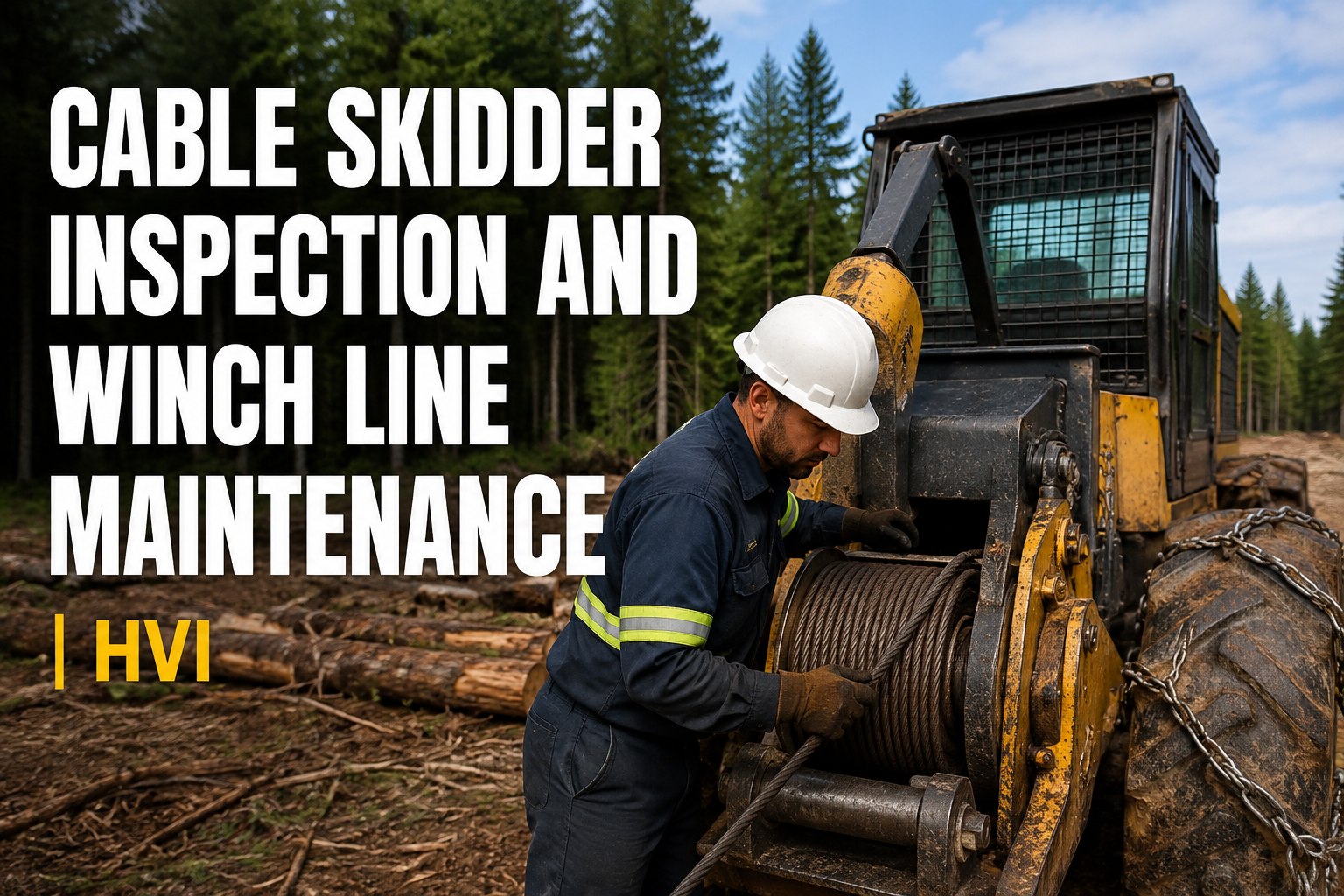
The brake is the only thing between a suspended turn and gravity. Test hold under a known load, watch for creep, fade after repeated cycles, and glazed or oil-soaked linings. A brake that drags generates heat that anneals the rope section parked on the drum — you lose line life and braking capacity at the same time. Log brake test results per machine so a fading trend triggers a work order before a dropped load does.
Drum condition & spooling behaviour
Inspect drum flanges for cracks and the groove profile for wear or corrugation. Watch the line spool under load: cross-winding, gaps and riding turns crush lower layers and cut rope life dramatically. Correct spooling tension on installation and a smooth drum surface are the cheapest wire-rope-life insurance you can buy.
Fairlead rollers — where abrasion concentrates
Every metre of line passes the fairlead, often at an angle. Seized rollers, flat spots and worn grooves turn a guide into a grinder — this is where the 3–5× wear multiplier lives. Spin every roller by hand weekly, check bearings for play, and measure groove wear. A roller kit costs almost nothing next to an early mainline replacement.
Choker inspection and retirement criteria
Chokers are consumables with a serial number's worth of history each. Treating them as anonymous iron is how worn rigging stays in circulation until it lets go at the worst moment.
| Component | What to inspect | Retire when | Record to keep |
|---|---|---|---|
| Choker cable | Broken wires, kinks, crushed sections, abrasion at the bell | Broken-wire count hits threshold, any kink, visible core | Photo + wire count per choker ID |
| Ferrules & buttons | Cracks, slippage marks, deformation at the nub | Any crack or visible wire movement in the fitting | Close-up photo, date, inspector |
| Hooks & links | Throat opening stretch, twist, wear at bearing points | Throat opened beyond spec, any twist or crack | Measurement against new-part baseline |
| Anchor & machine attachment points | Weld cracks, elongated pin holes, frame distortion | Any crack or deformation — repair before next winch cycle | Photo + work order reference |
Giving every choker an ID and a photo history is exactly the kind of rigging inspection forestry teams start logging free in HVI — retirement stops being an argument and becomes a record.
Winching practice: where people get hurt
Hardware inspection removes the weak line. Operating practice removes the person standing where the weak line goes when it parts. Both belong in the same program.
Do — every winch cycle
- Clear every person out of the bight and off the line's recoil path before tension comes on
- Keep the operator behind the machine's protection, never beside a tensioned line
- Use a spotter with agreed hand or radio signals when the turn is out of sight
- Tension slowly and watch the first metres of spool for cross-winding
- Tag and quarantine any line or choker that fails inspection until it is replaced
Don't — the shortcuts that kill
- Never straddle, step over or stand inside the bight of a tensioned or about-to-be-tensioned line
- Never shock-load a stuck turn to break it free — that is how ropes and fittings part
- Never run a line that "failed a bit" — removal criteria are binary for a reason
- Never winch at an angle the fairlead was not built to take without checking roller condition first
- Never let a replacement line go on without a documented baseline diameter and photo
See your wire rope history per machine — before the line decides for you
Book a 30-minute demo and we will load a cable skidder template — mainline, winch, fairlead, chokers — and show you the wear trend, the photo trail and the audit view on your own fleet's terms.
What one parted mainline really costs a logging side
Run the arithmetic on a single avoidable failure and the inspection program pays for itself before lunch.
Compare that with the cost of the alternative: a 10-minute documented inspection per shift, a caliper reading at marked points weekly, and a photo per choker per check. Fleets running this through a CMMS with preventive maintenance scheduling by engine hours report the same pattern — a demo on your own units shows the payback table with your actual rope spend and downtime rate, not industry averages.
Cable skidder PM, documented end to end
HVI is cloud + mobile inspection and maintenance work order software built for fleet-heavy operations. Four capabilities carry the wire rope workload specifically.
Configurable wire rope templates
Build one checklist covering wire rope, reeving, block and hook alongside the machine systems — engine, hydraulics, brakes, tires. Every skidder gets the same defensible standard, on any phone, at the landing or in the shop.
Photo-backed wear documentation
Broken-wire counts, caliper readings and fairlead grooves captured as timestamped photos on the inspection itself. When a client, insurer or safety auditor asks, you prove the condition in seconds instead of hunting through group chats.
Per-machine history for line planning
Every reading lives against the asset, so diameter-loss trends tell you when to order rope before it hits retirement. Line replacement becomes planned maintenance with parts in inventory, not a mid-shift emergency.
Defect-to-work-order in one tap
A failed brake hold test or a cracked ferrule becomes a work order with the photo attached, assigned and tracked to close. No defect dies in a notebook, and no skidder goes back to the bush with an open line-item.
Cable skidder inspection, boiled down
Measure, don't judge
Broken-wire counts, diameter reduction and abrasion depth all have numeric thresholds. A cable skidder inspection that records numbers survives an audit; one that records "OK" does not.
The hardware shapes the line's life
Winch brake, drum condition, spooling and fairlead rollers decide whether a mainline reaches its service life or dies at a third of it. Inspect the path, not just the rope.
Chokers are tracked assets
Give every choker an ID, a photo history and a retirement record. Anonymous rigging is how worn gear stays in circulation.
Line-of-fire is a system, not a slogan
Positioning discipline, slow tensioning and quarantine of failed gear close the loop that hardware inspection opens. Put both in the same program and the same software — you can sign up free and have the template live this week.
"I used to find out a mainline was done when the operator radioed in that it was on the ground. Now my guys photograph the caliper reading every Friday and I watch the diameter trend on one screen. Last quarter we retired two lines early — planned, rope on the shelf, zero lost shifts. The number I track is unplanned line changes, and it's been zero for six months. That's the only rigging KPI my owner asks about anymore."
Dale Merrick — Maintenance Manager, contract logging & hauling operation
Cable skidder inspection questions, answered
How often should a skidder mainline be inspected?
What are the removal criteria for wire rope on a logging winch?
Why do fairlead rollers matter so much for line life?
How should chokers be tracked and retired?
Can a digital inspection app handle off-road machines like skidders?
Put every mainline, choker and fairlead on the record
Start with one skidder and one wire rope template. See the photo trail, the wear trend and the work order loop — then roll it across the side.
Free to start — Works on any phone — No card needed