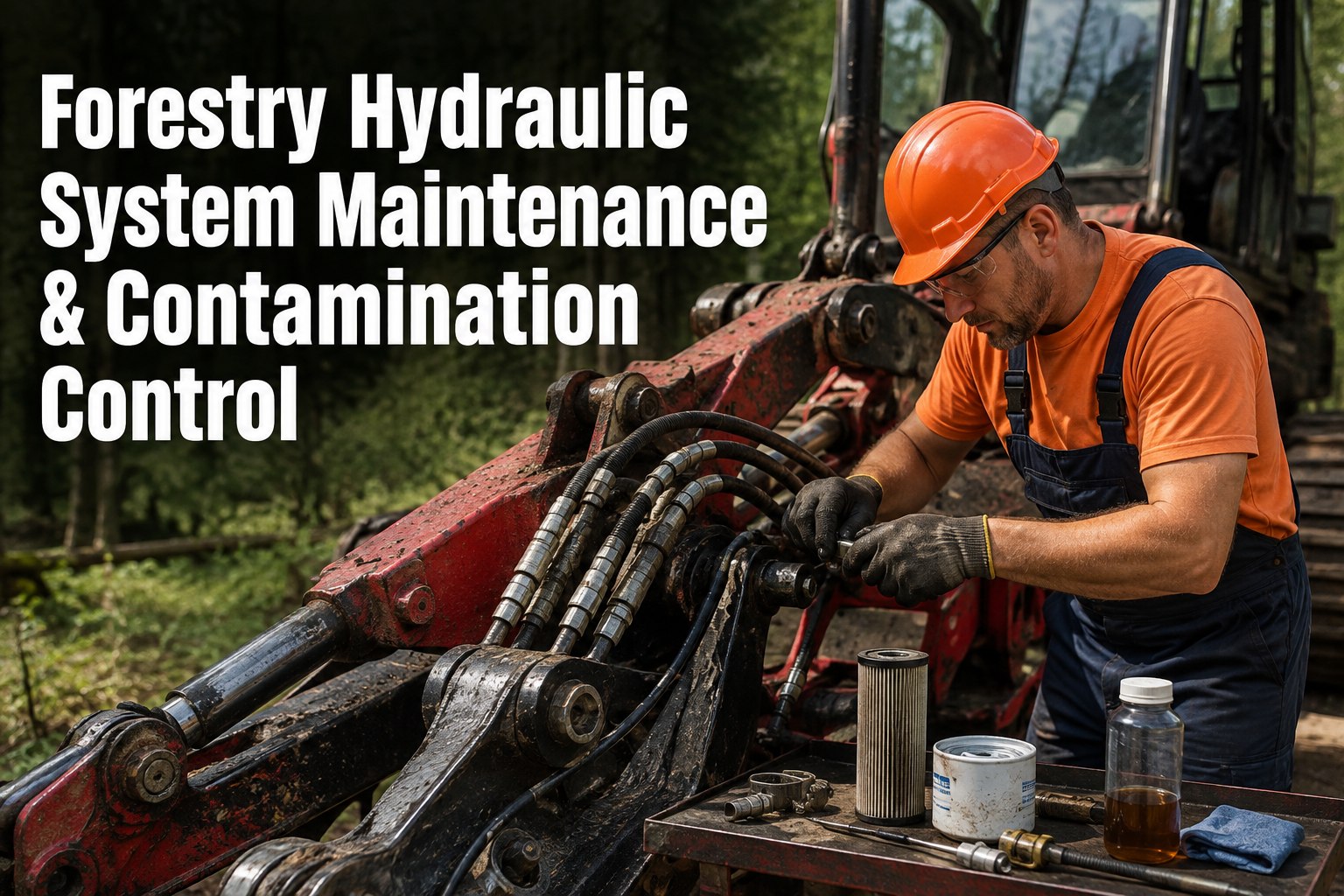
Contamination is the leading cause of premature hydraulic component failure — and forestry hydraulic systems operate in one of the harshest environments for contamination control anywhere. Wood dust, bark particles, water ingress, dramatic temperature swings, and constant boom and grapple movement create both the ingress opportunity and the wear demand. ISO 4406 codes turn "the oil looks dirty" into measurable data. Preventing contamination at every entry point keeps feller bunchers, skidders, and harvesters producing. This 2026 guide walks the pathways. Book a demo .
Forestry Hydraulics — Six Contamination Pathways That Kill Components
Every pathway has a prevention. Every prevention takes discipline the manual doesn't enforce.
Forestry equipment hydraulic systems face contamination challenges most industrial hydraulics never see. Wood chips, bark dust, and sawdust are abrasive and everywhere on a cut site. Water ingress happens in rain, wet snow, and stream crossings. Temperature swings from cold morning starts to sustained loaded operation drive thermal cycling that pumps ambient air through breathers hundreds of times a day. And the equipment itself — feller bunchers, skidders, harvesters, forwarders, delimbers — runs continuous heavy hydraulic movement through boom, grapple, saw head, blade, and traction functions. Contamination that would build slowly in a stationary industrial press builds fast in the woods. The maintenance discipline has to match.
Hose failures — the largest single cause of forestry hydraulic downtimeWhere hoses fail, why routing matters, and what pre-start inspection has to catch
Hoses fail in predictable patterns. The failures are catchable in pre-start visual inspection when the crew knows what to look for. When they're not caught, the failure mode is often mid-shift blowout — a machine down in the woods, hydraulic fluid spilled in the operating area, and depending on the pressure and location, a hazard to anyone nearby. Book a demo to see hydraulic hose inspection templates in HVI
Abrasion damage from routing
Hose rubbing against boom structure, frame edges, or adjacent hoses wears through the outer cover, then the reinforcement layer, then blows. Cover wear is visible before failure — catch it in pre-start visual and reroute or add abrasion protection before the reinforcement is exposed.
Fitting weeps and coupling leaks
Wet spots at fittings signal a seep that will grow. Torque check on the fitting is the first response; if it seeps after retorque, the fitting or hose end needs replacement. Wet spots are the primary pre-start visual signal.
Bend radius violations
Hose bent tighter than manufacturer minimum bend radius stresses reinforcement and shortens life dramatically. Common after component replacements where new hose is routed by feel rather than by spec. Bend radius check at hose replacement is the prevention.
Kink and crush damage
Hoses caught between moving components, stepped on, or crushed by falling material develop internal reinforcement damage invisible from outside. Any suspected crush event flags the hose for closer inspection or replacement — internal damage produces failures that pre-start visual misses.
UV and weather degradation
Hose covers exposed to sun and weather harden and crack over time. Cover cracking around fittings, at high-flex zones, or in general along hose length signals age-out replacement. Preventive replacement on age or hours interval, not run-to-failure, on high-consequence hoses.
Pressure spike / impulse fatigue
Rapid pressure spikes from high-flow valve actuation fatigue hoses at fittings. Ballooning near fittings signals impulse fatigue and imminent failure. Preventive replacement when observed; addressing the cause (relief valve setting, valve actuation speed) prevents recurrence.
Every visible hose failure mode is a pre-start finding — when the inspection actually gets done and defects actually get flagged. Book a demo to see hose inspection templates with photo evidence in HVI
Fluid analysis and cleanliness targetsWhy ISO 4406 codes matter and what forestry targets look like
Fluid analysis converts hydraulic maintenance from a schedule to a condition-based discipline. Instead of changing fluid every X hours regardless of condition, or ignoring it until failure, fluid analysis tells you what the system is actually doing — particle count, wear metals, water content, additive depletion, oxidation. The data drives the intervention timing.
ISO 4406 particle count
Wear metals
Water content
Additive depletion + oxidation
Biodegradable hydraulic fluids and environmental considerationsWhere forestry-specific fluid choice matters — and where the trade-offs live
Forestry operations near water sources (stream buffers, wetlands, riparian zones) increasingly require biodegradable hydraulic fluids — typically synthetic ester-based fluids that break down naturally in the environment vs mineral-based fluids that persist. The performance profile is similar but not identical, and the maintenance implications differ. Start a free trial to configure PM schedules that match fluid-specific manufacturer intervals.
Where required
Operations within stream buffers, over water, in municipal watersheds, or on public lands with environmental protection requirements. Many customer contracts (public forest agencies, environmental-certified operations) mandate biodegradable fluids in specific zones. Verify contract requirements before assuming.
Fluid categories
Vegetable-oil-based (HETG) — lower cost, lower performance, temperature-limited. Synthetic ester (HEES) — higher cost, closest to mineral oil performance, most common choice for forestry. Polyalkylene glycol (HEPG) — specialty applications. Manufacturer-approved biodegradable options for the specific equipment matter more than the category alone.
Seal compatibility
Biodegradable fluids can affect seal life differently than mineral oils. Manufacturer approval for the specific machine is important; using a biodegradable fluid the OEM hasn't approved can void warranty and cause premature seal failure. Verify OEM approval list before switching.
Fluid-change intervals
Biodegradable fluids typically have shorter service life than mineral oils in the same application — oxidation resistance is often lower. Manufacturer-specified change intervals may be tighter, and fluid analysis becomes more important to catch end-of-life before performance drops.
PM discipline that tracks fluid type per machine and matches inspection templates to the OEM approval list is the operational reality of running biodegradable fluid across a mixed fleet. Book a demo to see fluid-type-aware PM in HVI
From a forestry maintenance manager on the contamination-control payoff
We were losing pumps on our skidders faster than we should have — two pump failures in one quarter across an eight-machine fleet. When we finally ran fluid analysis on the samples, the ISO codes came back around 22/20/17 across most units. That's not contamination, that's a bath. Bulk fill practice was the culprit — five-gallon buckets, no filter cart, wiped fill port with whatever rag was handy.
We invested in a filter cart, established a "wipe, filter, pump" protocol for every fluid transfer, and put breather condition on the pre-start check. Six months later our ISO codes averaged 17/15/12 across the fleet, no pump failures in the following year, and fluid change intervals extended because analysis showed the fluid holding up longer. Contamination control isn't glamorous. It's just what makes hydraulic components last.
Frequently asked questions
Why is contamination control so important for forestry hydraulic systems?
Contamination is the leading cause of premature hydraulic component failure across all industries, and forestry equipment operates in one of the harshest contamination environments anywhere. Wood dust, bark particles, sawdust, water ingress from rain and wet snow, and dramatic temperature swings that pump ambient air through reservoir breathers hundreds of times a day all contribute contamination pressure. Continuous heavy hydraulic movement through boom, grapple, saw head, blade, and traction functions on feller bunchers, skidders, harvesters, and forwarders means the system is circulating contaminants at high rates once they're present. Particles as small as 4 microns cause silt-level wear on precision components; 14-micron particles can immediately score cylinders and damage servo valves. The ISO 4406 standard quantifies contamination as three-number codes (particles per mL at ≥4µm / ≥6µm / ≥14µm thresholds) that let fleets set measurable cleanliness targets and track trends over time. Forestry systems typically target 18/16/13 or cleaner; systems with sensitive servo valves target 16/14/11 or cleaner. Contamination control that keeps the ISO code in target extends component life, reduces unplanned failures, and lets fluid-change intervals be driven by condition instead of calendar.
What are the main contamination pathways into a hydraulic system?
Six pathways account for most contamination ingress. Reservoir breather: ambient air pulled through the breather during thermal cycling brings dust and moisture with it — desiccant breathers in dusty environments and monthly condition checks are the prevention. Fill and top-up practice: dirty funnel, unwiped fill port, or unfiltered new-fluid transfer introduces bulk contamination in a single event — wipe fill port before opening, use filter cart or filtered transfer pump, and pre-filter new fluid to the target ISO code. Hose fittings during service: fitting disassembly for repair exposes the system to shop dust — clean the external area before disassembly, cap or plug open ports immediately, and flush after major service. Cylinder rod damage: scored rod pulls contaminants past the wiper seal on retraction — rod inspection at every PM and nick or gouge flagged for replacement. Filter neglect or bypass: loaded return filter bypasses under differential pressure and sends unfiltered fluid back to the reservoir — change per differential-pressure indicator, not "when we remember." Internal component wear: pumps, valves, and cylinders generate wear particles that contaminate the fluid they run in — fluid analysis at defined intervals catches the wear-particle trend before component failure.
What should a forestry hydraulic pre-start inspection cover?
A forestry hydraulic pre-start inspection should cover visible-failure early warning signs and the safety-critical items an operator can verify in minutes. Hose visual: walk-around visual for abrasion damage (cover wear from routing rub), fitting weeps or wet spots (signals a growing leak), bend radius violations from recent hose replacements, kink or crush damage from operational events, cover cracking from UV/weather age-out, and ballooning near fittings signaling impulse fatigue. Reservoir: fluid level within spec, breather clean and not saturated, visible cleanliness of external tank area. Cylinder rods: rod surface for scoring, nicks, or gouges that would pull contaminants past the wiper seal. Filter indicators: differential-pressure indicator on return filter within green range (not indicating bypass). Cooler: cooler fins clear of debris (bark, sawdust accumulate), fan function verified. Leaks generally: any visible leak, weep, or fluid accumulation flagged for closer inspection. Never search for a suspected leak with a bare hand — use cardboard or wood, and treat any suspected injection injury as a medical emergency.
Does HVI support forestry hydraulic maintenance workflows?
Yes. HVI supports hydraulic maintenance workflows for forestry equipment (feller bunchers, skidders, harvesters, forwarders, delimbers) as maintainable assets in the fleet inspection and maintenance platform. Features include configurable pre-start inspection templates covering hose visual inspection, fitting weep checks, reservoir and breather condition, cylinder rod inspection, and filter differential-pressure indicator, photo documentation of leaks or damage with GPS and timestamp on every flagged item, defect reporting with severity-based escalation for safety-critical items that alerts supervisors before the machine returns to the cutting face, work order generation from flagged defects with parts and labor tracking, and PM scheduling based on manufacturer recommendations, operating hours, and equipment-specific condition triggers. HVI is not a hydraulic fluid analysis lab, an ISO 4406 particle-counting service, a hydraulic component OEM (Parker, Eaton, Continental, John Deere, Tigercat, Komatsu Forest), a certified hydraulic repair shop, or a specialty filtration system provider. Fluid analysis, contamination measurement, and hydraulic component repair remain with fluid analysis labs, filtration specialists, and hydraulic technicians. HVI is the inspection and maintenance-workflow documentation layer that pairs with them.
Are biodegradable hydraulic fluids required for forestry operations?
Biodegradable hydraulic fluids are required in specific operational contexts, not universally. Operations within stream buffers, over water, in municipal watersheds, on public lands with environmental protection requirements, or under customer contracts (public forest agencies, environmental-certified operations) commonly mandate biodegradable fluids. The main categories are vegetable-oil-based (HETG, lower cost and lower performance, temperature-limited), synthetic ester (HEES, closest performance to mineral oil, most common forestry choice), and polyalkylene glycol (HEPG, specialty applications). Manufacturer approval for the specific equipment matters more than the fluid category alone — using a biodegradable fluid the OEM has not approved can void warranty and cause premature seal failure. Biodegradable fluids typically have shorter service life than mineral oils in the same application, so fluid analysis becomes more important to catch end-of-life before performance drops. Biodegradability also does not mean instant harmlessness — fluids break down over weeks or months rather than years, but spill response procedures, containment materials, and reporting requirements still apply in most jurisdictions. Preventing hydraulic leaks through good maintenance is always cheaper than spill response, biodegradable or not.
Catch hydraulic leaks and abrasion in pre-start, not in mid-shift blowout reports
HVI supports forestry hydraulic maintenance workflows — pre-start inspection templates for hoses, fittings, cylinders, filters, and reservoirs, photo documentation of every flagged defect with GPS and timestamp, severity-based escalation for safety-critical items, work order generation, and PM scheduling based on manufacturer intervals, operating hours, and condition triggers. Fluid analysis, ISO 4406 particle counting, and hydraulic component repair remain with specialty labs and technicians. HVI is the inspection and workflow layer that documents the fitness gate.
No credit card · No hardware · Forestry hydraulic templates ready on day one