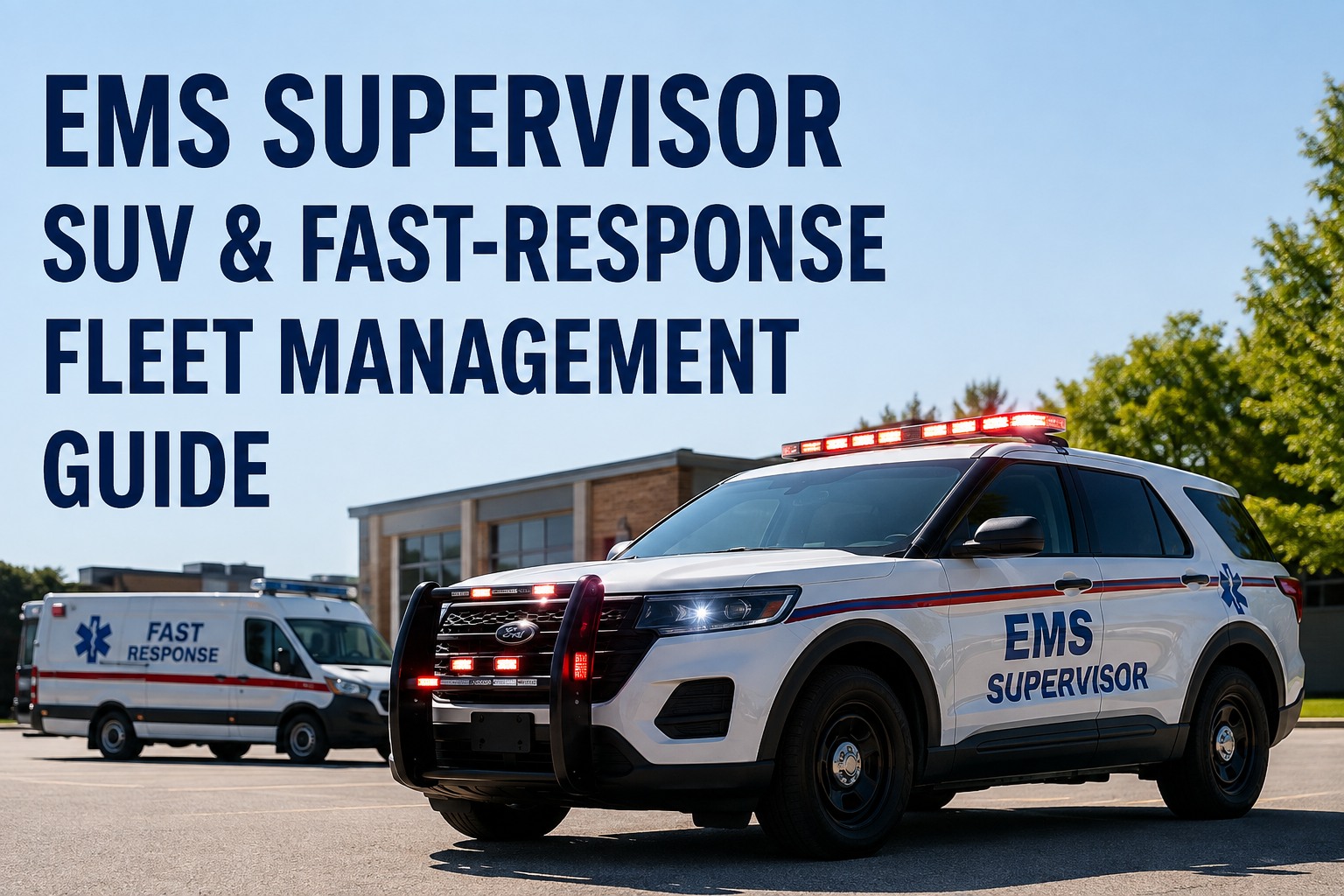
Your EMS supervisor SUV just rolled 180,000 miles, but the odometer is lying to you. That Tahoe has spent 60% of its duty cycle idling at scenes, running lights and sirens through traffic, and sitting at idle for six hours straight while your crew manages a mass casualty. The engine hours tell the real story: 3,000 hours of severe service that would kill a civilian vehicle at 100,000 miles. If you are running these fast-response EMS fleet vehicles on standard 7,500-mile oil intervals because that is what the dashboard reminder says, you are building engine sludge and transmission heat that will strand a paramedic supervisor at 3 AM when the next cardiac call comes in. Whether you operate a single fly car or a fleet of EMS chief vehicles, the maintenance math changes completely when a Suburban or Expedition works as a mobile command post instead of a grocery getter. If you want to see how severe-duty scheduling works on your actual units, book a walkthrough of HVI's EMS templates before the next quarterly PM comes due.
Your EMS Supervisor SUV Is Not a Civilian Vehicle With Lights
Tahoes, Suburbans, and Expeditions running 24/7 emergency response need severe-duty PM schedules that account for idle time, not just mileage. Here is how to keep your quick response vehicles ready when the next call drops.
Faster Oil Degradation
Extended idle breaks down 5.3L and 6.2L GM V8 oil viscosity twice as fast as highway driving. Change at 3,000-4,000 miles, not 7,500.
Transmission Rebuild Cost
Heat soak from idling cooks 6L80 and 10R80 fluid. Service every 30,000 miles or pay for a rebuild at 90,000.
Fuel Budget Waste
An EMS supervisor SUV idling 12 hours daily burns 0.8 gallons per hour with zero miles driven. Track engine hours, not just odometer.
Inspection Time Saved
Digital DVIR checklists cut pre-shift inspection time by three-quarters compared to paper forms while capturing photo evidence of tire wear and light function.
Why Your EMS Supervisor SUV Needs a Different PM Schedule
Standard fleet schedules assume highway miles and regular engine cooling. Emergency response creates the opposite: maximum heat, minimum airflow, and constant electrical load from lights, radios, and mobile data terminals.
Engine Oil & Filter
5.3L and 6.2L GM V8s and 3.5L EcoBoost engines shear oil viscosity rapidly during extended idle. Fuel dilution from cold starts compounds the issue.
Transmission Service
6L80, 10L80, and 10R80 transmissions generate extreme heat when stationary with the torque converter engaged. Fluid oxidizes and loses friction modifiers.
Brake System
High-speed response followed by immediate idle heat-soaks rotors and boils brake fluid. Inspect pads every 10,000 miles; flush fluid annually regardless of mileage.
Battery & Charging
Constant 12V load from emergency lighting, radios, and laptops drains batteries even with high-output alternators. Test conductance quarterly.
The 7-Minute EMS Fly Car Inspection Checklist
Your paramedic supervisor vehicle carries $15,000 in medical gear and needs to start immediately at 3 AM. This checklist catches the failures that strand crews.
Engine Hours & Idle Time
Log engine hours at shift change. When hours hit 250 since last oil change (roughly 3,500 miles), schedule service regardless of odometer reading.
Tire Condition & Pressure
Check for uneven wear from curb strikes during response. EMS SUVs run 50-80 PSI depending on load; verify when cold, not after highway runs.
Battery Voltage & Connections
Load test weekly. Look for corrosion on terminals from constant vibration. Verify auxiliary battery isolator function for medical equipment circuits.
Emergency Lighting & Sirens
Test all Whelen or Federal Signal light heads, intersection clearing lights, and siren tones. Document any LED module failures immediately for warranty claims.
Fluid Leaks & Levels
Inspect for oil cooler line leaks common on 6.2L Tahoes. Check transmission fluid level and color—dark or burnt smell indicates immediate service needed.
Radio & MDT Function
Verify mobile data terminal charging and radio transmission clarity. Dead radios delay response; document issues for immediate repair.
| Component | Standard Interval | EMS Severe Interval | Failure Risk |
|---|---|---|---|
| Engine Oil (5.3L/6.2L/3.5EB) | 7,500-10,000 mi | 3,000-4,000 mi or 250 engine hours | Sludge, bearing wear, VVT failure |
| Transmission Fluid | 100,000 mi | 30,000 mi | Torque converter shudder, gear slip |
| Spark Plugs | 100,000 mi | 60,000 mi | Misfire under load, poor idle quality |
| Brake Fluid | 3 years | 12 months | Boil-over, pedal fade during response |
| Air Filter | 30,000 mi | 15,000 mi | Dust ingestion during idle at scenes |
What One Missed PM Costs Your EMS Fleet
Run the numbers on a single 2022 Tahoe PPV used for EMS command. The math shows why severe-duty scheduling pays for itself.
That calculation does not include the liability cost of a paramedic supervisor vehicle failing to start during a mass casualty incident. When your EMS chief vehicle is the only command unit on scene, availability is measured in lives, not just dollars. See how HVI tracks engine hours automatically to prevent these failures.
Stop Guessing When Your EMS SUVs Need Service
HVI tracks engine hours, idle time, and severe-duty intervals automatically. Get alerts when your Tahoes and Suburbans actually need oil, not when the odometer hits an arbitrary number.
HVI for EMS Supervisor SUV and Fast-Response Fleet Management
Paper logs and spreadsheet reminders fail when your fleet never stops moving. HVI's CMMS platform handles the complexity of 24/7 emergency vehicle maintenance.
Engine-Hour Based PM Scheduling
Set preventive maintenance triggers by engine hours, not just mileage. HVI alerts you at 250 hours since last oil change, accounting for the 60% idle time that destroys EMS supervisor SUV engines.
Digital DVIR with Photo Capture
Crews complete the 7-minute inspection on any phone or tablet. Photos of tire damage or fluid leaks attach directly to the vehicle record, creating an audit trail for DOT or insurance reviews.
Instant Defect-to-Work-Order
When a paramedic finds a non-functioning light bar during checkout, HVI converts that defect to a work order immediately. No text messages, no lost notes, no delayed repairs on critical safety equipment.
Cost-Per-Mile Analytics
Track the true cost of your EMS fly car fleet including fuel waste from idling. Compare 5.3L versus 6.2L versus 3.5L EcoBoost operating costs to optimize future purchases.
Real Results for EMS Fleets
Agencies switching to HVI's severe-duty templates report 40% fewer roadside breakdowns and 25% lower maintenance costs within six months. The system pays for itself when it prevents one transmission failure. Start your free account to import your fleet today.
Keep Your Quick Response Vehicles Ready
Ignore the odometer for oil changes. With 60% idle time, your EMS supervisor SUV needs oil every 3,000-4,000 miles or 250 engine hours, whichever comes first.
Service transmissions at 30,000 miles. Heat from idling destroys fluid faster than highway miles. Budget for fluid exchanges, not rebuilds.
Track engine hours religiously. The odometer lies about wear. Install hour meters or use telematics integration to capture true usage.
Digitize your inspections. Paper checklists get lost. Digital DVIRs with photo proof protect you during audits and ensure defects become work orders immediately.
Your Tahoe, Suburban, or Expedition works harder than any police cruiser. Treat it that way. Book a demo to see HVI's EMS templates configured for your specific fleet mix.
"We lost two 6.2L Tahoes to engine failure before I figured out the idle time was killing them. The oil looked fine at 6,000 miles, but the bearings were shot. Now I track engine hours religiously and change oil every 3,500 miles no matter what the dashboard says. My breakdowns dropped to zero, and I have the data to prove why we need replacement vehicles at 150,000 miles instead of 200,000."
EMS Supervisor SUV Maintenance Questions
How often should I change oil in an EMS supervisor SUV?
Change oil every 3,000-4,000 miles or 250 engine hours, whichever comes first. EMS vehicles idle 60% or more of their duty cycle, which breaks down oil viscosity twice as fast as highway driving. The 5.3L, 6.2L, and 3.5L EcoBoost engines in Tahoes, Suburbans, and Expeditions are particularly susceptible to fuel dilution and sludge when idled extensively. Do not rely on the 7,500-mile dashboard reminder.
What is the best SUV for EMS supervisor and command use?
The Chevrolet Tahoe PPV and Suburban are the most common EMS supervisor vehicles due to their 6.2L V8 power, heavy-duty cooling, and interior space for command boards. The Ford Expedition with 3.5L EcoBoost offers better fuel economy but requires strict 30,000-mile transmission service intervals. Choose based on your idle time percentage—high-idle agencies need the GM V8's simpler valvetrain, while mixed-use fleets benefit from the Ford's efficiency.
How do I track maintenance on vehicles that idle constantly?
Track engine hours, not just mileage. Install an hour meter or use telematics integration to capture idle time. Set your CMMS to trigger PMs at 250 engine hours for oil changes and 1,000 hours for transmission service. This accounts for the fact that one hour of idle equals roughly 25-30 miles of wear on the engine and drivetrain.
What should be included in an EMS fly car daily inspection?
Check engine hours and oil life, tire condition and pressure, battery voltage and connections, emergency lighting and siren function, fluid leaks, and radio/MDT operation. Document any defects with photos immediately. This 7-minute inspection catches the electrical and cooling system failures that commonly strand EMS SUVs during extended idle at scenes.
Can HVI handle both our ambulances and supervisor SUVs?
Yes. HVI manages mixed fleets including Type I, II, and III ambulances alongside EMS supervisor SUVs, fly cars, and quick response vehicles. You can set different PM schedules for each asset class—severe-duty intervals for high-idle SUVs and standard intervals for highway-driven ambulances. Book a demo to see mixed-fleet scheduling in action.
Ready to Extend the Life of Your EMS Fleet?
Join hundreds of EMS agencies using HVI to track severe-duty maintenance, reduce breakdowns, and prove compliance during audits. Works on any phone, no hardware required.
Free to start • Works on any phone • No credit card needed