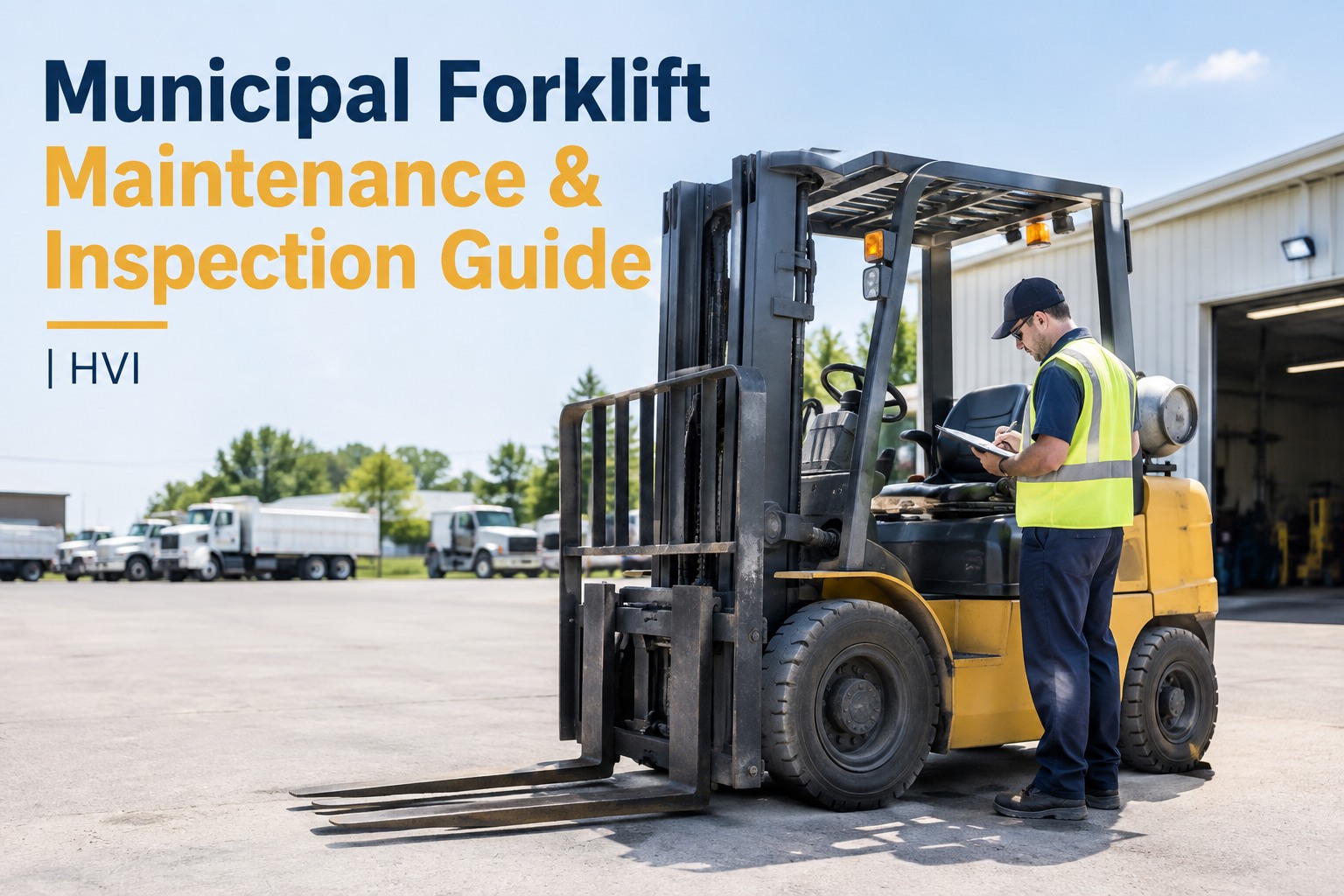
A forklift at the water treatment plant has been leaking hydraulic fluid for two weeks. Nobody's filled out a daily inspection sheet in longer than that, because the plant only has one forklift and everyone assumes someone else is checking it. Then a fork drops unexpectedly under a load, and the near-miss report asks a question nobody can answer: when was this thing last actually inspected?
Municipal Forklift Maintenance: What the Daily Rule Actually Requires
A forklift parked at a water plant or a parks depot doesn't get less scrutiny than one running in a central warehouse — the same daily examination, training, and maintenance requirements apply everywhere a powered industrial truck operates.
The Daily Examination OSHA Actually Requires
29 CFR 1910.178(q)(7) is short, and worth reading exactly as written: industrial trucks must be examined before being placed in service, at least daily, and after each shift where a truck runs around the clock. Any condition adversely affecting safety means the truck doesn't go into service until it's fixed. Defects, once found, must be reported and corrected immediately — not logged for the next PM cycle.
Federal OSHA doesn't mandate a specific written checklist format, which is exactly why so many municipal shops end up with an inconsistent one: a laminated sheet in the cab that half the operators skip, a verbal "looked fine to me," or nothing at all once the forklift leaves a central depot. The rule doesn't care how informal the process becomes — it cares whether the examination actually happened and whether a found defect actually got the truck pulled from service. Sign up for a free trial to turn that laminated sheet into a completed, timestamped record every shift.
Operator Training Is a Separate Record From Equipment Maintenance
These two get merged constantly, and they shouldn't be. A trained, evaluated operator does not make an unmaintained forklift safe, and a perfectly maintained forklift does not make an untrained operator safe. Under 29 CFR 1910.178(l), operators must be trained and evaluated before operating independently, with formal re-evaluation required at least every three years or sooner after an incident, a near-miss, or observed unsafe operation.
Operator Record
- Initial formal instruction and practical training
- Performance evaluation before independent operation
- Re-evaluation at least every three years
- Refresher training after an incident or unsafe operation
Equipment Record
- Daily pre-shift examination result
- Hour-based preventive maintenance history
- Defects found, repairs made, and sign-off
- Removal-from-service and return-to-service dates
What Gets Inspected: Forks, Mast, Chains, Hydraulics, and More
A daily examination isn't a walk past the truck. Direct operators and technicians to your manufacturer's specific checklist and applicable jurisdictional standard, but the core inspection points look like this across most forklift types. Book a demo to see these points loaded as a configurable template your operators complete from a phone.
Matching PM to Power Type: Electric, Propane, and Diesel
Electric
Battery charging must happen in a designated, ventilated area under 29 CFR 1910.178(g), with fire protection and spill-handling equipment, and chargers protected from truck impact. PM focuses on battery condition, terminal corrosion, and charge cycle health.
Propane (LP)
Cylinder mounting, valve protection, and hose/fitting integrity matter as much as engine service. Indoor use requires adequate ventilation to manage exhaust and any fuel system leaks.
Diesel
Fuel system condition, exhaust system integrity, and emissions equipment take priority alongside standard engine PM — especially where diesel units run indoors or in enclosed depots.
Whatever the power source, the underlying rule is the same: engine or battery hours plus manufacturer-recommended calendar intervals, not a single generic schedule applied across every unit regardless of type or duty cycle. Book a demo to see hour-based PM configured differently for your electric, propane, and diesel units.
From an Equipment Manager Who Found the Gap Between Depots
Our central warehouse forklifts were in great shape — logged daily, serviced on schedule, no argument. The units out at parks facilities and the water plant were a different story. One hadn't had a documented inspection in months because it wasn't really "on anyone's list."
Now every forklift, no matter which building it lives in, is on the same asset register with the same recurring schedule. The water plant unit gets exactly the same daily and hour-based attention as the ones in the main yard.
Forklifts Outside the Central Depot Still Need a Record
Municipalities rarely keep every forklift in one warehouse. One might sit at a water treatment plant, another at a parks maintenance building, another at a utilities yard used twice a week. Distance from the main shop doesn't change what OSHA requires or what a proper PM schedule needs — it just makes it easier to lose track of. Sign up for a free trial to bring every forklift, wherever it's stationed, onto one recurring inspection schedule that works offline in facilities with no signal.
Practical Forklift Inspection & Maintenance Checklist
Conclusion: Municipal Forklift Maintenance Shouldn't Depend on Which Building It's Parked In
A forklift's risk doesn't shrink because it's the only one at a small facility, and its inspection requirement doesn't loosen because it's far from the main shop. Municipal forklift maintenance holds up when the daily examination happens every shift, operator training stays current and separate from equipment records, PM runs on hours and manufacturer spec rather than guesswork, and every unit — central warehouse or outlying depot — lives on the same recurring schedule. Book a demo to see that schedule built against your own forklift fleet, wherever each unit is stationed.
Frequently Asked Questions
How often must forklifts be inspected under OSHA rules?
Under 29 CFR 1910.178(q)(7), powered industrial trucks must be examined before being placed in service, at least daily. Forklifts used on a round-the-clock basis must be examined after each shift. If the examination reveals a condition adversely affecting safety, the truck must not be placed in service until the defect is corrected, and defects must be reported and corrected immediately once found.
Does federal OSHA require a written forklift inspection checklist?
Federal OSHA does not mandate a specific written checklist format for the daily forklift examination, but it does require the examination itself to occur and defects to be reported and corrected. In practice, most safety programs use a documented checklist because it is the clearest way to demonstrate the examination actually happened and to create a record of any defects found.
How often does forklift operator training need to be renewed?
Under 29 CFR 1910.178(l), an operator must be trained and evaluated before operating a forklift independently. Formal re-evaluation of each operator's performance is required at least once every three years, and refresher training is required sooner if the operator is observed operating the truck unsafely, is involved in an accident or near-miss, is assigned to a different type of truck, or if workplace conditions change in a way that could affect safe operation.
What are the OSHA requirements for forklift battery charging areas?
Under 29 CFR 1910.178(g), battery charging must take place in a location designated for that purpose. These areas must be adequately ventilated to disperse fumes, equipped with facilities to flush and neutralize spilled electrolyte, provided with fire protection equipment, and designed to protect charging apparatus from damage by trucks. Open flames, sparks, and smoking must be prohibited in battery charging areas due to the explosive hydrogen gas produced during charging.
How should municipalities track forklifts located outside the main depot?
A forklift stationed at a satellite facility, such as a water treatment plant or a parks maintenance building, should be entered on the same asset register as forklifts in a central warehouse, assigned to a department, and placed on the same recurring inspection and PM schedule. Using a system that supports offline inspections helps ensure equipment at remote or low-connectivity facilities receives the same consistent documentation as equipment at the main shop.
Manage every forklift the same way, wherever it's stationed
HVI gives municipalities configurable inspection templates for daily, recurring, and PM checks, hour-based maintenance scheduling by manufacturer spec, offline field capture for remote facilities, and equipment-level records that stay complete no matter which depot the forklift calls home.
No credit card · Works offline in the field · Live in under two weeks