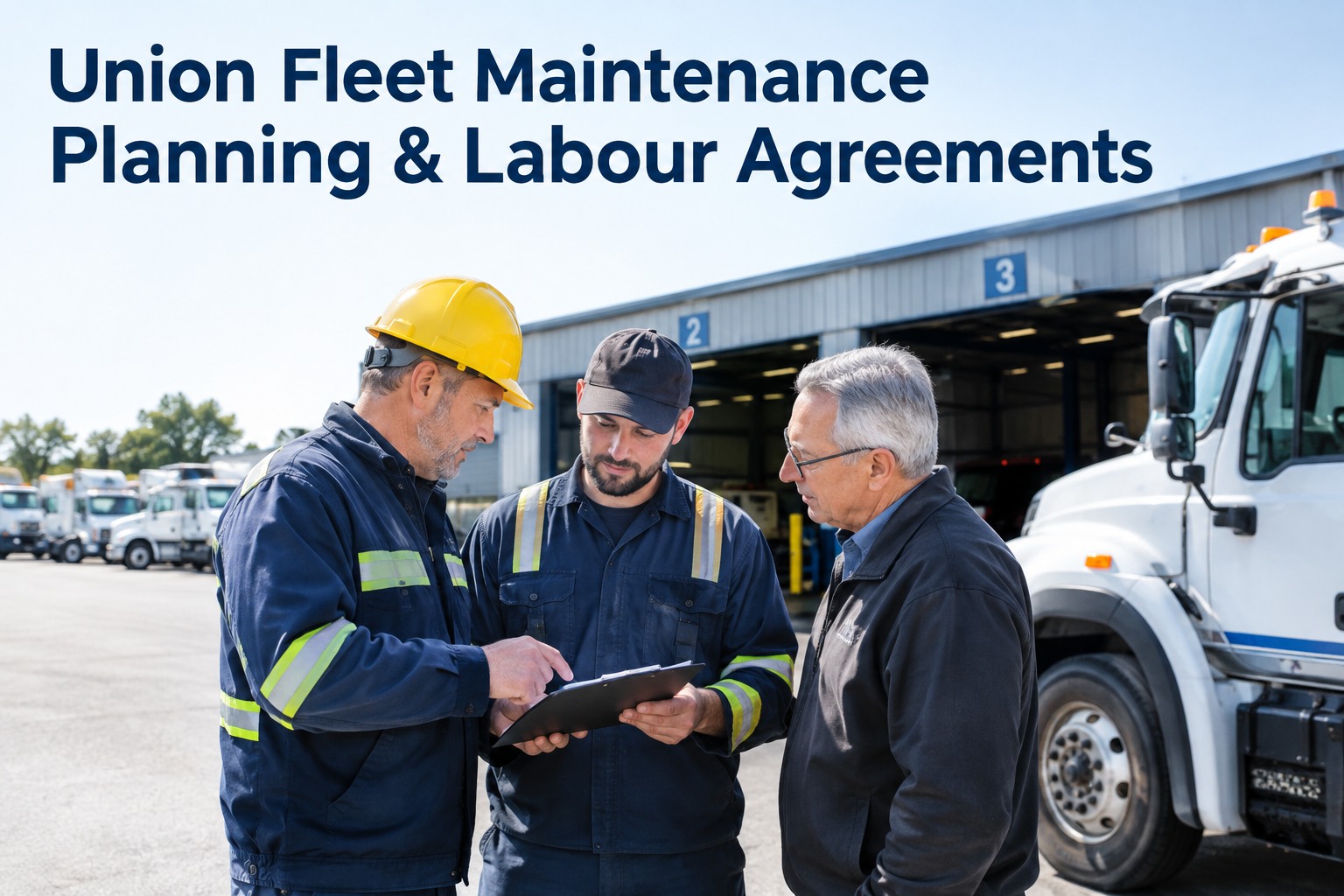
A transmission fails on a Friday afternoon. The nearest available hand is a driver-mechanic one classification short of the repair, and the steward is on the phone before the hood's even up. The truck sits until Monday, not because nobody could fix it, but because nobody who could fix it was allowed to. Union fleet maintenance planning isn't a paperwork problem — it's the difference between a schedule that survives contact with the agreement and one that breaks the first time reality doesn't match the org chart. Book a demo to see how a documented work-assignment trail keeps that Friday from becoming a Monday problem.
What a Collective Agreement Actually Controls in Fleet Maintenance
Every agreement is different, and the specifics always come down to the actual contract language your agency signed — this isn't legal advice, and any real decision should go through your labor relations office. But across most public-sector maintenance agreements, the same six areas show up, and each one directly shapes what a fleet manager can actually schedule.
Technician Classification
Defines what a Mechanic I, II, or Master Tech is licensed to touch. Assigning brake work to someone classified below that line is one of the fastest routes to a grievance.
Work Assignment Rules
Often ties specific tasks to seniority or shift bidding — meaning "whoever's free" isn't always who's allowed to take the job.
Overtime & Callouts
Usually spells out minimum call-in hours, rotation order, and rest-period requirements between an emergency callout and the next scheduled shift.
Outsourcing / Contracting Out
Frequently requires advance notice or consultation with the union before sending work to an outside shop — skipping that step is a common source of arbitration.
Emergency & Storm Response
May carry separate rules from day-to-day work, since storm and disaster response often changes who's on the clock and how they're paid.
Training & Progression
Ties pay grade advancement to completed training hours — an obligation that, done right, becomes a built-in workforce development plan.
Classification Rules: Who's Actually Allowed to Touch the Truck
The scenario at the top of this page plays out in some form in almost every unionized shop: the technician standing closest to a broken vehicle isn't automatically the one cleared to fix it. Classification lines exist to protect training standards and pay structures, but they also mean a fleet manager can't treat technician capacity as one interchangeable pool. A Mechanic I sent to do Mechanic II-level diagnostic work — even with good intentions, even to keep a vehicle moving — can trigger a grievance that costs more in labor relations time than the repair itself would have.
The practical fix isn't fighting the classification system; it's planning around it. That means knowing, before the breakdown happens, which technicians on shift are actually cleared for which repair categories — not guessing based on who's standing nearest the bay.
Outsourcing and Contracting-Out Clauses
Sending an overflow repair to a private shop feels like a simple capacity decision — until the agreement says otherwise. Many public-sector maintenance contracts include a contracting-out clause requiring notice to the union, a consultation period, or a demonstration that in-house capacity genuinely couldn't handle the work, before that vehicle goes to an outside vendor. Skip that step and the union can grieve the decision itself, regardless of how reasonable it looked from the shop floor. Book a demo to see how in-house capacity and workload get documented automatically, before an outsourcing decision is even made.
A contracting-out grievance rarely stops at the one vehicle in question — it can freeze future outsourcing decisions across the whole department while it's litigated. A documented record of in-house capacity and workload at the time of the decision is usually what settles the question quickly instead of expensively.
Overtime, Callouts & the Real Cost of After-Hours Repair
Emergency maintenance almost never happens on a convenient shift. A snowplow that fails mid-storm, a transit bus that breaks down on a Sunday route — these trigger callout provisions that are frequently the most expensive labor line in a fleet's maintenance budget, and the least visible one until the invoice lands. Rotation rules determine who gets called first; minimum call-in hours mean a 45-minute fix can still bill four hours; and mandatory rest periods after a night callout can quietly shrink the next day's available labor pool.
None of that is a reason to avoid emergency response planning — it's a reason to build the rotation, the minimums, and the rest-period math into the plan itself, instead of discovering the true cost of a storm callout three pay periods later when finance asks why maintenance labor spiked. Book a demo to see callout and overtime hours broken out as their own line, not buried inside general labor cost.
Training & Progression: The Clause That Can Work in Your Favor
Most agreements tie pay-grade advancement to a defined set of completed training hours or certifications. Fleet directors sometimes treat this as pure compliance overhead, but it's also the most direct lever available for closing a technician shortage the agency didn't create and can't outbid its way out of. A documented, trackable path from Mechanic I to Master Tech — one that shows exactly which hours and certifications each technician has already banked — turns a contractual obligation into an actual pipeline for the workforce a fleet is going to need in three years regardless of hiring budget. Sign up for a free trial to start tracking that training pipeline against your own roster today.
From a Public Works Director Who Rewrote the Planning Process
We used to build the maintenance schedule like technician hours were an unlimited resource, then get surprised every time a callout or a classification issue blew a hole in it. The turning point was pulling six months of actual work assignment records and finally seeing which repairs were consistently going to overtime versus which ones could be planned into a normal shift.
Now when the union and I sit down for the next contract talk, I'm not guessing about how often we've used callouts or contracted out work — I've got the record. That alone has shortened two labor discussions from weeks to a single meeting.
Building a Maintenance Plan Around the Agreement, Not Around Guesswork
-
1
Map every technician to their actual classification
Not their job title — the specific repair categories the agreement actually clears them to perform.
-
2
Log every work assignment and completion against that classification
So a grievance question gets answered with a record instead of a recollection weeks later.
-
3
Track overtime, callouts, and outsourcing as their own cost category
Instead of letting them blend into a general "maintenance labor" line where the real driver of cost stays invisible.
-
4
Bring the documented history to every contract and budget conversation
A labor discussion grounded in actual work-assignment and cost data moves faster than one built on impressions from both sides of the table.
None of this changes what the agreement says. It changes whether the fleet is planning against that agreement on purpose, or discovering its terms one grievance at a time. If your maintenance cost reporting can't currently separate overtime, callout, and outsourcing costs from routine labor, that's usually the first gap worth closing.
Conclusion: Union Fleet Maintenance Planning Works Best on a Documented Record
Every agreement is unique, and the specific rules on classification, overtime, callouts, and outsourcing always come down to the language your agency actually signed — treat this as a starting framework, not a substitute for your labor relations office. What holds true across nearly every public fleet, though, is this: union fleet maintenance planning built on guesswork about who's available and what work is allowed eventually collides with the contract, usually at the worst possible moment. Planning built on a documented history of work assignments, completions, and costs doesn't just avoid that collision — it walks into the next contract negotiation, budget review, or grievance hearing already holding the answer. Book a demo to see what that documented record looks like against your own fleet's work history.
Frequently Asked Questions
How do union agreements affect fleet maintenance scheduling?
Collective bargaining agreements commonly govern technician classification, work assignment rules, overtime and callout procedures, and outsourcing conditions in public fleet maintenance shops. This means a fleet manager cannot treat technician capacity as a single interchangeable pool — specific repairs may need to be assigned based on classification or seniority rules defined in the applicable agreement, and schedules built without accounting for these rules are more likely to trigger disputes or unplanned delays.
Can a fleet manager assign a repair to a technician outside their classification?
Generally, this creates significant risk of a grievance. Most collective agreements define specific technician classifications tied to particular types of repair work, and assigning tasks outside those boundaries — even temporarily, even to keep a vehicle in service — can violate the agreement's work assignment provisions. The specific rules and any exceptions depend entirely on the applicable agreement and should be confirmed with labor relations before an assignment is made outside normal classification lines.
What is a contracting-out clause and how does it affect outsourcing decisions?
A contracting-out (or subcontracting) clause typically requires an employer to provide notice to the union, and sometimes a consultation period, before sending bargaining-unit work to an outside vendor. In public fleet maintenance, this means a decision to outsource a repair — even for capacity or speed reasons — may need to follow a specific process rather than being made unilaterally. Failing to follow that process is a common source of grievances and arbitration in unionized maintenance shops.
How do overtime and callout rules affect fleet maintenance costs?
Callout provisions in many agreements include minimum call-in hours (meaning a technician called in may be paid a guaranteed minimum regardless of how long the actual repair takes), defined rotation order for who is called first, and mandatory rest periods afterward. These provisions can make after-hours and emergency maintenance significantly more expensive than routine daytime work, and can also reduce technician availability the following shift due to rest-period requirements — both of which should be factored into maintenance budgeting and emergency response planning.
Why is documentation important for union fleet maintenance planning?
Documented work assignments, completion records, labor hours, and maintenance costs give fleet leaders an objective record to reference during grievances, arbitration, contract negotiations, and budget discussions. Instead of relying on recollection about how often overtime, callouts, or outsourcing were used, a documented history allows fleet directors and labor relations teams to make faster, better-supported decisions and reduces disputes rooted in incomplete or inconsistent information.
Track fleet work and costs without the guesswork
HVI documents every work assignment, completion, technician activity, and cost against the vehicle and the classification it required — giving fleet directors, finance officers, and labor relations teams a shared, defensible record for planning, budgeting, and grievance response.
No credit card · Cost reporting by technician and vehicle · Live in under two weeks