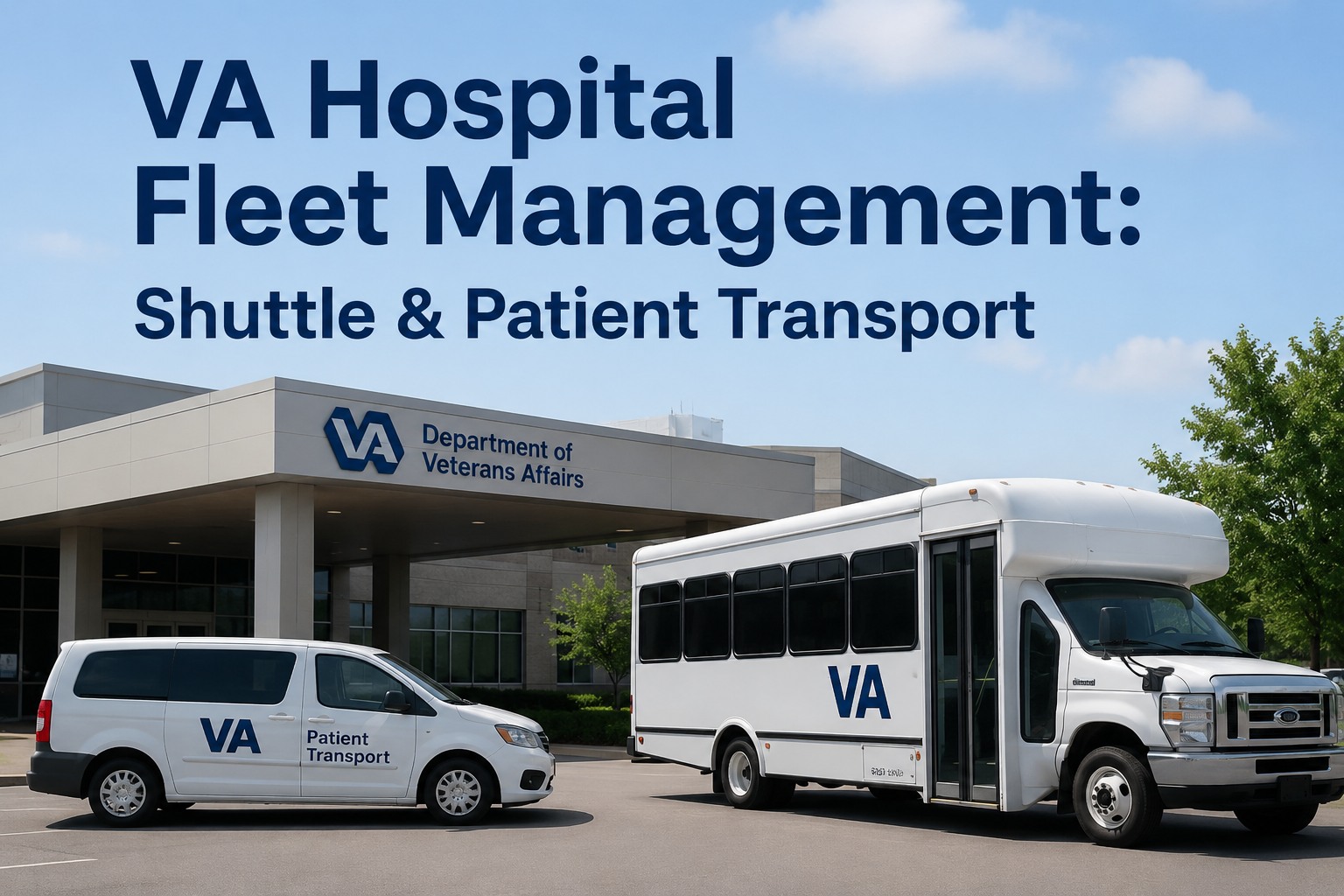
It is 6:40 a.m. and your first patient shuttle of the day is sitting at the curb with a wheelchair lift that will not cycle. The driver texted a photo to three different people, the lift contractor cannot come until Thursday, and the veterans who booked rides to their cardiology appointments are already waiting in the lobby. If you run a VA hospital fleet, this morning is not hypothetical — it is a Tuesday. A VA medical center fleet is a strange mix: patient shuttles, non-emergency medical transport vans, courier and supply vehicles, sometimes a handful of sedans and a gator or two for the grounds crew. Every one of them carries a compliance burden that a typical commercial fleet never sees, because you are answering to VA transportation policy and Joint Commission environment-of-care standards at the same time. Most shops are still stitching that together with paper checklists, a shared spreadsheet, and a group chat. There is a cleaner way to run it, and you can see it running on your own shuttle and transport units in a 30-minute demo before your next morning muster.
One fleet, three missions, two sets of auditors — is your paperwork keeping up?
Patient shuttles, non-emergency transport vans and supply vehicles all live under VA transportation policy and Joint Commission LS.01.02.01 vehicle safety expectations. HVI puts every inspection, PM and work order for all of them in one audit-ready system.
The real price of running a VA shuttle fleet on paper
None of these numbers are exotic. They are the quiet leaks that show up in every medical center fleet office that still runs on clipboards and texted photos.
VA hospital fleet requirements, mapped to the records you actually need
Joint Commission LS.01.02.01 expects the organization to manage safety risks in the environment of care — and patient transport vehicles sit squarely inside that scope. VA transportation policy adds its own layer for government-owned vehicles. Here is what surveyors and auditors ask for, and what a digital system hands them.
| Requirement area | What they ask to see | Paper reality | With HVI |
|---|---|---|---|
| Daily vehicle safety checks | Completed pre-trip inspections for every shuttle and transport van in service | Clipboards in the van, half the sheets missing signatures | Timestamped mobile DVIR with photos, driver ID and GPS stamp |
| Wheelchair lift & securement PM | Documented preventive maintenance on lifts, ramps, restraints and tie-downs | A contractor's invoice folder, no link to the vehicle | PM schedule per unit with due/overdue alerts and attached service records |
| Defect correction | Proof that reported defects were repaired before the vehicle returned to service | Text messages and a hope that the shop remembers | Defect auto-converts to a work order; vehicle flagged until closed |
| Environment-of-care rounds | Vehicle safety included in EOC tours and committee reporting | Manually compiled spreadsheet the night before the meeting | One-click compliance report filtered by vehicle class or date range |
| Operator & assignment records | Who drove what, and whether that vehicle was fit for patient transport | A sign-out sheet in a drawer | Driver-linked inspections and assignment history per asset |
How a VA medical shuttle day runs on HVI, step by step
This is the same 6:40 a.m. scene, run through a digital workflow instead of a group chat. Total added driver time: about four minutes.
Driver walks the shuttle with a phone, not a clipboard
The pre-trip checklist for that exact vehicle class loads on any phone — lights, tires, lift cycle, securement straps, interior cleanliness, fluid leaks. A failed item requires a photo before the form can be submitted.
The lift defect becomes a work order in seconds
The failed lift check auto-generates a work order, assigns it to the shop or flags it for the lift contractor, and marks the unit out of service so dispatch cannot schedule it. No forwarding, no telephone game.
Dispatch swaps the unit before the first pickup
The spare van — already inspected and green on the dashboard — takes the route. The veterans make their cardiology appointments. The broken unit waits for repair instead of carrying passengers.
The record files itself
Inspection, defect, work order, parts used, contractor invoice and return-to-service sign-off all live on that vehicle's timeline. When the EOC committee or a surveyor asks, you pull it in one search — or book a walkthrough and watch that search happen live.
Where a VA patient transport fleet actually spends its maintenance hours
Ask any medical center garage supervisor and the split is remarkably consistent: the patient-facing equipment eats the schedule, not the drivetrain.
The takeaway: if your PM program treats a shuttle bus like a cargo van, you are under-servicing the 40% of work that carries the most patient risk. HVI lets you build different inspection templates and PM intervals per vehicle class — shuttle, transport van, supply — inside the same account. You can start building those templates free and clone them across every unit.
See your own shuttle fleet on the HVI dashboard
Bring one vehicle list to a 30-minute demo and we will show you the inspections, PM schedules and audit reports on your actual mix of shuttles and transport vans.
Built for fleets that answer to two auditors at once
HVI is a cloud plus mobile vehicle inspection and maintenance work order CMMS. For a VA hospital fleet, four capabilities do the heavy lifting.
Class-specific digital inspections
Shuttle, transport van and supply vehicle templates with required photos on critical items like lifts and securement. Outcome: every daily check is complete, timestamped and retrievable — no more missing sheets when LS.01.02.01 comes up on a survey.
Defect-to-work-order automation
A failed inspection item opens a work order automatically and flags the unit out of service. Outcome: the 2–4 hour text-message lag disappears, and no vehicle carries patients with an open safety defect.
PM scheduling by date, mileage or hours
Lift servicing every 90 days, brake inspections by mileage, annual safety checks by date — all with due and overdue alerts per unit. Outcome: the one missed PM that creates a survey finding stops being possible.
Audit-ready reporting in one search
Filter by vehicle, class, date range or defect type and export for the EOC committee, a VA auditor or a Joint Commission surveyor. Outcome: the night-before spreadsheet scramble becomes a two-minute report pull — see a live compliance report in a demo.
What one avoided out-of-service morning is worth
Take a medical center running 12 patient transport vans. Say a missed lift PM leads to one van failing during a loaded run once a quarter — a realistic scenario, not a scare story.
Multiply by four quarters and you are looking at $6,000+ a year in avoidable cost for one van class — before you count the patient-safety exposure or the survey finding if an auditor connects the missed PM to the incident. A PM alert that fires 14 days before the lift service is due costs nothing once the schedule is set. That is the math that makes setting up your first PM schedules free an easy decision.
Running a VA hospital fleet without the paper chase
- Your fleet is three fleets. Shuttles, non-emergency transport vans and supply vehicles need different checklists and PM intervals — one generic form underserves the patient-facing units.
- LS.01.02.01 makes vehicles an environment-of-care issue. Surveyors can ask for vehicle safety records the same way they ask for fire drills; timestamped digital records end that conversation in minutes.
- The lift is the liability. Roughly 40% of maintenance hours on a patient transport fleet go to lifts, ramps and securement — schedule them like the patient-safety equipment they are.
- Defects must route themselves. A defect reported by text is a defect waiting to be forgotten; defect-to-work-order automation closes the loop before the vehicle rolls.
- The fix is not a bigger binder. A VA hospital fleet running on a CMMS gets the inspection, the repair, the part and the proof in one timeline per vehicle — and you can walk through it on your own units before spending a dollar.
I used to keep a manila folder for every van and pray nobody asked for more than one at a time. The thing I track now is overdue PMs on lift-equipped units — that number has to be zero, every Monday, no exceptions. Last survey, the team asked for six months of vehicle checks and I sent the report before they finished the sentence. That never happened with the folders.
Daniel Reyes — Fleet & Transportation Manager, regional veterans' healthcare network
VA hospital fleet management, answered
Does Joint Commission LS.01.02.01 really apply to patient transport vehicles?
Yes — LS.01.02.01 requires the organization to identify and manage safety risks in the environment of care, and vehicles used to move patients fall inside that scope. Surveyors can ask how you inspect vehicles, how defects get corrected, and how you document preventive maintenance on patient-carrying equipment like wheelchair lifts. Timestamped digital inspection and PM records answer all three in one search.
We run shuttles, transport vans and supply vehicles. Do we need separate systems?
No — you need separate templates, not separate systems. HVI lets you build a different inspection checklist and PM schedule for each vehicle class while keeping every unit in one account and one report. Dispatch sees one dashboard; the shop sees one work order queue; auditors see one record set. You can book a demo and see a mixed-fleet setup on screen.
How do drivers handle digital inspections if they are not tech-savvy?
The checklist loads on any phone or tablet as big tap targets — pass, fail, photo. Most drivers finish a full pre-trip in under five minutes with no training beyond a two-minute walkthrough. Failed items force a photo, which actually makes the driver's job easier: no writing descriptions, no chasing the shop.
Can HVI track contractor-serviced equipment like wheelchair lifts?
Yes. You schedule the lift PM per unit, get due and overdue alerts, and when the contractor completes the work the invoice and service notes attach to that vehicle's work order and timeline. The PM interval resets automatically, so the next service is already on the calendar — no separate spreadsheet for vendor work.
What does it cost to try this on our fleet?
Nothing to start. You can sign up free, load a handful of vehicles and run real inspections the same day. If you want it configured around your routes, vehicle classes and reporting needs first, a 30-minute demo with your own unit list is the faster path.
Your next survey will ask for vehicle records. Have them in one search.
Move your shuttle, transport and supply fleet off clipboards and group chats into one audit-ready CMMS — inspections, PMs, work orders and reports included.
Free to start — Works on any phone — No card needed