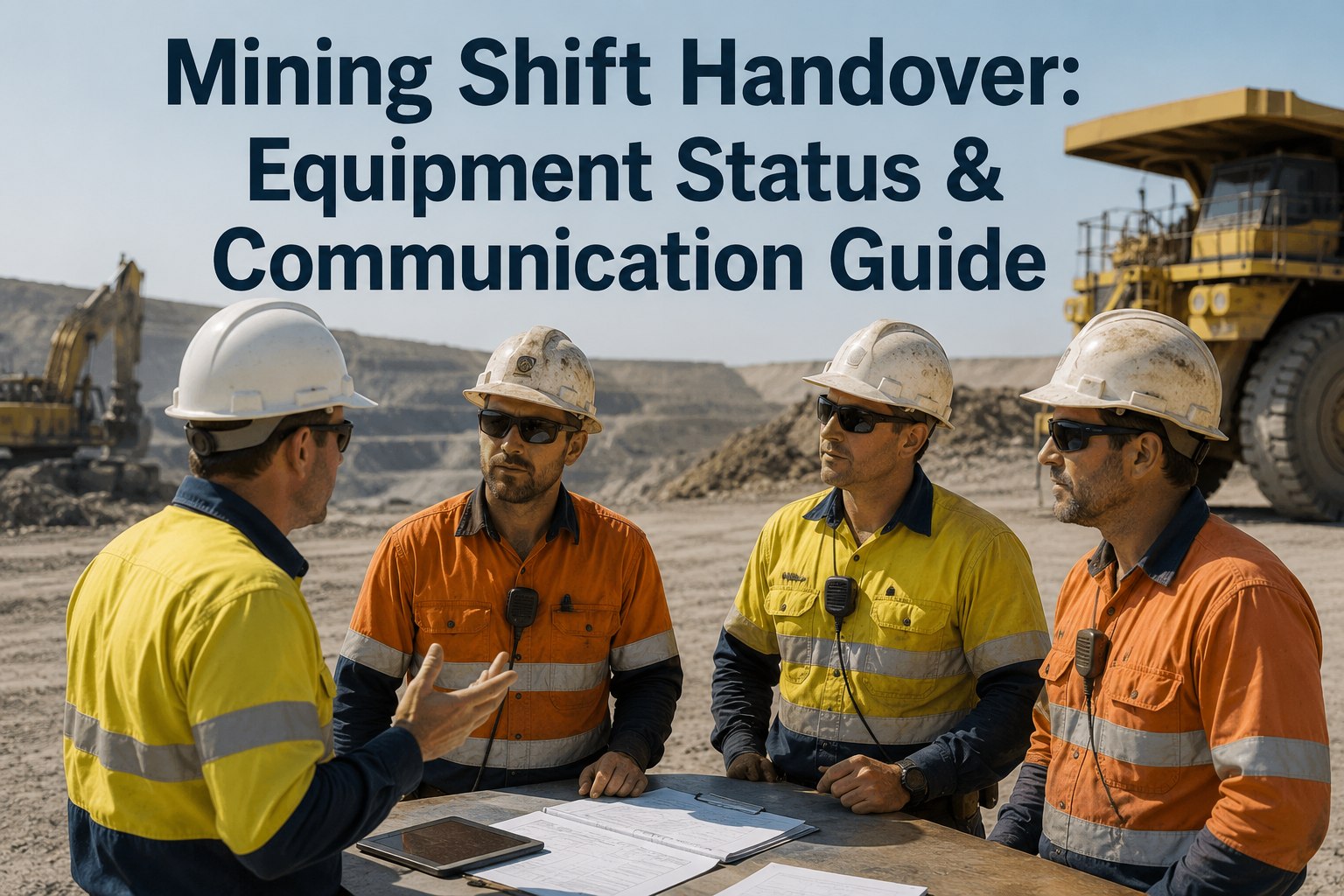
Mining performance drops 20–40% during the last hour of the off-going shift and the first hour of the oncoming shift. That "handover valley" is where equipment defects get lost, work-in-progress gets restarted, and the incoming crew inherits an operating picture built from what the outgoing crew remembered to say out loud. A structured mining shift handover fixes it — combining verbal briefing, digital equipment records that persist beyond one shift, and independent pre-shift verification by the incoming operator. Book a demo to see the persistent record.
The Same Equipment. Two Handovers. Two Different Days.
What actually transfers between crews depends entirely on whether the information exists somewhere other than one operator's head.
- ×"Bucket vibration — probably fine"
- ×Grease leak forgotten in the rush
- ×WO number lost between crews
- ×Parts pending order — nobody said
- ×Prior shift's operator gone home
- ✓Defect logged with photo timestamp
- ✓Open WO visible on the asset record
- ✓Parts status queryable in one tap
- ✓Pre-shift confirms all still valid
- ✓Every shift builds the history
Verbal handovers fail predictably under time pressure — not because operators are careless, but because human memory of 40 assets, 12 open defects, 6 work orders, and 3 area hazards over a 12-hour shift is not a reliable transfer medium. The fix isn't more discipline in the verbal briefing; it's making sure every piece of information that matters exists somewhere the incoming crew can query directly from their own device. Verbal + digital + independent verification is the three-layer model. Remove any layer and blind spots return.
What actually needs to transfer between shiftsThe 7 categories every mining shift handover must cover
Every mining site has its own handover form, but the categories below appear in almost every credible template — from Golding SWC production supervisor handovers to CVM mine services work-area inspections to standard 24/7 continuous operations protocols. If any of the seven is missing from your handover, that's the category where incidents happen. Book a demo to see how equipment and defect handover categories are captured in HVI
Equipment status by unit ID
Every asset on the crew's roster with a current status: running / down / on hold / red-tagged. EX931, LDR06, HT27 — specific unit IDs, not "the loader."
Open defects & their state
Each open defect: what was flagged, when, by whom, current disposition (waiting on parts, awaiting inspection, on the shop schedule, safe to operate with restriction).
Equipment removed from service
Every unit tagged out or red-tagged: unit ID, reason, who tagged it, expected return-to-service. Never rely on visual tag alone — the digital record is the audit trail.
Work in progress
Shop work orders currently mid-repair, external contractor work active on-site, incomplete PMs. Includes work that will span across the shift boundary and require continuity.
Abnormal equipment conditions
Unusual noises, temperatures, fluid conditions, operator complaints that don't yet rise to a defect flag but need watching. The "keep an eye on this" list.
Operational & area hazards
New JSAs in place, area restrictions (blast zones, water on the bench, poor visibility zones), rope shovel cable positions, active LOTO isolations elsewhere on site.
Environmental & ground conditions
Weather forecast, ground conditions (freeze, thaw, mud, dust), lighting conditions for early night start, water levels in pits, road surface state.
Why verbal handover alone failsThree failure modes that show up in every incident review
Verbal handovers work fine on a slow shift with 8 assets and one open defect. On a real production shift with 40 assets across the roster, they fail in predictable ways — not because the outgoing supervisor didn't care, but because time pressure, fatigue, and the volume of information overwhelm what any human can accurately transfer in a 20-minute window.
Time pressure compression
The off-going crew wants to leave. The oncoming crew wants to get to work. Twenty minutes of scheduled handover becomes five minutes of "everything's fine, take the sheet." The defects that got skipped are the ones that surface at 09:30 as unplanned downtime.
Selective memory
The outgoing operator remembers the defect that annoyed them, forgets the one that got fixed mid-shift, and vaguely recalls the one they meant to report but didn't. Human memory prioritizes emotional salience over operational significance — which is exactly the wrong ranking for maintenance handover.
Personnel turnover
The operator who found the defect on Tuesday night is on days off Wednesday. The Wednesday-night operator on that unit has never seen the machine. Whatever information wasn't written down is now gone — and reconstructing it takes longer than doing the original inspection would have.
The failure modes above are structural, not disciplinary — which means they need a structural fix, not a "try harder" fix. Book a demo to see how per-asset records close each of these gaps automatically
The incoming pre-shift is verification, not informationWhy the operator's own inspection matters even after a good handover
A common mistake in mining operations is treating the pre-shift inspection as redundant when the handover was thorough. It's not redundant — it serves a different purpose. The handover transfers information the incoming crew wouldn't otherwise have. The pre-shift verifies that information against current asset state, and catches anything that changed between the handover briefing and the incoming operator taking the keys. Both are required for defensible operations.
Independent verification of handover claims
The outgoing crew said "brakes fine, service done at 04:00." The pre-shift confirms it directly. Trust and verify — not because the outgoing crew is dishonest, but because equipment state can change between the handover and the pre-shift.
New defect capture window
Overnight the machine may have developed a small hydraulic weep, a tire cut from the last pass, or an air leak. Pre-shift is the operator's first look at their specific unit with fresh eyes — defects too small to raise during operation often stand out during a walk-around.
Operator ownership & accountability
The pre-shift signature ties the incoming operator to the equipment's condition at start-of-shift. Any defect not flagged then that surfaces mid-shift is much harder to attribute to prior crew — which drives real operator engagement with the walk-around instead of a signature ritual.
Feeds the next handover
The pre-shift record is the first data point on the current shift's asset log. What the incoming operator flags at 07:15 is what the outgoing operator will hand over at 19:15. The chain only stays intact if every crew adds to it.
Building a consistent shift handover checklistThe structure that survives real operational pressure
A shift handover checklist that actually gets completed during shift changes has three characteristics: it fits on a phone screen, it maps to the assets on that crew's roster, and it produces a record the next crew can read without asking questions. Below is the practical structure most mining operations converge on after abandoning the multi-page paper form. Start a free trial to configure this structure against your own asset list.
Header: shift, date, crew, area, sign-off placeholders
Off-going supervisor name + on-coming supervisor name at the top. Both must sign at handover close — digital signatures are timestamped automatically.
Asset roster with current status per unit
Every unit on the crew's operating list with a single status: running / down / hold / red-tag. Not free-text — enforced dropdown so trending is possible.
Open defects section — pulled live from HVI, not re-typed
Every open defect on the roster's assets shown automatically, with severity, WO number, and current disposition. No manual re-entry means no transcription errors.
Work in progress + parts status
Active work orders, pending parts orders, external contractor work on-site. What's being done, who's doing it, expected duration.
Hazards, JSAs, area conditions
Active JSAs, area restrictions, LOTO isolations, cable positions, ground/weather conditions. Enforced fields so nothing gets skipped under time pressure.
Free-text notes for anything not covered above
The catch-all. Kept last so operators don't skip the structured sections to jump straight to it. Free-text is for context, not primary data.
Dual sign-off before handover is complete
Off-going + on-coming supervisor both sign digitally. Handover is not closed until both signatures are captured — and both parties have queryable access to the record afterward.
From a mine supervisor after rebuilding their handover process
We had a haul truck flagged for brake vibration on Tuesday night shift. Operator mentioned it verbally, meant to write it up, ran out of time. Wednesday day-shift operator ran the truck for 4 hours before the same vibration surfaced — and by then it was worse. We ended up pulling the truck for a same-shift brake service. That's 6 hours of production for a defect that should have gone straight to the shop overnight.
After that we went to digital pre-shift with photo evidence tied to the specific unit. Every defect logged goes on the asset record and is visible to the next crew before they even hit the yard. The night-to-day handover on that same truck a month later — new brake noise flagged at 22:00, WO fired to the shop by 22:15, service scheduled during meal break, back in production at 03:00. Same defect, different handover, six hours of production saved. Multiply that across a fleet and it's real money.
Frequently asked questions
Why isn't a thorough verbal handover enough for mining operations?
Because verbal handovers fail under real operational conditions in ways the outgoing crew cannot see. Time pressure compresses the briefing, selective memory prioritizes emotionally salient defects over operationally significant ones, and personnel turnover means the person who found a defect on Tuesday night may not be back for three days — and their knowledge leaves the site with them. Industry research indicates that mining operations experience 20–40% performance drops during the last hour of the off-going shift and the first hour of the oncoming shift, which is measurable evidence of information not transferring cleanly. Verbal briefings work fine on quiet shifts with few assets and few defects. They fail predictably on real production shifts. The fix is not more discipline in the verbal briefing — it's making sure every piece of information that matters exists in a digital record the incoming crew can query directly, with the verbal briefing focused on interpretation and priority-setting rather than raw data transfer.
What are the essential categories every mining shift handover should cover?
The seven categories that appear across virtually every credible mining handover template: equipment status by specific unit ID (running / down / hold / red-tagged); open defects with current disposition (waiting on parts, on the shop schedule, safe to operate with restriction); equipment removed from service with reason and expected return; work in progress including shop work orders, contractor work, and incomplete PMs; abnormal equipment conditions not yet at defect threshold (the "keep an eye on this" list); operational and area hazards including JSAs, LOTO isolations, and cable positions; environmental and ground conditions including weather, road state, and visibility. Some sites add specific categories for their operations (blast schedules, dewatering status, geological conditions), but if any of the seven above is missing, that's the category where handover-related incidents happen.
Should the incoming operator still do a pre-shift inspection if the handover was thorough?
Yes — the pre-shift serves a different purpose than the handover and cannot replace it. The handover transfers information the incoming operator wouldn't otherwise have (defects from the prior shift, work in progress, area hazards). The pre-shift verifies that information against current equipment state, catches anything that changed between the handover briefing and the operator taking the keys, and provides operator ownership of the equipment's condition at start-of-shift. Under most jurisdictions the pre-shift is also a regulatory requirement — MSHA 30 CFR 56.14100 requires pre-operational examination of self-propelled mobile equipment before it is placed in operation each shift, and this is not waivable based on a good handover. Treat the two as complementary: the handover is the briefing, the pre-shift is the verification. Both are required for defensible operations.
How do we prevent defects from staying trapped with one crew?
Structural workflow, not process discipline. When a defect is logged on the pre-shift or during operation, it must land in a persistent per-asset record that any crew can query — not in an operator's personal notebook or a paper form that lives on the outgoing supervisor's clipboard. The most reliable pattern: every defect flagged goes onto the asset's inspection history in the CMMS immediately, generates a work order visible to maintenance, and remains open until closed by qualified personnel per site procedures. In HVI this means the defect logged at 02:00 on night shift is visible on the asset record when the day crew queries the same unit at 07:15 — without depending on any human relay. The night operator can go home; the information stays. This is what "persistent record beyond one shift" actually means in practice.
Does HVI automatically prevent equipment dispatch if there are open critical defects?
No. HVI does not enforce tag-out and does not automatically prevent equipment dispatch based on defect status. Equipment dispatch decisions, red-tag enforcement, and operational hold procedures remain with the mine operator's own safety program and procedures. What HVI does support is the documentation layer around those decisions: per-asset inspection history that shows every open defect with its severity, work orders visible on the asset record, and full maintenance history queryable by any authorized user. When a mine supervisor or dispatch operator reviews the record before releasing equipment, they see the current defect picture in one view — but the actual go/no-go decision is a human decision anchored in the site's safety program, not an automated platform action. This separation is deliberate: dispatch decisions have too much operational and safety context for a CMMS to automate without risk of the wrong outcome in an edge case.
Make shift handover a persistent record, not a fading conversation
HVI supports per-asset inspection history, digital inspection records with photo evidence, defect documentation tied to specific unit IDs, maintenance work orders visible across shifts, and equipment records that stay queryable long after the operator who logged them has gone home. The verbal briefing focuses on interpretation and priority. The digital record carries the data. Both crews see the same picture.
No credit card · No hardware · Shift handover records ready on day one