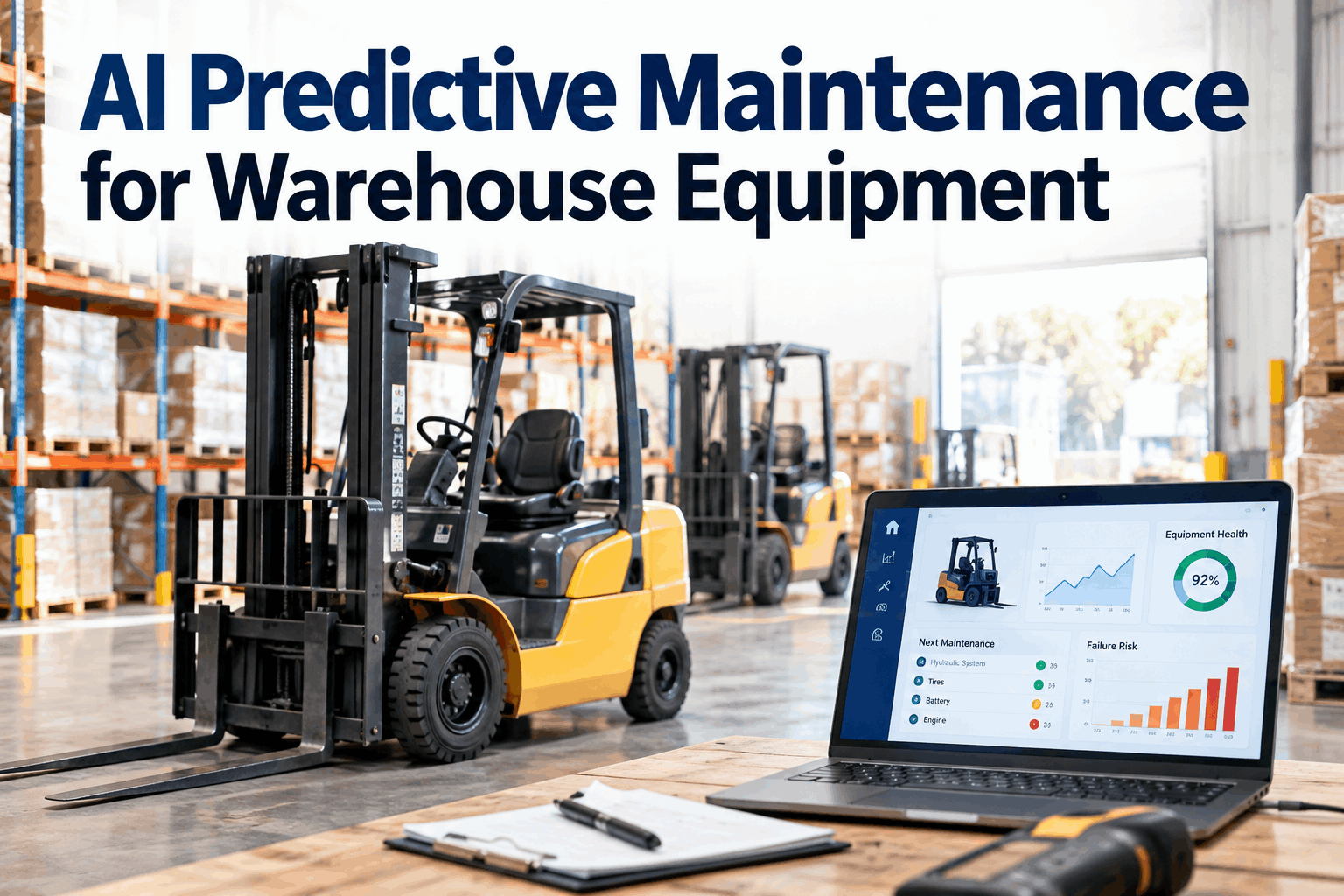
AI predictive maintenance for warehouse equipment is sold as an algorithm, but it lives or dies on something far less glamorous: your data. A model can only forecast a forklift's hydraulic failure if it has been fed clean maintenance history, telematics, and consistent fault codes to learn from. Feed it a shoebox of paper work orders and half-logged breakdowns and it predicts nothing. The honest truth is that AI predictive maintenance is a data problem before it's an AI problem. Book a demo to see the data foundation that makes prediction possible.
AI predictive maintenance runs on four data inputs
A prediction is only as good as what feeds it. Clean maintenance history, telematics, fault codes, and asset data are the fuel — get those right and AI can flag a failing forklift before it drops a load, not after.
Every vendor pitch leads with the model — the neural network, the anomaly detection, the dashboard that lights up before a forklift fails. What they skip is the part that decides whether any of it works: the data underneath. AI predictive maintenance learns the signature of a failure from history, so if your history is thin, scattered, or inconsistent, the model has nothing to learn from. This guide is about the unglamorous foundation — the four data inputs AI needs, whether your warehouse is ready to feed them, and what prediction actually delivers once it is.
It's a data problem before it's an AI problemwhy most predictive projects stall
The reason AI predictive maintenance projects underdeliver is rarely the algorithm — it's what's fed into it. A model trained on gaps and guesses produces predictions you can't trust, and a prediction you can't trust gets ignored.
- Paper work orders and half-logged repairs
- Fault codes cleared but never recorded
- Usage hours estimated, not measured
- Assets tracked inconsistently across sites
- Structured digital history per asset
- Fault codes captured and tagged to the unit
- Real telematics hours and load data
- One consistent asset record fleet-wide
The model is the easy part — plenty of good ones exist. The hard part, and the part that determines success, is arriving with data worth learning from. Book a demo to see what predictive-ready warehouse data looks like.
The four inputs AI predictive maintenance needswhat each one contributes to the forecast
Predictive maintenance for warehouse equipment draws on four data streams. Each answers a different question about a forklift's health, and a gap in any one weakens the whole prediction.
Clean maintenance history
The record of what failed, when, and what fixed it — per asset, digitally, over time. This is the training data: AI learns a failure's fingerprint from past ones. Paper and memory can't be learned from.
Feeds: the failure patternsTelematics & usage
Real run hours, load cycles, impacts, and duty from the truck itself — not an estimate. A forklift's true workload is the strongest signal of how fast its components are wearing toward failure.
Feeds: the wear rateFault codes
The truck's own diagnostic trouble codes, captured and kept — not cleared and forgotten. Codes are early symptoms; a pattern of intermittent faults often precedes the hard failure by days or weeks.
Feeds: the early symptomsStandardized asset data
Make, model, age, configuration, and battery type — consistent across the fleet. It lets the model compare like with like, so a pattern learned on one truck applies correctly to its siblings, not to everything.
Feeds: the contextPut together, these four turn a forklift from a black box into a readable signal. Miss one and the model is guessing in that dimension. Start free and capture all four inputs on every truck.
Are you ready for it?the honest readiness check most skip
Before buying an AI predictive maintenance platform, the real question isn't which model — it's whether your warehouse produces data worth predicting from. Here's the gap between wanting prediction and being ready for it.
- Maintenance lives on paper or in people's heads
- No telematics, or data nobody uses
- Fault codes get cleared, not logged
- Every site records assets its own way
- Every asset has a clean digital service history
- Telematics and usage flow in automatically
- Fault codes are captured and tied to the unit
- One asset standard across the whole fleet
The good news: getting predictive-ready isn't an AI project — it's a data-discipline project, and it pays off on its own even before a model is added. Book a demo to see where your warehouse sits on the readiness curve.
What it actually predicts on a forkliftthe payoff once the data is flowing
Feed the four inputs and prediction stops being abstract. On warehouse equipment it targets the components that strand a truck mid-shift — the ones a fixed PM interval either catches too late or replaces too early.
Each of these turns an unplanned mid-shift breakdown into a planned fix on your schedule — which is the entire point of predictive over reactive. Start free and start building the history these predictions rely on.
The predictive-readiness checklistwhat each input needs before AI can use it
Readiness comes down to whether each of the four inputs is complete, consistent, and captured automatically. Use this as the honest self-check before any AI predictive maintenance evaluation.
| Data input | Ready when it's… | Not ready if… |
|---|---|---|
| Maintenance history | Digital, per-asset, going back months | On paper or in memory |
| Telematics & usage | Flowing in automatically, per unit | Estimated hours or none |
| Fault codes | Captured and tagged to the truck | Cleared without a record |
| Asset data | One standard across all sites | Every depot logs its own way |
| Integration | All four live in one connected system | Scattered across tools that don't talk |
If most rows land in the right column, you're ready to predict; if not, that's the work to do first — and it's worth doing regardless. Book a demo to run your fleet against this readiness checklist.
How HVI makes warehouse equipment predictive-ready
The gap in AI predictive maintenance for warehouse equipment is almost never the algorithm — it's arriving with data clean enough to trust. HVI is the system that produces that data, pairing preventive maintenance, telematics, and maintenance analytics into one connected record per asset.
Capture clean history
Every inspection, work order, and repair is logged digitally against the specific forklift — building the structured service history a model can actually learn from.
Pull telematics & codes
Real run hours, usage, and fault codes flow in from the trucks and integrations, tied to each asset — so wear and early symptoms are measured, not guessed.
Standardize & analyze
One asset standard fleet-wide, with analytics that surface trends today and hand a clean, complete dataset to any predictive model tomorrow.
It's the same foundation behind our warehouse MHE preventive maintenance guide and our work to reduce forklift downtime — the clean-data groundwork that any AI predictive maintenance program depends on, running on HVI's preventive maintenance and analytics tools.
We bought into a predictive platform expecting magic and got noise — because we fed it two years of patchy paper records and telematics nobody had ever reconciled. The model wasn't wrong; our data was. Half the alerts were for trucks we'd already fixed and never logged.
We stopped chasing the algorithm and fixed the inputs first — every repair logged against the asset, telematics and fault codes flowing in, one asset standard across all four warehouses. Within a couple of quarters the same kind of model was actually useful, because for the first time it had something clean to learn from. Predictive maintenance turned out to be a data project wearing an AI costume.
AI predictive maintenance FAQsthe questions warehouse teams ask most
What does AI predictive maintenance need to work on warehouse equipment?
Four data inputs: clean, per-asset maintenance history; telematics and real usage; captured fault codes; and standardized asset data. The model learns failure patterns from these, so a gap in any one weakens the prediction. AI predictive maintenance is a data problem before it's an algorithm problem.
Can you do predictive maintenance without good data?
Not reliably. A model trained on paper records, estimated hours, and unlogged fault codes produces predictions you can't trust — and untrusted alerts get ignored. The most valuable first step is getting the data clean and connected, which improves maintenance on its own, before adding any predictive layer.
What can AI predict on a forklift?
Once the data is flowing, it targets the components that strand a truck mid-shift: battery and charging decline, hydraulic and lift issues, brake and tire wear timed to real duty, and drive-motor or transmission strain. Each becomes a planned fix on your schedule instead of an unplanned breakdown.
Is HVI an AI predictive maintenance tool?
HVI is the data foundation predictive maintenance depends on. It captures clean maintenance history, pulls telematics and fault codes, and standardizes asset data — the structured, complete inputs any predictive model needs. Better data makes better forecasts, whoever builds the model on top.
How do I know if my warehouse is predictive-ready?
Check each input: is maintenance history digital and per-asset, is telematics flowing automatically, are fault codes captured and tagged, and is asset data consistent across sites? If most are yes, you're ready to predict. If not, that data-discipline work is the right first move — and it pays off regardless.
Get predictive-ready before you buy the prediction
Structure your warehouse maintenance history, pull telematics and fault codes, and standardize every asset — so your data is ready the day you turn AI predictive maintenance on, and your maintenance is better in the meantime. HVI builds the foundation the model runs on. Live for your fleet in days.
No credit card · start structuring your fleet data on day one