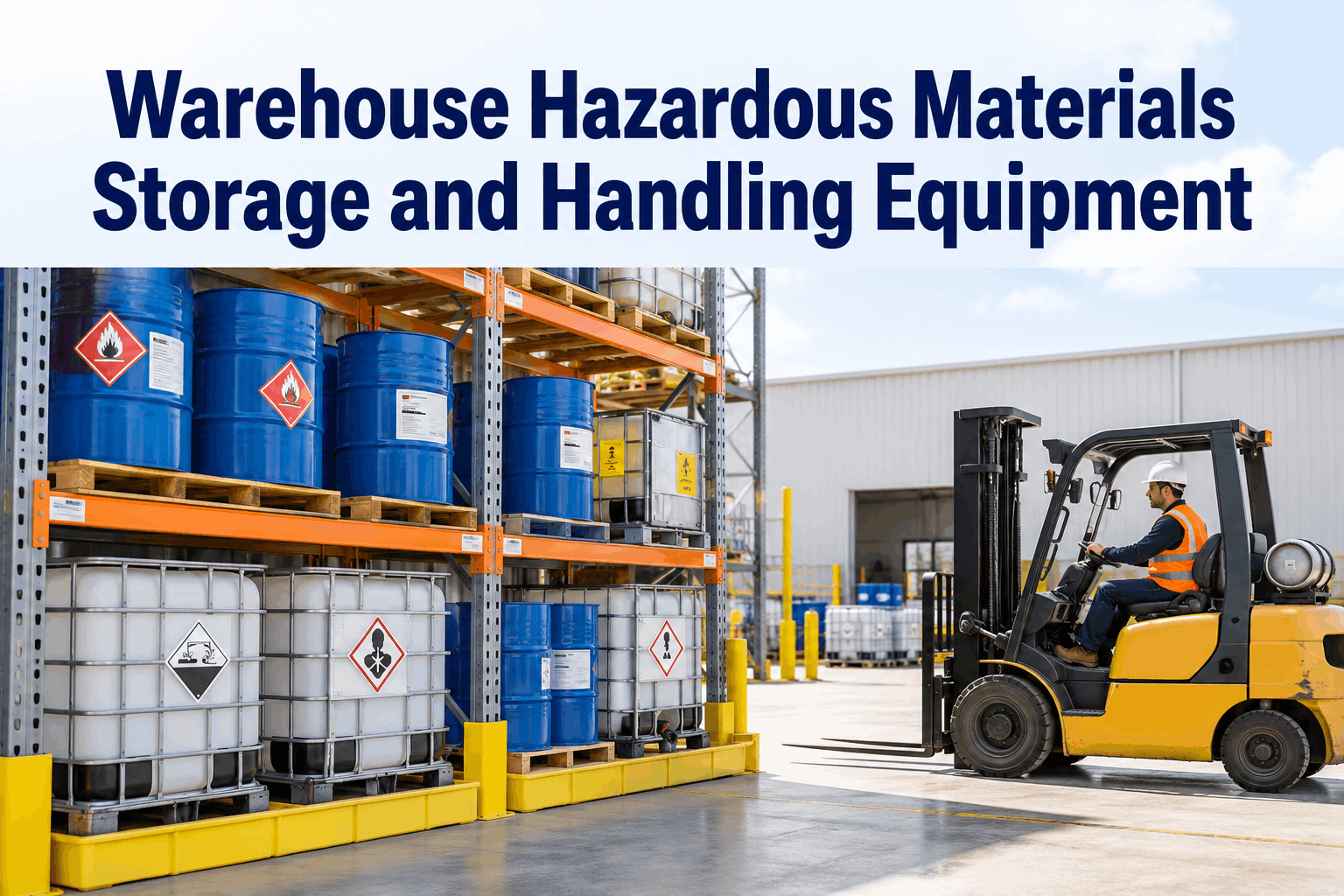
Hazardous materials storage comes down to two jobs done well: keep the wrong things apart, and catch whatever leaks. Put an oxidizer next to a flammable or an acid beside a base and you've built a reaction waiting for a cracked drum. Skip the secondary containment and one slow leak becomes a floor drain full of something that shouldn't be there. Everything else — labels, ventilation, the right forklift — supports those two jobs. Book a demo to see hazmat storage checks tracked in HVI.
Hazardous Materials Storage Is Mostly About Keeping Things Apart
Every chemical has neighbours it can't have. A segregation plan decides what sits next to what, containment decides what happens when one leaks, and inspection decides whether either is still true today. Get the first two right and most incidents never start.
- ·Compatible
- !Separate / review SDS
- ×Never store together
A chemical warehouse is one of the few places where the storage plan itself is a safety control. Where a drum sits, what's on the shelf below it, whether there's a bund under the rack — these aren't housekeeping, they're the difference between a contained spill and an evacuation. Good hazardous materials storage turns that plan into checks that confirm it's still holding.
5controls that make hazardous materials storage safe — and inspectable
Safe hazmat storage isn't one rule — it's five layers working together. Each answers a different question, and each can be checked. When one slips, the others buy you time; when two slip, incidents happen.
Incompatible chemicals kept apart by distance or a barrier — oxidizers from flammables, acids from bases, per the SDS and a compatibility chart.
Spill pallets, bunds and sealed, chemical-resistant floors so a leak is caught in a tray, not running toward a drain or another chemical.
Every container GHS-labelled, hazard class and location logged, and the SDS on hand for staff and first responders before anything is moved.
Vapours extracted below exposure limits, flammables in fire-rated rooms, and ignition sources controlled where static or sparks could set something off.
Explosion-proof or rated forklifts in flammable zones, non-sparking tools, and loads restrained so a drum doesn't fall and breach in the first place.
Each of these is a thing you can inspect and date — which is how a plan on paper becomes storage you can prove is safe. Book a demo to see all five controls on one inspection.
Segregation is the control that prevents the reactiona leak is a cleanup; two incompatible leaks meeting is an emergency
The single most important storage decision is what sits next to what. A spill on its own is a contained problem. The same spill reaching an incompatible chemical is fire, toxic gas or a violent reaction — so segregation is the control that stops a small event becoming a big one.
An oxidizer feeds a fire anything flammable starts — keep them in separate areas, never the same rack.
Mix and they react violently, generating heat and sometimes gas — store apart with containment between them.
A classic reactive pair — together they can ignite or explode, so they never share containment or a spill path.
The SDS and a compatibility chart decide every one of these calls — never a guess about what looks harmless together. Book a demo to see segregation checks built into the storage inspection.
Containment is the layer that buys you timea leak you catch in a tray is a cleanup; one you catch at the drain is a report
Every container leaks eventually. The question is whether the leak is caught at the source or discovered somewhere it should never have reached. Containment is layered — each layer catches what the one before it missed.
The first catch — a drum or tote sits over a sump that holds a leak right where it starts.
A kerbed, sealed zone sized to hold the largest container so a bigger spill can't spread across the floor.
Chemical-resistant coating and no path to a drain, so nothing migrates out of the room if the first layers are overrun.
Kits matched to the largest single-container volume, stocked and in date, positioned where a spill is likely.
Daily visual leak checks and a monthly formal containment inspection are what keep all of this real rather than assumed. Sign up free and put containment checks on a schedule.
In a hazmat zone, the forklift is part of the hazardordinary material-handling equipment can be the ignition source you forgot about
Handling hazardous materials safely isn't only about the chemicals — it's about what moves them. A standard forklift throws sparks and runs hot; in a flammable-vapour zone that's an ignition source on wheels. The equipment has to match the zone, and that match has to be verified.
Forklifts rated for the hazardous zone they work in — sealed electrics, no open ignition, matched to the material class.
Spark-resistant tools and proper static grounding where a single spark near vapour is all it takes.
Pallet restraints and secure wrap so a container doesn't fall and breach during a lift or a turn.
The "rated" forklift only counts if its rating is current and its condition is checked — the same discipline as the chemicals it moves.
This is the hazmat layer on top of everyday material handling — see the wider warehouse equipment inspection picture and the daily forklift inspection routine it builds on, with the hazmat-zone rating checked on top.
How a warehouse runs hazardous materials storage in HVIscheduled checks to work orders to a record an auditor can follow
The point isn't a thicker safety binder — it's that segregation, containment and labelling are checked on a schedule, a leaking drum or a missing SDS becomes an action, and the whole storage area's status is something you can show a regulator in minutes.
One digital hazmat inspection — segregation, containment, labels, ventilation, equipment — the same every time, with SDS on hand.
A leaking container, a missing label or a misplaced drum becomes a work order with a photo and a priority — fixed, not noted.
Every check and correction logged on the storage area — proof for a regulator, an insurer or an internal review, on demand.
That's the difference between having a storage plan and being able to prove it's working. Book a demo to see the full hazmat storage record on your site.
From a warehouse EHS manager
The scare that changed how we work wasn't a big spill — it was a near miss. A pallet of oxidizer got put one bay over from solvents because someone was in a hurry and the floor label had faded. Nothing happened, but it could have.
After that, segregation and containment became scheduled checks, not assumptions. Labels get verified, bunds get inspected, the SDS is linked to the location. When the auditor comes now I hand them a record instead of walking them around and hoping. The storage plan only ever mattered if we could prove it was being followed.
DE Damon E.EHS Manager · Chemical distribution warehouse
Hazardous materials storage FAQs
What are the key controls for hazardous materials storage?
Five layers: segregation of incompatible chemicals, secondary containment for spills, GHS labelling with SDS on hand, ventilation and fire precautions, and the right rated equipment. Each answers a different risk and each can be inspected. Segregation and containment are the two that stop a small event becoming a serious one, so they come first.
Which chemicals must be stored separately?
Keep incompatibles apart: oxidizers away from flammables and organics, acids away from bases, and oxidizers away from reducing agents. Mixing these can cause fire, violent reactions or toxic gas. Always check each product's safety data sheet and a chemical compatibility chart before deciding what can share an area — never judge by appearance.
What is secondary containment and why does it matter?
Secondary containment is the layer that catches a leak the primary container can't hold — spill pallets, bunded areas and sealed chemical-resistant floors. Sized to the largest single container, it stops a spill spreading to a drain, the wider floor or an incompatible chemical. It turns a potential emergency into a contained cleanup, which is why it's inspected regularly.
What forklift is needed for hazardous materials areas?
In flammable-vapour or classified zones, use an explosion-proof or hazardous-location-rated forklift with sealed electrics and no open ignition source, matched to the material class. Pair it with non-sparking tools and proper grounding. Crucially, the rating only counts if it's current and the machine's condition is verified — a rated truck in poor repair is still a risk.
How does HVI help with hazardous materials storage?
HVI lets you build hazmat inspections covering segregation, containment, labelling, ventilation and equipment, schedule them, turn any finding into a work order with a photo, and keep an audit-ready record per storage area. It supports the inspection and record-keeping workflow — it doesn't replace your chemical safety program, SDS obligations, fire code or local hazmat regulations.
Make Hazardous Materials Storage Something You Can Prove
Put segregation, containment, labelling, ventilation and equipment on scheduled checks, log every leak and lapse, and keep an audit-ready record — so hazardous materials storage is a verified state, not a plan on a shelf.