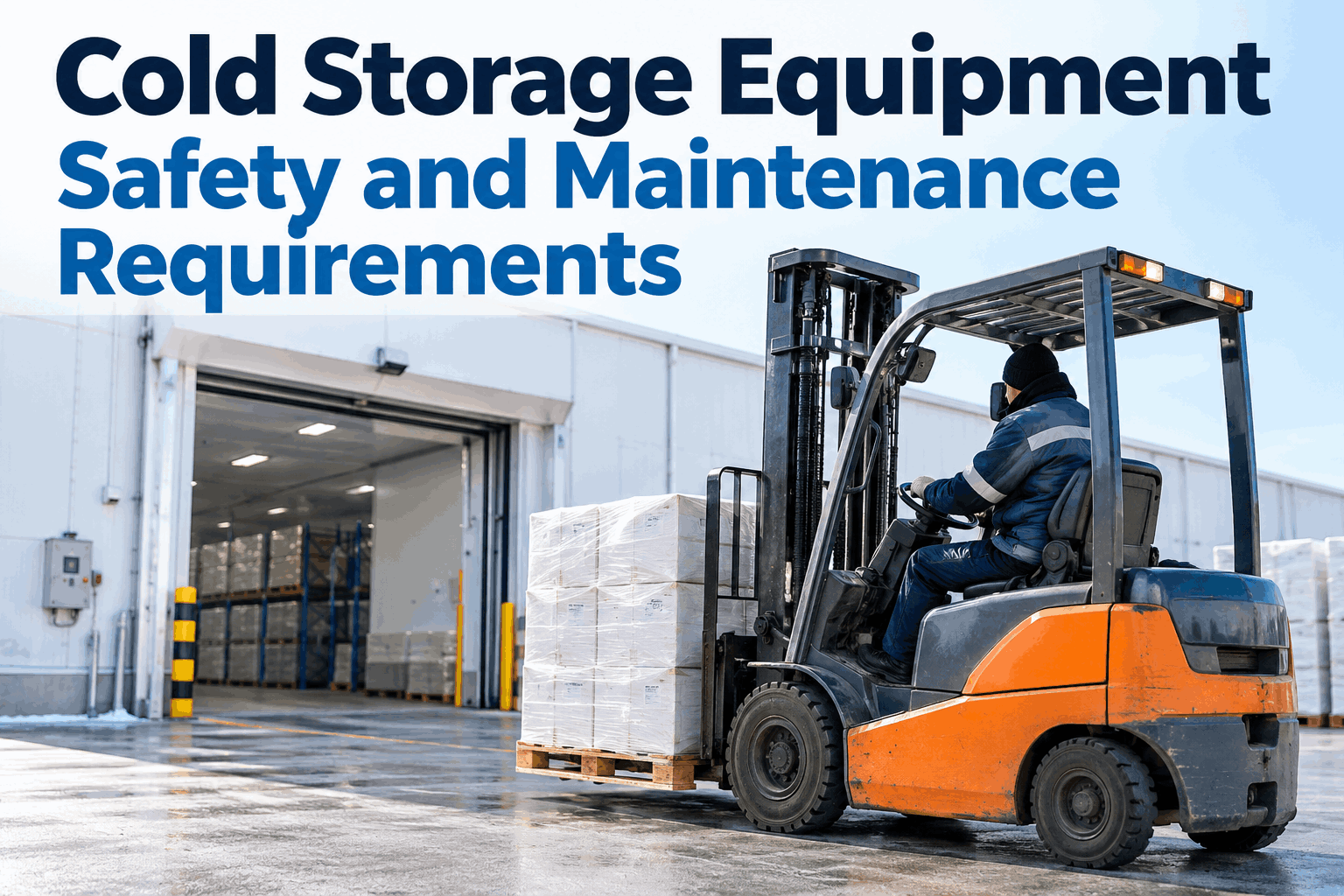
Cold storage equipment maintenance has one enemy most maintenance plans ignore: it isn't the cold, it's the crossing. Every time a forklift, pallet jack or scrubber rolls from a warm dock into a freezer aisle and back, warm moist air meets frozen metal and condensation forms — then freezes inside the machine. That hidden water is what cracks seals, corrodes contacts and drains batteries, long before the cold itself does any harm. Book a demo to see cold-storage equipment checks tracked in HVI.
Cold Storage Equipment Maintenance Is About the Temperature Crossing
Standard PM assumes a stable environment. Cold-store equipment lives in a thermal cycle — warm dock, frozen aisle, warm dock — and every crossing leaves moisture behind. Maintain for the cycle, not the cold.
- Warm, humid dock air
- Crossing = condensation
- Freezer = it turns to ice
A machine that runs flawlessly in an ambient warehouse can struggle in cold storage for reasons that have nothing to do with how it's built — and everything to do with where it lives. Batteries lose capacity, hydraulics stiffen, seals go brittle and condensation attacks the electronics. Cold storage equipment maintenance is standard maintenance plus the four things the cold cycle does to a machine.
4systems the cold cycle attacks that a normal PM plan never accounts for
The cold doesn't damage a machine evenly — it goes after four specific systems, each in its own way. Knowing which system the cold is working on tells you what to check more often and what to spec differently.
Cold slows the chemistry — a battery delivers fewer usable amp-hours and takes longer to charge, so run times drop and charging routines have to adapt.
Check charge & run timeCold fluid thickens, so lifts and tilts run sluggish and slow until the system warms — and the wrong fluid grade never fully loosens up.
Right fluid grade for coldRubber seals and hoses harden and crack in sustained cold, opening slow leaks — low-temperature-rated components hold their flex where standard ones fail.
Low-temp seals & greaseThe real cold-store killer. Moisture from zone crossings settles on boards and contacts, causing faults and corrosion — sealed electronics and dry-out routines fight it.
Sealed & dried electronicsCovering all four is what separates cold storage equipment maintenance from a normal PM plan run in a cold room. Book a demo to see all four cold-cycle checks on one inspection.
Condensation is the master variablefollow one zone crossing and you see why cold-store gear fails from the inside
Almost every cold-storage failure traces back to one thing: water that appeared from nowhere. Here's the cycle that creates it, step by step — and why the damage is invisible until a board shorts or a contact corrodes through.
The machine rolls from a warm, humid dock into the freezer. Its metal is still warm and carrying moist air in every cavity.
Warm moist air hits cold surfaces and condenses — water forms on boards, contacts and inside housings where you can't see it.
In the freezer that water turns to ice inside the machine — jamming switches, stressing seals and bridging contacts.
Back on the warm dock it melts and sits as water. Cycle after cycle, that is what corrodes contacts and kills electronics.
Because the damage builds invisibly across hundreds of crossings, the only defence is checking for it on a schedule instead of waiting for the fault. Book a demo to see condensation checks built into the routine.
Cold shortens the maintenance clocksame machine, harder life — the PM interval that works in ambient is too long in a freezer
A forklift that needs service every 250 hours in a dry warehouse is living a harder life in cold storage, so the interval has to tighten. These are the checks that move up the schedule when a machine works the cold cycle.
Wipe down and dry the machine, check for ice buildup, confirm battery charge and run time, look for condensation on electronics.
Seals and hoses for cracking, hydraulic fluid condition and grade, electrical connections for corrosion — more often than the ambient interval.
Low-temperature hydraulic fluid and grease, sealed or heated electronics, cold-store tyres — the spec that stops the problem at the source.
Tracking the tighter cold-store interval per machine is exactly what a maintenance system is for. Sign up free and set cold-store PM intervals per asset.
Cold storage is a safety problem toosluggish machines and icy floors change how equipment has to be run and checked
Cold doesn't just wear equipment — it changes how safely that equipment operates. A hydraulic lift that responds slowly, a floor with frost patches, reduced grip and fogged vision all raise the risk, and all belong on the cold-store check.
Frost patches and ice on the floor cut traction for tyres and feet alike — check surfaces and tyre condition before each shift.
Cold hydraulics make lifts and steering respond slowly until warm — operators need to allow for it, and it needs logging when it persists.
Cabs and mirrors fog and ice at the zone line, cutting visibility — demisting and clear sightlines are a safety check, not a comfort one.
A seal or hose that cracks in the cold can fail suddenly under load — the inspection that catches brittleness early is a safety check too.
This broadens the forklift-specific view — for the deeper fleet playbook see cold storage forklift maintenance best practices, part of the wider warehouse equipment inspection picture that keeps every cold-store asset on one record.
Cold storage equipment maintenance in HVIcold-store checks to work orders to a history that proves the interval works
The value isn't a colder-climate checklist — it's that condensation on a board or a brittle seal becomes a work order, the cold-store interval is tracked per machine, and the history shows whether the tighter schedule is actually keeping the fleet up.
One digital check tuned for the freezer — battery, hydraulics, seals, electronics, ice and condensation — same every shift.
Condensation, a cracked seal or a weak battery becomes a work order with the part attached — fixed before the cycle makes it worse.
Every cold-store PM lands on the asset — so you can see if the tighter interval is cutting failures or needs to tighten further.
That's how a freezer fleet stops being a mystery line on the repair budget. Book a demo to see cold-store maintenance history by machine.
From a cold storage maintenance manager
For years we ran the same PM schedule in the freezer as in the ambient warehouse and couldn't work out why the cold-store machines died twice as fast. The failures were always electrical — a controller, a sensor, a connector — never the obvious cold stuff.
It was condensation the whole time. Once we treated the zone crossing as the real problem — tighter interval, dry the machine, seal the electronics, log it — the electrical failures dropped off a cliff. The cold was never the enemy. The water the cold left behind was.
RV Renata V.Maintenance Manager · Cold storage distribution
Cold storage equipment maintenance FAQs
What makes cold storage equipment maintenance different?
The thermal cycle. Equipment crossing between a warm dock and a freezer picks up condensation that freezes inside the machine, while cold also cuts battery capacity, stiffens hydraulics and hardens seals. So cold storage equipment maintenance is standard PM plus checks for condensation, a tighter interval, and cold-rated fluids, seals and electronics.
Why does condensation damage cold storage equipment?
Every time a machine moves from warm, humid air into the freezer, moisture condenses on its cold surfaces — including boards, contacts and inside housings — then freezes. Over hundreds of crossings that water corrodes electrical connections and shorts electronics. It's the leading cause of cold-store equipment failure, and it builds invisibly until something faults.
How does cold affect forklift batteries in cold storage?
Cold slows the battery's chemistry, so it delivers fewer usable amp-hours and takes longer to recharge. Run times drop and charging routines have to adapt. Tracking charge level and real run time per shift catches a battery that's fading from the cold before it strands a machine mid-aisle. Cold-store charging practices help too.
Should PM intervals change for cold storage equipment?
Yes. The cold cycle is a harder life than an ambient warehouse, so the PM interval that works at room temperature is usually too long in a freezer. Seals, hydraulic fluid and electrical connections need checking more often, and daily drying and ice checks are added. Follow the OEM's cold-store guidance and tighten from there based on your failure history.
How does HVI help with cold storage equipment maintenance?
HVI lets you build a cold-store inspection covering batteries, hydraulics, seals, electronics and condensation, set a tighter PM interval per machine, turn any defect into a work order, and keep a history that shows whether the interval is working. It supports the inspection and maintenance workflow — it doesn't replace OEM service requirements or your site's safety procedures.
Beat the Thermal Cycle Before It Beats Your Fleet
Build cold storage equipment maintenance around the temperature crossing — condensation checks, a tighter interval, cold-rated spec and a history per machine — so the freezer stops quietly taking out your batteries, hydraulics, seals and electronics.