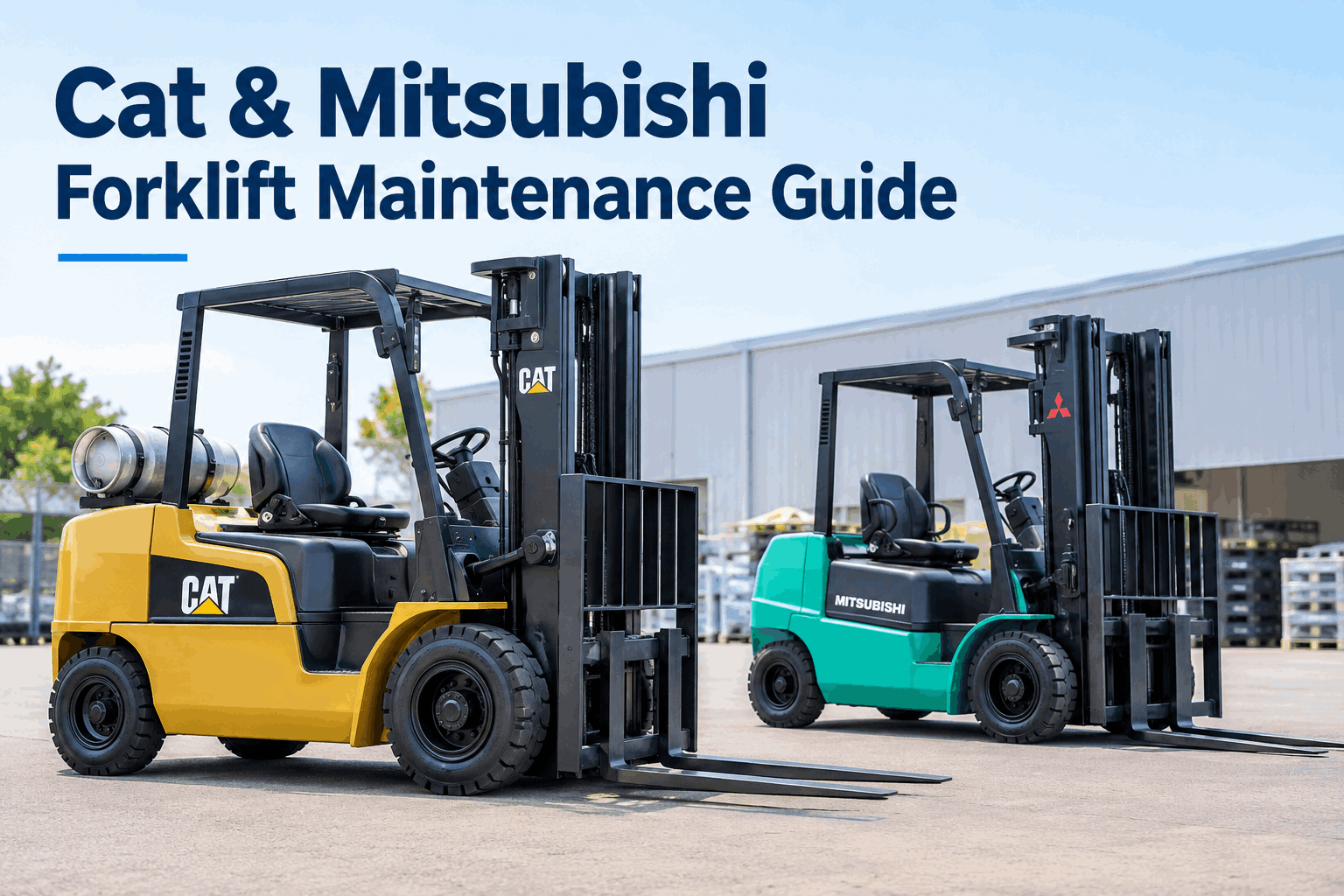
Here's what most operators don't realize about Cat and Mitsubishi forklift maintenance: on many models, they're the exact same machine. Cat® lift trucks and Mitsubishi forklifts come from the same manufacturer, so a Cat GP25 and its Mitsubishi twin share the same engine, mast, and service schedule — the badge is cosmetic. What drives the maintenance plan isn't the brand; it's the equipment class and powertrain. This page shows how to build a program around what really matters, with the model's manual as the authority. Book a demo to see PM by equipment class.
Two Badges, Often the Same Machine Underneath
Cat and Mitsubishi lift trucks share a maker and, on many models, an identical build. So stop maintaining them by brand and start maintaining them by what changes the schedule: the equipment class and the powertrain.
Cat and Mitsubishi lift trucks span warehouse electrics, electric counterbalance trucks, and internal-combustion counterbalance forklifts — and that range, not the brand name, is where maintenance requirements actually diverge. Get the class right and the schedule follows; fixate on the badge and you'll miss the real differences.
Figures from OSHA and warehouse material-handling reporting. On a mixed Cat and Mitsubishi fleet, hitting these gains means running each truck on the right schedule for its class — not one blanket plan.
The Badge Doesn't Change the Maintenance
Cat lift trucks and Mitsubishi forklifts come out of the same manufacturer, and on shared models they're mechanically identical — same components, same intervals, same service procedures. Technicians who work both brands use the same diagnostic tools and the same manuals for equivalent models. That's genuinely useful to know.
- The engine, mast, hydraulics, and drivetrain on shared models
- The manufacturer-specified service intervals
- The diagnostic tools and procedures technicians use
- The safety systems and inspection points
- Equipment class — warehouse electric, electric counterbalance, or IC
- Powertrain — battery, or diesel/LPG engine and emissions
- The specific model and its capacity
- Duty cycle and operating environment
So the practical move is to stop thinking "Cat schedule" versus "Mitsubishi schedule" and start thinking by class and model. The one non-negotiable: whichever badge is on the truck, the operator and service manual for that specific model is the authority for exact intervals, fluids, and specs — and following it protects your warranty. Book a demo to configure PM by model, not badge.
The Three Equipment Classes That Drive the Schedule
Cat and Mitsubishi build across three broad classes, and each has a genuinely different maintenance profile. This — not the brand — is the first thing to sort a truck by when you build its program.
Warehouse electric trucks
Reach trucks, order pickers, and lighter electric units for indoor work. Maintenance centers on the battery, drive motor, controller, and the mast and hydraulics — no engine, fuel, or emissions service at all.
Electric counterbalance
Heavier electric counterbalance lifts that handle bigger loads than warehouse trucks. Same battery and motor focus, but with the larger brakes, hydraulics, and tires that come with higher capacity.
IC counterbalance
Diesel and LPG counterbalance trucks for yards and heavy loads. These carry the full engine program — oil, fuel, cooling, belts, and emissions — on top of the shared mast, brakes, and hydraulics.
A generic schedule that ignores class asks a warehouse electric about engine oil and lets a diesel counterbalance skip its fuel filters — both wrong. Sorting each truck into its class first is what makes a maintenance program fit the machine instead of the label on it. That's exactly why equipment-class templates matter more than brand ones. Start free with templates built by equipment class.
The Standard Service Interval Framework
Whatever the badge, Cat and Mitsubishi trucks follow an hour-based rhythm. This is the common framework across the range — treat it as the shape of the schedule, and let your specific model's manual set the exact figures and items.
Two cautions on this table. Internal-combustion trucks often carry a shorter base interval than electrics, and the annual mark pairs Cat and Mitsubishi's major service with the OSHA load test — two obligations that land together and both need documenting. The exact hours are the manual's call, not this framework's. Book a demo to load your model's real intervals.
The Maintenance Areas Every Cat & Mitsubishi Shares
Across all three classes, these systems are on every Cat and Mitsubishi PM and daily check. They're the shared foundation — and each is safety-critical on a truck lifting loads over people.
Mast & lift chains
Chain wear, stretch, and lubrication; rollers, pivots, and sliding surfaces; smooth lift and tilt with no drift under load.
Hydraulics
Cylinder and hose condition, leaks, fluid level and quality, filter service; lift, tilt, and side-shift operating cleanly.
Brakes
Service and parking brake function, fluid and lining condition; holding on a grade — checked daily, serviced on the model's schedule.
Tires & wheels
Cushion or pneumatic wear, chunking, flat spots, and pressure; wheel and bearing condition — worn tires cut stability and control.
Forks & carriage
Heel wear, cracks, and bend; fork-tip alignment; carriage, side-shift, and backrest condition; a legible capacity plate for audits.
Powertrain & safety
Battery and cables (electric) or engine, fuel, and emissions (IC); plus seat belt, horn, lights, alarms, and overhead guard on every truck.
These shared areas run on a common inspection rhythm even when the powertrain service diverges by class — which is why a good program separates the shared daily check from the class-specific PM. Start free and capture the daily operator check on a phone. Book a demo to cover the shared checks and class PM.
How Duty Cycle and Conditions Shift the Plan
The base intervals assume normal use. Cat and Mitsubishi trucks often work harder than that, and heavy or dirty duty pulls every interval forward. Match the schedule to the work, not the average.
Heavy loads & capacity
A counterbalance lifting near its rating stresses hydraulics, mast, drivetrain, and brakes harder than a light warehouse pick — those systems need earlier, closer attention.
Harsh environments
Dust, heat, cold storage, and dirty yards clog filters and radiators fast. Manufacturer notes flag dirty duty for daily cleaning and tighter intervals — follow them.
Multi-shift operation
A truck running around the clock hits its hour marks in a fraction of the calendar time. Schedule off the meter so the busy units don't quietly fall behind on service.
The practical answer is hour-meter scheduling with condition awareness: the trigger fires on real usage, and a manager tightens intervals on trucks in heavy or dirty duty. A calendar-only plan over-services the light units and under-services the hard-worked ones — the exact opposite of what you want on a mixed Cat and Mitsubishi fleet. Start free and schedule off the hour meter.
The Cat & Mitsubishi Inspection & Defect Checklist
Between scheduled services, the daily operator check catches the sudden defect. This is the shift-start inspection that keeps a Cat or Mitsubishi truck safe and flags anything needing a work order — run it before the truck moves.
- Mast lifts, lowers, and tilts smoothly with no drift
- Lift chains even, lubricated, no stretch or damage
- Forks free of cracks, heel wear, or bend; tips aligned
- Hydraulic hoses and cylinders dry, no leaks
- Service and parking brakes hold firm, no fade
- Steering responds smoothly with no excess play
- Tires free of chunking, flat spots, or low pressure
- Electric: charge and cables; IC: oil, coolant, fuel
- Seat belt, horn, lights, and alarms functional
- Overhead guard and operator-presence system intact
- Capacity and data plates legible
- Any defect flagged, photographed, routed to a work order
That last line is what turns an inspection into protection: a failed item becomes a tracked defect and, if it's safety-critical, an out-of-service tag until repaired — not a note lost between shifts. Closing that paper-to-work-order gap is where a phone-based check earns its place. Book a demo to see defect-to-work-order routing.
How HVI Runs Cat, Mitsubishi & Mixed Fleets by Class
Most warehouses don't run one brand — they run Cat, Mitsubishi, and often others, across all three classes. The challenge is holding each model to its own manual while managing the whole fleet on one screen. Three capabilities do exactly that.
Templates by equipment class
Warehouse electric, electric counterbalance, and IC each get their own inspection checklist — so a battery item never lands on a diesel and a fuel-filter check never lands on an electric.
PM configured per model
Set each model's manual-specified intervals once. Cat and Mitsubishi twins share a schedule; different models carry their own, and hour-meter entries fire the right alert.
One dashboard, every brand
Cat, Mitsubishi, and any other make on a single due/overdue board with full maintenance history and mobile defect capture — no separate system per brand.
The manuals stay the authority; HVI just makes sure their intervals fire and their records exist — timestamped, photo-backed, and audit-ready across the whole fleet, with the same class-and-model discipline across all your warehouse equipment. Start free and build the record for every unit. Book a demo to see your fleet on one board.
Cat & Mitsubishi maintenance, in five lines
Cat and Mitsubishi come from the same maker — on shared models they're identical, so the badge doesn't change the maintenance.
Equipment class — warehouse electric, electric counterbalance, or IC — and powertrain set the schedule, not the brand name.
Follow the hour-based framework (250 / 500 / 1,000 / 2,000 hr plus a daily check), but confirm exact intervals in the model's manual.
Schedule off the hour meter and tighten intervals for heavy or dirty duty — a calendar-only plan mis-serves the whole fleet.
Class-based templates, per-model PM, and one dashboard let a mixed Cat/Mitsubishi fleet stay on schedule and audit-ready.
From a fleet manager running Cat and Mitsubishi together
It took me a while to realize half our Cat and Mitsubishi trucks were literally the same model with a different sticker — we'd kept two sets of schedules for one machine. Once we organized the fleet by class instead of brand, the electrics and IC trucks each got the right checklist, the twins shared a schedule, and it all collapsed onto one board. Less admin, nothing slipping.
Frequently asked questions
Are Cat and Mitsubishi forklifts the same?
On many models, yes — Cat lift trucks and Mitsubishi forklifts come from the same manufacturer, and equivalent models are mechanically identical, sharing the same engine, mast, hydraulics, and service schedule. The badge differs; the machine often doesn't. Technicians use the same diagnostic tools and manuals for the equivalent models. That means their maintenance is the same too — so build the program around the specific model and equipment class rather than the brand name.
How often should a Cat or Mitsubishi forklift be serviced?
It depends on the equipment class, model, and powertrain, not the badge. A common framework runs a basic service around every 250 hours, fluids and filters around 500 hours, and major service around 2,000 hours, with daily operator checks and an annual OSHA load test — and internal-combustion trucks often service more frequently than electric ones. These are typical figures only; always confirm the exact intervals for your specific model in its operator or service manual.
What are the three forklift equipment classes for maintenance?
For maintenance planning, Cat and Mitsubishi trucks sort broadly into warehouse electric trucks (reach trucks, pickers, lighter units — battery and motor focus), electric counterbalance trucks (heavier electric lifts — battery plus larger brakes and hydraulics), and internal-combustion counterbalance forklifts (diesel or LPG — the full engine, fuel, cooling, and emissions program). The class, more than the brand, determines what gets serviced and how often, which is why class-based inspection templates fit better than brand-based ones.
Do electric and IC Cat/Mitsubishi forklifts need different maintenance?
Yes. They share the mast, chains, forks, hydraulics, and brakes on the same inspection rhythm, but their power systems differ completely. Electric units need battery service, drive-motor and controller checks, and contactor and cable inspection. IC units need engine oil and filters, fuel-system service, coolant, belts, and emissions components, and often a shorter base interval. Using one generic checklist for both misses items on each — which is why class-specific templates matter.
Where do I find the exact service schedule for my model?
In the operator and service manual for that specific Cat or Mitsubishi model, available from the manufacturer or your dealer. Intervals, fluids, and specs vary by model and powertrain, so a diesel counterbalance, an LPG truck, and an electric each carry their own schedule. Treat the manual as the authority; a generic framework is only for planning, and following the manufacturer's specified service is also what keeps warranty coverage intact.
Maintain Every Lift by Class and Model, on One Board
Equipment-class inspection templates, per-model PM configured from each manual, hour-meter triggers, mobile defect capture, and full history — Cat, Mitsubishi, and every other brand on a single dashboard. The manual stays the authority; HVI makes sure it fires. Live in under two weeks.
No credit card · No hardware · Load your Cat & Mitsubishi models in an afternoon