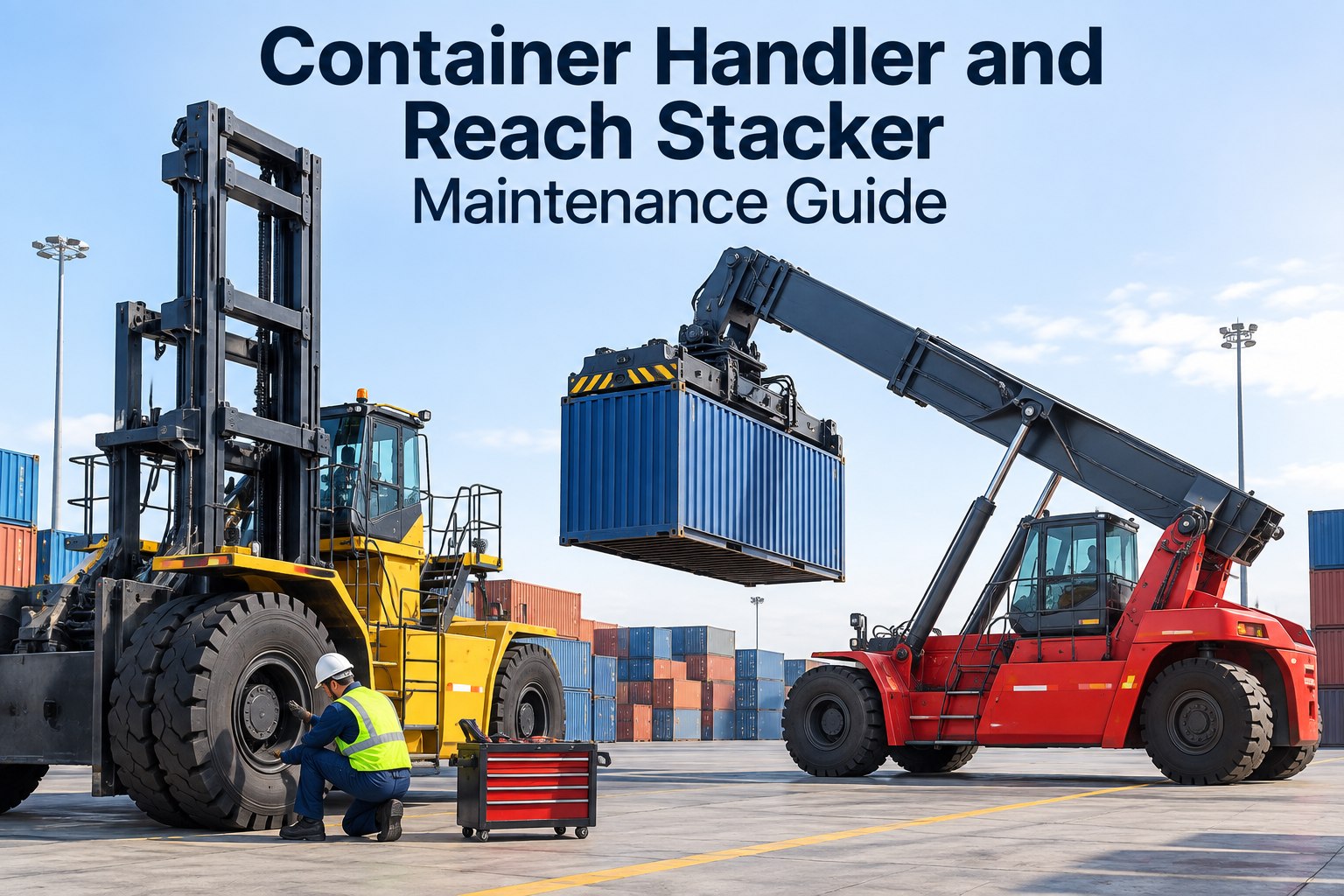
A reach stacker goes down mid-shift and the whole yard feels it within minutes: trucks queue at the gate, the straddle carrier picks up double moves it was never scheduled for, and the planner starts reshuffling tomorrow's vessel window. Container handler maintenance is what stands between that chaos and a terminal that just keeps flowing. These machines carry the duty cycle of warehouse forklifts and the consequence profile of a 45-tonne crane, which means the spreader, boom, hydraulics and tyres all need inspection discipline that a paper binder in the workshop simply cannot deliver. This guide walks through the systems that actually fail, the PM structure that catches them early, and how to see it running on your own handlers in a 30-minute demo before you commit to anything.
Is your spreader inspection strong enough to stop a dropped box?
Top lift handlers and reach stackers lift 30 to 45 tonnes over truck cabs and personnel every single shift. One worn twistlock, one weeping boom cylinder, one under-inflated tyre under a stacked load — and availability, safety and your insurance position all take the hit at once.
The numbers your yard already pays
Every figure below is money leaving your operation when a handler sits waiting on a part that a $40 inspection would have flagged three weeks earlier.
The four systems that decide reach stacker service life
A container handler is not a big forklift. It is a mobile lifting appliance with a truck chassis underneath, and each of these systems fails in its own way, on its own schedule.
Spreader & Twistlocks
Twistlocks are the only thing holding a 30-tonne box. Check for cracked or mushroomed heads, worn engagement flags, and sensors that lie about lock status. Rotation and side-shift systems wear their slew rings and bushings quietly — play in the spreader is a fatigue warning, not an annoyance. Verify the load-securing indication on every lift, because a green light with a half-engaged lock is how containers end up on truck cabs.
Boom & Extension Structure
The telescopic boom cycles under full load thousands of times a month, and fatigue cracks start at welds, pin bosses and the extension wear-pad zones long before they are visible from the ground. Boom extension chains or cylinders, wear pads and the boom-to-chassis pivot all need scheduled structural inspection — not just a glance during the daily walk-around. A crack found at 200 hours of growth is a weld repair; the same crack found by a failure is a boom replacement.
High-Pressure Hydraulics
Lift, telescoping, spreader functions and steering all run off a high-pressure, high-flow hydraulic system working near its limits on every pick. Hose chafing at the boom head, cylinder seal weep, contaminated oil and tired pumps show up first as slower cycle times and hotter oil. Track oil analysis results and cycle-time drift per machine — they tell you which pump is dying weeks before it strands a handler with a box in the air.
Tyres & Stability Systems
A laden handler's front tyres carry enormous axle loads at low speed on abrasive concrete, and a sidewall cut or 10% under-inflation shortens casing life fast. Load moment indicators and stability systems are only trustworthy if their calibration and fault codes are checked, not assumed. A stability warning ignored because "it always does that" is the last step before a tip-over with a driver in the seat.
A container handler inspection checklist that actually catches failures
Three tiers, matched to how these machines really degrade: what the operator sees every shift, what a technician verifies weekly, and what only a scheduled structural look will find.
Operator walk-around — 8 minutes
- Twistlocks: heads intact, flags move freely, lock/unlock indication matches physical position on all four corners
- Spreader: no visible cracks, side-shift and rotation smooth with no grinding or dead spots
- Hydraulics: no fresh oil on cylinders, hoses or the ground; no chafed lines at the boom head
- Tyres: no sidewall cuts, chunking or obvious pressure loss on the loaded axle
- Safety systems: load moment display active, no stored fault codes, alarms and lights functional
Technician verification — 45 minutes
- Spreader play: measure slew ring and bushing wear against spec; photograph twistlock wear faces
- Boom wear pads: check thickness and adjustment; inspect extension chains or cylinder mounts for fretting
- Hydraulic condition: oil level, temperature trend, filter restriction indicators, cycle-time check against baseline
- Steering & brakes: accumulator charge, brake wear, steering ram seals under full lock
- Structure: dye-penetrant or close visual on known crack zones — boom foot welds, spreader frame corners
Scheduled service — by engine hours
- 250–500 hrs: engine and hydraulic filters, oil sampling, full grease of spreader and boom pivot points
- 1,000 hrs: hydraulic oil condition report, twistlock dimensional check, boom extension system overhaul inspection
- 2,000+ hrs: structural NDT of boom and spreader, slew ring measurement, stability system recalibration
- Every PM: tyre depth and pressure logged per position, rotation planned before the loaded axle hits wear limits
| Failure mode | First warning sign | Caught by | Cost if missed |
|---|---|---|---|
| Twistlock fatigue crack | Stiff engagement, worn flag travel | Daily check + photo | Dropped container, injury, written-off cargo |
| Boom weld crack | Paint flaking, rust bleed at weld toe | Weekly structural look | Boom replacement, 4–8 weeks downtime |
| Hydraulic pump wear | Slower lift cycle, hotter oil | Cycle-time trend + oil sample | Pump failure under load, contamination of whole system |
| Tyre casing failure | Under-inflation, sidewall cuts | Per-position pressure log | Blowout with a raised load, rim damage, stability event |
| Load moment fault | Stored fault codes, erratic readings | Daily system check | Overload lift, structural damage, tip-over risk |
See your own spreader checklist running in HVI
Book a 30-minute demo and we will build a container handler template live — twistlocks, boom, hydraulics, tyres — on your own asset list.
How a spreader defect should move through your shop
The gap between "operator noticed it" and "technician fixed it" is where container handlers are lost. This is the five-step flow that closes it — and it works on paper only if nobody is busy, which is never.
Operator flags it on the walk-around
A stiff twistlock or a weeping lift cylinder gets logged with a photo from the cab-side phone, not mentioned at shift change and forgotten. The photo is the evidence — a wear face, an oil trail, a crack — captured before the machine moves another box.
Supervisor triages: run, restrict or ground
Not every defect stops the machine. A seeping hose might run to end of shift under watch; a twistlock crack grounds it now. The decision and its reasoning are recorded against the asset, so the next shift knows exactly why unit 7 is on light duties.
Work order raised with parts attached
The defect becomes a work order with the photo, the hour-meter reading and the likely parts list already on it. If the twistlock kit or seal set is in your stores, it is reserved against the job; if not, the order goes out the same morning, not after three days of phone calls.
Repair verified against the original photo
The technician closes the job with a photo of the fitted part and the measured clearances. You now have a before-and-after record on the exact item a safety auditor or insurer will ask about after any lifting incident.
The trend updates the PM plan
Three twistlock replacements in four months across the fleet is not bad luck — it is a duty-cycle or supplier problem. When defects live in one system, that pattern is visible on a dashboard instead of buried in three different notebooks. If you want to walk this flow through on your own units, it takes about half an hour.
Built for terminal handling equipment, not just trucks
HVI runs the same inspection and work order discipline across your reach stackers, empty handlers, terminal tractors and road fleet — one platform, one audit trail.
Custom spreader & boom templates
Build inspection templates around twistlock condition, slew play, boom welds and hydraulic checks — your items, your pass/fail criteria. Outcome: nothing critical relies on an operator's memory, and every handler in the fleet is checked to the same standard.
Photo capture on lifting items
Mandatory photos on twistlocks, crack zones and tyre damage, timestamped and tied to the asset. Outcome: when a client, insurer or safety regulator asks how you verify load-securing condition, you show them in seconds instead of digging through binders.
Hour-based PM scheduling
Preventive maintenance triggered by engine hours, not calendar guesses, with due and overdue alerts per machine. Outcome: the 1,000-hour twistlock dimensional check and the 2,000-hour structural NDT happen on time even when the yard is flat out.
Per-asset availability tracking
Uptime, downtime reasons and cost per asset on one dashboard across the whole container handling fleet. Outcome: you can prove to operations which machine is the real constraint and defend the replacement budget with numbers, not frustration. Many managers start logging inspections free on one handler and expand once the data proves itself.
Container handler reliability is a system, not a slogan
If you take five things from this guide, take these — they are the difference between a yard that flows and a yard that phones customers with bad news.
You do not need a bigger workshop or more technicians to fix this. You need every inspection, defect and PM interval in one place, visible from the yard office and the phone in your pocket. That is exactly what HVI was built for, and you can book a demo around your own fleet list to see it before spending a cent.
"I track one number every Monday: moves lost to handler downtime. Before we digitised the inspections, a twistlock problem surfaced when the box shifted on the spreader — now the operator photographs it at 6am and my fitter has the kit picked before smoko. The gripe I had with paper was never the paperwork, it was finding out three shifts late. We cut our unplanned handler stops by roughly a third in the first year just by seeing defects the day they appeared."
Container handler and reach stacker maintenance FAQs
How often should a reach stacker be inspected?
Operators should complete a walk-around every shift — about eight minutes covering twistlocks, spreader, hydraulics, tyres and safety systems. A technician verification weekly, and hour-based preventive maintenance at 250–500, 1,000 and 2,000+ hour intervals for filters, oil analysis, dimensional checks and structural NDT. High-utilisation terminal machines often need the weekly check moved to twice weekly.
What is the most critical item on a container handler inspection?
The twistlocks and their engagement indication. They are the only connection between the spreader and a 30-plus-tonne container, and a false "locked" signal is how dropped-box incidents happen. Check head condition, flag travel and that the cab indication matches physical lock position on all four corners — and photograph the wear faces so you can trend them. You can set up a photo-mandatory twistlock check free and have it running this week.
How do I know when a reach stacker boom needs structural inspection?
Beyond the manufacturer's scheduled intervals, watch for paint flaking or rust bleeding at weld toes, increased play in extension sections, and any change in how the boom tracks under load. Machines working high cycles in corrosive port air justify shorter NDT intervals than the book minimum. Any crack indication grounds the machine until a qualified assessment is done.
Can digital inspection software handle mixed terminal equipment?
Yes — that is exactly the use case. HVI runs different templates per asset type, so your reach stackers get spreader and boom items, empty handlers get mast and carriage checks, and terminal tractors get a standard DVIR, all in one system with one availability dashboard. Most terminals book a demo with their asset list and see every machine type templated in a single session.
What records should I keep for container handling equipment audits?
Keep timestamped daily inspections with photos on lifting items, every work order with before-and-after evidence, PM completion against engine-hour intervals, and structural examination reports for boom and spreader. Auditors, clients and insurers increasingly expect photo-backed proof rather than ticked boxes. Digital records tied to each asset's serial number let you produce a complete history in seconds instead of days.
Keep every handler lifting, every shift
Move your spreader, boom and hydraulic inspections off paper and into HVI — photo-backed, hour-scheduled and audit-ready across your whole container handling fleet.