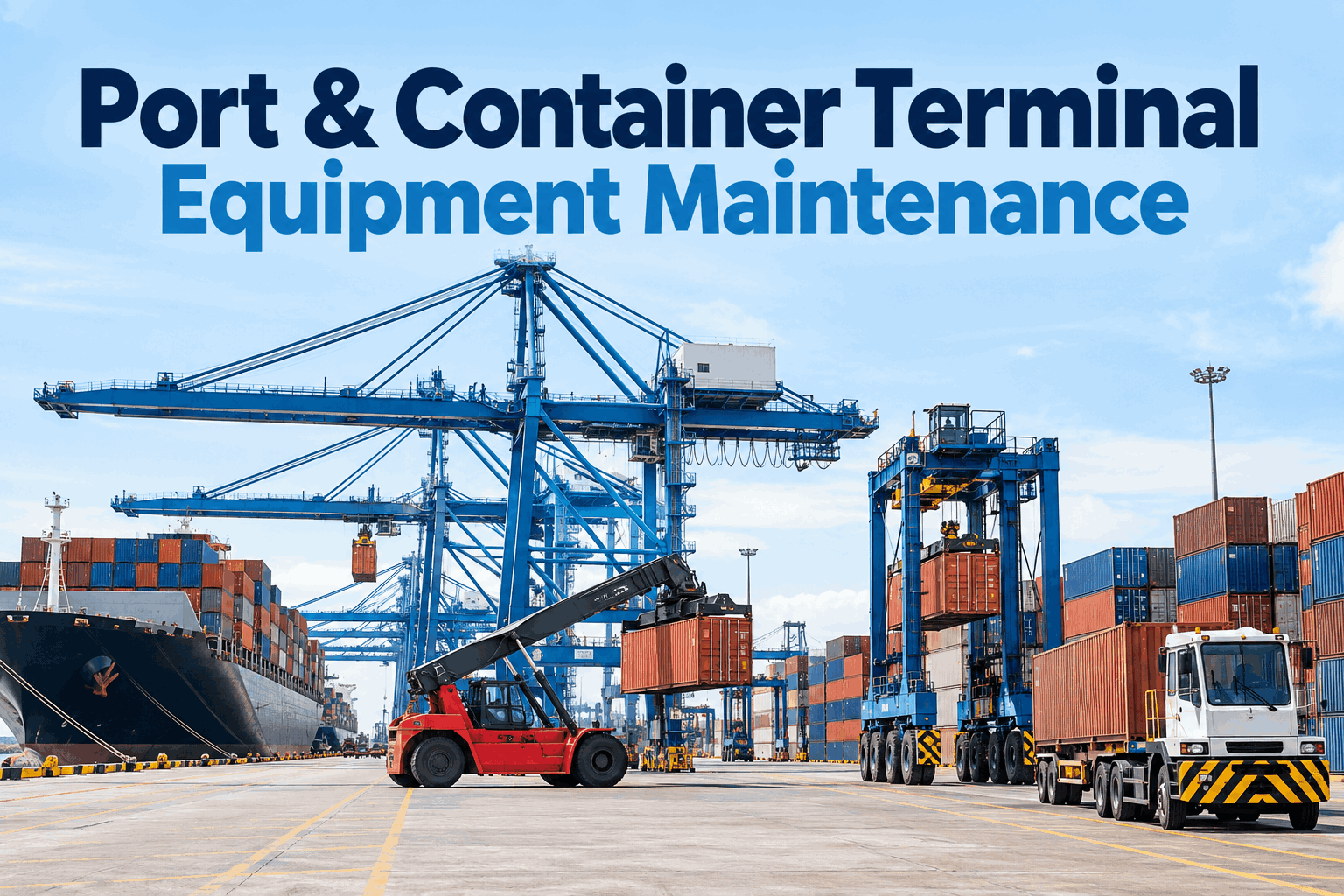
A ship-to-shore crane and a straddle carrier sit fifty yards apart on the same terminal and fail for almost entirely different reasons. Port equipment maintenance breaks down the moment a terminal applies one generic PM schedule across machines with fundamentally different duty cycles, structures and failure modes. Here's how maintenance rhythm actually needs to differ by equipment class, why coastal corrosion deserves its own tracking discipline, and where the maintenance loop most often breaks.
Which PM Interval Fits This Machine?
Pick an equipment class. See what typically drives its maintenance interval — because hours, cycles and calendar time don't apply evenly across a terminal fleet.
Wire rope, hoist and trolley wear track operating hours, but structural and electrical inspection timing often follows vessel call frequency — the machine's real duty cycle, not a flat calendar.
Gantry travel motors, wheel assemblies and lift mechanisms wear by cycle count as much as by hour — a yard crane running tight stack rotations needs a shorter interval than one on a quieter block.
Straddle carriers run hydraulic systems almost continuously under load — hour-based intervals need to weight hydraulic service far more heavily than a typical mobile equipment schedule would.
Terminal tractors behave closer to a highway truck — engine hours plus duty intensity (how many short hitch-and-drop cycles per shift) both factor into a realistic interval.
One Terminal, Five Equipment Classes, Five Different Maintenance Rhythms
A terminal's fleet spans ship-to-shore cranes, rubber-tired and rail-mounted gantries, straddle carriers, reach stackers and empty container handlers, and terminal tractors — machines that share a yard but not much else structurally or operationally. Port equipment maintenance programs that apply one generic preventive maintenance template across all of them consistently under-service the assets that need more attention and over-service the ones that don't, because hour counts, duty cycles and failure modes genuinely differ by class. A reach stacker handling high lifts all shift wears differently than a terminal tractor doing short hitch-and-drop runs between the yard and the gate, and treating them identically on a schedule built for neither produces exactly the unplanned downtime a PM program exists to prevent.
Coastal Corrosion: The Maintenance Driver Most Programs Underrate
Salt air and marine humidity attack port equipment in ways an inland fleet never has to account for, and the damage concentrates in specific, predictable places: structural steel welds and connections, electrical enclosures and terminal connectors, fasteners and hardware, and exposed hydraulic fittings and cylinder rods. None of this shows up as a single failure event — it's a slow reduction in structural and electrical integrity that's easy to miss on a single inspection and only becomes obvious once it's already advanced.
Structural Steel
Welds, booms and gantry legs lose protective coating faster in marine air — pitting and section loss progress quietly under paint that still looks intact from a distance.
Electrical Enclosures & Connectors
Salt-laden moisture infiltrates seals and connector pins, causing intermittent faults long before a connector visibly fails — often misdiagnosed as a control system issue.
Fasteners & Hardware
Bolts and hardware corrode at a different rate than the structure they're securing, and a corroded fastener can compromise a connection well before the surrounding steel shows comparable wear.
Hydraulic Components
Exposed cylinder rods and fittings pit under salt exposure, which accelerates seal wear and turns a cosmetic corrosion issue into a hydraulic leak.
The only way to catch corrosion progression before it becomes structural or electrical failure is comparing condition over time — the same joint, the same enclosure, photographed at each inspection, so deterioration shows up as a trend instead of being judged fresh each time by whoever happens to be looking. Book a demo to see corrosion photo-tracked against the same component over successive inspections, instead of relying on memory for whether something looks worse than it did last quarter.
Straddle Carriers: The Most Maintenance-Intensive Asset on the Yard
Academic research into container terminal operations has specifically flagged straddle carriers as notoriously maintenance-intensive relative to other yard equipment, driven by their heavy reliance on hydraulic systems operating under near-continuous load. That same research applies standard reliability metrics — mean time between failure and mean time between maintenance — to forecast how different PM regimes affect straddle-fleet availability, a more analytical lens than a simple inspection checklist provides. The practical takeaway for a terminal maintenance program: a straddle carrier's hydraulic system deserves a service interval weighted more aggressively than a generic mobile-equipment schedule would assign it, because the failure data consistently shows hydraulics as the dominant driver of straddle carrier downtime.
From Defect to Work Order: Closing the Loop
An inspection that surfaces a defect but doesn't connect it to a tracked repair is only half a maintenance process. A hairline crack flagged on a gantry leg, a hydraulic fitting noted as weeping, a corroded connector logged during a routine check — each needs to flow directly into a work order with an owner and a completion record, not sit as a note in an inspection report nobody revisits. Equally important is watching for the pattern underneath individual defects: the same component failing repeatedly across multiple machines of the same class is a signal worth escalating past routine repair, whether that means a design or maintenance-interval change, not just another work order closed and forgotten. Sign up free to see defects routed straight into work orders automatically, with recurring failures visible across the fleet instead of buried in individual repair tickets.
Certification Records: The One Thing That Can't Slip
Lifting and load-handling equipment on a terminal falls under specific regulatory requirements — in the U.S., 29 CFR 1917.45 and 1917.50 govern crane and derrick certification and testing within marine terminal operations, with equivalent load-test and thorough-examination requirements under UK, Canadian and Australian frameworks. Unlike a corrosion trend or a recurring hydraulic fault, a lapsed certification or an expired load test isn't a gradual risk — it's a hard compliance gap the moment the date passes, and it needs its own tracked renewal cycle separate from routine PM scheduling.
Spare Parts: Planning Around Long Lead Times
A terminal's most specialized components — crane hoist motors, spreader actuators, gantry travel gearboxes — often carry procurement lead times measured in months, not days, because they're built to order or shipped from a limited number of manufacturers. Stocking decisions for these parts shouldn't be guesswork; equipment criticality and maintenance history together indicate which components are worth holding in inventory versus which can safely wait for standard procurement. A spare that's never stocked because the failure seemed unlikely is exactly the part that puts a crane out of service for weeks when it finally fails, during precisely the vessel schedule a terminal can least afford to miss.
What a Terminal Maintenance Manager Actually Watches For
We used to run every yard asset off the same monthly PM calendar regardless of class, and our straddle carriers were constantly surprising us with hydraulic failures between scheduled services. Once we separated the schedules by equipment type and weighted straddle carrier intervals toward hydraulic service specifically, unplanned downtime on that fleet dropped noticeably within two quarters. The crane and tractor schedules didn't need nearly as much adjustment — it was specifically the straddles that needed their own rhythm.
The Takeaway
Port equipment maintenance works when it stops treating a terminal fleet as one undifferentiated asset list and starts scheduling by what each equipment class actually fails from — hydraulic load on straddle carriers, travel-cycle wear on gantries, vessel-cycle demand on ship-to-shore cranes, and coastal corrosion working quietly across all of it. Pair equipment-specific PM intervals with photo-tracked corrosion monitoring and a defect-to-work-order loop that actually closes, and the result is fewer surprise failures during exactly the vessel windows a terminal can't afford to miss. Sign up free and build maintenance schedules around what each machine on your yard actually needs.
Frequently Asked Questions
Why can't a single PM schedule work across a whole container terminal fleet?
Terminal equipment classes fail from different mechanisms and on different cycles — ship-to-shore cranes wear by operating hours and vessel-call frequency, gantry cranes by travel cycles and wheel wear, straddle carriers predominantly by hydraulic system load, and terminal tractors by a mix of engine hours and short hitch-and-drop duty cycles. A single generic schedule applied across all of them typically over-services some equipment and under-services the assets that actually need more frequent attention.
Which components are most affected by coastal corrosion on port equipment?
Corrosion concentrates predictably in structural steel welds and connections, electrical enclosures and connector pins, fasteners and hardware, and exposed hydraulic fittings and cylinder rods. Progression is often gradual and easy to miss on a single visual inspection, which is why comparing photographed condition over time at the same component location is more reliable than judging severity fresh at each inspection.
Why are straddle carriers considered especially maintenance-intensive?
Academic research into container terminal operations has identified straddle carriers as notoriously maintenance-intensive compared to other yard equipment, primarily due to heavy reliance on hydraulic systems operating under near-continuous load. This has led researchers to apply reliability metrics such as mean time between failure and mean time between maintenance specifically to straddle carrier fleets to forecast how different preventive maintenance regimes affect availability.
What regulations govern crane certification at marine terminals?
In the United States, 29 CFR 1917.45 and 1917.50 govern crane, derrick and lifting equipment certification and testing requirements specifically within marine terminal operations, with comparable load-test and thorough-examination requirements under equivalent frameworks in the UK, Canada and Australia. Unlike gradual maintenance issues, a lapsed certification or expired load test represents an immediate compliance gap the moment the renewal date passes.
How should a terminal plan spare parts inventory for critical equipment?
Specialized components such as crane hoist motors, spreader actuators and gantry travel gearboxes often carry procurement lead times of months rather than days, since many are built to order or sourced from a limited number of manufacturers. Stocking decisions should weigh equipment criticality against maintenance history to identify which long-lead components are worth holding in inventory, since an unstocked critical part can take a crane out of service for weeks during a failure.
Give Every Terminal Equipment Class Its Own Maintenance Rhythm
HVI runs equipment-specific inspection templates, hour-based preventive maintenance, corrosion photo tracking, certification records and work orders in one system, with availability KPIs showing which assets are actually driving downtime.
No credit card · No hardware required · Live before your next vessel schedule