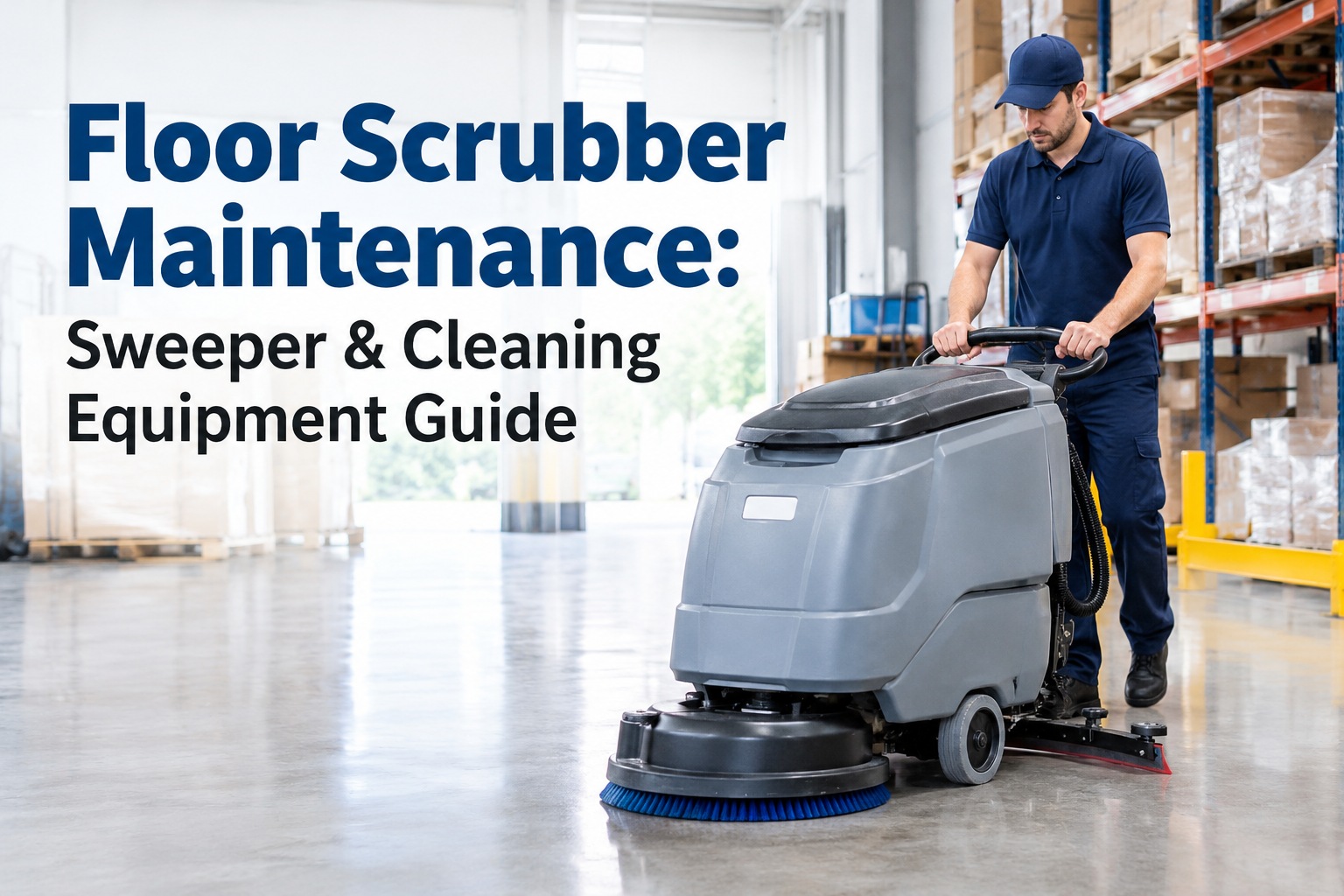
The floor scrubber parked in the corner of your warehouse is a piece of working equipment, not a fancy mop — and treating it like housekeeping is exactly why it's leaving water trails and dying mid-shift. Floor scrubber maintenance is real equipment maintenance: brushes wear, squeegees round off, batteries fade, filters clog, and every failure shows up as a dirty floor or a machine that quits early. The fix is the same discipline you'd give any fleet asset — scheduled PM, daily checks, tracked wear parts — with intervals you tune to your machine and its hours.
A Cleaning Machine Is Working Equipment
Every wet trail and dead battery traces back to a wear part nobody scheduled. The four systems that decide whether your scrubber shows up ready each shift:
If you're a facilities, warehouse, or maintenance manager, your cleaning equipment probably lives in a blind spot — not on the fleet PM schedule, no logged hours, attention only when it stops working. That's backwards. A scrubber runs a motor, carries a battery, and wears consumables — it's an asset that belongs in the same preventive-maintenance workflow as your trucks and forklifts, and it rewards that treatment with reliability.
Preventive Maintenance by Usage, Not a Universal Calendardaily, weekly, monthly — tuned to your machine and hours
The honest caveat up front: no single maintenance interval fits every scrubber and sweeper. A machine running eight hours a day needs far more attention than one used twice a week. Manufacturer manuals give model-specific intervals, and the smartest approach ties PM to run hours, not just the calendar. Use the tiers below as a framework, then set the actual frequency from your manual and usage.
- Empty, rinse, and air-dry the recovery tank; flush the intake screen
- Clean the squeegee assembly; wipe blades and check for nicks
- Inspect and clean brushes or pads; clear embedded debris
- Recharge the battery correctly after use
- Wipe down the machine; spot early leaks or loose fittings
- Check battery water level on flooded lead-acid cells (distilled water, never overfill)
- Inspect battery terminals for corrosion; clean as needed
- Clean the solution tank, filters, screens, and hoses
- Check squeegee blade wear and rotate double-sided blades
- Inspect wheels, casters, and drive components
- Deep-inspect brushes, pads, and squeegees for replacement
- Test battery runtime; log any noticeable decline
- Check the solution pump, valves, and flow rate
- Inspect the vacuum motor and hoses for restriction
- Verify the charger output and connections
The most important habit there is the daily recovery-tank rinse — it prevents more problems than any other five minutes you'll spend. And whenever your machine tracks run hours, prefer hour-based scheduling: wear follows how long it runs, not how many days pass on a calendar. Book a demo to schedule scrubber PM by run hours alongside your other equipment
The Wear Parts That Decide Performanceconsumables to inspect, rotate, and stock
Most scrubber problems come down to four consumables. Know how each one fails and what it looks like when it's done, and you'll catch trouble before it shows up on the floor.
The most common failure point. Look for nicks, tears, rounding, curling edges, or uneven wear — any of which lets water slip past. Wipe after every use; rotate double-sided blades to extend life; replace when the edge rounds off. A bad squeegee is the number-one cause of water left behind.
A brush can look fine and still be worn — it loses the stiffness that agitates the floor. Check the scrub pattern after a run: even, clean path means good contact. Match the brush or pad to your floor type; the wrong pad cleans poorly no matter how new it is.
Scrubbers work in dirt all day, so solution filters, vacuum screens, and the tank intake clog steadily. A restriction quietly cuts solution flow and water pickup. Clean them on your weekly pass; a clogged filter mimics a "weak" machine that's really just choked.
The consumable with the biggest replacement cost. Runtime that drops noticeably is your signal to test it. Charging habits matter more than anything — more on battery type below, because the routine depends on which kind you have.
The operational lesson: readiness depends on having these consumables on the shelf. A worn squeegee you can't replace because the spare isn't stocked means a machine down or cleaning badly until the part arrives. Tracking cleaning-equipment consumables in your parts inventory is what keeps the machine ready for the next shift. Start free and track scrubber wear parts in the same inventory as your fleet
Battery Care Depends on the Battery Typeflooded lead-acid, AGM, gel, and lithium aren't the same
Battery maintenance is where the "no universal rule" caveat matters most, because the routine genuinely differs by chemistry. Doing the wrong thing — watering a sealed battery, or skipping watering on a flooded one — damages it. Always follow your battery and machine manufacturer's guidance; here's the general shape.
Universal across every type is the charging discipline: charge fully after each use, use the specified charger, don't interrupt cycles, and never store the machine depleted. Those habits protect runtime more than anything — and if a scrubber won't hold a charge, test the charger output before condemning the battery, since the charger is often the real culprit.
Reading the Warning Signssymptom, likely cause, first check
A scrubber almost always warns you before it fails outright — a wet trail, a new noise, a shorter runtime. Learn to read the symptom back to its usual cause and you catch small problems before they become downtime.
A change in sound is the most underrated warning sign — a vacuum motor working harder against a restriction, or a drive system starting to labor, will tell you something's wrong before the machine quits. If a scrubber suddenly sounds different, stop and look. When the trouble is mechanical or electrical rather than a wear part — a drive motor, a charger fault, recurring error codes — it's past routine care and time for a service technician. Book a demo to log operator-reported symptoms straight into a work order
Sweepers & Scrubber-Sweeper Combosthe sweep side adds its own routine
If you run a sweeper or a combo machine, the sweep system stacks its own maintenance on top of everything above. The mechanics are different — brooms and dust filtration instead of squeegees and recovery — but the discipline is the same.
On the sweep side, empty the hopper after each use and clear the main and side brooms of wire, string, and tangled debris — the most common sweeper problem is a broom wrapped in material that stops it picking up. Check the dust filter regularly: a clogged filter kills dust control and lets fine debris blow back out, and on many machines it's a simple shake-down or replacement. Inspect broom wear and adjust broom pattern to the floor, just as you'd check a scrub brush. A sweeper that leaves a trail of debris usually has a worn broom, a full hopper, or a broom fouled with wire.
The combo machine is two maintenance routines in one chassis — run both. Skipping the sweep-side filter because you were focused on the scrub side is how a combo ends up half-working. Book a demo to run one inspection template across scrubbers, sweepers, and combos
Paper Logs vs Digital Equipment Trackingwhy cleaning gear falls through the cracks on paper
Cleaning equipment gets neglected precisely because it's usually tracked worse than the rest of the fleet — a clipboard by the charger, if anything. Here's the difference a real system makes.
- PM happens when someone remembers, if ever
- No run-hour data to schedule against
- Operator finds a problem, tells no one
- Spare squeegees and brushes aren't stocked
- The machine is invisible until it quits
- Hour-based PM scheduled automatically
- Operator inspection on a phone each shift
- A reported defect becomes a work order
- Consumables tracked in parts inventory
- The machine sits on one equipment dashboard
This is the reframe that matters: a digital equipment inspection and PM platform treats a scrubber like the asset it is. Operators run a quick daily inspection from a phone, hour-based PM schedules itself, defects flow into work orders, and consumables sit in the same inventory as your truck parts — so the machine that lived in a blind spot is finally as visible and maintainable as everything else you run.
From a facilities manager who put scrubbers on the fleet system
Our scrubbers were the orphans of the maintenance program. The trucks and forklifts had PM schedules and inspections; the cleaning machines got fixed when they broke, which was always at the worst possible time — usually the night before an audit when the floors had to be spotless.
We put them on the same system as everything else. Now the operators do a two-minute inspection each shift, the PM is scheduled off run hours, and I keep squeegees and brushes on the shelf. The machines stopped dying mid-job, and honestly the floors look better because a worn squeegee gets caught and swapped instead of dragging for weeks. Treating them like real equipment was the whole fix.
Floor scrubber maintenance: the takeaway
Floor scrubber maintenance isn't complicated — it's just consistent. Rinse the recovery tank daily, inspect the squeegee and brushes, charge the battery the way its chemistry needs, clean the filters weekly, and schedule the deeper PM by run hours against your manufacturer's manual. Do that and the machine shows up ready every shift and the floors stay clean. The real unlock is treating cleaning equipment like the fleet asset it is — visible, scheduled, and stocked — instead of an afterthought that only gets noticed when it fails. Book a demo to bring your cleaning equipment onto one maintenance dashboard
Frequently asked questions
How often should a floor scrubber be serviced?
There's no single interval that fits every machine — it depends on how much you use it, the size and soil level of the area, and the manufacturer's recommendations. Basic care happens on a usage rhythm: daily or after-each-use tasks (empty and rinse the recovery tank, clean the squeegee and brushes, recharge), weekly tasks (battery water and terminals on flooded cells, clean filters and tanks, check squeegee wear), and deeper monthly or hour-based tasks (inspect wear parts for replacement, test battery runtime, check the pump and vacuum). A machine used eight hours a day needs attention far more often than one used twice a week, which is why tying preventive maintenance to run hours rather than a fixed calendar is the best approach where the machine tracks them. For model-specific service intervals and procedures, always follow your equipment's manufacturer manual, and schedule a professional PM inspection periodically — many facilities do this every few months, more often for heavy use.
What causes a floor scrubber to leave water behind?
Leaving water behind is the most common floor scrubber complaint, and the culprit is almost always the water-pickup system. Start with the squeegee blades: if they're torn, worn down, rounded, curled, or installed backward, they can't make full contact with the floor and water slips past. Wipe them, inspect the edge, rotate double-sided blades, and replace them when the edge rounds off. If the squeegee looks good, check the vacuum recovery path — a clogged or loose vacuum hose, a full recovery tank, a stuck float shut-off, or a damaged tank gasket will all cut suction so the machine can't pick up the water it lays down. Uneven or damaged flooring can also break blade contact and cause trails. Work through the squeegee first, then the recovery tank and hose, and you'll resolve the large majority of water-behind problems without a service call.
How do you maintain scrubber batteries?
Battery care depends on the battery type, so first confirm what your machine has. Flooded lead-acid batteries need regular watering with distilled water — check the level weekly, top up only when needed, and never overfill — plus clean, corrosion-free terminals. Sealed AGM and gel batteries must not be watered; adding water damages them, so focus on correct charging and terminal inspection. Lithium batteries, found on newer machines, don't need watering and often tolerate opportunity charging, but follow the manufacturer's specific charging and storage guidance. Across every type, the charging discipline is what protects lifespan: charge fully after each use, use the charger specified for that battery, don't interrupt charge cycles, and never store the machine with a depleted battery. If runtime drops noticeably, test the battery — but also test the charger output first, since a failing charger is often mistaken for a bad battery. Always defer to your battery and machine manufacturer's documentation.
How often should scrubber squeegees and brushes be replaced?
There's no fixed replacement schedule — it's driven by condition and hours of use, not the calendar, so you replace them by inspection rather than a set date. For squeegees, replace when the blade edge is rounded, torn, nicked, or curled and no longer wipes cleanly; signs include water trails, poor pickup, and uneven drying. Double-sided blades can often be rotated to a fresh edge to extend usable life before full replacement. For brushes and pads, replacement is due when they've worn down or lost the stiffness needed to agitate the floor — a brush that looks intact can still be too soft to clean effectively, so check the scrub pattern after a run for even, complete contact. Heavy daily use in high-soil environments wears both far faster than light use. The practical approach is inspecting these consumables on your weekly and monthly maintenance passes and keeping spares stocked so a worn part can be swapped immediately rather than running the machine degraded.
How do you maintain a warehouse sweeper?
A sweeper's maintenance centers on its brooms, hopper, and dust filtration rather than squeegees and recovery. After each use, empty the hopper and clear the main and side brooms of wire, string, and tangled debris — a broom wrapped in material is the most common reason a sweeper stops picking up. Check the dust filter regularly, since a clogged filter destroys dust control and lets fine debris blow back out; depending on the machine it's a shake-down or a replacement. Inspect broom wear and adjust the broom pattern to the floor, the same way you'd check a scrub brush. On a scrubber-sweeper combo machine, you run both routines — the full scrubber maintenance plus the sweep-side hopper, brooms, and filter — because skipping either half leaves the machine only partly working. As with scrubbers, tie the deeper maintenance to run hours and follow the manufacturer's manual for model-specific intervals and procedures.
Bring cleaning equipment out of the maintenance blind spot
HVI puts floor scrubbers and sweepers on the same equipment dashboard as your trucks and forklifts — standardized operator inspections each shift, hour-based PM schedules, consumable parts tracked in inventory, and reported defects that turn straight into work orders. Your cleaning machines finally get the same visibility and preventive care as the rest of your fleet.
No credit card · No hardware · Equipment PM ready on day one