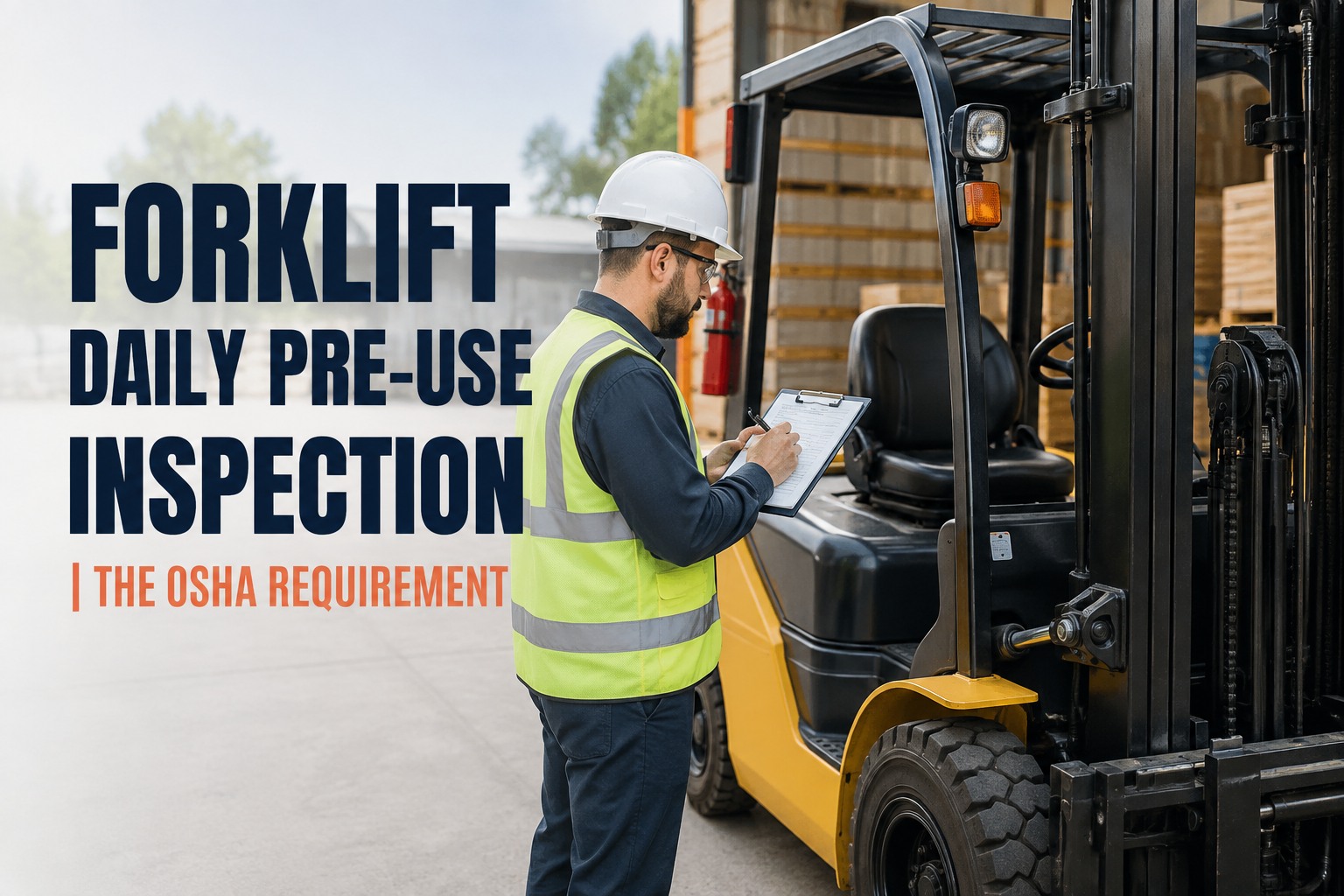
The forklift sits in the same aisle it was parked in eight hours ago, but the guy who drove it last shift is gone and the one climbing on now is about to move three pallets of steel stock. A daily forklift inspection is supposed to catch the leaking seal, the cracked fork heel, or the dead horn before the truck moves a single inch. Under OSHA's powered industrial truck standard, that examination has to happen before each shift begins, and if your yard runs twenty-four hours, that means three separate checks a day, not one rubber-stamped sign-off at dawn. If you want to see exactly how a modern digital workflow handles that on your floor, you can walk through the inspection process on a live demo without changing a single spreadsheet.
Forklift Daily Pre-Use Inspection
Three shifts a day means three signed inspections, not one
OSHA does not want a once-a-day gesture. If a truck is in service around the clock, the pre use examination forklift operators perform must happen before every single shift, and the record has to prove it. Paper makes that easy to fake. Digital records make it easy to defend.
The Real Cost of Skipping Checks
Why the forklift walkaround is your cheapest safety lever
A pre operational check forklift operators do at the start of every shift takes about three to five minutes. Skipping it costs you in three ways, and none of them show up on the same budget line, which is why the problem hides.
The real argument for a daily forklift checklist is not compliance, though compliance is what forces the issue. The argument is that a leaking hydraulic hose spotted at 06:00 costs a fifteen-dollar fitting and twenty minutes. The same hose rupturing at 14:30 with a full load four metres up costs a dropped pallet, a damaged rack, a written-off truck, and potentially a person under it. Every defect you catch in the inspection is a defect that cannot bite you later, and the ones you miss are the ones that end up on an incident report. When you are ready to stop relying on clipboards and trust, book a quick demo to see how digital forklift inspection documentation works on your actual units.
OSHA 1910.178(q)(7)
The forklift inspection frequency rule, plainly
The regulation is short. Industrial trucks need to be examined before being placed in service and must not be placed in service if the examination shows any condition adversely affecting safety. Where trucks are used on a round-the-clock basis, they must be examined after each shift. The defects found have to be logged.
That word "after each shift" is what catches people out. A single daily forklift checklist completed at 07:00 does not cover the operator who takes the same truck at 15:00 or 23:00. Each driver must do their own pre shift forklift check, and each one needs to sign that they did. If a truck runs three shifts and you have one check on file for that calendar day, an inspector will view the other two shifts as unchecked operations. See how HVI enforces shift-level inspection frequency by requiring a fresh timestamped record before the truck can be released to the next operator.
What Gets Checked
The daily forklift checklist: six systems, zero shortcuts
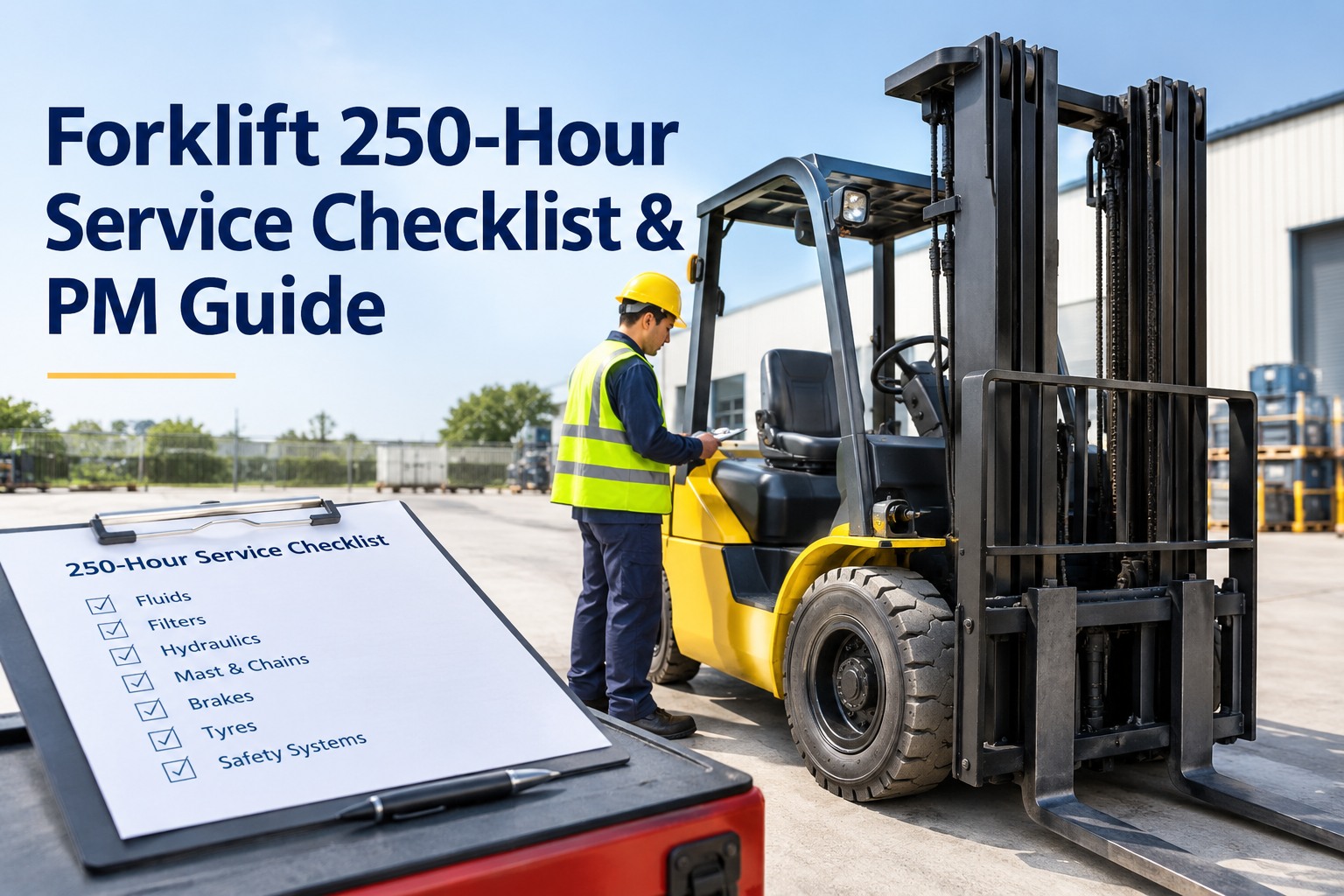
A proper forklift condition check is not a glance at the tires. It is a structured walkaround that covers six mechanical and safety systems. Here is what each block should cover and what you are actually looking for.
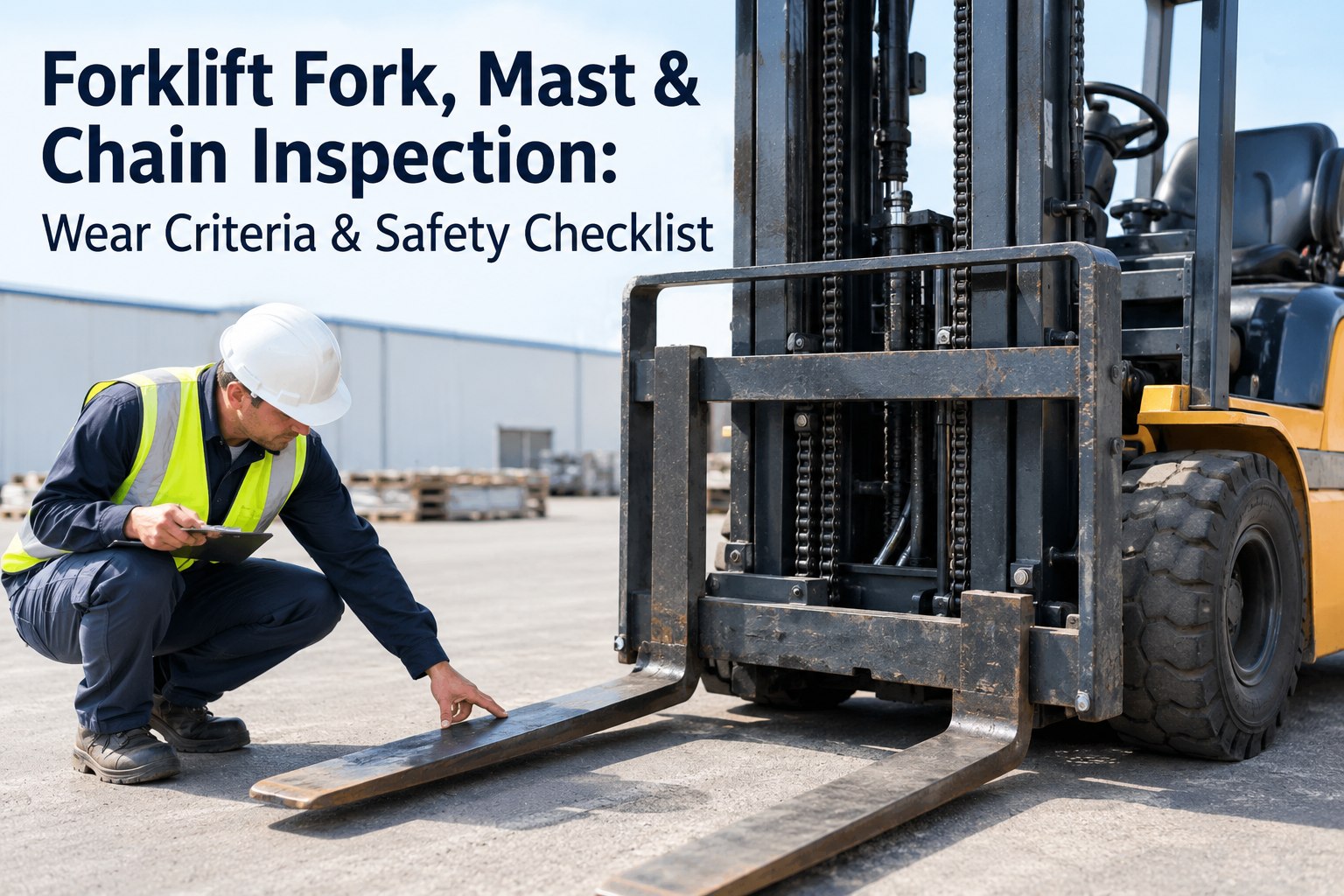
- Fork heels and tips for cracks, bends or wear beyond 10% of original thickness
- Mast chains for stretch, broken links, rust and proper lubrication
- Carriage rollers and mast channels for smooth travel and no binding
- Hydraulic cylinders for leaks, score marks and drifted operation
- Fork positioning lock and retention pins fully seated
- Service brake pedal travel, firmness and stopping power in a short test roll
- Parking brake holds the loaded truck on the yard grade
- Steering responds freely with no excessive play or jerking
- No unusual noises from the drive axle or brake components
- Tyre condition: chunks missing, exposed cords, low pressure on pneumatics
- Wheel nuts and rims intact, no evidence of looseness or oil seepage
- Battery charge above 20% or propane cylinder full, secured and within date
- No fuel, oil or coolant puddles under the truck where it was parked
- Lift, tilt and side-shift functions operate smoothly through full range
- No drop in load under pressure; cylinder drift measured over a minute
- Hoses and fittings dry, no weeping at crimp ends or junction blocks
- All dashboard gauges and hour meter functional and readable
- Horn audible from ten metres in normal yard noise
- Headlight, strobe and beacon illuminated and clean
- Reverse alarm triggers immediately and is clearly audible
- Blue spot or red zone warning light aligned and functional if fitted
- Capacity data plate legible, present and matches the truck configuration
- Seatbelt or operator restraint system latches and retracts correctly
- Overhead guard and backrest free of cracks, weld breaks or heavy impact damage
- Fire extinguisher present, charged and within inspection date
Immediate Action, Not Scheduled
When a defect is found: tag it out, do not park it
The OSHA daily inspection requirement is blunt about this: if the examination shows any condition adversely affecting the safety of the truck, it comes out of service. Not after the next delivery. Not at the end of the shift. Immediately. The key goes to the supervisor, the truck gets a tag, and it does not move under power until the defect is repaired and the repair is documented.
That sounds simple until you watch it fail in practice. An operator spots a soft brake pedal, mentions it to the relief driver, and the relief driver decides the load is light enough to risk it. By lunchtime the wheel cylinder has failed completely. With a digital workflow, the moment a defect is logged the truck status changes to out-of-service in the system, a work order is created automatically, and the next operator who scans the truck sees a red flag before they can accept it. If that sounds like the control you have been missing, start logging inspections free and see the defect-to-work-order flow on your own yard.
Paper vs Digital
The rubber-stamping problem paper enables
Paper inspection forms are the single biggest reason forklift inspection compliance looks perfect on paper and falls apart in an audit. The form gets initialled at the start of the day, photocopied at the end of the week, and filed in a binder nobody opens until an incident happens.
| What you need | Paper forklift inspection form | HVI digital inspection |
|---|---|---|
| Proof of when it happened | Handwritten date and time, easily backfilled | Automatic server-side timestamp on every submission |
| Proof of who did it | Initials on a line, no identity verification | Operator login tied to the specific unit and shift |
| Evidence of defects | Checkbox and a scribbled note, often illegible | Mandatory photo capture on any flagged item |
| Removal from service | Verbal handover, truck often keeps running | Truck status flips to out-of-service, next operator blocked |
| Repair tracking | Separate paper work order, if one exists | Defect auto-creates a work order linked to the asset |
| Audit retrieval | Hours flipping through binders by date and truck number | Filter by asset, date or operator and export in seconds |
The shift in forklift inspection compliance comes down to friction. Paper has low friction at the moment of inspection, because a signature costs nothing, and high friction at the moment of proof, because finding that signature three months later is painful. Digital flips that. It adds a small, deliberate step at the moment of inspection, because the operator actually has to walk the truck and photograph anything wrong, and removes almost all friction from the moment of proof. When OSHA, your client, or your own insurer asks for the records for truck fourteen on a Tuesday in March, the answer arrives before the question is finished. You can see the audit export on a live call and judge it for yourself.
Mini Worked Example
What a missed defect actually costs a 40-truck yard
Take a mid-size distribution operation running 40 forklifts across two shifts. On paper, compliance is 100%. In reality, the night shift checks are initialled by the supervisor at the start of the shift based on a quick glance, because the night crew is lean and the trucks looked fine yesterday.
The repair bill is the smallest number on that list, and it is the one most managers fixate on. The lost throughput and the written-off stock are ten times the cost of the part, and both were entirely preventable by an operator pushing a brake pedal, noting the travel, and flagging it before the truck moved. This is the math you bring to the room when someone questions the budget for inspection software. Book a 30-minute demo and we will build the same breakdown using your own truck count and shift pattern.
Stop filing inspections. Start proving them.
See how HVI turns every shift inspection into a timestamped, photo-backed, audit-ready record in the time it takes to walk around the truck.
How HVI Helps
Four ways HVI closes the forklift inspection gap
HVI is built for the realities of a working yard, not a clean office. These are the four capabilities that matter most for multi-shift forklift inspection compliance.
Mandatory photo capture on defects
When an operator flags a defect, the app will not accept the submission until a photo is attached. That single rule kills rubber-stamping, because you cannot photograph a problem you did not look at. The photo lives on the record forever, tied to the asset and the timestamp.
Timestamped, shift-level records
Every inspection carries a server-side timestamp and the operator's identity. On a three-shift operation, the system expects three discrete records per truck per day. If a shift is missed, it shows as a gap in the compliance dashboard before it shows as a finding in an audit.
Defects auto-create work orders
The moment a defect is logged, HVI generates a work order linked to that specific asset, assigns it to the right shop queue, and holds the truck out of service until the work is closed. No phone calls, no sticky notes, no truck slipping back into rotation because nobody told the next shift.
OSHA-ready export in seconds
Filter by truck, operator, date range or defect type and export a clean, audit-ready report. Whether it is an OSHA visit, a client safety audit or an insurance renewal, the records are there in one click instead of three hours of binder digging.
Key Takeaways
What to defend internally and what to fix next
If you are the person who has to stand in front of a safety committee or an external auditor and explain how you know every truck was checked before it moved, the answer has to be better than a binder of initialled paper. Start a free HVI account and run it alongside your current paper system for a week to see the difference in your own records, or book a guided demo focused on forklift inspection compliance.
The night shift was signing off inspections in the first five minutes of the shift, before they even walked the floor. I knew it, the supervisor knew it, and the paper form let us all pretend it was fine. We moved to phones with mandatory photos on any defect, and the rubber-stamping stopped overnight, because nobody wants to be the operator whose name is on the last inspection before a failure. That is what actually changed behaviour, not the rule.
Frequently Asked Questions
Forklift daily inspection: the questions auditors ask first
Does OSHA require a forklift inspection every shift or just once a day?
What must be included in a pre shift forklift check?
Do forklift inspection records need to be kept, and for how long?
Can an operator continue using a forklift if a minor defect is found?
Is a digital forklift inspection form acceptable for OSHA compliance?
See HVI running on your own fleet
Book a 30-minute demo and we will set up your forklift asset list, build a shift-level inspection template, and show you the defect-to-work-order flow on your actual yard workflow.
Free to start - Works on any phone - No card needed