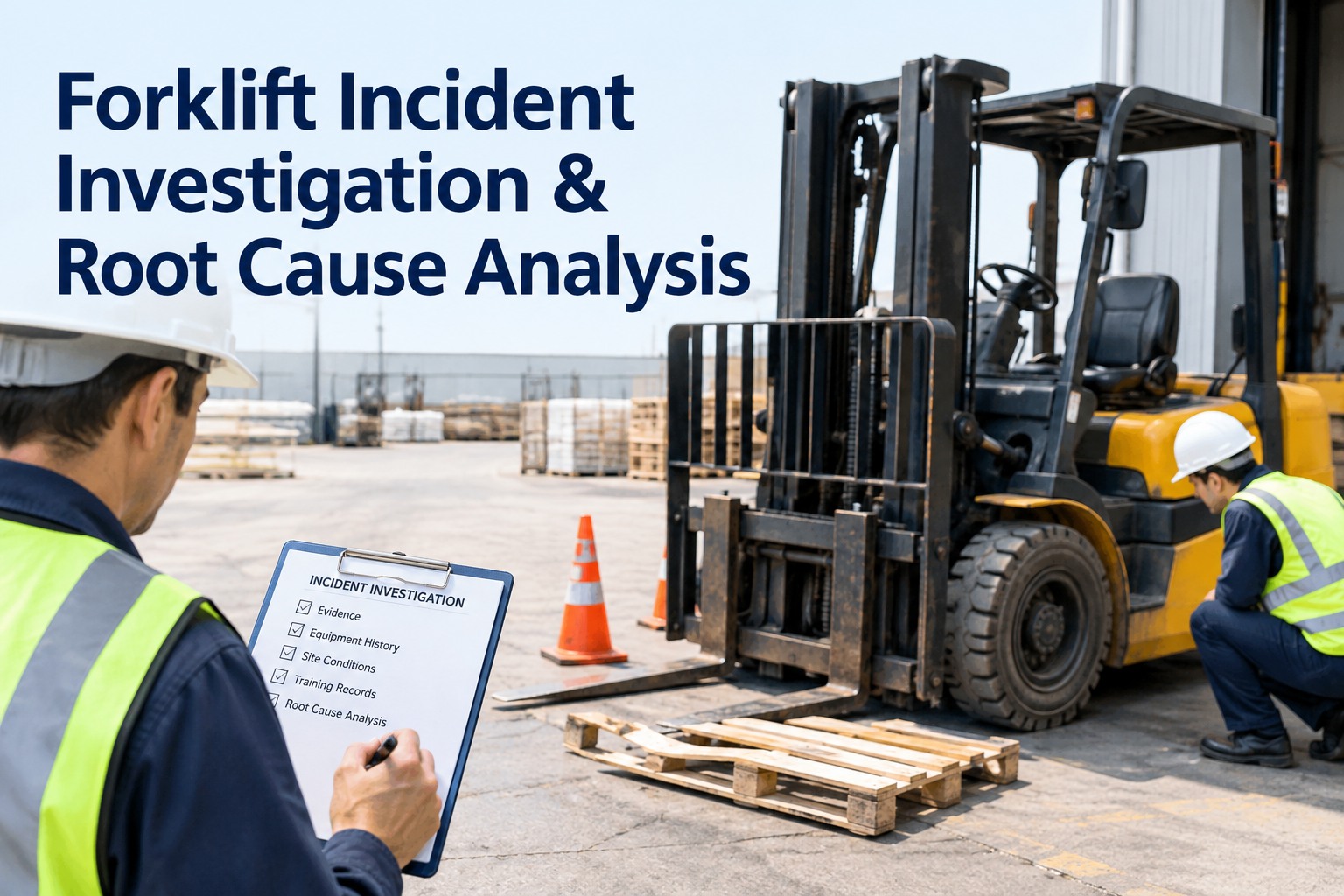
The fastest forklift investigation ends with "operator error," a fixed brake, and a signature — and it's almost always wrong. Operator error shows up in roughly 70% of forklift accidents, but it's the surface, not the cause: underneath it is usually a missed inspection, an overdue repair, or a training gap that let the mistake happen. A real forklift incident investigation and root cause analysis goes past the operator's last move to the conditions that made it possible — and lives or dies on the records you can pull. See the asset history an investigation actually needs
"Operator Error" Is Where Bad Investigations Stop
The same incident, two ways to close it. One blames a person and fixes nothing. The other finds why it was possible — and stops the next one.
Fix the brake, retrain the driver, close the file. The condition that caused it is still there — and it fails again on a different truck next month.
Deals with the symptomThe brake defect was flagged three weeks ago and never worked. The PM was overdue. That's the root cause — fix that and the whole fleet gets safer.
Stops recurrenceA good investigation is a process, not a verdict. Below is how it runs — secure the scene, preserve the evidence, separate the immediate event from the conditions beneath it, act on the real cause, and verify it held — plus the near-miss and trend work that catches the next one before it happens.
The five-step investigation, in order
Every credible investigation follows the same arc. Skip a step — especially the last two — and you get a closed file that doesn't prevent anything. Here's the sequence, and what each step actually requires on a warehouse floor.
Care for the injured, control any ongoing hazard, and keep people clear. Nothing else starts until the scene is safe.
Photograph everything before anything moves — forklift position, load, floor, sightlines. Preserve the truck and pull its inspection and maintenance records now, before they're overwritten or lost.
Interview witnesses separately, and gather the three evidence types: the scene, the people, and the documents — equipment history, defect and repair records, training and evaluation files.
Separate the immediate event from the underlying and contributing conditions. Keep asking "why could that happen?" until you reach a cause you can actually fix — not a person to blame.
Fix the real cause, give the action a named owner and a due date, and — the step most skip — verify weeks later that it worked and the condition is actually gone.
Steps 2 and 3 are where investigations quietly fail, because the evidence they need has to already exist. If the truck's inspection history is on a clipboard that's now missing, the investigation starts blind. Book a demo to see inspection and maintenance history ready per asset.
Immediate cause vs root cause: the layer that matters
This is the whole discipline in one idea. The immediate cause is the last thing that happened — the collision, the tip-over. The root cause is the condition that made that possible. Stop at the first and you fix a symptom; reach the last and you fix the fleet. It's the "5 Whys" applied to a real forklift incident.
Notice where it lands: not on the operator, but on a broken records-and-follow-up process — exactly the kind of root cause that recurs across trucks and shifts until it's fixed at the system level. The only way to trace those layers is to have the defect and repair history to follow. Book a demo to trace every defect to its repair.
The three kinds of evidence — and the one most warehouses lose
A forklift investigation runs on three evidence types. Two are gathered in the moment; the third has to already exist before the incident — and it's the one that decides whether you find root cause or just guess.
Position, load, floor, sightlines — photographed before anything is moved, because it's gone the moment cleanup starts.
Witnesses interviewed separately so memories don't blur, plus the operator's account — captured while it's fresh.
Inspection records, defect and repair history, training and evaluation files. The evidence that answers "did we know?" — and the one most often missing, on paper, or unverifiable.
OSHA and insurers ask the same first question after a serious incident: was the truck inspected, and were known defects addressed? If that record is missing or can't be trusted, it becomes its own finding — separate from whatever caused the accident. Timestamped digital records with photos answer it instantly. Book a demo to see photo evidence attached to every inspection and defect.
Corrective action that actually closes the loop
"Retraining completed" is where most investigations end — and why the same incident comes back. A corrective action isn't done when the training's logged; it's done when someone verified, weeks later, that the condition is gone. Three things separate a real corrective action from a checkbox.
Logging that training happened isn't corrective action — it's documentation. The action is proven when the defect, the trend, or the near-miss stops recurring. Start free and track corrective actions to verified closure.
Near-misses and trends: catching the next one first
The best investigation is the one you run before anyone gets hurt. A near-miss is a free incident — all the warning, none of the injury — and a trend is a near-miss repeating across trucks, shifts, or sites. Both are only visible if you're capturing and comparing them.
A truck that "almost" clipped a pedestrian at the same blind corner is telling you exactly where the next real one happens. Investigate it like it counted — because next time it will.
The same defect on three trucks, incidents clustering on one shift or one aisle — patterns no single report shows. Trend analysis finds the systemic cause before it produces an injury.
A single incident is a story; a trend is a diagnosis. Capturing near-misses and defect trends per asset and per site is how a fleet moves from investigating injuries to preventing them. Book a demo to see defect trends across trucks, shifts, and sites.
The first-response evidence checklist
The first hour decides whether the investigation has evidence or guesswork. Run this the moment the scene is safe — before cleanup erases it. Use this incident-response checklist online free, so photos and records attach to the asset and the corrective action tracks to closure.
From a safety manager who changed how they close incidents
For years our incident reports all ended the same way: "operator error, retrained." Then the same near-miss kept happening at one dock corner, and when I finally pulled the history I found the same forklift had a flagged visibility-camera fault three separate times — each one "noted," none actually fixed. That wasn't operator error. That was us.
Now every incident starts with the asset's record open — inspections, defects, repairs, photos, right there. We trace the immediate cause down to why it was possible, assign the fix to a person, and verify it weeks later. The investigations got shorter and the repeat incidents stopped, because we were finally fixing causes instead of blaming people.
Frequently asked questions
What are the steps in a forklift incident investigation?
Five, in order: respond and make the scene safe; secure the scene and preserve evidence (photograph before anything moves, keep the forklift, pull its records); collect the full picture (witnesses interviewed separately, plus scene, people, and document evidence); find the root cause by separating the immediate event from the underlying conditions; and take corrective action with an owner, a due date, and later verification. The last two steps are the most-skipped — and skipping them is why incidents recur.
What is root cause analysis for a forklift accident?
It's the discipline of going past the immediate cause to the condition that made it possible. "Operator lost control" is the immediate cause; asking "why?" repeatedly — the 5 Whys — leads to answers like a brake defect that was flagged but never repaired, and then to no system tracking that defect to a completed fix. That final answer is the root cause. Fixing it prevents recurrence across the whole fleet, whereas fixing only the immediate cause just addresses a symptom.
Why shouldn't an investigation stop at "operator error"?
Because operator error is usually a symptom, not a cause. Operator error is cited in roughly 70% of forklift accidents, but underneath it there's almost always an underlying condition — a missed inspection, an overdue repair, poor visibility, a training or supervision gap — that allowed the mistake. Stopping at "operator error" blames a person and leaves that condition in place, so the same incident happens again on a different truck or shift. Root cause analysis fixes the condition.
What records do you need for a forklift investigation?
Document evidence is critical and has to exist before the incident: the forklift's inspection history, open and past defects, repair and work-order records, and the operator's training and evaluation files. OSHA and insurers ask first whether the truck was inspected and whether known defects were addressed — and if that record is missing, on paper, or unverifiable, it becomes its own finding separate from the accident's cause. Timestamped digital records with photo evidence answer that question instantly.
Should near-misses be investigated like accidents?
Yes — a near-miss is a free incident, with all the warning and none of the injury. The same truck nearly clipping a pedestrian at the same blind corner is telling you where the next real accident happens. Investigating near-misses, and running trend analysis to spot the same defect or event repeating across trucks and shifts, is how a program moves from reacting to injuries to preventing them — but only if they're captured and compared.
Turn every incident into a cause you fixed, not a person you blamed
HVI keeps inspection and maintenance history per asset, photo evidence on every inspection and defect, defect trends and work-order history, and corrective actions tracked to verified closure — with training records alongside. So your investigations start with the evidence already in hand, reach the real root cause, and prove the fix worked. Stop closing incidents with "operator error."
No credit card · Asset history & photo evidence · Corrective actions to verified closure