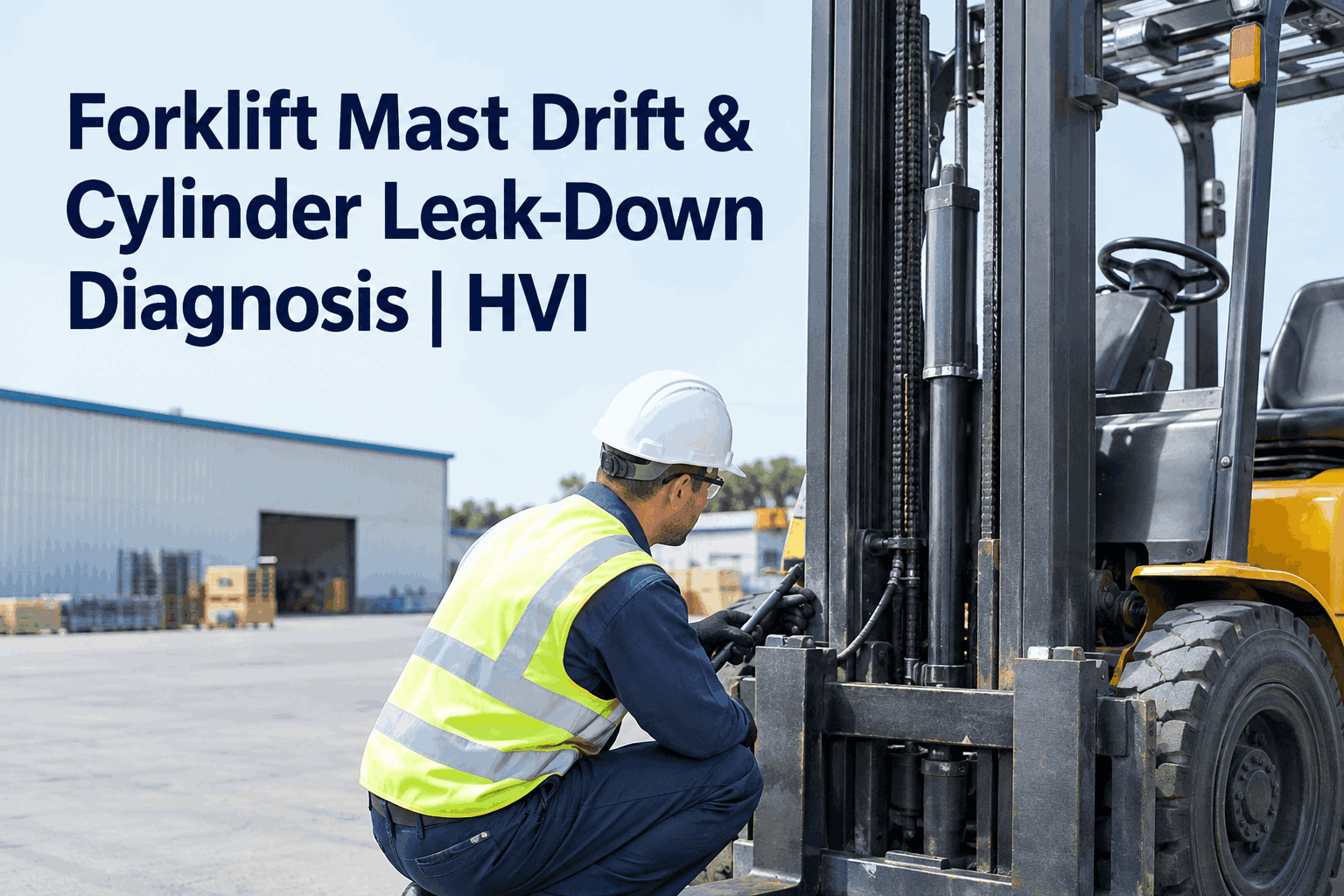
A forklift mast that slowly settles after you set a load and let go isn't a quirk — it's a hydraulic holding component leaking internally. Forklift mast drift is one of the clearest warnings of a cylinder seal bypass or a control-valve leak, and left alone it becomes a load that won't stay where an operator needs it. This page walks the controlled drift test, how to tell a leaking cylinder from a leaking valve, and when the truck comes out of service. Book a demo to see the drift measurement captured and routed.
When the Mast Won't Hold, It's Leaking Inside
A raised load that creeps down on its own is an internal hydraulic leak — at a cylinder seal or a control valve. The only way to know which, and whether it's out of spec, is a controlled drift test measured against your truck's own limit.
Every hydraulic lift truck has a small allowable creep — no forklift holds a load perfectly forever. The problem starts when that creep exceeds the manufacturer's limit, because past that point the mast is no longer reliably holding, and a settling load is a hazard the moment someone works near it. So the question is never "does it drift" but "does it drift more than the manual allows."
What Mast Drift Actually Tells You
Mast drift — also called vertical creep or load settling — is the mast or load moving down from where the operator left it, with the controls in neutral and no input. Because the hydraulics are supposed to hold that position, any movement past spec means fluid is escaping past a seal or a valve somewhere it shouldn't.
The load won't stay put
A raised load slowly sinking is the visible symptom. In a rack or over a person, that settling is a real hazard — not a cosmetic annoyance.
Fluid is bypassing internally
There may be no external leak at all. The oil is escaping inside the system — past a cylinder piston seal or through a control valve — which is why you can't always see it.
That last point trips people up: a mast can drift badly with a bone-dry floor under it, because an internal leak doesn't drip. The seal or valve is passing fluid from one side of the circuit to the other, letting the load push itself down. Catching it means testing for it, not just looking for puddles. Book a demo to see a drift defect logged with its measurement.
The Controlled Mast-Drift Test
Drift is only meaningful when it's measured under controlled conditions and compared to the manufacturer's tolerance. The general procedure below follows the standard manufacturer method — run your model's exact version, with its own limits.
Warm the hydraulic oil
Cycle a capacity load up and down until the oil reaches operating temperature (manufacturers often specify around 65°C / 150°F). Cold oil reads differently — temperature matters.
Load and raise
With a rated-capacity load on the forks, raise them to the test height the manual specifies (commonly about 1 m / 3.3 ft), on level ground.
Neutral and measure
Put the lift controls in neutral and measure the vertical drop over the specified window — typically 10 minutes. Mark the start position and measure the settle.
Compare to the limit
Check the measured creep against your model's allowance. As an example, one manufacturer allows up to 100 mm (3.94 in) in 10 minutes for trucks up to 10 tons — but yours may differ, so use the manual.
The output of this test is a number, and that number is the whole point: it's either inside the manufacturer's tolerance or it isn't. Capturing it — not just "seems to drift" — is what turns a vague complaint into a defensible tag-out or a clean pass. That measurement belongs on the record, next to the truck and the date. Start free and capture the drift measurement on the check.
Cylinder Seal Bypass vs. Control-Valve Leak
Once the truck fails the drift test, the next question is where the leak is — because the fix is completely different. There are two main culprits, and one simple test tells them apart.
- Worn piston packing lets fluid pass the piston inside the cylinder
- The load pushes itself down through the cylinder itself
- Often paired with a scored rod or weeping gland seal
- Fix lives in the cylinder: reseal, or repair/replace it
- A worn check valve or spool in the control valve passes fluid
- Oil escapes back through the valve, not the cylinder
- A faulty velocity fuse or lowering valve can also be involved
- Fix lives in the valve: inspect, reseal, or replace the section
The isolation test that separates them: install a gate valve in each supply line between the lift cylinder and the control valve, raise a capacity load, and close the valves. If the load still drifts with the valves closed, the cylinders are bypassing and need resealing. If the drift stops, the leak is upstream in the control valve. That one check saves you from resealing a cylinder that was never the problem. Book a demo to see the diagnosis logged to the unit.
Tilt Drift and Other Holding Problems
Vertical creep is the most common, but the same internal-leak logic applies to any hydraulic holding function. Tilt drift — the mast slowly tilting forward or back after you release the lever — has its own set of usual suspects.
Tilt cylinder packing
Worn packing in a tilt cylinder lets it bypass, so the mast won't hold its tilt angle — the tilt equivalent of a lift-cylinder seal leak.
Tilt control valve
A leaking spool or check in the tilt section of the control valve lets the mast creep — test it the same isolation way as the lift circuit.
Cracked junction block
A cracked fitting or connection block above the operator, where tilt hoses join, can leak internally and cause persistent tilt drift — a pressure test confirms it.
The lesson across all of them: don't assume the first component you suspect. Tilt drift that survives repacked cylinders and a swapped control valve is pointing somewhere else — often a cracked block — and only methodical isolation finds it. Log what you tested and ruled out, so the next tech doesn't repeat your work. Start free and keep the diagnostic history on the unit.
What Causes and Worsens Mast Drift
Drift usually traces to one of a handful of root causes — and a couple of factors make any of them read worse. Knowing the list narrows the diagnosis before you pick up a wrench.
The classic cylinder-side cause — seals age and let the piston bypass fluid.
The valve that stops a runaway drop can itself pass fluid when defective.
A worn check valve or spool in the control valve lets the load bleed down.
Dirty oil scores seals and valve seats, turning a small bypass into a growing one.
Warmer, thinner oil slips past worn seals more easily — why the test specifies temperature.
Loads near or over rating and high hours accelerate seal and valve wear.
Two of these — fluid condition and temperature — are worth checking first because they're cheap to rule out and they distort every other reading. Clean, correct-viscosity oil at the right test temperature gives you an honest drift number; skip that and you may chase a seal that a filter change would have quieted. Book a demo to trend drift against fluid and PM history.
When to Remove the Forklift From Service
This isn't a "finish the shift and look at it later" defect. Under OSHA 1910.178, a powered industrial truck in unsafe condition must be taken out of service — and a load that won't hold is squarely that.
Forks that drift down under load, a mast that tilts without input, or any loss of load control is an immediate out-of-service condition — not a judgment call. The truck is tagged, the drift measurement and cause are logged, and it stays out until a repair is verified and signed off. Running a lift that can't hold a load over people is exactly the scenario the standard exists to prevent.
The measurement makes this defensible: a documented creep figure over the manufacturer's limit is a clear, auditable reason the truck came out of service — and the signed repair record is what puts it safely back. That chain, captured at the moment of the test, is the difference between a controlled process and a maintenance argument. Start free and get tag-out with a measurement attached.
Repair Considerations Once You've Found It
The diagnosis points straight at the repair. Which path you take depends on where the leak is and the condition of the parts around it.
If the cylinder bore and rod are sound and only the packing is worn, resealing the cylinder restores the hold at the lowest cost. The common first fix for a bypassing cylinder.
A scored rod, pitted bore, or damaged gland means resealing alone won't last — the cylinder needs machining/repair or replacement to hold reliably again.
If isolation pointed upstream, inspect the control valve, velocity fuse, and lowering valve — reseal or replace the affected section rather than touching the cylinder.
Whichever path, re-run the drift test after the repair and log the new measurement — a fix isn't verified until the creep is back inside the manufacturer's limit. That before-and-after pair on the record is what certifies the truck for return to service and closes the loop cleanly. Book a demo to see the verified-repair record close the work order.
How HVI Captures the Drift Test and Routes the Defect
The whole diagnostic only pays off if the measurement and the decision live on the record. Three capabilities make that automatic instead of a clipboard note that disappears.
Configurable test steps
Build the drift test into an inspection or PM checklist — warm-up, load, height, and the 10-minute measure — so techs run it the same way every time, to your model's spec.
Measurement & severity capture
Record the actual creep in millimeters, flag it against the tolerance, and set the severity — a pass is logged, a fail escalates automatically.
Routing & history
A failed test routes to a work order with the measurement attached, and the unit keeps a full history — every drift test, cause, and verified repair on one record.
The result is that a drifting mast stops being tribal knowledge and becomes data: a number, a cause, a repair, and a verified re-test, all tied to the truck. That's what makes the fix stick and the audit trail hold. It's the same measurement-and-routing discipline HVI brings to every forklift inspection you'd see in a demo. Start free and put the drift test on the record.
From a shop lead who chased a phantom mast drift
We resealed a lift cylinder twice on a truck that kept drifting — turned out the leak was a check valve in the control valve the whole time. The day we started running the gate-valve isolation test first and logging the creep in millimeters, the guessing stopped. Now the drift number goes on the record, the fix is verified with a re-test, and I'm not paying to reseal cylinders that were never the problem.
Frequently asked questions
What causes a forklift mast to drift down?
An internal hydraulic leak. The most common causes are worn piston packing in the lift cylinder (letting fluid bypass the piston) and a leaking check valve or spool in the control valve. A faulty velocity fuse or lowering valve, contaminated fluid, and hot thin oil can all cause or worsen it. Because the leak is internal, the mast can drift badly with no visible fluid on the floor — which is why you diagnose it with a measured test, not by looking for puddles.
How much mast drift is acceptable?
There's no single universal number — it's set by the manufacturer for your model. Every hydraulic lift truck has a small allowable creep; the limit is what matters. As one example, a manufacturer may allow up to 100 mm (about 3.9 in) of vertical creep in 10 minutes for trucks up to 10 tons, with a larger allowance for bigger trucks — but your model's manual gives the figure and test conditions that actually apply. Measure against that, not a rule of thumb.
How do you test forklift mast drift?
Warm the hydraulic oil to operating temperature by cycling a capacity load, then raise a rated load to the test height the manual specifies (often around 1 m / 3.3 ft) on level ground. Put the lift controls in neutral and measure the vertical drop over the specified window, usually 10 minutes. Compare the measured creep to your model's tolerance. Run the exact procedure and limits from your manufacturer, since temperature, height, and allowance all vary by truck.
Is it the cylinder or the control valve?
Use a gate-valve isolation test. Install a gate valve in each supply line between the lift cylinder and the control valve, raise a capacity load, and close the valves. If the load still drifts with the valves closed, the leak is inside the cylinders and they need resealing. If the drift stops, the leak is upstream in the control valve. This one test prevents you from resealing a cylinder when the real problem was the valve, or vice versa.
Should a forklift with mast drift be taken out of service?
If a raised load won't hold — forks drifting down under load, or the mast tilting without input — yes. Under OSHA 1910.178, a powered industrial truck in unsafe condition must be removed from service, and loss of load control qualifies. Tag it out, log the drift measurement and cause, and keep it out until the repair is completed and verified with a re-test that brings the creep back within the manufacturer's limit. A load that can't hold over people is exactly what the rule targets.
Make Every Mast-Drift Test a Measured, Routed, Verified Record
Build the drift test into your inspection, capture the creep in millimeters against the manufacturer's limit, route a failed truck to a work order with its history, and verify the repair with a re-test — all on one record per unit. Live in under two weeks, trusted by 25,000+ users worldwide.
No credit card · No hardware · Configurable inspection steps ready on day one