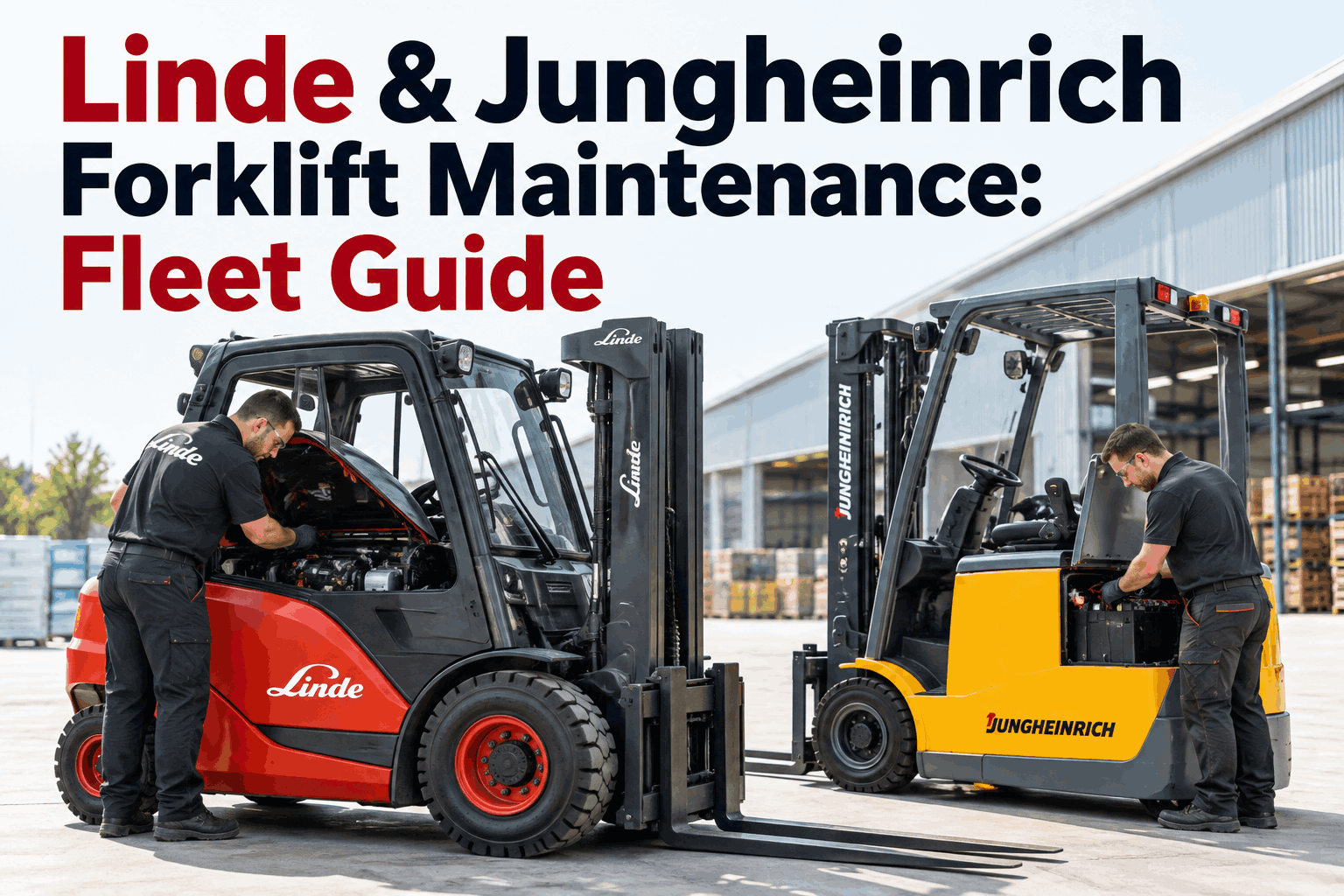
Linde Jungheinrich forklift maintenance becomes more complicated when both brands share the same warehouse fleet. Forks, masts, brakes, tires and safety systems create common inspection needs, but drive technology, batteries, model specifications and service requirements can differ significantly. The practical answer is one fleet-level maintenance process that still preserves the correct OEM requirements for every truck.
One Fleet View. Two OEM Maintenance Paths.
Standardize how your team manages inspections, PM, defects and history without forcing Linde and Jungheinrich trucks into the same maintenance schedule.
The goal is not to make Linde and Jungheinrich maintenance identical. It is to make the management process consistent: every asset has the right inspection template, the right preventive maintenance schedule, a visible repair history and comparable fleet-level maintenance information.
Standardize the Process — Not the Maintenance Specificationa mixed fleet needs common control without generic service intervals
Start by separating what can be standardized from what must remain specific to the truck. Asset identification, inspection completion, defect reporting, work history and maintenance status can follow one fleet process. Exact service intervals, fluids, procedures and replacement criteria should remain tied to the applicable Linde or Jungheinrich documentation.
Model, serial, power source, location and meter information.
Consistent completion, findings, photos and defect escalation.
Keep completed repairs and PM against the correct truck.
OEM-SPECIFIC
This distinction prevents a common multi-brand problem: simplifying administration by accidentally simplifying the maintenance requirement. If your warehouse has several makes and models, see how HVI can give each forklift its own PM schedule while keeping one fleet maintenance view.
Start With the Components Both Brands Still Sharethe common inspection foundation makes mixed-fleet execution easier
Regardless of brand, industrial trucks still depend on load-handling, travel and safety systems that need routine attention. The exact procedure and acceptance criteria can vary, but these shared maintenance areas provide a useful foundation for consistent warehouse inspections.
Foundation Linde + Jungheinrich
Wear, damage, locking and load-handling condition.
Lift components, rollers, channels and chain condition.
Hoses, cylinders, fittings, leaks and response.
Wear, damage and application-specific condition.
Operational response and abnormal condition.
Controls, warnings, guards and applicable restraints.
With custom digital equipment inspections, common checkpoints can remain consistent while brand- or model-specific questions appear only where required. For mixed fleets, see how HVI can separate Linde and Jungheinrich inspection requirements without creating two disconnected processes.
Linde Maintenance: Account for the Drive Architecturehydrostatic systems on applicable IC trucks create a different service profile
Linde's portfolio includes electric warehouse equipment as well as internal-combustion forklifts, and the maintenance plan should follow the actual model. A notable difference on applicable Linde IC ranges is the hydrostatic drive system, which replaces the conventional drivetrain architecture found on many industrial trucks.
Know which maintenance architecture is actually fitted.
Follow applicable fluids, intervals and technical procedures.
Keep drive-system work visible over the asset lifecycle.
Linde describes its hydrostatic drive as a low-maintenance system on applicable equipment, but that does not make the truck maintenance-free. The mast, hydraulics, engine-related systems, tires, safety equipment and other components still need the correct service attention. See how HVI can keep Linde-specific service requirements attached to the correct forklift record.
Jungheinrich Maintenance: Keep Battery and Electrical Records Visibleelectric fleets still need maintenance structure — just around different systems
Jungheinrich has a substantial electric equipment portfolio with both lead-acid and lithium-ion energy options. That makes battery identity, charging equipment, electrical condition and chemistry-specific requirements important parts of the maintenance record.
Follow applicable battery inspection, charging and maintenance requirements.
Use the approved truck, battery and charger requirements for the installed system.
Jungheinrich's lithium-ion systems use electronic battery management, while lead-acid batteries have a different maintenance profile. The practical fleet rule is simple: do not use one generic “electric forklift battery” checklist for every configuration.
Give Each Truck Its Own PM Logicone dashboard does not require one maintenance interval
The most useful mixed-fleet PM structure starts with the manufacturer requirement and then connects it to the truck's meter, calendar, configuration and application. This keeps maintenance administration centralized without turning different equipment into artificial equivalents.
Using meter- and calendar-based preventive maintenance lets the maintenance team manage different schedules from one place while preserving the source requirement for each truck. If spreadsheet rows are currently acting as your mixed-fleet PM system, see how HVI organizes different forklift maintenance schedules by asset and model.
Use Maintenance History to Compare Assets Without Pretending They Are Identicalfleet reporting becomes useful when you can move from the overview back to the individual truck
Mixed-brand reporting should help managers find expensive, unreliable or frequently unavailable equipment without stripping away the context behind those numbers. Compare maintenance activity at fleet level, then drill back into the specific asset history before deciding what action to take.
This gives maintenance managers a common reporting language while technicians still work from the correct model requirements. For fleets spanning several manufacturers or warehouse locations, see how HVI brings multi-brand forklift maintenance history into one reporting view.
Keep OEM Fleet Platforms and the Maintenance Layer in Their Proper RolesLinde connect and Jungheinrich FMS provide valuable OEM ecosystems; HVI should complement rather than imitate them
Linde connect can support functions such as operating-hour visibility, access control, impact information, usage analysis and battery-related data on configured equipment. Jungheinrich FMS combines technical and commercial fleet information and supports areas such as operating hours, costs, productivity, access control and impact events.
Connected truck, utilization, safety and fleet information depending on configuration.
Technical and commercial truck data, fleet analysis and connected management capabilities.
Manufacturer manuals, service documentation and diagnostic systems remain authoritative for truck-specific technical procedures. HVI organizes the maintenance workflow around those requirements.
Build the Fleet Record Around the Asset Lifecyclethe maintenance history should survive technicians, shifts, sites and equipment changes
The strongest mixed-fleet maintenance process is not a comparison spreadsheet created once a quarter. Each truck should accumulate a usable record from inspection through PM, corrective work and eventual replacement evaluation.
Capture condition and defects.
Apply the correct OEM-based PM.
Record labor, parts and findings.
See repeat work and downtime.
Use history for fleet planning.
That asset-level continuity is particularly useful when Linde, Jungheinrich and other brands operate together. Instead of rebuilding the maintenance story from invoices and spreadsheets, see how HVI keeps the full forklift maintenance lifecycle attached to each asset.
Linde & Jungheinrich Forklift Maintenance: Quick Answers
Can Linde and Jungheinrich forklifts use the same maintenance schedule?
They can share a common maintenance-management process, but they should not automatically use the same service intervals or technical procedures. Maintenance should follow the specific model, power source, operating conditions and applicable manufacturer documentation.
What is different about Linde hydrostatic forklift maintenance?
Applicable Linde internal-combustion forklift ranges use hydrostatic drive technology rather than a conventional drivetrain architecture. Maintenance teams should identify the actual drive system and follow the relevant Linde service requirements rather than applying a generic transmission-maintenance checklist.
What should be included in Jungheinrich electric forklift maintenance?
In addition to common forklift areas such as forks, mast, brakes, tires and safety equipment, maintain records for the installed battery, charger and electrical system. Battery tasks should reflect whether the truck uses lead-acid, lithium-ion or another approved configuration.
How should a warehouse manage maintenance across multiple forklift brands?
Keep model-specific service requirements at asset level while standardizing the surrounding workflow. A central system can manage inspections, PM due dates, repair history, costs and status across the fleet without forcing different trucks onto one generic service schedule.
Does HVI replace Linde connect or Jungheinrich FMS?
No. OEM platforms provide their own connected-fleet and manufacturer-specific capabilities. HVI can complement those ecosystems by providing centralized inspection, preventive maintenance, asset-history and multi-brand maintenance workflows. OEM manuals and authorized technical information should remain the source for model-specific service procedures and specifications.
Manage Linde and Jungheinrich as One Fleet Without Maintaining Them as One Machine
Give every forklift the right inspection and PM requirements while keeping maintenance history, open work and fleet-level reporting visible in one place.