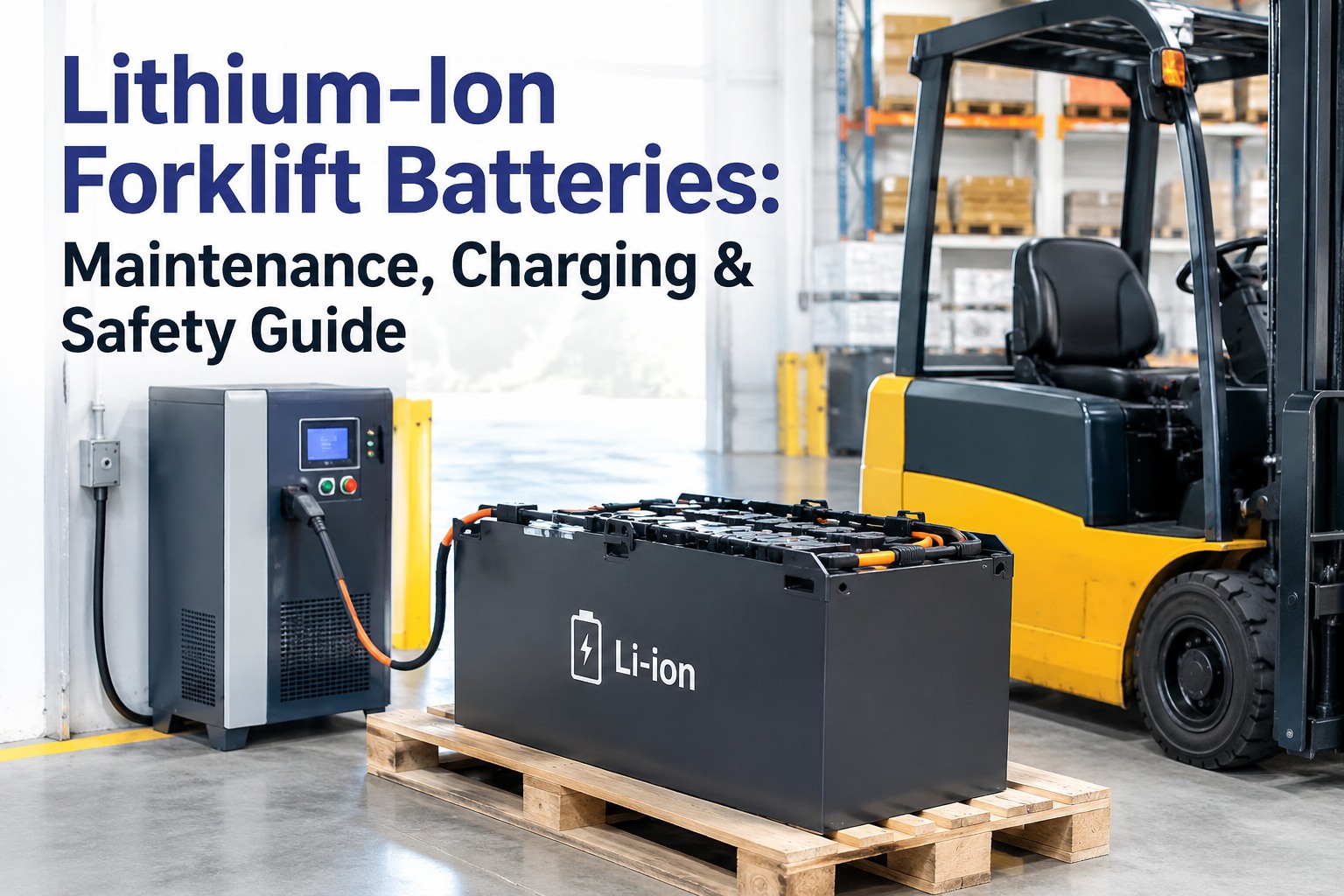
Switch a forklift fleet to lithium-ion and the battery room goes quiet — no more watering, no equalizing, no swapping packs mid-shift. That is why lithium-ion forklift batteries are taking over warehouses. But "maintenance-free" is the phrase that gets fleets in trouble, because it isn't the same as "ignore-free." A lithium-ion battery still needs the right charging discipline, a healthy battery management system, and periodic checks — a completely different set from the lead-acid chores you know. This guide covers what actually changes, and whether the switch pencils out for your operation.
The Chores Go Away. The Discipline Changes.
Lithium-ion eliminates the lead-acid maintenance you know — and replaces it with a smaller, different set of things that actually matter. Carry over the old habits and you'll manage the new battery wrong.
- Watering cells
- Equalization charges
- Ventilated battery room
- Cool-down periods
- Battery swapping
- A healthy, monitored BMS
- Correct charger & charging habits
- Avoiding cold-charging & deep discharge
- Damage inspection before use
- Tracking state of health over time
If you're a fleet, warehouse, MHE, or maintenance manager, you're likely either running lithium-ion already or weighing the switch — and either way, the risk is applying old assumptions to new chemistry. Lead-acid habits either don't help or actively harm a lithium-ion pack, while the things lithium-ion genuinely needs are easy to overlook precisely because the daily chores disappeared. This guide is about running the new chemistry correctly, and making a clear-eyed decision about whether it fits your operation.
The BMS: The Brain You Don't Manage Manuallywhat the battery management system does — and why it's the whole game
The defining difference between lithium-ion and lead-acid is the battery management system, the electronics built into every lithium-ion pack. Where lead-acid relied on a human to water cells and run equalization charges to keep them balanced, the BMS does that work automatically and continuously — it's the reason lithium-ion is "maintenance-free" in the first place.
The BMS constantly monitors voltage, current, and temperature across the cells, and protects the battery from the three things that damage or endanger it: overcharging, over-discharging, and overheating. It balances the cells so they don't drift apart, and it will shut the battery down if it detects an unsafe condition. Critically, it's also your safety system — the BMS is the primary safeguard against thermal runaway. That has two practical implications. First, you don't manage cells manually anymore; you let the BMS do it and never bypass its protections to squeeze out extra runtime. Second, because the BMS is doing so much, it's the most common failure point on a lithium pack — which is why quality, certified batteries with a proven BMS are worth paying for, and why keeping the BMS healthy and its firmware current is the real maintenance job. Book a demo to track BMS health alerts and state of health per battery
Charging & Opportunity Chargingthe biggest operational advantage — used correctly
Charging is where lithium-ion changes warehouse operations most, and the headline feature is opportunity charging: topping up the battery during natural breaks — a meal break, a shift change, an idle period — instead of running one pack down and swapping in another. Because lithium-ion tolerates partial charging without damage (a habit that wrecks lead-acid), one battery can run across multiple shifts, charged in the gaps.
The operational payoff is large: no dedicated charging room, no spare batteries staged for swaps, no labor changing packs, and no gassing, so the battery charges right where it works. For a multi-shift operation, eliminating battery swapping alone changes the economics — but it only works if the charging discipline above is followed, using chargers matched to your specific battery system. Start free and schedule charger checks and battery inspections in one place
The Actual Lithium-Ion Maintenance Listshort, but not empty
Here's the honest version of lithium-ion maintenance: it's genuinely short, but it's not nothing. The daily chemistry chores are gone; what remains is periodic monitoring, inspection, and protecting the pack from the few things that harm it.
Periodically check the battery management system's status and the pack's state of health (SOH), the BMS's read on remaining capacity. A steadily declining SOH is your objective signal that a pack is nearing end of life — and heed every BMS alert rather than clearing it.
Before use and charging, check the pack, connectors, and cables for damage, swelling, corrosion, or heat marks. A damaged lithium battery is a safety risk — remove it from service and follow the manufacturer's process rather than running it.
Verify clean, tight connections and confirm the charger stays matched and compliant. Keep firmware current via a professional. On counterbalance retrofits, verify ballast, since lithium packs are lighter than the lead-acid they replace.
That's the core of it. Against lead-acid — weekly equalization taking hours of downtime, daily watering, acid cleaning, ventilation — the maintenance reduction is dramatic. But none of the remaining items are "do nothing." The failure mode for lithium fleets isn't overwork; it's assuming maintenance-free means unmonitored, and missing a declining SOH or a BMS alert until it's a problem. Book a demo to standardize lithium battery inspections across the fleet
Safety & Thermal Runaway, Honestlythe real risk, and what actually controls it
Thermal runaway — a self-sustaining overheating reaction that can lead to fire — is the safety concern people raise about lithium-ion, and it deserves a straight answer: the risk is real but manageable, and it's driven by specific, preventable causes rather than random failure.
Most industrial forklift lithium batteries use LiFePO4 chemistry, which is notably thermally stable and resistant to thermal runaway compared to some other lithium types. And the BMS exists precisely to prevent the conditions that cause it — overcharging, over-discharging, and overheating — shutting the pack down if it detects trouble. Thermal events overwhelmingly trace to avoidable causes: a non-compliant charger that bypasses BMS protection, physical damage to the pack, a failed or absent BMS, or a low-quality battery. That's why the safety practices are also the maintenance practices — use the approved charger, never bypass the BMS, inspect for damage and remove damaged packs, and buy quality certified batteries.
A few specifics worth knowing: lithium-ion eliminates two of lead-acid's biggest hazards — sulfuric acid spills and hydrogen gas generation — so in some respects it's the safer daily chemistry. But if a lithium fire does occur, water can worsen it; facilities should confirm the correct extinguisher type (specialized Class D or lithium-rated) and train staff on lithium battery handling, storage, and disposal, including never sending packs to landfill. Safety here isn't about fear — it's about the same handful of disciplines that also keep the battery healthy. Book a demo to build lithium battery safety checks into your inspections
Lithium-Ion vs Lead-Acid: The Real Decisionit's not universal — it depends on your operation
The honest framing is that lithium-ion isn't automatically right for every fleet — the decision turns on how you actually operate. Here's the comparison that matters, without pretending one answer fits all.
Single-shift operations with tighter budgets and existing chargers can still get genuine value from lead-acid — if they keep up the watering and equalization. Lower purchase price, higher ongoing maintenance and labor.
Multi-shift, high-frequency, cold-storage, or labor-constrained operations usually come out ahead with lithium over a multi-year horizon — longer cycle life, opportunity charging, no swapping, less labor and space. Higher upfront, lower lifetime cost.
The factors that push the decision toward lithium are shift count, planning horizon, temperature environment, labor availability, and existing infrastructure. On cycle life, industry sources generally put lithium-ion around 3,000 or more charge cycles against roughly 1,000–1,500 for lead-acid, and multi-shift lead-acid operations often need two or three batteries per truck where lithium needs one. Analyses commonly find lithium's total cost of ownership lands meaningfully lower over a five-year horizon for those higher-utilization operations — but the exact numbers depend entirely on your usage, so run them on your own operation rather than trusting a generic figure. Start free and track per-battery cost to build your own TCO comparison
Planning the Transition From Lead-Acidinfrastructure, phasing, and the ROI case
If the decision points to lithium, the switch is a project, not a purchase — and the fleets that do it well plan the infrastructure and the phasing rather than just buying batteries.
On infrastructure, the good news is lithium removes the dedicated ventilated battery room, but you still need charging points positioned where opportunity charging actually happens — near break areas and staging, not in a back corner. Confirm electrical capacity for the chargers. On phasing, many fleets transition gradually, running mixed chemistries during the rollout; if you do, be careful with chargers, since lead-acid and lithium chargers aren't interchangeable, though some advanced chargers handle multiple profiles — verify compatibility with each battery's manufacturer rather than assuming. On counterbalance trucks, remember lithium packs are lighter, so ballast may need verifying to preserve the truck's rated capacity. On the ROI case, the savings come from real, countable sources — eliminated swapping labor, reclaimed battery-room space, fewer batteries per truck, longer replacement intervals, and reduced downtime — so build the business case from your own operation's numbers on each of those, not a vendor's headline percentage. Book a demo to track the cost data that supports a lead-acid-to-lithium business case
From a fleet manager who switched a multi-shift operation
The battery room emptying out was the visible win — no more swap crew, no more acid, no more waiting on cool-downs. What I didn't expect was how easy it'd be to get complacent. "Maintenance-free" got into people's heads and suddenly nobody was looking at the batteries at all.
We had a pack whose state of health had been sliding for months and nobody clocked it, because there was no routine anymore. That's the trap. Now we track SOH and the BMS alerts on a schedule like any other asset — the daily chores are gone, but the monitoring isn't optional. Run it that way and lithium is everything it's sold as. Ignore it because it's "maintenance-free" and you'll get surprised.
Lithium-ion forklift batteries: the takeaway
Lithium-ion forklift batteries deliver on the promise — less maintenance, opportunity charging, longer life, a quieter battery room — but only for fleets that understand what "maintenance-free" actually means. It means the chemistry chores are gone, not that the battery is unmanaged. Let the BMS do its job, charge with discipline, keep the short inspection routine, respect the real (and preventable) safety risks, and decide based on how your operation actually runs. Do that, and the switch pays off exactly as advertised. Book a demo to run lithium battery inspections, SOH tracking, and cost analytics in HVI
Frequently asked questions
Do lithium-ion forklift batteries need maintenance?
Yes, but far less than lead-acid, and of a completely different kind. Lithium-ion batteries eliminate the daily and weekly chemistry chores that lead-acid demands: no watering of cells, no equalization charges, no acid cleaning, and no dedicated ventilated battery room, because the built-in battery management system (BMS) handles cell balancing automatically. However, "maintenance-free" is not "ignore-free." Lithium-ion still requires periodic monitoring of the BMS status and the battery's state of health, inspection of the pack and connections for physical damage before use, keeping the charger matched and compliant and firmware current, and, on counterbalance retrofits, verifying ballast since lithium packs are lighter. The failure mode for lithium fleets is not overwork but complacency — assuming a maintenance-free battery means an unmonitored one and missing a declining state of health or a BMS alert until it becomes a problem. The practical approach is to treat the battery as a monitored asset with a short scheduled routine, even though the labor-intensive lead-acid tasks are gone.
What is opportunity charging for lithium forklift batteries?
Opportunity charging is the practice of topping up a lithium-ion forklift battery during natural periods of downtime — a meal break, a shift change, or any idle period — rather than running the pack down and swapping in a fully charged spare. It is one of lithium-ion's defining advantages, and it works because lithium tolerates partial charging without damage, whereas doing the same to a lead-acid battery would shorten its life. Opportunity charging lets a single battery run across multiple shifts, charged in the gaps, which eliminates the labor and equipment of battery swapping, removes the need for staged spare batteries and a dedicated charging room, and reduces downtime. To do it correctly, use only the charger approved and matched to the battery's BMS, let the BMS manage the charge (it stops at full, so leaving a pack plugged in does not overcharge it), and avoid routinely draining the pack to near-empty even though lithium tolerates deeper discharge than lead-acid. For multi-shift operations, opportunity charging is often the single biggest operational reason to switch to lithium.
What does a forklift battery management system (BMS) do?
The battery management system is the electronic brain built into every lithium-ion forklift battery, and it is the reason the chemistry is considered low-maintenance and safe for daily industrial use. The BMS continuously monitors voltage, current, and temperature across the battery's cells and protects the pack from the three conditions that damage or endanger it: overcharging, over-discharging, and overheating. It automatically balances the cells so they do not drift apart in charge (the job a human did manually with equalization charges on lead-acid), and it will shut the battery down if it detects an unsafe condition, making it the primary safeguard against thermal runaway. It also reports the battery's state of health, the measure of remaining capacity used to judge end of life. Two practical implications follow: first, operators should never bypass or override BMS protections to gain extra runtime, since those protections prevent dangerous failures; and second, because the BMS does so much, it is the most common failure point on a lithium pack, which is why buying quality, certified batteries with a proven BMS and keeping its firmware current matters.
Are lithium-ion forklift batteries safe?
Yes, when they are quality units used correctly, and in some respects they are safer for daily use than lead-acid. Most industrial forklift lithium batteries use LiFePO4 chemistry, which is thermally stable and resistant to thermal runaway, and every pack includes a BMS specifically designed to prevent the conditions that cause overheating. Lithium-ion also eliminates two of lead-acid's biggest hazards: sulfuric acid spills and the hydrogen gas generated during lead-acid charging. The genuine risk, thermal runaway leading to fire, is real but overwhelmingly traces to preventable causes: using a non-compliant charger that bypasses BMS protection, physical damage to the pack, a failed or absent BMS, or a low-quality battery. That is why the key safety practices are also the maintenance practices — use the approved charger, never bypass the BMS, inspect for and remove damaged packs, and buy certified batteries. Facilities should also confirm the correct fire extinguisher type, since water can worsen a lithium fire, and train staff on proper handling, storage, and disposal, including never sending batteries to landfill.
Is it worth switching from lead-acid to lithium forklift batteries?
It depends on how your operation runs, and the honest answer is that lithium is not automatically right for every fleet. The decision is driven by shift count, planning horizon, temperature environment, labor availability, and existing infrastructure. Single-shift operations with tighter budgets and functioning lead-acid chargers can still get genuine value from lead-acid, provided they keep up the watering and equalization. Multi-shift, high-frequency, cold-storage, or labor-constrained operations usually come out ahead with lithium over a multi-year horizon, because of longer cycle life (industry sources generally cite around 3,000-plus cycles for lithium versus roughly 1,000 to 1,500 for lead-acid), opportunity charging that eliminates battery swapping, fewer batteries needed per truck, and lower labor and space requirements. Total cost of ownership analyses commonly find lithium lands meaningfully lower over about five years for higher-utilization operations, but the exact figures depend entirely on your usage, so the right approach is to build the business case from your own numbers on swapping labor, space, battery count, replacement intervals, and downtime rather than relying on a generic percentage.
Keep your lithium fleet monitored, not just "maintenance-free"
The BMS manages the cells — HVI manages everything around it. Schedule the periodic lithium battery inspections and charger checks, log the BMS-reported state of health so you catch a declining pack early, track each battery as an asset with full history, and roll up the cost data that proves your lithium investment and supports the transition case. The monitoring layer that stops a maintenance-free fleet from quietly becoming an unmonitored one.
No credit card · No hardware required to start · Equipment inspections & asset tracking on day one