LPG forklift maintenance lives or dies on the small things your operators do every day: how they handle a 33-pound cylinder swap, whether they actually sniff-test the connections, and whether anyone has looked at that regulator since last quarter. Unlike an electric unit where the daily check is mostly a battery gauge, a propane forklift carries a pressurised fuel system, indoor carbon monoxide exposure and a carburettor that drifts out of tune — and most of the daily items sit with the operator, not your technician. If your current system is a laminated card on the cage and a binder nobody opens, it is worth seeing how a 30-minute walkthrough of digital LPG inspections replaces both.
Is your LPG fuel system being checked daily — or just assumed to be fine?
A propane forklift runs on a pressurised flammable gas system inside your building. The leak check, the cylinder change and the regulator condition are operator-level daily items, and the paper trail proving they happened is what protects you when something goes wrong.
The real numbers behind propane forklift service
LPG forklifts remain the workhorse of mixed indoor-outdoor fleets, but the fuel system adds a layer of daily discipline that electric units simply do not have. These are the figures that matter when you defend the inspection budget internally.
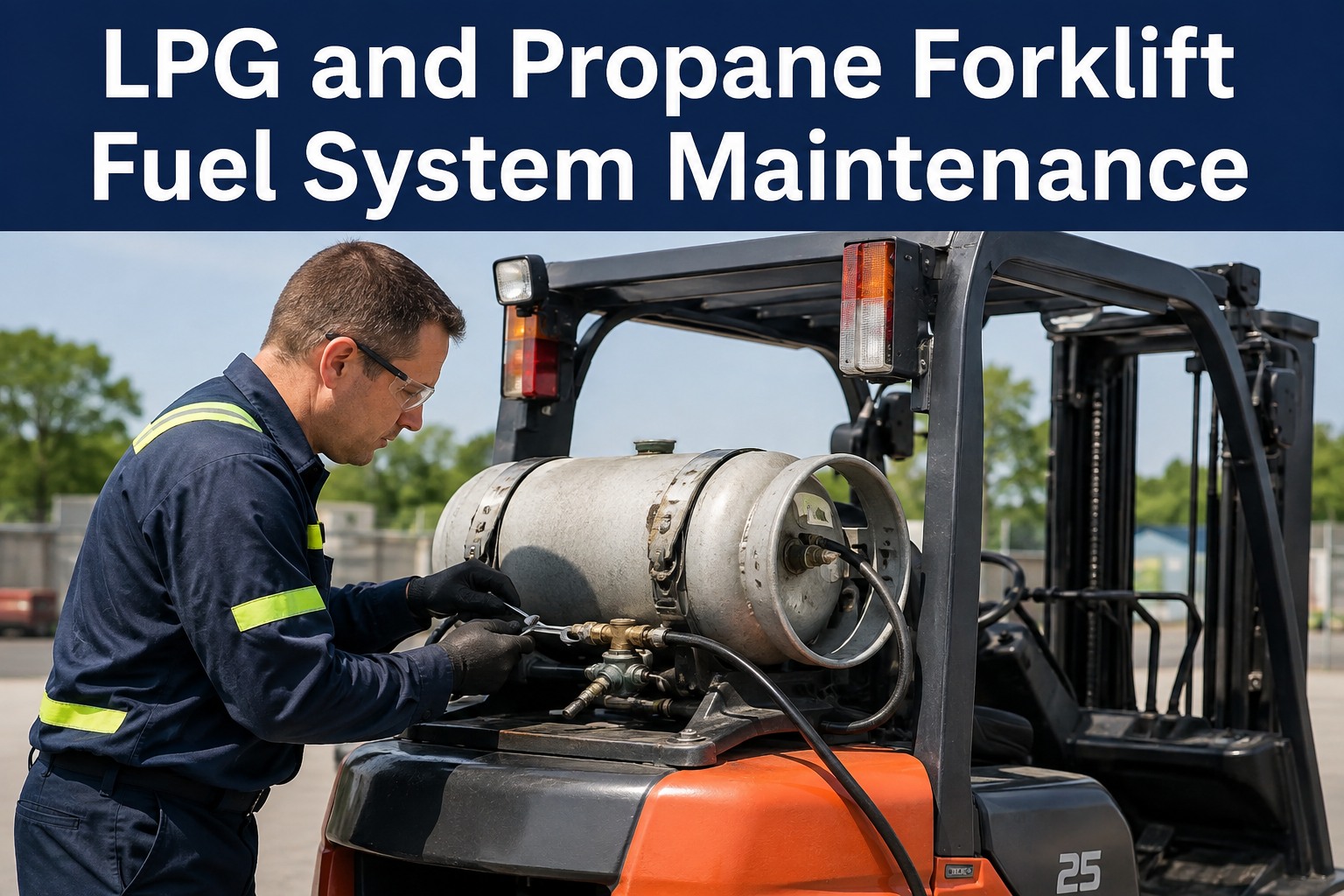
Cylinder handling and changing: the 6-step procedure
The cylinder swap is where most LPG incidents and injuries start. A rushed change with a cross-threaded connection or a cylinder dropped on a toe is a recordable injury and a gas release in one move. This is the sequence your operators should follow every single time.
Park, shut down, close the service valve
Park on level ground, set the brake, lower the forks and shut the engine off. Close the cylinder service valve fully before touching any fitting. Let the engine run the line dry if the design allows it.
Disconnect with gloves and eye protection
Liquid propane causes instant frostbite on skin contact. Gloves and safety glasses are non-negotiable. Crack the fitting slowly and stand to the side, never directly over the connection.
Lift with legs, not back — use the bracket
A full 33-pound cylinder at awkward height is a classic manual handling strain. Use the truck's cylinder bracket or swing-out arm where fitted, keep the cylinder vertical and never roll or drop it.
Inspect the new cylinder before mounting
Check the cylinder for dents, rust, damaged foot rings and a legible test date. Look at the O-ring on the service valve — a cracked or missing O-ring is the single most common source of connection leaks.
Mount, align and secure the bracket
Seat the cylinder so the locating pin engages the collar hole, then tighten the bracket or strap fully. A loose cylinder vibrating against its bracket wears hoses and fittings over weeks.
Reconnect, open slowly, leak-check
Hand-tighten the fitting, open the service valve slowly, then leak-check every connection you touched with a soap solution or electronic detector. Bubbles mean shut down and fix — never "it will seat itself."
When these six steps live inside a free digital inspection template on the operator's phone, with a required photo of the secured cylinder, the skipped-step problem largely disappears.
LPG leak checks and regulator inspection: what happens when
The biggest maintenance mistake on propane fleets is treating the fuel system like the rest of the truck — something the technician sees every 250 hours. The leak check is a daily operator item. The regulator and vaporiser are the primary technician service components. Confuse the two and both get missed.
| Component | Check | Frequency | Who |
|---|---|---|---|
| Cylinder, valve, O-ring | Damage, test date, leak test at connection | Every cylinder change | Operator |
| Hoses and fittings | Cracks, chafing, kinks, soap-solution leak check | Daily, pre-shift | Operator |
| Regulator / converter | Visual condition, frost patterns, mounting security | Daily visual; full service per hours | Operator / Technician |
| Vaporiser | Coolant connections, heat exchange, lock-off function | Hour-based PM (typically 250–500 hrs) | Technician |
| Carburettor and mixer | Idle quality, mixture setting, air filter condition | Hour-based PM | Technician |
| Ignition system | Plugs, leads, timing, spark quality | Hour-based PM | Technician |
| Exhaust and emissions | CO output, smoke, ventilation adequacy | Periodic, site-dependent | Technician / Safety |
HVI splits these naturally: the daily items sit in the operator's LPG-specific pre-shift checklist, while the hour-based PM lines generate work orders automatically as each truck approaches its interval. You can see that split running on a live demo fleet before you commit to anything.
LPG cylinder storage and indoor emissions: the two quiet risks
Two risks on propane fleets rarely make the maintenance meeting until something goes wrong: how and where you store spare cylinders, and what the exhaust is doing to the air your people breathe all shift.
Cylinder storage requirements
- Ventilation first: store cylinders outdoors or in a dedicated ventilated cage — propane is heavier than air and pools at floor level in enclosed rooms.
- Separation: keep storage away from exits, stairwells, ignition sources and oxidisers; full and empty cylinders segregated and clearly marked.
- Quantity limits: most jurisdictions cap how many cylinders may be kept inside a building — know your local limit and enforce it at the cage, not on paper.
- Secured and upright: cylinders chained or racked so they cannot fall, valves closed, protective caps on any cylinder not connected.
Indoor carbon monoxide exposure
- The mechanism: a mistuned propane engine produces carbon monoxide; in a warehouse with closed dock doors in winter, concentrations build through the shift.
- Ventilation adequacy: general dilution ventilation is the baseline — if your building relies on open doors, your CO risk doubles the day the weather closes them.
- Monitoring: operations with long indoor run times increasingly fit fixed or personal CO monitors — the exposure limit is an 8-hour average, and symptoms start well below it.
- The maintenance link: CO output is a tuning problem. A forklift with a drifting carburettor or fouled plugs emits multiples of a well-serviced unit — engine service content is an emissions control, not just reliability work.
See every leak check, cylinder change and PM — timestamped, on one screen
Book a 30-minute demo and we will load your LPG checklist into HVI so you can watch an operator complete it on a phone, photo evidence included.
What a missed regulator service actually costs
Take a 12-truck propane fleet in a regional distribution centre. One truck's regulator starts sticking — the operator notices a rough idle and a faint gas smell but the paper checklist has no line for it, so it gets a shrug and the truck keeps working.
Now the same fleet on HVI: the operator flags "gas smell / rough idle" on the pre-shift check with a photo, the defect converts to a work order automatically, and the regulator is swapped at the next break for the cost of the part. Multiply that pattern across a year of small fuel-system defects and the software pays for itself on avoided callouts alone. If you want to run the numbers on your own fleet, book a demo and bring your downtime figures — we will map them live.
LPG forklift maintenance, built into the daily workflow
LPG-specific inspection variants
Dedicated propane checklists with cylinder-change steps, leak-check lines and CO-awareness prompts — not a generic forklift template with gas items bolted on. Operators complete them on any phone in under five minutes.
Hour-based preventive maintenance
Regulator, vaporiser, carburettor and ignition service scheduled by engine hours with due and overdue alerts — so the 250-hour service actually happens at 250 hours, not when the truck breaks.
Photo evidence on every defect
A cracked O-ring or chafed hose gets photographed at the truck and attached to the defect record — no more text-message photos lost in a group chat, and instant defect-to-work-order conversion.
Audit-ready safety records
Every inspection timestamped, attributed and retrievable in seconds — the proof a safety auditor, insurer or client wants when they ask how you manage flammable gas equipment indoors.
Propane forklift PM: the short version
Daily items belong to operators
The leak check, cylinder condition and connection integrity are pre-shift items. Give operators a checklist that actually contains them and a phone to complete it on.
The regulator is your primary service component
Regulator and vaporiser health drives reliability, fuel economy and CO output. Schedule them by engine hours and never let the interval slide.
Storage and air quality are maintenance issues
Cylinder storage discipline and engine tuning both control your indoor risk. A well-maintained LPG fleet is an emissions strategy, not just an uptime one.
The record is the defence
When an incident or audit comes, the question is never "did you maintain it" — it is "show me." Timestamped, photo-backed digital records answer it in seconds. You can start building that record free today.
The thing that used to keep me up was the cylinder swap. Sixty changes a day across three shifts, and my only evidence was a tick on a card. Now every change has a photo of the secured cylinder and the leak check result, and I can pull any truck's history in about ten seconds. We caught two cracked O-rings in the first month that would have sailed straight through the old system.
Daniel Reeves — Safety & Compliance Manager, regional cold-storage logistics operator
LPG forklift maintenance FAQs
How often should a propane forklift fuel system be inspected?
What is the correct procedure for changing an LPG forklift cylinder?
Are propane forklifts safe to use indoors?
What are the storage rules for spare LPG cylinders?
Can software really manage LPG-specific inspections, or is a generic checklist enough?
Put your LPG fuel system on record — starting with tomorrow's first shift
Digital propane inspections, hour-based PM and photo-backed defect records on any phone. Book a demo and we will build your LPG checklist with you, live.
Free to start — Works on any phone — No card needed