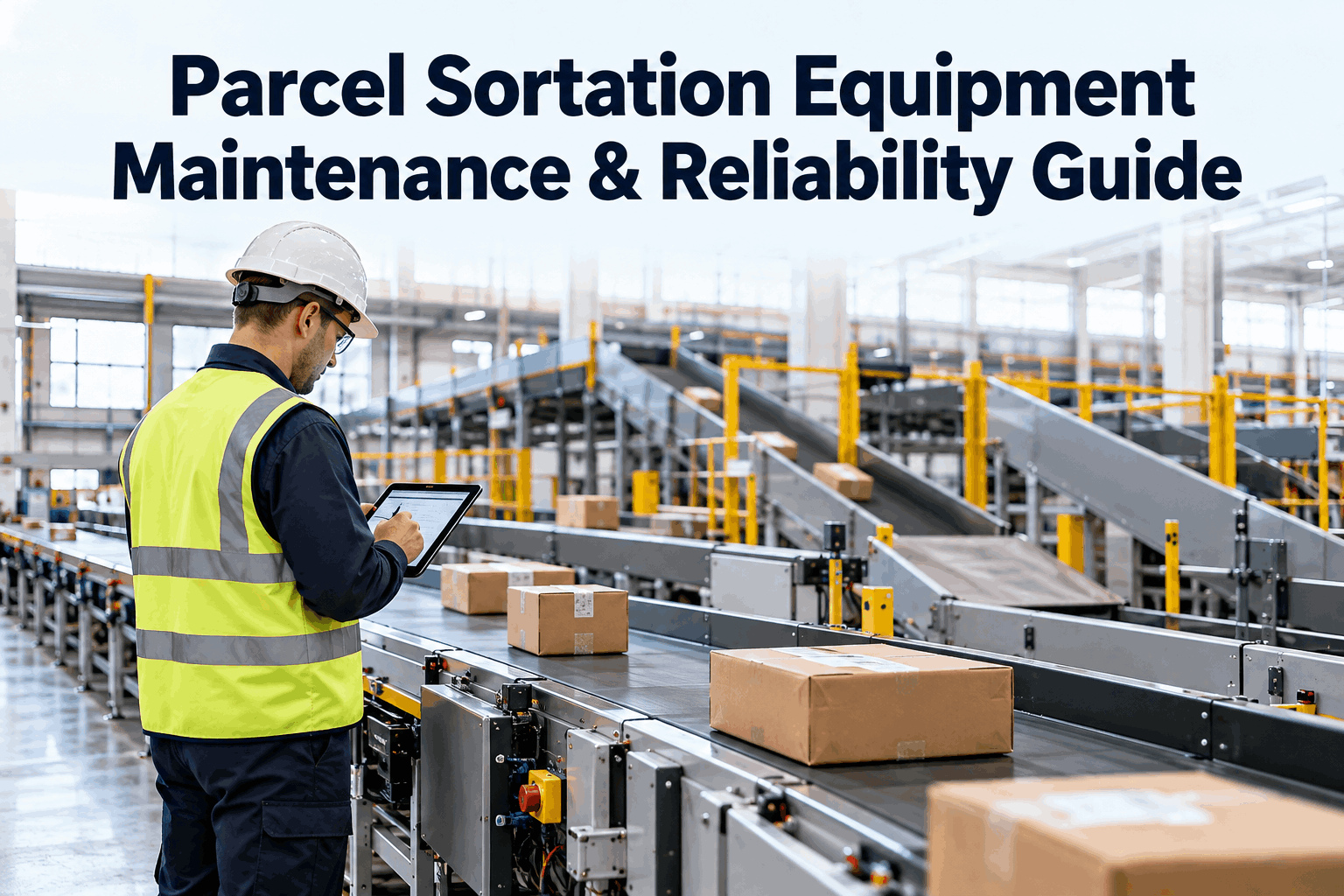
When parcels start recirculating, a divert misses repeatedly or one induction lane begins backing up, the problem rarely looks like maintenance at first — it looks like lost throughput. Parcel sortation equipment maintenance helps teams catch worn rollers, dirty sensors, drive issues and recurring defects before a small fault becomes a shift-wide bottleneck.
Keep Parcels Moving Before a Small Fault Becomes a Bottleneck
A high-throughput sortation line is only as reliable as the handoffs inside it. Give conveyors, scanners, sensors, drives, diverts and destination equipment a clear inspection, PM and repair history.
A reliable parcel hub needs more than a conveyor checklist. The maintenance program should follow the parcel through induction, identification, transport, diverting and destination equipment — then connect what technicians find to scheduled work, spare parts and previous repair history.
One Parcel, Several Maintenance-Critical Handoffsfollow the flow instead of treating the sorter as one asset
A parcel can enter the line correctly and still fail further downstream. Breaking the system into logical maintenance zones gives technicians clearer inspection points and gives managers better records than a generic “sorter issue.”
Zone-based records make the history useful. Instead of recording only “sorter repaired,” technicians can identify where the condition occurred, what they found and what action followed. Book an HVI demo to map your sortation assets.
The Warning Signs Show Up Before the Shutdownturn ordinary shift observations into maintenance signals
A sorter does not have to stop completely to tell you something is changing. Repeated jams, unusual noise, tracking changes, misreads and recurring intervention at the same location can justify a closer maintenance inspection.
That history changes the maintenance decision. A fault that appears minor today may deserve more attention when the same asset has generated several similar events recently.
Build PM Around the Way the Sorter Actually WorksOEM guidance first, operating duty and history second
There is no responsible universal maintenance interval for every parcel sorter. Equipment design, operating hours, parcel mix, contamination, peak periods and manufacturer requirements all affect how frequently components should be inspected or serviced.
HVI's preventive maintenance tools help teams schedule recurring work and retain completion history. The maintenance interval still comes from OEM requirements and your maintenance strategy; the system helps keep the work visible and traceable.
The Spare-Parts Shelf Is Part of Sorter Reliabilityfinding the fault early only helps when the repair can be completed
A maintenance team can identify a worn component early and still lose the repair window if the replacement is unavailable. Critical-spares planning should consider failure history, lead time and the operational consequence of not having the component when it is needed.
HVI's parts and inventory management helps teams connect stock visibility and parts usage with maintenance work instead of maintaining a separate inventory record that tells only half the story.
Find the Repeat Offender, Not Just the Latest Repairasset history turns separate events into a maintenance pattern
The useful reliability question is often not “what failed today?” but “what keeps coming back?” Keeping inspection findings and completed repairs attached to the asset gives maintenance managers the context needed before approving another identical repair.
A connected history helps the next technician see what has already been tried. Book a demo to see asset maintenance history in HVI.
Measure the Maintenance Process, Not the Sorter Logicfocus reporting on the questions your maintenance team can act on
HVI is not the PLC, WCS or WES controlling parcel routing and automation logic. Its value sits around the equipment: whether planned work is being completed, which assets keep generating repairs and where maintenance resources are being consumed.
Is planned maintenance being completed when expected?
Which assets keep returning for similar maintenance?
Which critical spares need attention before the next repair?
Which zones consume disproportionate maintenance attention?
HVI's analytics and reporting can help turn those maintenance records into a clearer view of recurring work, PM performance and asset history without implying control of the automation system itself.
A Practical Parcel Sortation Maintenance Loop
The strongest process is a loop rather than a stack of disconnected checklists. Each inspection either confirms condition or creates a clear next action, while every completed repair improves the history available for the next maintenance decision.
That is where HVI fits: as the maintenance-management layer around your sortation assets. If inspection records, PM schedules, repair history and spare-parts information currently live in different places, start organizing the maintenance workflow in HVI.
Parcel Sortation Equipment Maintenance: Quick Answers
What should parcel sortation equipment maintenance include?
The program should cover maintainable equipment across induction, identification, transport, sortation and destination areas. Depending on the installed system, this may include belts, rollers, bearings, drives, guides, scanners, photo eyes, sensors and divert mechanisms. Exact tasks and acceptance criteria should follow the manufacturer's instructions for each asset.
How often should parcel sortation equipment be inspected?
There is no single interval for every sorter. Begin with OEM inspection and maintenance requirements, then consider operating hours, duty cycle, contamination, parcel mix, seasonal peaks and maintenance history. Higher-duty equipment may require more frequent attention than equipment with lighter use.
How does a CMMS help with parcel sorter maintenance?
A CMMS can centralize inspections, preventive maintenance, corrective work, parts usage and asset history. That gives technicians more context and helps managers identify overdue work or recurring maintenance rather than treating each fault as an isolated event.
Which parcel sorter spare parts should be kept in stock?
Build the critical-spares list around OEM recommendations, your own failure history, replacement lead time and the operational consequence of not having a part. Frequently consumed wear items and long-lead components that can delay important repairs deserve especially close inventory control.
Does HVI control parcel sortation equipment?
HVI is an inspection and maintenance management platform around maintainable assets. It can help organize inspections, PM schedules, maintenance work, parts records, history and reporting. It is not positioned as the PLC, warehouse control system or warehouse execution system controlling parcel routing or sorter logic.
Turn Sorter Maintenance Into a Repeatable Reliability Process
Parcel sortation equipment maintenance becomes easier to manage when inspections, PM schedules, corrective work, critical spares and equipment history live in one connected workflow.