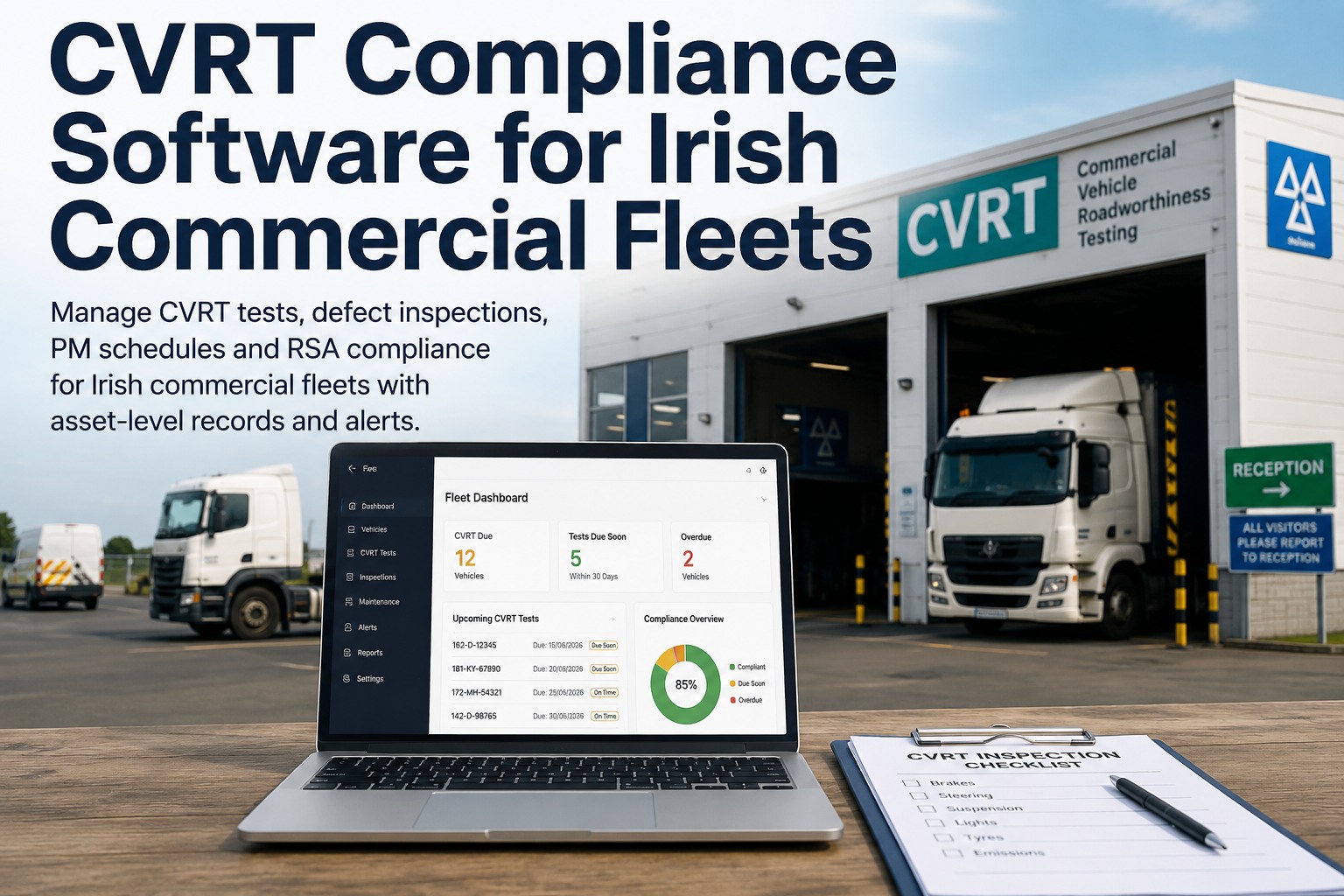
CVRT compliance software has to hold two things at once: the annual RSA test cycle for every N1, N2, N3, M2, M3, O3, and O4 asset, and the S.I. 348/2013 requirement to retain maintenance and defect records for at least two years. Miss either and CRW status lapses, or the audit file collapses. This guide covers the test regime, the 4 possible outcomes, and the workflow tying walkarounds, defect reporting, and PM into one audit trail — book a demo to manage CVRT in HVI.
The 4 CVR Test Outcomes — and What Each Means for Your Fleet
Aligned to Directive 2014/45/EU, every CVRT ends in one of four verdicts. Only two of them keep the vehicle earning.
No defects, or Minor only
Failed — repair & retest within 30 days
Fail Dangerous — do not drive from centre
Refusal to test
A fleet running with visibility of the outcome distribution across its assets can predict downtime and plan around it. Without it, every Major or Dangerous is a surprise event.
The rest of this page walks the CVRT regime by vehicle category, the two-year record retention rule under S.I. 348/2013, how daily walkarounds prevent test-day Fails, and what cross-border operators need to hold for Northern Ireland and GB in parallel. Book a 30-minute demo to see CVRT tracking against every asset in HVI.
Which vehicles need CVRT, and how often
The Commercial Vehicle Roadworthiness Test is administered by the Road Safety Authority (RSA) through the CVRT.ie network, and applies to commercial vehicles, buses, trailers over 3,500kg, and fast tractors. The regime is aligned to EU Directive 2014/45/EU. First-test timing and subsequent frequency vary by vehicle category, and getting the category right for each asset is the first requirement of any compliant fleet register.
| Vehicle category | Description | First CVRT due | Subsequent tests |
|---|---|---|---|
| N1 | Goods vehicles ≤ 3,500kg GVW (vans, jeeps, car vans) | 1 year after first registration | Annually thereafter |
| N2 | Goods vehicles 3,500kg – 12,000kg GVW | 1 year after first registration | Annually thereafter |
| N3 | Goods vehicles > 12,000kg GVW (HGVs, trucks) | 1 year after first registration | Annually thereafter |
| M2 | Buses ≤ 5,000kg (minibuses, >8 passenger seats) | 1 year after first registration | Annually thereafter |
| M3 | Buses > 5,000kg (coaches, large passenger vehicles) | 1 year after first registration | Annually thereafter |
| O3 | Trailers 3,500kg – 10,000kg design GVW | 1 year after first registration | Annually thereafter |
| O4 | Trailers > 10,000kg design GVW | 1 year after first registration | Annually thereafter |
| Fast tractors | Commercially-used tractors > 40 km/hr design speed | 4 years after first registration | Every 2 years |
| Motor caravan | Motor caravan (whether or not used commercially) | 4 years after first registration | Annually thereafter |
| Ambulance | Ambulance (all sizes) | 1 year after first registration | Annually thereafter |
Vehicles that fall outside CVRT scope include passenger cars (M1 category — subject to NCT instead), motorcycles (L category), light trailers under 3,500kg (O1 and O2 categories), and slow-speed tractors. Fleet registers that mix M1 pool cars with N-series commercial vehicles need to track both regimes separately because the test cadences and centres are different. Verify the current test cadence for any specific vehicle at RSA.ie or cvrt.ie before booking. Book a demo to see mixed-category fleet tracking with correct test cadence per asset.
S.I. 348/2013 — the 2-year record retention rule that catches most audits
The CVRT certificate is only half of the compliance picture. Under S.I. 348/2013 Reg. 10(3), operators must retain vehicle maintenance and defect records for at least 2 years. This is separate from the test itself — it's the ongoing evidence that the vehicle was maintained in roadworthy condition between tests. The Road Safety Authority, DVSA on cross-border operations, or a Transport Manager audit will ask for these records, and the two-year retention floor is not negotiable. What actually needs to be held per vehicle:
Daily walkarounds
- Driver pre-use walkaround check per shift
- Signed and dated by the driver
- Defects noted with detail (not "no defects" default)
- Retained for 2 years minimum
Defect reports
- Every driver-reported defect logged
- Corrective action documented (repair, monitor, VOR)
- Sign-off from mechanic or workshop
- Photo evidence of pre- and post-repair state
Planned maintenance
- PM inspections at manufacturer-recommended intervals
- Safety inspection every 6 to 13 weeks (typical HGV)
- Records of oil, filter, brake, tyre checks
- Signed by competent inspector
CVR certificates
- Copy of each CRW with issue and expiry date
- Copy of failure reports where applicable
- Retest results linked to failures
- Kept for at least the certificate validity period
The compliance failure that comes up most often on RSA or Transport Manager audit is not a missing CRW — it's a missing maintenance file for the period between CRW issue and the audit date. A CRW that expires next month is fine on its own; a CRW plus a folder of driver walkarounds, defect reports, and PM records dated across the past 12 months is the actual compliance position. Book a demo to see how HVI holds the full S.I. 348 audit file per asset.
Test preparation — how daily walkarounds prevent test-day Fails
The RSA publishes CVRT statistics annually, and the pattern is consistent: most Fails at CVRT are for defects that a proper driver walkaround and PM cycle would have caught weeks earlier. Test-day Fails are almost never a surprise — they're the accumulation of items that weren't logged, weren't fixed, or weren't followed up. Four categories account for the majority of Major and Dangerous fails.
Lights & signalling
Headlights, indicators, marker lights, brake lights, number plate lamps, reflectors. Bulb failures build up over weeks and drivers stop noticing. Weekly walkaround catches every one of these before test day.
Brakes & tyres
Brake wear, disc condition, tyre tread (below 1.6mm car / 1mm HGV), sidewall damage, incorrect pressures. Tyres are one of the most common Dangerous-category items on truck tests.
Emissions & underbody
Excessive smoke, DPF issues, exhaust leaks, corrosion on chassis members, brake pipe corrosion. Underbody condition on older vehicles is a common area of surprise Major faults.
Seatbelts, wipers, cab
Seatbelt condition and function, wiper blades, washer function, driver's seat security, steering play, mirror damage. Cab items are easy to defer and easy to fail on.
The operational fix is not a "prep for CVRT" event 2 weeks before the test date — it's the driver walkaround being taken seriously every shift, and the defect flow being closed every time. A vehicle that goes through 12 months of properly-signed walkarounds and closed defects passes CVRT nearly every time. A vehicle that goes through 12 months of "no defects" default entries fails almost every time. Start a free HVI trial to run driver walkarounds with real defect capture against every asset in your fleet.
Cross-border operations — Ireland, Northern Ireland, Great Britain
Three regimes, three enforcement bodies, one asset moving between all three
Ireland, Northern Ireland, and Great Britain each run their own commercial vehicle roadworthiness regime, and an asset moving across all three needs the paperwork for the jurisdiction it's currently operating in. The Republic of Ireland regime is CVRT under the Road Safety Authority (RSA), aligned to EU Directive 2014/45/EU, with annual testing at CVRT.ie centres. Northern Ireland regime is administered by the Driver & Vehicle Agency (DVA) with its own HGV/PSV testing at DVA test centres in NI. Great Britain regime is the MOT / HGV Annual Test administered by the Driver and Vehicle Standards Agency (DVSA), which is entirely separate from both Irish and NI regimes post-Brexit. A CRW issued in Ireland is not automatically valid in GB, and the reverse is also true — each jurisdiction requires the appropriate test to be current for the vehicle to be legally on-road there. Directive 2014/47/EU on roadside inspection creates a common EU framework for what a foreign-plated vehicle can be inspected against in another member state, but that's a checkpoint framework — it does not substitute for holding a valid CRW in the home jurisdiction and, where applicable, appropriate documentation for the operating jurisdiction. Operator licensing is also jurisdiction-specific: an Irish Road Transport Operator Licence does not cover GB operations, and a GB O-licence does not cover Ireland. Fleets running Belfast-Dublin-Manchester routes need three sets of paperwork per asset, three record retention schedules, and three sets of driver walkaround compliance in parallel. Verify current requirements with RSA (Ireland), DVA (NI), and DVSA (GB) for each vehicle and route.
An Irish transport manager on the shift from spreadsheets to asset-level records
We run 34 HGVs and 12 vans out of two depots in Leinster. The CRW spreadsheet was fine until it wasn't — two years back, a CRW expiry got missed on a trailer that then got pulled at a roadside check and off-road for three days. That's when we moved to per-asset digital records.
The two changes that mattered: automatic alerts at 90, 60, and 30 days before every CRW expiry, and daily walkarounds captured on driver phones with actual defect flow to the workshop. When the RSA audited us the following year, the maintenance file for every vehicle across the audit window was one export — not two people spending a week in the filing room. First-pass CVRT rate went from about 78% to 91% in the first year, mostly because defects stopped sitting in someone's head between the walkaround and the workshop.
Frequently asked questions
What is CVRT and which vehicles need it?
CVRT is the Commercial Vehicle Roadworthiness Test administered by the Road Safety Authority (RSA) through the CVRT.ie network of authorised test centres in Ireland. It is aligned to EU Directive 2014/45/EU and applies to commercial vehicles, buses, trailers over 3,500kg, and fast tractors. Vehicle categories covered include N1 (goods vehicles up to 3,500kg such as vans and jeeps), N2 (3,500kg to 12,000kg), N3 (over 12,000kg HGVs), M2 and M3 (buses and coaches with more than 8 passenger seats), O3 and O4 (trailers over 3,500kg design GVW), fast tractors with design speed over 40km/hr, motor caravans, and ambulances. Passenger cars (M1 category) fall under NCT instead. First test is generally due 1 year after first registration and annually thereafter, with the exception of fast tractors (4 years first test, every 2 years thereafter) and motor caravans (4 years first test). A passed test produces a Certificate of Roadworthiness (CRW) valid for 12 months, which must be displayed on the vehicle. Verify current requirements with RSA or at CVRT.ie for any specific vehicle.
What are the four possible CVRT test outcomes?
Every CVRT under Directive 2014/45/EU produces one of four results. Pass: no defects or Minor defects only. CRW is issued valid 12 months. Minor items should be fixed in the fleet's own PM cycle. Vehicle is fully legal for road use. Major (Fail): one or more defects classified as Major. CRW is not issued. Vehicle must be repaired and retested within 30 days at the same centre for a reduced retest fee. Vehicle is off road until retest passes. Dangerous (Fail): defect(s) classified as Dangerous constituting a direct or immediate risk to road safety. CRW is not issued. Vehicle must not be driven from the test centre — recovery vehicle required. Vehicle is fully off road until repaired. Refusal to test: test not carried out due to missing Presenter ID, vehicle unfit for test presentation, or paperwork gap. Full fee applies to rebook. Only Pass keeps the vehicle earning without downtime; Major and Dangerous both take the vehicle off the road immediately. The distribution of outcomes across a fleet's tests over time is a leading indicator of PM programme quality.
How long do I need to keep CVRT and maintenance records?
Under S.I. 348/2013 Regulation 10(3), Irish commercial vehicle operators must retain vehicle maintenance and defect records for at least 2 years. This is a floor, not a target — many operators retain records for the life of the vehicle to support residual value, insurance claims, and cross-border operator licence audits. The records that must be held include daily driver walkaround checks (signed and dated per shift), defect reports with corrective action documented, planned maintenance inspection records at manufacturer-recommended intervals (typically every 6 to 13 weeks for HGVs, per operator licensing guidance), copies of each Certificate of Roadworthiness with issue and expiry dates, and any CVRT failure reports linked to retest results. The compliance failure most commonly identified on RSA or Transport Manager audit is not a missing CRW — it's a missing maintenance file for the period between CRW issue and the audit date. A CRW plus a folder of driver walkarounds, defect reports, and PM records dated across the past 12 months is the actual compliance position, not the CRW alone.
What is the difference between CVRT, MOT, and NI HGV testing?
Three separate regimes cover commercial vehicle roadworthiness across the islands. Republic of Ireland: CVRT under the Road Safety Authority (RSA), aligned to EU Directive 2014/45/EU, tested at CVRT.ie authorised centres, produces a Certificate of Roadworthiness (CRW). Northern Ireland: HGV and PSV testing administered by the Driver & Vehicle Agency (DVA) at DVA test centres in NI — separate from the Republic's CVRT. Great Britain: HGV Annual Test administered by the Driver and Vehicle Standards Agency (DVSA), with car MOT for lighter vehicles — entirely separate from both Irish and NI regimes post-Brexit. A CRW issued in Ireland is not automatically valid in GB, and the reverse is also true. Directive 2014/47/EU on roadside inspection creates a common EU framework for what a foreign-plated vehicle can be inspected against in another member state, but does not substitute for holding a valid roadworthiness certificate in the home jurisdiction. Operator licensing is also jurisdiction-specific: an Irish Road Transport Operator Licence does not cover GB operations. Fleets running Belfast-Dublin-Manchester routes need three sets of paperwork, three record retention schedules, and three sets of walkaround compliance in parallel.
Why does CVRT compliance software matter over a spreadsheet?
A CRW spreadsheet is fine until it isn't. Three failure modes catch operators managing CVRT compliance on shared spreadsheets and folders. First, expiry tracking depends on someone remembering to look at the spreadsheet in time. When a CRW expires unnoticed, the vehicle is technically off-road from the expiry date, and a roadside check produces a fine, downtime, and a mark on the operator licence. Second, the maintenance file the RSA or Transport Manager needs at audit is scattered across the mechanic's clipboard, driver phones, WhatsApp threads, and the fuel card portal — assembling it takes days and typically has gaps that would fail an audit. Third, first-pass CVRT rate depends on defect flow being closed between walkaround and workshop, which paper and spreadsheet workflows simply don't enforce. CVRT compliance software addresses all three structurally: expiry alerts at 90/60/30 days per asset, daily walkarounds captured on driver phones with defect flow to the workshop, and the S.I. 348/2013 maintenance file exportable per asset for any date range. The result is fewer expiry surprises, higher first-pass CVRT rates, and audit files ready on demand.
Manage CVRT and RSA compliance from one asset-level record
HVI holds each vehicle's CRW expiry, daily walkaround record, defect and corrective work history, PM inspection cadence, and CVRT test history in one place. 90/60/30-day alerts before every CRW expiry. Defect flow from driver phone to workshop to sign-off. S.I. 348/2013 maintenance file exportable per asset for any date range. When the RSA audits, when a Transport Manager reviews, when a cross-border check happens — the file is one screen. Live in under two weeks. No hardware. No credit card.
Trusted by Irish haulage, distribution & passenger transport operators · Ready on day one