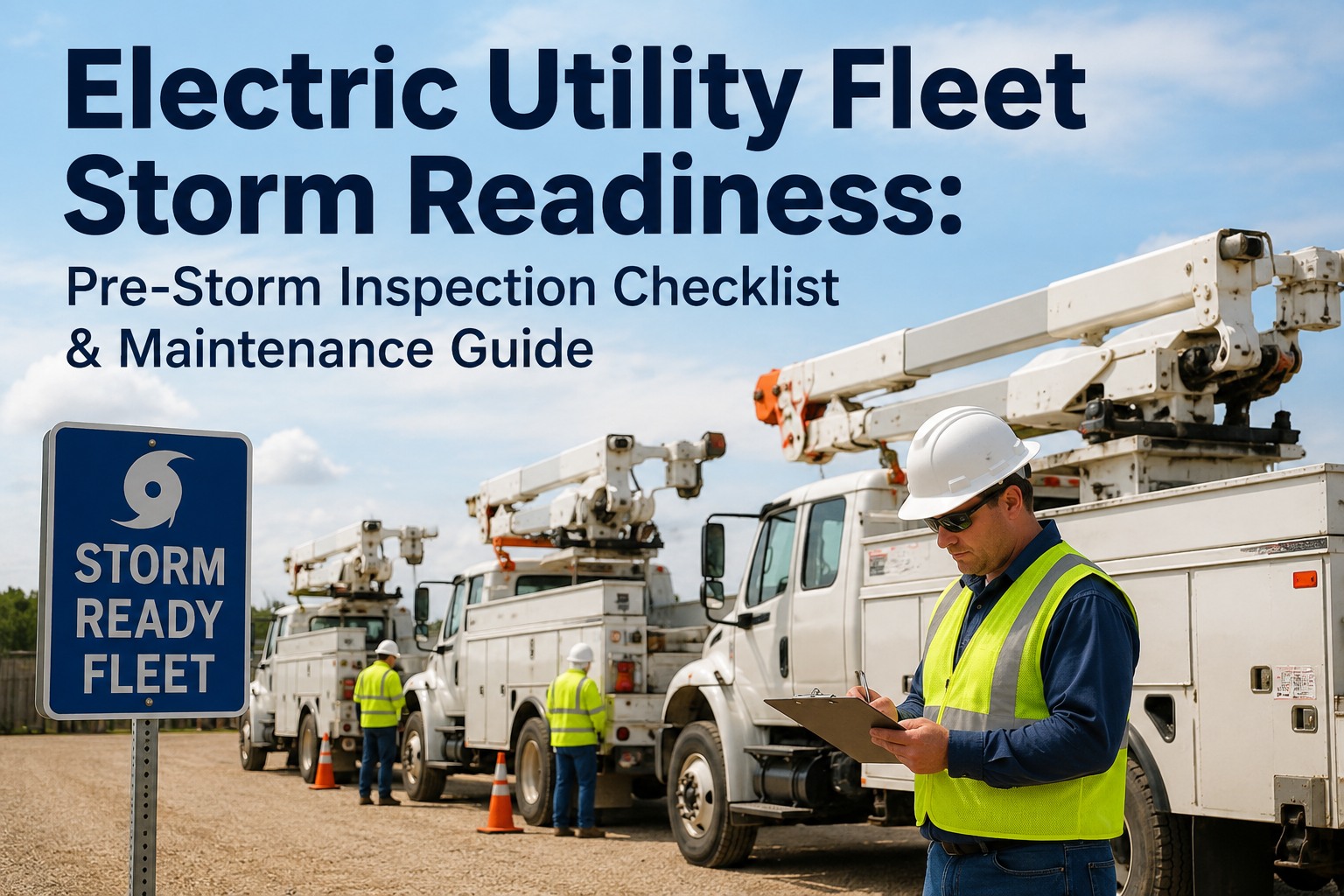
MEWP compliance software UK needs to hold two parallel regimes against every asset: LOLER Regulation 9 (6-monthly thorough examination by an independent competent person) and PUWER Regulation 6 (risk-based inspection intervals set by the duty holder). A clean LOLER report is not a PUWER pass, and a PUWER inspection does not substitute for a Schedule 1 thorough examination. Utility, DNO, and network operators running cherry pickers, scissor lifts, and vehicle-mounts across depots and contractors need both records per asset — book a demo to manage MEWP compliance in HVI.
LOLER and PUWER Both Apply to Every MEWP
The most common HSE finding on MEWP audits is treating a clean LOLER report as PUWER compliance. They are separate regimes with separate records.
LOLER Regulation 9
- Trigger: Fixed by statute — 6-monthly because MEWPs lift persons
- Who: Competent person, independent of daily maintenance
- Output: Schedule 1 Report of Thorough Examination
- Retention: Until next report or 2 years, whichever is later
- Reference: HSE ACOP L113 · INDG422
PUWER Regulation 6
- Trigger: Employer's risk assessment sets frequency
- Who: Competent person; in-house technician acceptable
- Output: Written inspection record with findings
- Retention: Available for HSE inspection; per site policy
- Reference: PUWER 1998 Reg 6 · ACOP L22
Pre-use daily checks are a third layer — PUWER + Work at Height Regulations 2005, operator responsibility. Neither LOLER nor PUWER replaces them.
The rest of this page walks the LOLER Schedule 1 report content, the PUWER risk-based interval logic, how contractor MEWPs get pulled into the same visibility model, and where utility and DNO fleets running storm response typically fall short. Book a 30-minute demo to see LOLER and PUWER tracked in parallel against every MEWP in HVI.
Schedule 1 — what a LOLER-compliant report must contain
The Schedule 1 requirements are what turn a service sheet into a thorough examination report. HSE inspectors specifically ask whether the reports on file meet Schedule 1, because a report missing any of the mandatory items is not LOLER-compliant regardless of who signed it. Eleven items are mandatory, and defect classification maps to three possible outcomes.
| Schedule 1 item | What it means | Common gap |
|---|---|---|
| 1. Employer name & address | Duty holder identified on report | Named as site instead of legal entity |
| 2. Equipment identification | Serial, fleet number, sufficient detail to identify uniquely | Only fleet number, no serial |
| 3. Examination date | Date physical examination completed | Date of report issue, not examination |
| 4. Last examination date | Prior thorough examination date | Missing when contractor first examines |
| 5. Examination location | Where the examination was carried out | Vague ("depot") vs specific address |
| 6. Purpose of examination | 6-monthly / installation / exceptional | Not specified — ambiguous trigger |
| 7. Parts examined & test results | What was checked, method, results | Generic tick-list instead of detail |
| 8. Defect & risk assessment | Any defect posing existing or imminent risk | Defect noted, risk classification missing |
| 9. Repair timescale | When repair must be completed | "ASAP" instead of specific timescale |
| 10. Next examination date | Latest date next examination must be completed | Not present on report |
| 11. Examiner & qualification | Name, qualification, employer of competent person | Signature only, no qualification detail |
The three defect outcomes carry different duty-holder actions. No defects: MEWP returns to service, next examination in 6 months. Defect requiring action: repair within the timescale specified on the report; MEWP may continue in service subject to any use restrictions the competent person specifies. Defect posing existing or imminent risk: MEWP must be taken out of service immediately; the competent person is required to notify the relevant enforcing authority (HSE for most workplaces, local authority for some sectors) as soon as practicable. Attempting to keep a MEWP in service with an unresolved imminent-risk defect is one of the fastest routes to enforcement action against the duty holder. Book a demo to see how HVI stores Schedule 1 reports per asset with expiry alerts.
PUWER inspection — when the risk-based interval is your call
PUWER Regulation 6 does not set a statutory frequency. The duty holder sets the inspection interval based on risk assessment: equipment type, use pattern, operating environment, defect history, manufacturer recommendations, and consequences of failure. For a MEWP in occasional light-duty indoor use, an annual PUWER inspection may be justified; for a MEWP in high-cycle utility storm-response work, monthly PUWER inspection is more likely defensible.
Light indoor use
- Scissor lift, indoor warehouse only
- < 100 operating hours per quarter
- Single trained operator
- Suggested PUWER: annual
- Pre-use check per shift
General outdoor use
- Truck-mount boom, mixed sites
- 100–400 hours per quarter
- Multiple operators, varied terrain
- Suggested PUWER: quarterly
- Pre-use check per shift
Utility / DNO field work
- Cherry picker for HV overhead lines
- 400+ hours per quarter, all weather
- Storm-response deployment
- Suggested PUWER: monthly
- Pre-use check per shift + supervisor spot-check
Exceptional / trigger-based
- Post-incident (collision, overload, impact)
- Post-major-repair (structural, hydraulic)
- After storage > 3 months
- Additional PUWER: on-trigger
- Additional LOLER: exceptional examination
The PUWER inspection record is written, retained, and available on HSE request. It documents what was inspected, findings, corrective actions, and inspector qualification. Unlike LOLER, the PUWER inspection can be performed by an in-house maintenance technician competent in the specific equipment — the independence rule that governs LOLER does not apply here. What both regimes share: the inspection must be genuine, not a rubber-stamp, and the record must be defensible if reviewed by HSE after an incident. Book a demo to see risk-based PUWER intervals per asset with defect flow.
Contractor MEWPs — where utility fleet visibility falls apart
Network operators, DNOs, and utility fleets routinely rely on contractor-owned or hire MEWPs alongside their own equipment. The compliance risk: the assumption that a contractor turning up with a MEWP has current LOLER, current PUWER, current operator IPAF training, and current insurance — and that assumption is where audits and post-incident investigations find the largest evidence gaps. HSE does not accept "the contractor said it was compliant" as evidence.
Pre-mobilisation evidence
Copy of current Schedule 1 LOLER report, PUWER inspection record, operator IPAF PAL card, insurance certificate, and manufacturer manual retained against the specific asset serial — before the MEWP is used on your site.
On-site pre-use verification
Your competent person spot-checks the MEWP on arrival: LOLER report matches serial, examination in date, no unresolved defects, operator familiar with the specific machine. Contractor's word is not the record.
Ongoing defect flow
Any defect identified during contractor use flows to the same defect register as owned equipment. Contractor is responsible for the repair; your record shows the defect was raised, communicated, and closed.
Off-site evidence retention
All evidence retained per your record retention policy after the contractor demobs. Post-incident inquiries can arrive months or years after the equipment leaves site — the evidence must survive their departure.
The visibility model that works: contractor MEWPs registered as assets in the compliance system before mobilisation, with the same expiry alerts, defect flow, and evidence retention as owned equipment. When the contractor demobs, the record stays — because the incident investigation happens against the site, not the contractor's yard. Utility and DNO operations running storm response with pre-agreed contractor pools are the most exposed on this if the pre-agreement doesn't extend to per-mobilisation evidence capture. Start a free HVI trial to bring contractor MEWPs into the same visibility as owned equipment.
Written Scheme of Examination — the one lever you have on frequency
You can shorten the LOLER interval — never lengthen it
Under LOLER Regulation 9(3), the duty holder can commission a Written Scheme of Examination from a competent person that specifies bespoke examination intervals for particular equipment or particular uses. In practice, this lever exists to shorten the statutory interval for high-risk, high-cycle, or safety-critical use cases — not to lengthen it. A Written Scheme cannot extend a MEWP's 6-monthly examination to 12 months on grounds of light use, and any attempt to do so leaves the duty holder exposed to enforcement action if an incident occurs in the extended interval. Legitimate use cases for a Written Scheme include: MEWPs in continuous 24/7 duty where 6 months of accumulated hours substantially exceed the exposure of a typical asset; MEWPs in aggressive environments (marine, chemical, high-vibration industrial) where accelerated wear justifies more frequent examination; MEWPs of an age or type where the manufacturer's own guidance specifies more frequent examination than LOLER's statutory minimum; and safety-critical use cases (near live overhead lines, hospital or healthcare work) where the risk assessment supports quarterly or monthly thorough examination. The Written Scheme itself must be drawn up by a competent person, retained on file alongside the examination reports, and reviewed periodically to ensure it remains fit for purpose. HSE inspectors familiar with the equipment class will ask to see the Written Scheme if the interval on the reports is anything other than the standard 6-monthly, and expect to see the technical justification from a competent person — not a duty-holder decision to change the interval unilaterally. The 6-month floor is what the regulation protects; below-floor bespoke intervals are the space the Written Scheme legitimately operates in.
A DNO fleet manager on the storm-response contractor visibility problem
We're a DNO with about 180 owned MEWPs across 14 depots — mostly truck-mounts for overhead line work — plus we pull in contractor MEWPs during storm response. During a bad autumn we might have 60 contractor units on the network for two to three weeks. Pre-2024 we handled contractor compliance on trust and paperwork emailed at mobilisation — and after a near-miss incident review, we discovered the LOLER report for one of the contractor units on the incident site had actually expired three weeks before the storm.
Contractor was reputable, meant no harm, but the report had genuinely lapsed and neither they nor we caught it. Full contractor MEWP visibility went into the compliance system after that: every contractor asset registered by serial before mobilisation, LOLER + PUWER + operator IPAF card scanned in at gate, expiry alerts run against contractor assets same as owned. Since implementation we've caught 11 expired documents at pre-mobilisation gate in 18 months — every one of them corrected before the asset went on network. Software cost per year is a small fraction of what a single serious near-miss investigation costs.
Frequently asked questions
How often does a MEWP need a LOLER thorough examination?
Every 6 months. Under LOLER Regulation 9(3), any lifting equipment used to lift persons must be thoroughly examined by a competent person at least every 6 months. All MEWPs (cherry pickers, scissor lifts, articulated boom lifts, telescopic boom lifts, spider lifts, trailer-mounted platforms, vehicle-mounted platforms) fall in that category because they exist specifically to elevate workers. The 12-month interval that applies to lifting equipment used for loads only does not apply to MEWPs. In addition to the 6-monthly interval, thorough examination is also required after installation at a new site, after significant modification, and after exposure to exceptional conditions that could affect safety (severe weather event, impact, overload). A Written Scheme of Examination drawn up by a competent person can specify bespoke intervals, but in practice this is used to shorten the 6-month interval for high-risk or high-cycle use, not to lengthen it. The duty holder has no discretion to extend the statutory interval unilaterally. The examination must be documented in a Schedule 1 Report of Thorough Examination and retained for at least until the next report is made, or 2 years, whichever is later.
What is the difference between LOLER and PUWER for MEWPs?
Both regulations apply to every MEWP and neither substitutes for the other. LOLER (Lifting Operations and Lifting Equipment Regulations 1998) is the statutory thorough-examination regime: Regulation 9(3) requires 6-monthly examination by a competent person, output is a Schedule 1 Report of Thorough Examination, and the competent person must be sufficiently independent of daily maintenance. LOLER intervals are fixed by statute; the duty holder has no discretion to lengthen them. PUWER (Provision and Use of Work Equipment Regulations 1998) is the routine inspection regime: Regulation 6 requires inspection at suitable intervals determined by the employer's risk assessment. Output is a written inspection record with findings. The competent person for PUWER can be an in-house maintenance technician competent in the specific equipment. Frequency depends on use, environment, defect history, and manufacturer recommendations. Both records must be held per asset and produced on HSE request. A clean LOLER thorough examination report is not a PUWER inspection record and vice versa — treating them as interchangeable is one of the most common HSE findings on MEWP compliance audits.
What must a LOLER Schedule 1 report contain?
Schedule 1 of LOLER lists 11 items that must appear on every thorough examination report. The name and address of the employer (duty holder). The identification of the equipment (serial number, fleet identifier, sufficient detail to identify uniquely). The date the examination was completed. The date of the last thorough examination. The location where the examination was carried out. The purpose of the examination (6-monthly / installation / exceptional). The parts examined, tests carried out, and results. Any defect and its assessment as posing existing or imminent risk to health and safety. The timescale within which any defect must be remedied. The latest date by which the next thorough examination must be completed. The name, address, and qualification of the competent person carrying out the examination, and their employer if applicable. A report missing any Schedule 1 item is not a LOLER-compliant report regardless of who signed it. HSE inspectors specifically ask whether reports on file meet the Schedule 1 requirements. Common gaps include: missing next-examination date, generic tick-list instead of parts-examined detail, defect noted without risk classification, "ASAP" repair timescale instead of specific date.
Can a service engineer carry out a LOLER thorough examination?
Not on equipment they maintain themselves. LOLER requires the competent person to be "sufficiently independent" of any daily maintenance arrangement for the same equipment, and HSE's Approved Code of Practice L113 sets out that the competent person should be practically independent of any maintenance contractor for the same asset. The reason: a maintenance contractor has a commercial interest in declaring the equipment safe, which is precisely the conflict the independence requirement exists to avoid. In practice this means a service engineer employed by the maintenance provider cannot sign off the LOLER thorough examination on equipment they or their firm maintains; the examination must be commissioned from an independent third-party competent person — typically an engineer surveyor from a SAFed-member inspection company or an equivalent qualified inspector. The independence requirement is stricter than PUWER, where an in-house maintenance technician can carry out the PUWER inspection on equipment they service. Failing the independence test can invalidate the LOLER report even if the examination was technically thorough, and HSE inspectors specifically ask who carried out the last thorough examination and what their relationship is to daily maintenance.
Are contractor MEWPs my responsibility?
When a contractor MEWP is used on your site or on your network, the compliance evidence is your responsibility as the site or network duty holder, even though the contractor owns the equipment. HSE does not accept "the contractor said it was compliant" as evidence during a post-incident investigation. The visibility model that stands up: before mobilisation, retain a copy of the contractor MEWP's current Schedule 1 LOLER report, PUWER inspection record, operator IPAF PAL card, and insurance certificate against the specific asset serial. On arrival, your competent person spot-checks the MEWP: LOLER report matches the serial, examination is in date, no unresolved defects, operator is familiar with the specific machine. During use, any defect flows to the same defect register as owned equipment — contractor is responsible for repair, your record shows the defect was raised, communicated, and closed. After demob, all evidence is retained per your record retention policy because post-incident inquiries can arrive months or years after the contractor leaves site. Storm response and pre-agreed contractor pools need per-mobilisation evidence capture; the pre-agreement is not a substitute for it.
Manage MEWP compliance for owned and contractor equipment from one record
HVI holds each MEWP's LOLER thorough examination cadence, PUWER inspection cadence, daily pre-use checks, defect and corrective work history, Schedule 1 report storage, and contractor-hired asset visibility in one place. 90-, 60-, and 30-day alerts before every LOLER expiry. PUWER intervals set per asset per risk profile. Schedule 1 reports exportable for HSE audit or insurance claim on demand. Contractor MEWPs held to the same evidence standard as owned assets. Live in under two weeks. No hardware. No credit card.
Trusted by UK utility, DNO, network operator & construction fleets · Ready on day one