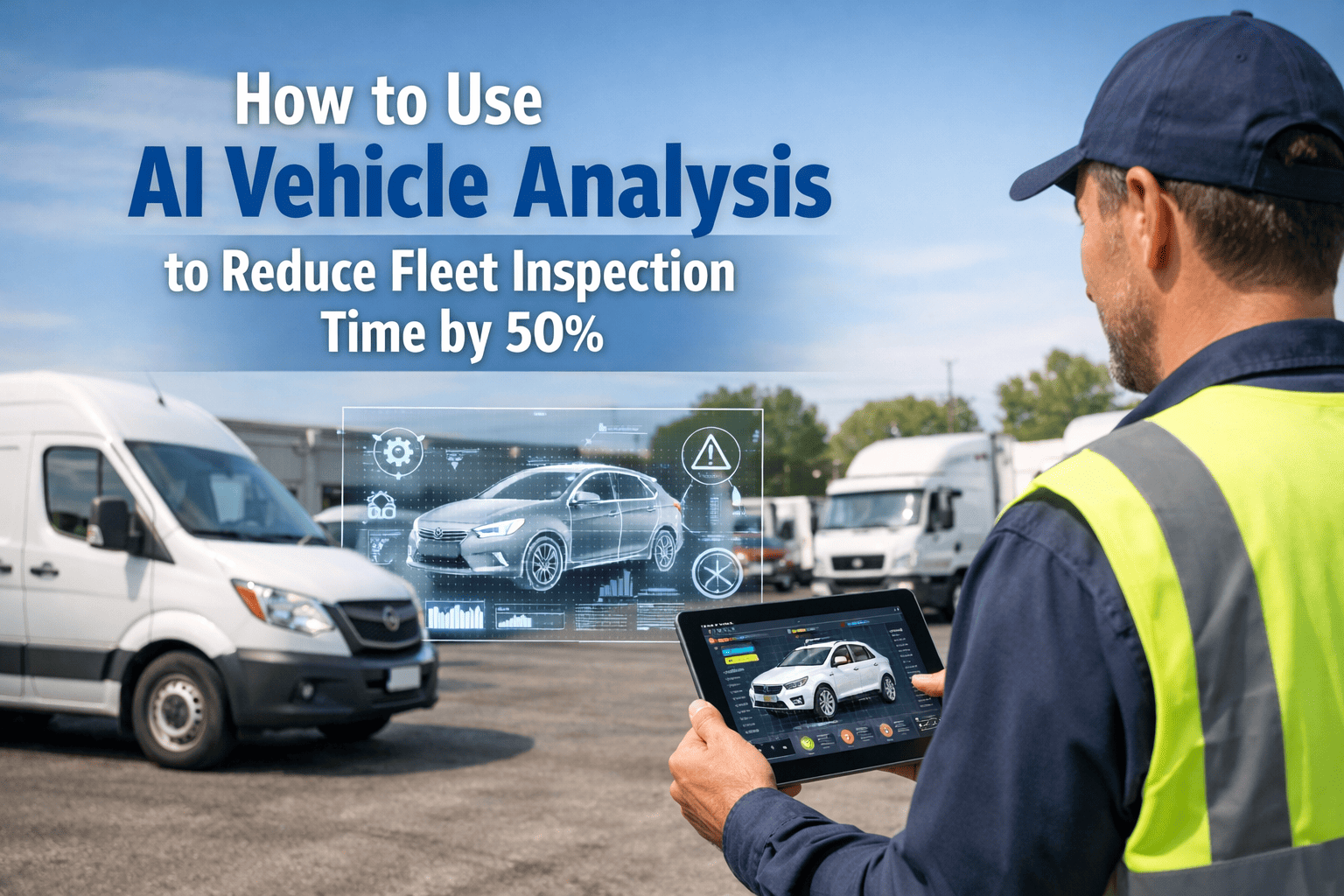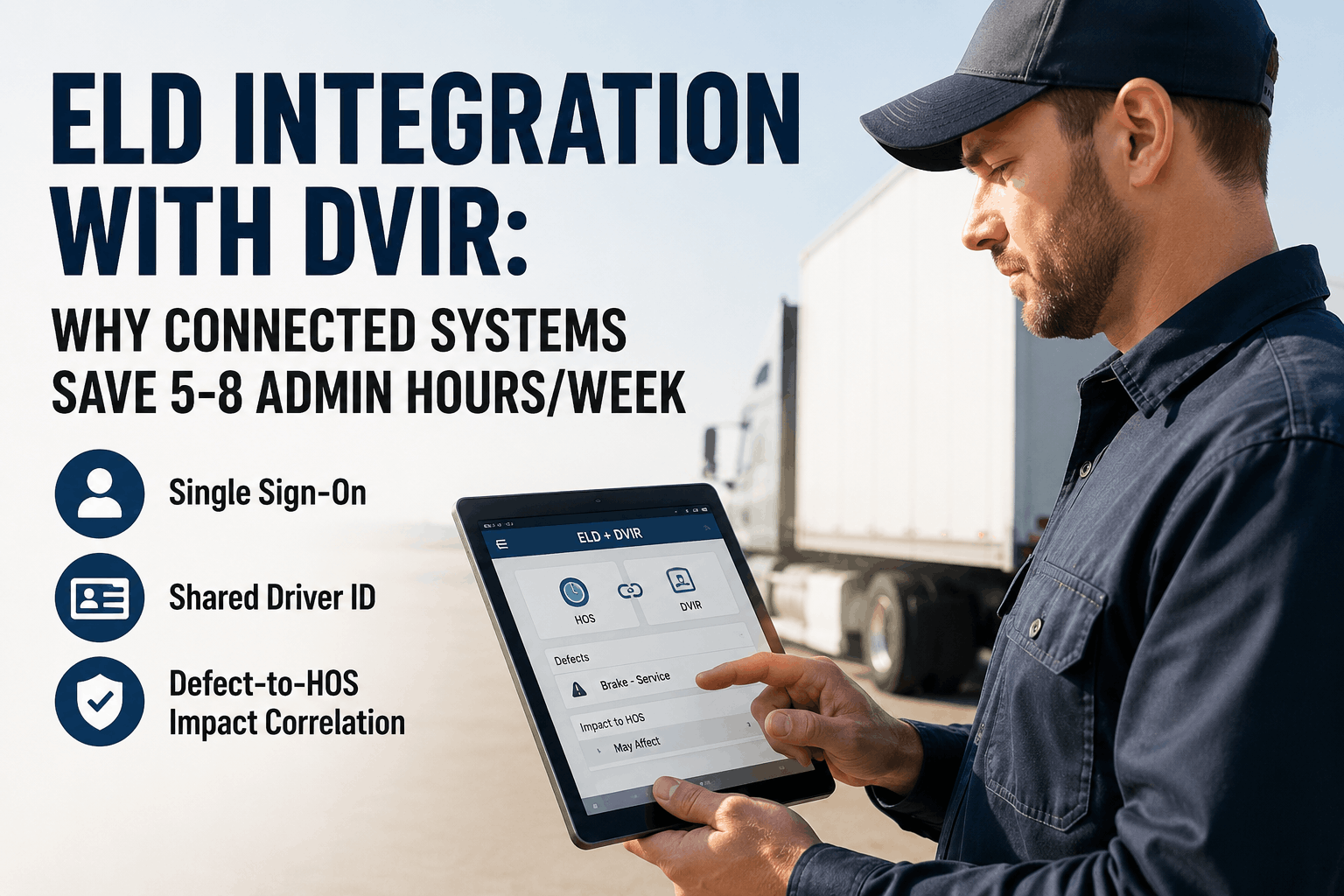
For fleet IT and operations teams, the ELD and the DVIR system are usually two separate logins, two separate driver databases, and two separate exports that someone has to manually reconcile every audit cycle. That disconnection is quietly costing 5–8 administrative hours per week — time spent re-keying driver IDs, cross-referencing defect reports against HOS logs, and assembling audit packets that should take 20 minutes but take 3–5 days. When ELD and DVIR run as connected systems sharing a single sign-on, a single driver identity, and a single data layer, that overhead largely disappears. This article breaks down exactly where the 5–8 hours go, the four integration mechanics that eliminate them (SSO, shared driver ID, defect-to-HOS-impact correlation, and unified audit export), and the architecture decisions that determine whether your two systems become one workflow or stay two silos. For fleet operations teams evaluating connected platforms, Start your free HVI trial to see how inspection data integrates with your compliance stack, or book a demo for an integration-architecture walkthrough.
Two silos vs one workflow — the architecture difference
The core problem isn't the ELD or the DVIR system individually. It's the gap between them. When they don't share identity and data, every cross-system task becomes manual. When they do, the system does the reconciliation for you.
- Two separate logins per admin
- Driver IDs maintained twice, manually synced
- Defects and HOS data never cross-reference
- Audit packets assembled by hand from two exports
- Credential gaps invisible until inspection
- Duplicate data entry across both systems
- Single sign-on across both systems
- One driver identity, one source of truth
- Defects auto-correlate to HOS and duty status
- Audit exports generate in one click
- Credential status verified before HOS starts
- Enter once, available everywhere
Where the 5–8 weekly hours actually go
"Admin overhead" is vague. Here's the specific task-by-task breakdown of where a fleet ops team loses time to disconnected systems — and how much each task costs per week for a typical 30–50 vehicle fleet.
The 4 integration mechanics that eliminate the overhead
Integration isn't a single switch — it's four distinct technical capabilities working together. Each one removes a specific category of manual work. A platform missing any one of them leaves a silo gap that admin time leaks through.
One credential set authenticates the admin across both ELD and DVIR systems. No second login, no separate password policy, no access-provisioning duplicated across two vendor portals. When a driver leaves, one deprovision closes both systems.
One driver record — not two that have to be kept in sync. CDL, medical cert, endorsements, and assignment live in a single profile that both systems read. Credential status verifies automatically before HOS recording starts, catching expired documents before the shift.
The technical heart of integration. A flagged DVIR defect links directly to the driver's duty status and HOS record, so you can see whether a vehicle defect occurred during on-duty time, whether a repair delay created a HOS violation cascade, and whether the same driver-vehicle pairing repeats defects.
One export pulls HOS records, DVIRs, defect histories, and credential documentation into a single audit-ready package indexed by driver, vehicle, and date. The 3–5 day manual assembly process collapses to a 20-minute generated export.
Defect-to-HOS correlation — the integration that matters most
Of the four mechanics, defect-to-HOS correlation is the one that's hardest to replicate manually and creates the most operational value. When a DVIR defect and the HOS record share a data layer, three correlations become visible that two siloed systems can never surface.
Was the defect present at pre-trip, or did it develop on-duty? Correlation shows exactly when in the duty cycle the defect was logged — which matters for liability, warranty claims, and identifying whether drivers are catching issues before or after they start driving.
When a defect pulls a vehicle out of service, the assigned driver's HOS plan collapses — they're now waiting, burning on-duty time, or being reassigned. Correlation quantifies the HOS cost of repair delays, making the case for faster maintenance response in hours, not gut feel.
Same defect, same driver-vehicle pairing, multiple times? Correlation surfaces whether it's a recurring mechanical issue or a driver-handling pattern. Two siloed systems would never connect the dots; one data layer makes the pattern obvious.
The real time-savings audit — task by task
Beyond the weekly admin hours, integration changes the unit economics of specific recurring tasks. Here's the before-and-after on the tasks fleet ops teams run most often.
One profile created once vs. duplicate entry in ELD and DVIR systems plus manual credential upload to both.
One unified export vs. pulling two separate datasets and reconciling them in a spreadsheet by hand.
One indexed audit package vs. manually matching HOS records to DVIRs to maintenance logs across systems.
Defect, driver, HOS context, and repair status in one view vs. cross-referencing timestamps across two logs.
Integration architecture — what fleet IT should evaluate
Not all "integrations" are equal. A platform that claims ELD-DVIR integration might mean anything from a nightly CSV sync to a true shared data layer. Here's the technical hierarchy fleet IT should evaluate, weakest to strongest.
Nightly CSV or API batch export from one system imported into the other. Data is stale by up to 24 hours. Driver IDs still maintained separately. Better than nothing, but most silo problems persist.
Systems exchange data via live API calls. Defects and HOS data can cross-reference in near-real-time. Driver IDs still maintained in two places but synced automatically. Eliminates most reconciliation work.
One driver identity, one data layer, one sign-on. ELD and DVIR are views into the same underlying data, not two systems exchanging messages. No sync lag, no reconciliation, no duplicate maintenance. This is the architecture that fully captures the 5–8 hour savings.
The hidden cost of staying disconnected
The 5–8 admin hours are the visible cost. The bigger risks are the ones that don't show up until an audit, an accident, or an insurance renewal. Fleet IT teams should weigh these against the cost of integration.
Disconnected systems make audit response slow and error-prone. Missing the link between a logged defect and its repair is exactly what auditors flag — and what turns a routine review into an expanded investigation.
"The data existed in one system but wasn't acted on because it lived in another" is not a defense. Courts treat logged-but-ignored compliance data as evidence of negligence in accident litigation.
Insurers discount premiums 8–15% for fleets that can document ELD compliance and clean CSA scores. Disconnected data makes that documentation hard to produce — leaving the discount on the table.
Without shared driver identity, an expired medical card or CDL endorsement can go undetected until a roadside inspection. Shared identity verifies credentials before HOS recording starts — closing the gap entirely.
How HVI fits a connected fleet compliance stack
HVI is the inspection-and-maintenance layer of a connected compliance architecture. It's built to integrate with ELD and telematics platforms via open API — so DVIR defects, PM schedules, and maintenance records share identity and data with your HOS system rather than living in a silo.
HVI connects to ELD, telematics, and TMS platforms through open API. Driver identity, vehicle data, and engine hours flow between systems rather than being re-keyed — the Tier 2/Tier 3 architecture, not file-based sync.
A flagged DVIR defect in HVI carries the driver, vehicle, timestamp, and duty-status context — so the defect-to-HOS correlation that matters most is built into the workflow, not assembled manually.
Every inspection, work order, repair certification, and PM record indexed by VIN and date — exportable as a single audit package in under a minute, ready to pair with your ELD's HOS export.
HVI runs the inspection-and-maintenance side independently — so you can switch ELD vendors (or survive an ELD revocation) without breaking your DVIR and maintenance compliance chain.
The cleanest connected-fleet architecture keeps inspection and maintenance on a platform that integrates with — but doesn't depend on — any single ELD vendor. Start your free HVI trial to see how HVI fits your compliance stack, or talk integration architecture with the team.
Frequently asked questions
Two systems, one workflow. Stop losing 5–8 hours a week to the gap between your ELD and your DVIR.
HVI integrates with your ELD and telematics stack through open API — sharing driver identity, defect data, and audit exports so compliance becomes one connected workflow instead of two silos. No vendor lock-in, no sync lag.
No credit card required · Open-API integration · Unified audit export from day one