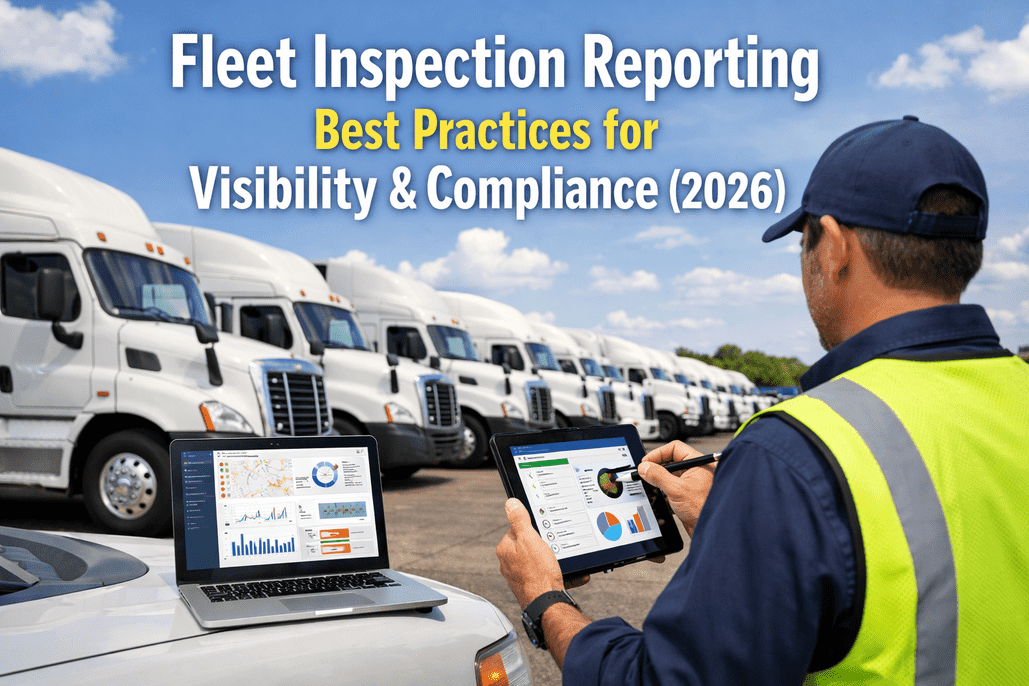
The difference between fleets that pass 95% of roadside inspections and those that fail 1 in 5 is not equipment quality — it is inspection process quality. During the 2025 CVSA International Roadcheck, 22.6% of vehicles were placed out of service for defects that a proper daily inspection should have caught: brake adjustment drift, tyre tread below DOT minimums, burned-out clearance markers, expired medical certificates. These are not hidden failures. They are visible, measurable, preventable defects that exist because the inspection process between them and the weigh station was not rigorous enough to find them. This guide delivers the 10 proven best practices that top-performing logistics and transport fleets use to keep their vehicles compliant, their drivers safe, and their CSA scores clean — practices that work whether you run 25 trucks or 500. Every practice is actionable today, and every one is built into HVI's digital inspection platform from day one.
10 Proven Practices. One Platform.
HVI implements every best practice in this guide — guided walk-arounds, AI defect detection, 3-signature enforcement, and audit-ready records. Setup takes 10 minutes.
Unguided inspections skip items. Drivers default to the components they know and miss the ones they do not. FMCSA research shows guided, sequenced checklists detect 40% more defects than open-format inspections — because the system enforces completeness, not the driver's memory.
How HVI implements this: Step-by-step walk-around sequence mirroring DOT Level I order — front to rear, exterior to interior. Photo-required checkpoints at brakes, tyres, coupling, and lights. No item can be skipped. Completion requires visiting every zone.
A Class 8 tractor needs a 37+ item FMCSA DVIR. A trailer needs 28+ items. A crane needs 70 items across OSHA and ASME B30 standards. Generic one-size-fits-all checklists create gaps on specialised equipment and irrelevant items on simpler vehicles — both reduce inspection quality.
How HVI implements this: Vehicle-type templates assigned automatically. Drivers see only the checklist for their assigned equipment type. Multi-regulation support: FMCSA for CMVs, OSHA for equipment, ASME B30 for cranes — all on one platform.
Checkbox-only inspections allow pencil whipping — tapping "pass" without genuinely checking. Photo-required checkpoints make this physically impossible because the driver must aim a camera at the component. Photos also provide visual documentation for maintenance teams and audit defence.
How HVI implements this: Mandatory photo capture at brakes, tyres, coupling, lighting, and fluid levels. AI analyses photos for tread depth, fluid leaks, and visible damage across 163+ components — catching defects drivers miss 20–30% of the time.
FMCSA requires driver report → mechanic repair certification → next-driver acknowledgment. On paper fleets, the mechanic signature is missing 40–60% of the time. Every broken chain is a 49 CFR 396.13 violation and — in litigation — evidence of systematic negligence.
How HVI implements this: Vehicle is dispatch-restricted until all three digital signatures are captured — with timestamps, GPS, and identity verification. The chain cannot break because the system blocks the vehicle from leaving.
The gap between defect detection and repair initiation is where safety failures live. On paper fleets, this gap averages 18–30 hours. A defect that sits in a paper tray overnight while the vehicle keeps running is not a compliance record — it is a liability.
How HVI implements this: Defects auto-generate prioritised work orders with photo evidence, severity classification, and parts pre-checked against inventory — routed to the correct technician instantly. Safety-critical items trigger immediate alerts.
These first 5 practices address the inspection itself — the next 5 address the system around it.
Sign up free for HVI and implement all 10 from day one. Or
schedule a demo to see each practice in action.
Completion rate is a vanity metric. A fleet can have 100% completion with 0% quality if every DVIR is pencil-whipped in 90 seconds. The 2026 CSA "Driver Observed" category now scores your inspection quality separately — making pencil whipping visible on your carrier profile.
How HVI implements this: AI scores every inspection on time taken, completeness, photo quality, and consistency. Rushed or low-quality inspections flagged for coaching. Quality trends tracked per driver, terminal, and fleet-wide.
Expired medical certificates cause 35% of all audit violations and carry a 55.2% OOS rate at roadside. CDL credential violations have a 98.7% OOS rate. Manual tracking across 50+ drivers with different expiration dates cannot maintain accuracy — one lapse creates a violation.
How HVI implements this: 60/30/7-day automated alerts for CDLs, medical certificates, Clearinghouse queries, and MVRs. Escalation from driver to supervisor to fleet manager. Dispatch-restricted at expiration — zero surprises at roadside.
Inspections happen at truck stops, rural yards, customer sites, and remote job locations — often with zero cellular connectivity. If the app requires internet, drivers either skip the inspection or produce a record with mismatched timestamps that auditors question.
How HVI implements this: Full offline mode — complete inspections with photos, defect reports, and digital signatures without connectivity. Auto-sync on reconnect. Zero inspection gaps from dead zones.
Industry average PM compliance is 61%. Top fleets achieve 95%+. Every missed PM becomes a future emergency repair at 3–9x cost. Moving from 72% to 85% compliance alone generates $1,800–$2,400 per vehicle annually in prevented emergency costs.
How HVI implements this: Multi-trigger PM scheduling (mileage, engine hours, calendar, whichever-comes-first) with 90/60/30-day lookahead alerts. Auto-generated work orders with correct service items per PM tier (A through D).
Paper DVIRs generate zero intelligence — 73% never reach the office, and those that do sit in filing cabinets unanalysed. Digital inspection data reveals which vehicles trend toward failure, which drivers need coaching, which components fail most, and when vehicles should be replaced.
How HVI implements this: Every inspection feeds defect trend analysis, driver quality scoring, vehicle health tracking, and cost-per-vehicle benchmarking automatically. No manual reporting — the analytics build from the data your drivers already generate.
All 10 best practices. One platform.
Start free with HVI today — drivers are proficient in 25 minutes, and your fleet sees measurable improvement within 30 days. Or
schedule a demo and see every practice running live on your vehicle types.
Best Practices Only Work When the System Enforces Them
Every fleet manager knows these practices. The difference between the fleets that execute them and the ones that do not is whether the inspection system enforces compliance or relies on human memory. Paper forms cannot guide a walk-around. Clipboards cannot enforce photo evidence. Filing cabinets cannot route defects to maintenance. Spreadsheets cannot restrict dispatch when credentials expire. HVI can — and does — enforce every one of these 10 practices automatically, for every vehicle, every driver, every inspection, every day. The fleets achieving 95%+ roadside pass rates, declining CSA scores, and 89% fewer breakdowns are not working harder at compliance — they are running their inspections through infrastructure that makes best practices the default, not the aspiration. Start free today — because best practices that are not enforced are just good intentions.
Implement All 10 Best Practices Today
Guided walk-arounds. Photo verification. 3-signature enforcement. AI quality scoring. Offline capability. PM automation. Analytics built in. Trusted by 25,000+ users.
Frequently Asked Questions
Q: What is the most important fleet inspection best practice?
Guided, photo-verified walk-arounds — because they address the root cause of most inspection failures: drivers skipping items or rushing through checks without genuinely verifying vehicle condition. Photo-required checkpoints make pencil whipping physically impossible while creating the visual evidence that strengthens audit defence and maintenance diagnosis. Everything else builds on this foundation.
Start free with HVI.
Q: How quickly can I implement these best practices?
With HVI, all 10 practices are active from the first inspection: guided templates are pre-built, photo requirements are configured during setup, 3-signature enforcement activates immediately, and credential tracking begins at driver import. Platform setup takes under a day. Driver training takes 25 minutes. 95%+ adoption within 30 days.
Schedule a demo to see the implementation timeline.
Q: Which best practices affect CSA scores most?
Three practices have the most direct CSA impact: (1) guided walk-arounds with photo evidence — directly feeds the 2026 "Driver Observed" BASIC category, (2) 3-signature DVIR enforcement — eliminates the most common maintenance compliance violation, and (3) credential tracking with dispatch restriction — prevents the highest-OOS-rate violations (98.7% for invalid CDL, 55.2% for expired medical certificate).
Q: Do these practices work for small fleets?
Yes — every practice scales. A 15-truck fleet benefits proportionally from guided inspections, automated defect routing, and credential tracking. Small fleets often see faster ROI because a single prevented breakdown has proportionally higher operational impact. HVI has no minimum vehicle count.
Start free.
Q: What results can I expect from implementing these best practices?
Documented outcomes from fleets implementing all 10 practices: 40% fewer compliance violations within 12 months, 89% fewer preventable breakdowns, defect-to-repair time reduced from 18–30 hours to 2–4 hours, $8,500 per vehicle in annual maintenance savings, and 95%+ vehicle availability. Most fleets see measurable improvement within 30 days of implementation.