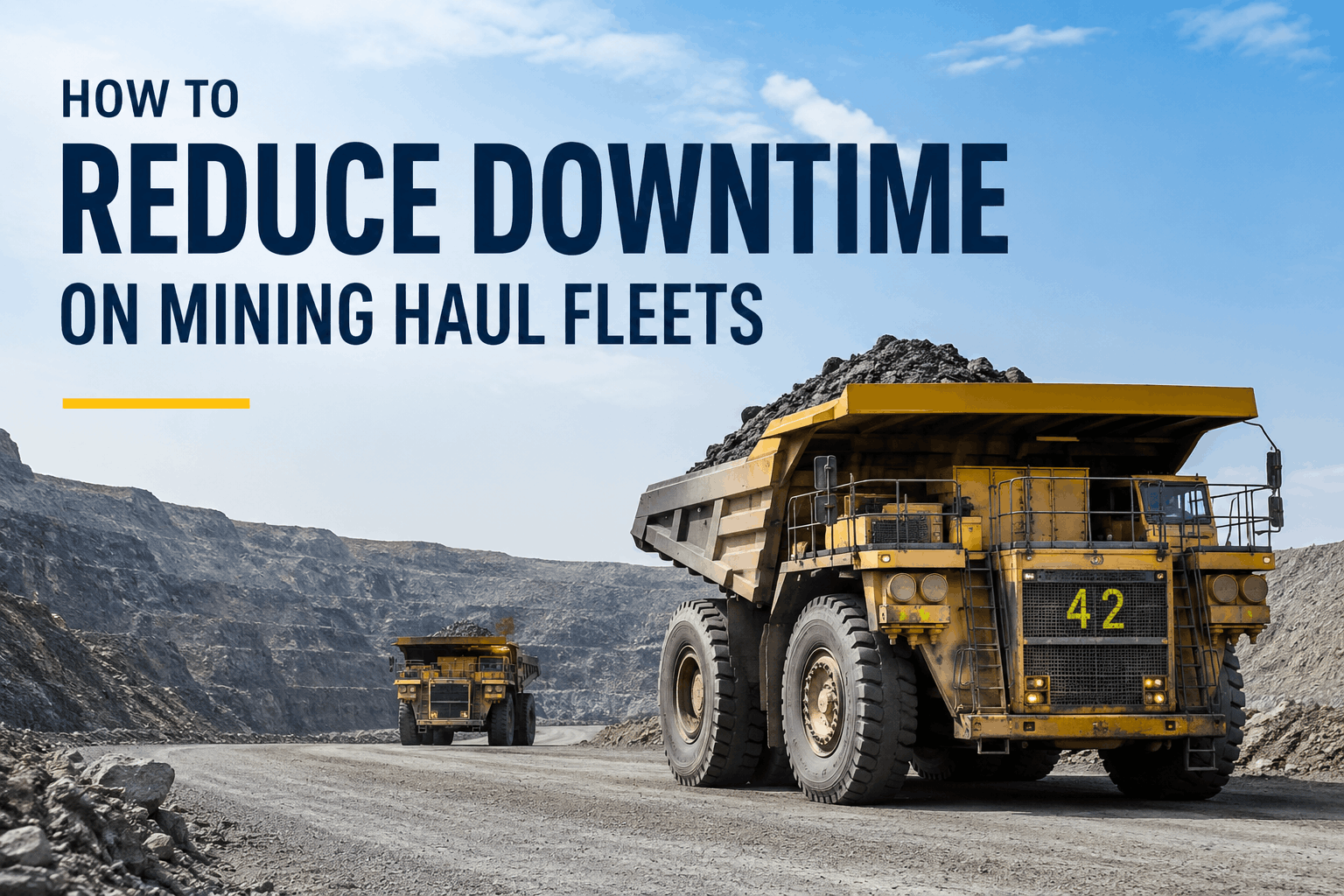
When a 400-ton haul truck stops mid-shift at a remote pit, it doesn't stop alone. Within minutes the shovel loading it has nowhere to dump, the trucks behind it stack up, the crusher starves, and the processing plant downstream slows — a single mechanical failure cascading into a production day that can cost up to $2 million. That's the brutal arithmetic of mining haul fleets: ultra-class truck downtime runs $5,000 to $20,000 an hour, the average truck loses 8.7 days of unplanned downtime a year, and a 400,000-mile engine rebuild waits at the end of every neglected warning sign. Yet world-class mines run their haul trucks at 92–94% availability while the industry average sits closer to 72–80% — proof that the gap between profit and loss isn't the equipment, it's how it's managed. The encouraging part: the levers that close that gap are well understood and don't require buying a single new truck. A systematic uptime program built on condition monitoring, PM compliance, parts kitting, and operator inspections can cut unplanned downtime by 30–50%. This page lays out those four tactics, what each one is worth, and how to run them as one connected system instead of four disconnected efforts.
A Stopped Haul Truck Stops the Whole Pit
HVI unifies condition monitoring, PM scheduling, parts inventory, and operator inspections into one platform — catching failures before they cascade, keeping the right parts on the shelf, and pushing availability toward the 92%+ that separates world-class mines from the rest.
The True Cost of a Stopped Truck
Before the tactics, the stakes. Mining downtime isn't a maintenance line item — it's a production-chain event, and the numbers explain why even a few points of availability are worth a fortune.
$5–20K
per hour, per truck
Ultra-class haul truck downtime cost in lost production — before cascading delays downstream.
$2M
per day, cascading
What one mid-shift failure can cost when it ripples through shovels, crushers, and processing.
8.7 days
lost per truck, per year
Average unplanned downtime per haul truck — nearly nine production days gone, per unit.
30–50%
downtime reduction
Achievable through a systematic uptime program — no new equipment required.
The Availability Gap: Where You Are vs. Where You Could Be
Availability is the master uptime metric, and the spread between average and world-class is enormous. Closing even half of it transforms a fleet's output without adding a single machine.
INDUSTRY AVERAGE
72–80%
Reactive-heavy operations — running trucks to failure and paying premium rates to recover.
WORLD-CLASS
92–94%
Planned windows of 8–10%, leaving under 8% unplanned. Systematic, data-driven uptime programs.
Every point of availability on a fleet running $5,000–$20,000-per-hour trucks is worth six figures a year. Moving from 78% to 92% can add the equivalent of multiple trucks of capacity — without buying any.
Four Tactics That Close the Gap
World-class uptime isn't one magic fix; it's four disciplines run together. Here's each lever, what it does, and the measurable downtime it removes.
01
Condition Monitoring
Modern haul trucks carry 200+ sensors reading engine temp, hydraulic pressure, vibration, and tire wear. Vibration signatures catch a failing bearing months ahead — and a $500 bearing left alone can take out a $50,000 gear set when it seizes.
Worth: 30–50% fewer unplanned failures
02
PM Compliance
Scheduling PM by engine hours and condition — not the calendar — and actually hitting it. Reactive repair costs roughly 4.8× a planned one. Lifting compliance toward 95% is the highest-leverage, lowest-cost move on the list.
Worth: ~4.8× cost avoided per repair
03
Parts Kitting
Pre-staging the parts a scheduled job needs — kitted and ready — instead of emergency procurement with 3–5 day delays. Smart spare-parts inventory with auto-reorder cuts repair delays by about 40%.
Worth: ~40% shorter repair delays
04
Operator Inspections
The operator sees the truck every shift — a pre-shift digital inspection catches the leak, the worn tire, the soft brake before it becomes a mid-shift failure. The cheapest condition data you own, captured for free, every shift.
Worth: first-line defect capture, daily
Reactive vs. Systematic: The Same Fleet, Two Outcomes
The four tactics only pay off run together. Here's the contrast between an operation managing by breakdown and one managing by data.
RUN-TO-FAILURE
Failures discovered when the truck stops in the pit
Emergency parts procurement, 3–5 day delays
Repairs at ~4.8× planned cost, premium labor
Availability stuck at 72–80%
One failure cascades through the whole chain
SYSTEMATIC UPTIME WITH HVI
Sensors and inspections flag failures weeks ahead
Parts kitted and staged before the job starts
Work done in planned windows at baseline cost
Availability pushed toward 92–94%
Problems fixed at shift change, not mid-shift
Run the Four Tactics as One Loop
The tactics aren't a checklist to do once — they're a continuous loop. Monitor, predict, prepare, execute, and the gains compound shift after shift.
1
Monitor
Sensor data and per-shift operator inspections stream the real condition of every truck into one view.
2
Predict
Trends flag the failure forming — a rising vibration, a creeping temp — before it becomes a breakdown.
3
Prepare
Parts kitted, work order built, crew scheduled into the next planned window — no scramble.
4
Execute
Fix it planned, document it, and feed the result back into the monitoring baseline.
Push Your Haul Fleet Toward 92% Availability
Condition monitoring, engine-hour PM scheduling and compliance tracking, parts kitting with auto-reorder, and digital operator inspections — unified in one platform built for mining-scale haul fleets. Cut unplanned downtime 30–50% without buying a truck. Trusted by 25,000+ users worldwide.
Frequently Asked Questions
How much does haul truck downtime actually cost?
Ultra-class haul truck downtime runs $5,000–$20,000 per hour in lost production, and because a stopped truck halts the shovel loading it and starves the crusher and plant downstream, a single mid-shift failure can cascade into a $2 million production day. The average haul truck loses about 8.7 days of unplanned downtime per year. That cascading, production-chain nature is why mining downtime is far costlier than in buffered industries like manufacturing.
Sign up for a free HVI trial to start cutting it.
What availability should a world-class haul fleet target?
World-class mines run haul trucks at 92–94% availability, versus an industry average closer to 72–80%. The math assumes planned maintenance windows of 8–10%, leaving under 8% for unplanned downtime. Closing even half that gap dramatically increases output: every point of availability on a fleet of $5,000–$20,000-per-hour trucks is worth six figures a year, and moving from 78% to 92% can add the equivalent of several trucks of capacity without any new purchases.
Schedule a demo to benchmark your fleet.
Which tactic reduces downtime the most?
They work best together, but PM compliance is the highest-leverage, lowest-cost lever because reactive repairs cost roughly 4.8 times a planned one, and most fleets sit well below the 95% compliance target. Condition monitoring then prevents 30–50% of unplanned failures by catching them early, parts kitting cuts repair delays about 40%, and operator inspections provide free first-line defect capture every shift. Run as one system, a 215-unit operation cut downtime 42% and saved $3.2M annually.
Sign up for a free HVI trial to run all four.
What is parts kitting and why does it cut downtime?
Parts kitting means pre-staging every part a scheduled job will need — picked, kitted, and ready at the bay before work starts — instead of discovering a missing component mid-repair and waiting 3–5 days for emergency procurement. Combined with smart min/max inventory levels and auto-reorder, kitting cuts repair delays by about 40%. On a remote mine where parts logistics are already slow, having the right component on the shelf is often the difference between a one-shift repair and a one-week outage.
How do operator inspections help if we already have sensors?
Sensors and operator inspections catch different things. Sensors excel at internal, gradual changes — vibration, temperature, pressure trends. Operators catch the visible and the sudden: a fresh leak, a damaged tire, a loose component, a soft brake pedal — often before any sensor threshold trips. A pre-shift digital inspection is the cheapest condition data you own, captured for free every shift, and it feeds the same system as your sensor data so nothing falls through the gap.
Sign up for a free HVI trial to digitize operator inspections.
.png)