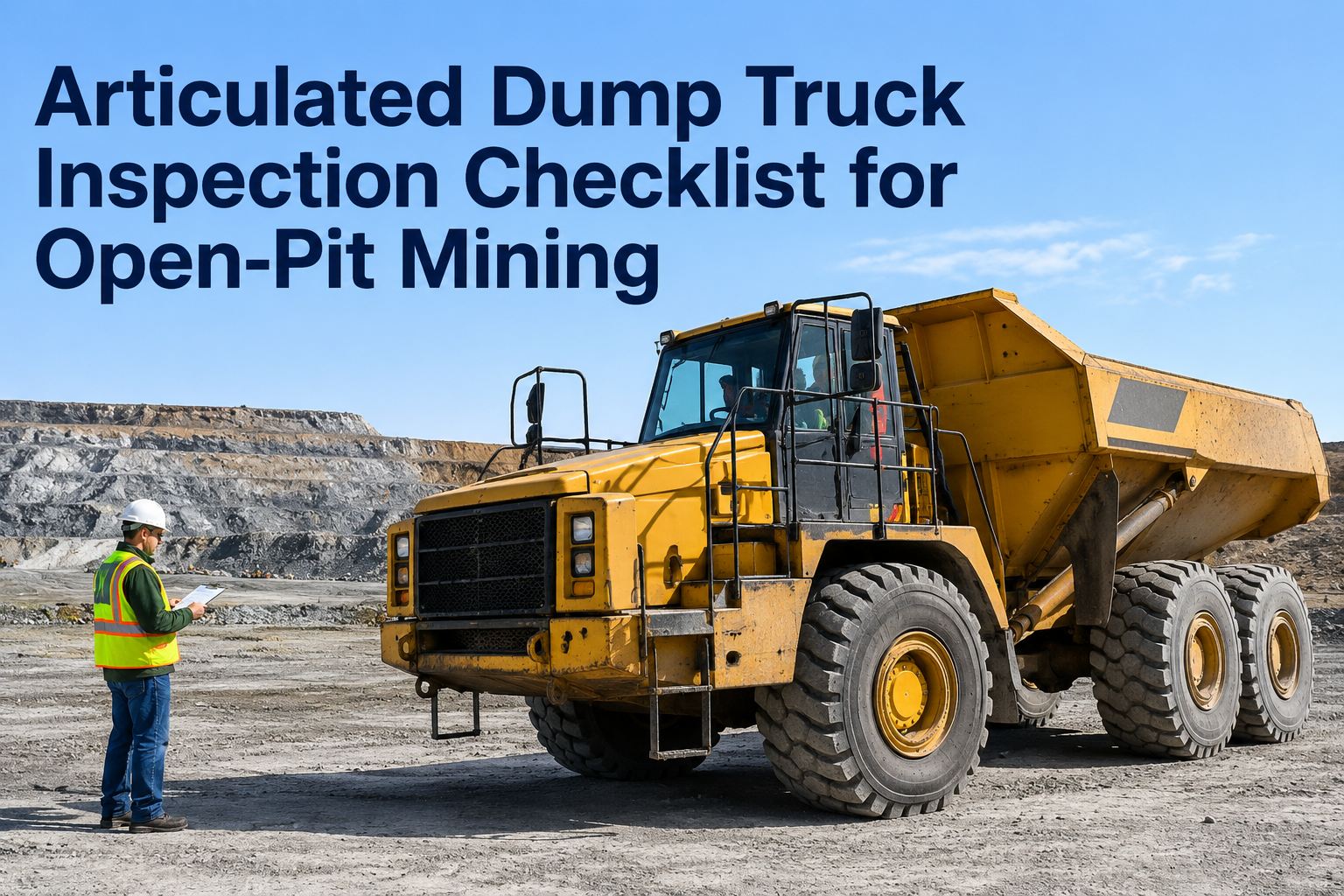
An articulated dump truck is built to do what a rigid hauler can't: carry 30 to 60 tons of material across soft, rutted, steep open-pit ground that would strand a stiff-framed truck. The feature that makes that possible — the articulation joint that lets the front and rear halves pivot and oscillate independently — is also the feature that makes its inspection different from any other haul truck. That central hitch, the all-terrain bogie, the 6×6 drivetrain with differential locks, and the wet brakes and retarder that hold a loaded truck on a downgrade are the systems an open-pit ADT lives and dies on, and a generic truck checklist covers almost none of them. On a mine haul road, the consequences are immediate: a loaded ADT that loses braking on a grade or steering through the articulation joint isn't a breakdown, it's a runaway. That's why a purpose-built pre-shift inspection — and the MSHA obligation behind it — matters so much. Under federal rules, this equipment must be inspected before each shift, with any safety defect tagged and the truck removed from service until repaired. This guide is your articulated dump truck inspection checklist for open-pit mining: what makes an ADT different, the daily pre-shift walk-around, the articulation and braking systems that need the closest watch, and the preventive-maintenance cadence. book a 30-minute walkthrough to see it set up for your fleet.
The articulation joint and the downhill brakes are what a generic truck check misses — and what an ADT can't run without.
HVI runs the articulated dump truck pre-shift from a phone — articulation hitch and oscillation, 6×6 drivetrain and diff locks, wet brakes and retarder, body and Safe-Tip, ROPS and alarms — flags any defect, tags an unsafe truck out of service per MSHA, and fires PM on real engine hours.
Why an ADT needs its own checklist
An articulated hauler isn't a rigid dump truck with a bend in the middle — its defining systems don't exist on other trucks. The inspection priorities follow from the design.
Three systems set the ADT apart
The articulation joint and oscillation let the truck steer and flex across uneven open-pit ground, but they also concentrate steering load and wear in one pivot that a rigid truck simply doesn't have. The wet brakes on every axle plus the retarder and engine brake exist to hold a fully loaded hauler on the steep, sustained downgrades of a pit haul road — service brakes alone would overheat and fade. And the body-raise stability protection, like Safe Tip, prevents lifting the bed when the rear chassis is rolled past a safe angle, guarding against a tip-over during dumping. None of these appear on a generic truck checklist — which is exactly why open-pit ADTs need a purpose-built inspection.
The daily pre-shift checklist
This is the walk-around before the first load, covering the ADT's unique systems alongside the standard haul-truck items. Each is a pass-or-pull decision.
The first five rows are the ADT-specific items a generic form skips — the articulation, steering, downhill braking, drivetrain, and body stability that the truck can't run without. sign up free and run the full ADT pre-shift on a phone with photo capture, or book a demo to see ADT-specific templates.
The articulation joint & steering
The central hitch is the ADT's signature — and its highest-wear, highest-consequence component. It gets the closest watch on every inspection.
Check the play
Inspect the articulation pivot and axle hinges for play, wear, and cracks. Excess play in the hitch is both a steering-precision problem and a structural warning — this joint carries the entire steering load.
Steering hydraulics & cylinders
The steering system is the hydraulics, the steering cylinders, and the articulation joint together. Leaking lines, contaminated fluid, or worn components create a control-loss risk — test for smooth, responsive operation with no unusual noise.
Grease & oscillation
The joint and oscillation bearing need their grease points serviced so they move freely under load. A dry or seized pivot accelerates wear and loads the whole front-to-rear connection.
The steering system's integrity — hydraulics, cylinders, and the articulation joint — is one of the most safety-critical things on the machine, because losing steering control on a loaded truck on a pit haul road is catastrophic. A modern maintenance-free rotating hitch reduces the service burden, but the inspection for play and damage still matters. HVI makes the articulation and steering check a required, photo-verified item.
Downhill braking on the haul road
Open-pit haul roads mean long, steep, loaded descents — the single hardest duty on an ADT's braking system. This is where the wet brakes and retarder earn their place.
Wet brakes on every axle
Oil-cooled multi-disc brakes on all axles resist the fade that would overheat dry brakes on a sustained grade. Verify they hold the loaded truck and check for leaks and response before the first descent.
Retarder & engine brake
The retarder and engine brake do the continuous work of controlling speed downhill so the service brakes aren't relied on alone. Confirm they engage and slow the truck — a failed retarder on a grade is a runaway risk.
Hill-hold & grade control
Functions like hill assist and downhill speed control prevent uncontrolled movement on slopes. Verify they activate as designed — these are the systems that keep a loaded ADT in control on the steepest part of the haul.
on the downgrade. The most dangerous moment in an ADT's day is a fully loaded descent on a long pit haul road, and the wet brakes, retarder, engine brake, and grade-control systems exist precisely to manage it. A pre-shift check that confirms all of them — not just the service brakes — is what keeps a 60-ton load under control. HVI makes the full braking-and-retarder check a required step before the truck rolls.
Stability, Safe-Tip & MSHA compliance
Two more failure modes are unique to a loaded hauler: tipping during dump, and the compliance exposure of an undocumented inspection. Both are managed on the pre-shift.
Safe-Tip body protection
Stability functions prevent raising the bed if the rear chassis roll exceeds a preset value, guarding against a tip-over while dumping on uneven ground. Confirm the body-raise interlock and on-board payload weighing work.
MSHA pre-shift & tag-out
MSHA requires self-propelled mobile equipment inspected before each shift; any safety defect means the truck is tagged out of service and removed until repaired. The documented inspection is the proof.
Records for the life of the truck
OSHA and MSHA expect inspection records kept — typically for the equipment's operational life. Digital records are permanent, searchable, and produce the audit trail an inspector can demand on the spot.
The pre-shift inspection satisfies the MSHA obligation and protects the operator at once — but only if it's documented and the defect actually drives a repair. sign up free and keep every ADT inspection MSHA-ready and audit-ready.
The preventive-maintenance cadence
Daily inspection layers over scheduled service fired by operating hours. Each tier protects the truck at a different depth.
Pre-shift inspection
The operator walk-around — articulation, steering, brakes, drivetrain, body, tires, ROPS, fluids — before the first load, with defects tagged and reported.
Scheduled service
Engine, transmission, hydraulic and brake service, articulation and oscillation servicing, diff-lock and bogie checks at the OEM interval, fired on real engine hours.
Major service
Deep inspection of the articulation joint, axles and bogie, brake and retarder systems, hoist cylinders, and structural frame and body for cracks and stress.
Manufacturers tie ADT service to operating hours — typically 250, 500, and 1,000-hour intervals — which means firing PM on real hours rather than calendar guesses, because a busy pit truck accumulates hours fast and a missed brake or articulation service on a loaded hauler is a serious risk. HVI tracks each truck's hours and fires PM automatically. book a demo to see hour-based scheduling.
Paper checklists vs. HVI
Both technically record a pre-shift. Only one covers the articulation, braking, and stability systems, tags an unsafe truck out of service, fires PM on real hours, and keeps the MSHA record.
Paper / generic
- Generic truck form skips the articulation joint
- Steering & retarder wear noticed too late
- Safe-Tip & diff-lock function never verified
- Defects on paper, machine runs anyway
- Hour-based service slips as hours go untracked
- No MSHA record when an inspector asks
With HVI software
- ADT template covers articulation, steering & brakes
- Retarder, diff locks & Safe-Tip checked every shift
- Critical defect tags the truck out of service
- Every defect auto-creates a tracked work order
- PM fires on real operating hours per truck
- One-click MSHA audit export, records kept for life
the articulated machine. An open-pit ADT carries 60 tons across the worst ground on the mine, steering through a pivot and braking down sustained grades — failure modes a rigid-truck checklist was never built to catch. A purpose-built inspection covering the articulation, the wet brakes and retarder, and the body stability, run every shift and documented for MSHA, is what keeps the truck and its operator safe. HVI makes that the routine across your hauler fleet.
Frequently asked questions
What should an articulated dump truck pre-shift inspection include?
An ADT pre-shift covers the truck's unique systems alongside standard haul-truck items. The articulation and oscillation joint comes first — check the hitch pivot and axle hinges for play, wear, cracks, and grease. The steering system, which combines hydraulics, steering cylinders, and the articulation joint, must operate smoothly with no play or leaks. The braking system includes the wet multi-disc brakes on all axles plus the retarder and engine brake for downhill control, all verified to hold and respond. The 6×6 drivetrain, differential locks, and bogie are checked for engagement and leaks. The body, liner, tailgate, hoist cylinders, and the Safe-Tip body-raise stability interlock are confirmed. And the standard items — tires, ROPS, seat belt, backup alarm, lights, mirrors, and fluid levels — round it out. The first several are ADT-specific systems a generic truck form skips entirely. HVI's inspection and maintenance software provides an ADT-specific template covering all of them. sign up free and run the full ADT check.
Why is the articulation joint so important to inspect?
The articulation joint is the central hitch that lets the front and rear halves of the truck pivot and oscillate independently, which is what allows an ADT to steer and flex across the soft, uneven open-pit ground a rigid truck couldn't handle. Because it carries the entire steering load and constantly flexes under a heavy load, it's both the highest-wear and one of the highest-consequence components on the machine. The inspection looks for play, wear, and cracks in the pivot and the axle hinges, because excess play is both a steering-precision problem and a structural warning sign. It's also part of the steering system along with the hydraulics and steering cylinders, and losing steering control on a loaded truck on a pit haul road is catastrophic — leaking lines, contaminated fluid, or worn components create a real control-loss risk. Modern designs increasingly use a maintenance-free rotating hitch, but the daily inspection for play and damage still matters. HVI's inspection and maintenance software makes the articulation and steering check a required, photo-verified item. book a demo to see the articulation check.
How do ADT brakes handle steep open-pit haul roads?
Open-pit haul roads subject a loaded ADT to long, steep, sustained descents, which is the hardest possible duty on a braking system, so ADTs use a layered braking approach rather than relying on service brakes alone. The foundation is oil-cooled wet multi-disc brakes on all axles, which resist the heat fade that would overwhelm dry brakes on a long grade. On top of that, a retarder and engine brake do the continuous work of controlling speed downhill, so the service brakes stay cool and available — a continuous-operation brake on many models activates automatically as the brake pedal is pressed for deceleration on hills. Grade-control functions like hill assist and downhill speed control add another layer, preventing uncontrolled movement on slopes. The pre-shift check must confirm all of these, not just the service brakes, because a failed retarder on a loaded descent is a runaway risk. HVI's inspection and maintenance software makes the full braking-and-retarder check a required step. sign up free and check every braking system.
What are the MSHA requirements for mining dump truck inspections?
Under MSHA's Title 30 CFR regulations, self-propelled mobile equipment like an articulated dump truck must be inspected before it's placed in operation each shift, by the operator who will run it. Any defects affecting safety must be reported, and equipment with a safety defect must be tagged out of service and removed from operation until the repair is complete. Operators are typically responsible for the daily pre-shift safety inspection, while qualified maintenance personnel conduct the comprehensive periodic inspections, and safety managers oversee the program, track defect resolution, and maintain records. Those records must be maintained according to OSHA and MSHA requirements — typically for the equipment's operational life — which is far easier with digital records that are permanent and searchable. Failure to conduct pre-shift examinations is among the most frequently cited mining violations, so both doing the inspection and documenting it matter. HVI's inspection and maintenance software runs the pre-shift against these requirements, enforces tag-out, and keeps the records audit-ready. book a demo to see MSHA compliance tracking.
How does HVI help with articulated dump truck inspections?
HVI is an inspection and maintenance software platform built for mining fleets, including articulated dump trucks. Operators run the daily pre-shift from a phone or tablet using an ADT-specific template that covers the unique systems — the articulation and oscillation joint, the steering hydraulics and cylinders, the wet brakes and retarder for downhill control, the 6×6 drivetrain and differential locks, and the body and Safe-Tip stability interlock — alongside the standard tires, ROPS, alarms, and fluids, with mandatory photo capture on defects, and it works offline in the pit. A flagged defect auto-creates an assigned work order, and a critical defect tags the truck out of service per the MSHA requirement so an unsafe hauler can't be run. Preventive maintenance fires on each truck's real operating hours at the 250, 500, and 1,000-hour intervals, and the platform keeps a complete, searchable inspection and repair history per truck for the life of the equipment, exporting a one-click MSHA audit package. book a demo and we'll map the software onto your fleet on the call.
Inspect the articulation, the downhill brakes, and the body stability — every shift, on every hauler.
HVI runs the articulated dump truck pre-shift from a phone — articulation and oscillation, steering, wet brakes and retarder, 6×6 drivetrain and diff locks, body and Safe-Tip, ROPS and alarms — tags an unsafe truck out of service per MSHA, auto-creates a work order from every defect, fires PM on real engine hours, and keeps records for the life of the truck. Keep every loaded descent under control.
No credit card required · Live in under two weeks · ADT-specific pre-shift + articulation & brake checks + hour-based PM + MSHA audit export in one platform