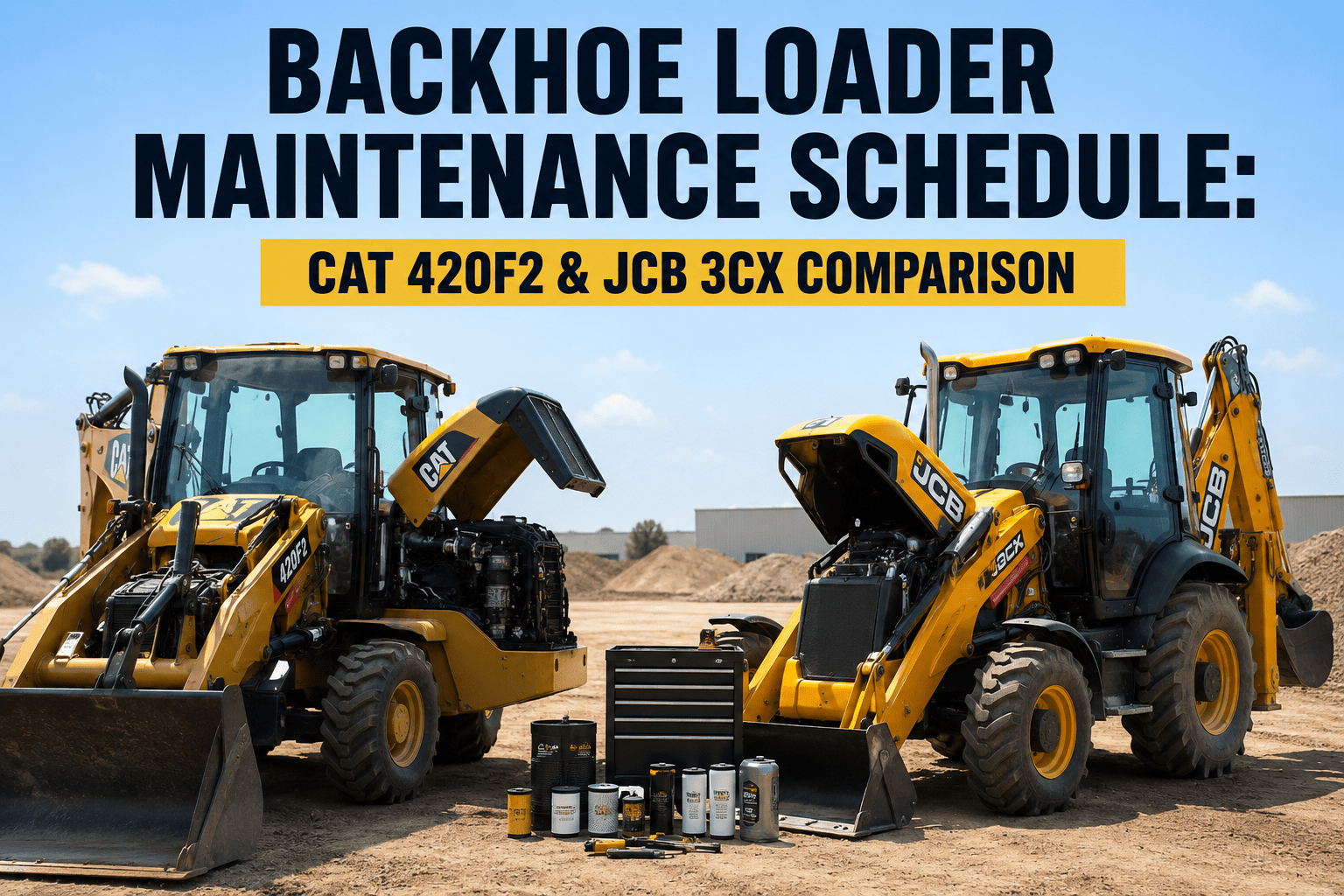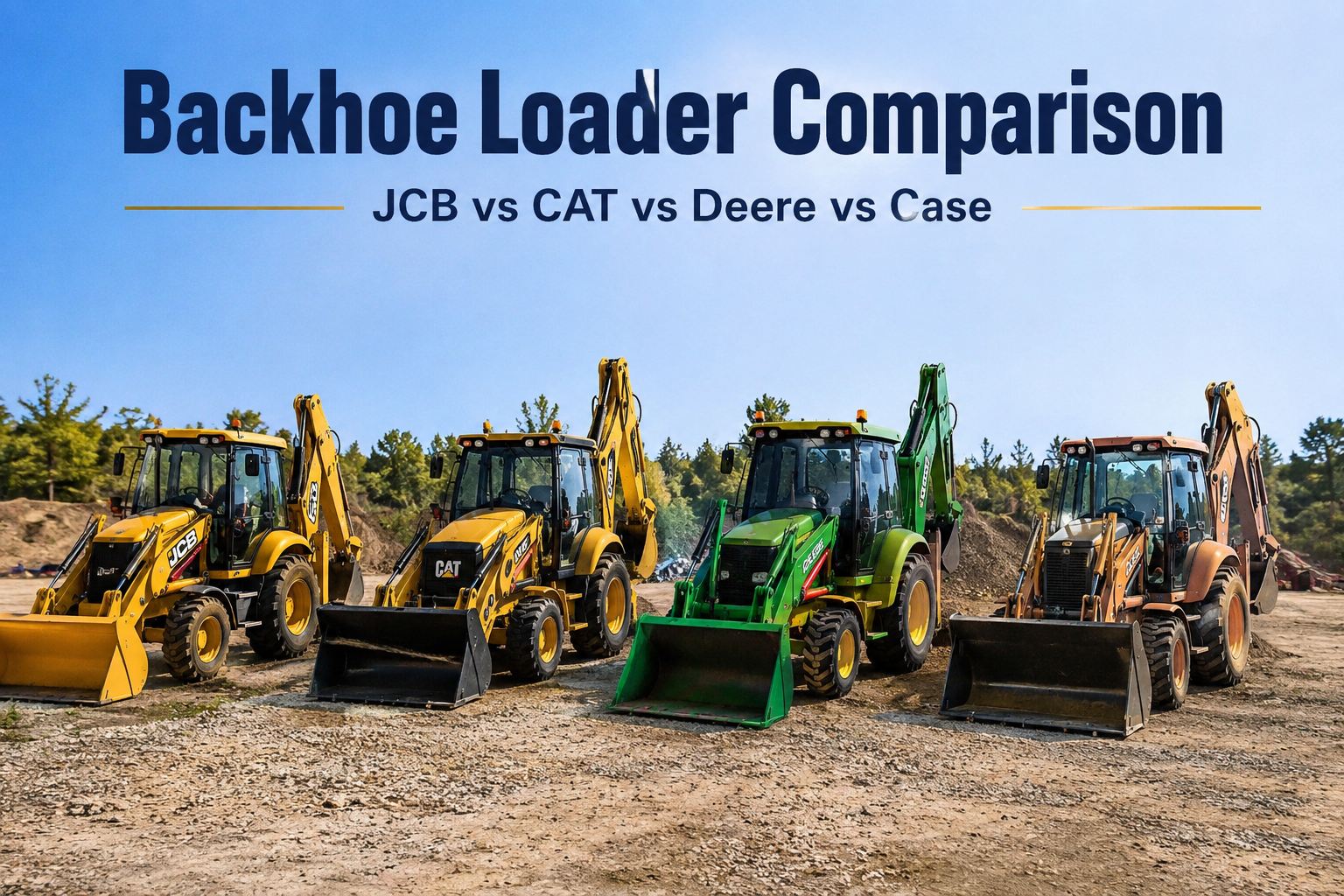
Four backhoe loaders. Four brand loyalists in your yard swearing theirs is the best buy. Four different price tags spread across a $65,000 range. This backhoe loader comparison walks JCB 3CX, Cat 420, John Deere 310L, and Case 580 head-to-head on the numbers that actually decide the purchase: net horsepower, total cost of ownership, dealer network reality, aftertreatment overhead, and resale value at 5,000 hours. No brand loyalty, no marketing copy — just what a fleet manager needs to sign the check with confidence. Book a 15-min HVI demo.
Four Brands. Four Price Tags. One Right Answer For Your Fleet.
The wrong pick costs you $30–$50K over a 5-year ownership cycle. The right one pays for itself in downtime avoided.
The Market Share Reality (And What It Tells You)
Before the spec sheet, look at the yard. In the North American market, Cat and Case each hold roughly 30% of backhoe loader sales. John Deere sits at 15%, JCB at 12%, and the remainder splits between Kubota, Sany, and Bobcat. Cat's share reflects the strength of its dealer network more than any single spec advantage. Case's share reflects price competitiveness. Deere and JCB run smaller volume but with fiercely loyal contractor bases. Globally JCB flips the leaderboard entirely — the 3CX is the world's most produced backhoe.
Why market share matters for a purchase decision: parts availability, dealer proximity, and resale market depth. A machine you can't get parts for in 24 hours is a machine that costs you a day per breakdown. Start a free HVI trial to see how HVI's cost analytics let you compare actual ownership numbers across whichever brand you already run.
The Direct Head-to-Head Specs Comparison
Same duty cycle, same operating hours per year, same operator skill level. The numbers that separate them:
| Specification | JCB 3CX | Cat 420 | Deere 310L | Case 580N |
|---|---|---|---|---|
| Net Horsepower | 74 HP | 92 HP | 93 HP | 93 HP |
| Operating Weight | 14,500 lb | 21,500 lb | 15,600 lb | 15,000 lb |
| Max Dig Depth | 14 ft 3 in | 14 ft 9 in | 14 ft 4 in | 14 ft 7 in |
| Loader Lift Capacity | 3,509 lb | 6,850 lb | 6,442 lb | 6,500 lb |
| Aftertreatment | No DEF/DPF | DEF + DPF | DEF + DPF | DEF + DPF |
| Transmission | 4-speed powershift | 4-speed automatic | 4-speed powershift | 4-speed powershift |
| Travel Speed | 25 mph (fastest) | 21 mph | 20 mph | 21 mph |
| Telematics | LiveLink | Product Link | JD Link (3-yr) | SiteWatch |
| Starting Price (New) | $95K – $120K | $110K – $140K | $90K – $120K | $75K – $110K |
| Dealer Network (US) | Growing | Widest | Extensive | Extensive |
| 5-Year Resale (of new) | ~58% | ~62% | ~60% | ~55% |
The single biggest architectural decision: JCB's EcoMAX engine meets EPA Tier 4 Final without DEF, DPF, or forced regeneration. Cat, Deere, and Case all require the full aftertreatment stack. Over 5,000 operating hours, that architectural difference drives 30-40% of the total maintenance cost gap.
JCB 3CX: The Simplicity Play
The 3CX has been in continuous production for 40+ years and is the world's most-produced backhoe loader. In North America it's an underdog by market share, but on contractor yards that own one, the retention rate is remarkable.
- EcoMAX engine: no DEF, no DPF, no forced regen — simplest PM in the segment
- Fastest travel speed at 25 mph (Cat 420 tops out at 21)
- Advanced hydraulic flow control and Eco mode
- LiveLink telematics with fleet-tracking dashboard
- 7-way multifunction lever reduces operator fatigue
- Loader lift capacity ~3,500 lb — lowest of the four
- US dealer network still growing; parts lead times variable
- Lower resale in North America than Cat or Deere
- Different maintenance philosophy takes some adjustment
Cat 420: The Reliability Premium
Cat's dominance in North America is dealer-driven. The 420 isn't dramatically better on any single spec, but the combined package of parts availability, resale strength, and support depth is why it commands the highest price and holds it.
- Largest dealer network in North America — parts typically same-day
- Highest 5-year resale value (~62% of new)
- Lift Mode boosts lift capacity by 15% for heavy loading
- Precision Mode for reduced flow — ideal for utility work
- Cat CVA agreement bundles PM and warranty predictably
- Highest starting price ($110K–$140K)
- Heaviest at 21,500 lb — requires larger transport truck
- DEF/DPF aftertreatment adds service points and cost
- Forced regen cycles interrupt work at inopportune times
John Deere 310L: The Efficient Workhorse
John Deere's 310L doesn't lead on any single dramatic spec, but it wins on the operational qualities that matter over a 5-year ownership window: fuel efficiency, cab ergonomics, ease of service, and standard telematics.
- Independent economy mode on backhoe and loader (fuel savings)
- 3-year JD Link telematics subscription standard
- Multi-language digital monitor with text diagnostics
- Ease of maintenance access — service points thoughtfully placed
- Strong municipal contract track record
- Backhoe attachment options more limited than competitors
- Not the raw-power leader in any category
- Deere-specific fluid specs require dedicated stock
- Rural dealer coverage lighter than Cat in some regions
Case 580N: The Value Winner
Case doesn't lead on any single premium metric but arrives at the same functional capability for meaningfully less money. Case machines have a reputation for absorbing operator abuse — 8,000+ operating hours is not unusual on well-maintained 580s.
- Lowest starting price at $75K — competitive TCO winner
- PowerLift feature on Super N models for peak lift performance
- Over-center backhoe design reduces spillage
- Reputation for durability under rough operator conditions
- Strong parts availability through CNH network
- Lower resale value (~55% of new at 5 years)
- Cabin refinement lags Cat and Deere on operator comfort
- DEF/DPF stack same overhead as Cat and Deere
- Telematics platform less mature than competitors
Whatever You Buy, You Have to Track It Right
HVI is brand-agnostic. Cat 420, JCB 3CX, Deere 310L, Case 580N — and the four you already own from last year's purchases. One dashboard for cost-per-hour, PM triggers, and ownership analytics across every brand in your fleet. See what actual TCO looks like at 5,000 hours.
Total Cost of Ownership: The 5-Year Reality
Purchase price is the sticker on the machine. Total cost of ownership is what actually shows up on your books over 5 years and 5,000 operating hours. The gap between the two is where fleet managers get surprised.
Case wins on total dollars out. JCB wins on maintenance simplicity and lifetime uptime. Cat wins on resale recovery. Deere sits in the middle on every axis. The $21K spread between the highest and lowest TCO is meaningful but not the deciding factor if uptime or dealer support matter more for your operation.
Which Backhoe Is Right for YOUR Operation?
Spec sheets don't buy the machine. Use cases do. Match the machine to what your fleet actually does, not the spec you find most impressive on paper.
How HVI Tracks Backhoe Ownership Across Any Brand
HVI is intentionally brand-agnostic. Whether you run one JCB or a mixed fleet of all four brands, HVI captures the operational data that turns a good buying decision into a good ownership outcome.
Frequently Asked Questions
Which backhoe loader is the best in 2026?
There isn't a single "best" — the right backhoe depends on your operation. Cat 420 leads on dealer network, resale value, and general reliability, which makes it the safest pick for established construction firms. Case 580N wins on price and TCO for rental fleets and value-conscious buyers. JCB 3CX offers the simplest maintenance stack (no DEF, no DPF, no forced regen) which pays off for off-highway and rural operations. John Deere 310L stands out for municipal and utility contractors who value ease of service and standard telematics. Market share tells the story: Cat and Case each hold about 30% of the US market, Deere 15%, and JCB 12%. Globally JCB's 3CX is the world's most-produced backhoe.
How much does a new backhoe loader cost in 2026?
New backhoe loader prices for the four major brands: Case 580N starts around $75,000 to $110,000 depending on configuration — the value leader. John Deere 310L runs $90,000 to $120,000. JCB 3CX prices at $95,000 to $120,000. Cat 420 tops the range at $110,000 to $140,000, reflecting the premium for dealer network and resale strength. Options and attachments (thumb, extendable dipper, cab package, telematics upgrades) can add $10K-$25K. Used pricing at 5 years and 5,000 hours typically holds 55-62% of new price depending on brand — Cat holds value best, Case least. When comparing prices, always add the 5-year TCO, not just acquisition — the total gap between brands is smaller than the sticker gap suggests.
Why does the JCB 3CX have no DEF or DPF?
JCB's EcoMAX engine achieves EPA Tier 4 Final emissions compliance through in-cylinder design (advanced combustion, high-pressure common rail injection) rather than downstream aftertreatment. The result: no diesel exhaust fluid tank, no diesel particulate filter, and no forced regeneration cycles. Cat, Deere, and Case all use downstream aftertreatment (DPF + SCR + DEF) to hit the same emissions target. The trade-off: JCB's approach reduces service points, eliminates DEF supply logistics, and removes forced-regen interruptions to work cycles — but requires precision-manufactured injectors and combustion chambers. Over 5,000 operating hours, the JCB's aftertreatment absence saves roughly $8K-$10K in DEF, DPF ash service, and regen-related downtime. This is why the 3CX ranks first on "simplest to maintain" in this comparison despite not leading on raw specs.
Which backhoe loader holds its resale value best?
Cat 420 typically holds the highest resale value at 5 years, retaining approximately 62% of new price under normal service conditions. This resale premium reflects the strength of Cat's dealer network and used-market demand more than any technical superiority. John Deere 310L follows at approximately 60%, JCB 3CX at 58%, and Case 580N at 55%. Real-world resale is driven by three factors more than brand alone: (1) documented maintenance history, (2) hour meter reading at sale, and (3) machine condition on inspection. A well-maintained Case 580N with complete PM records and 3,000 hours will out-sell a neglected Cat 420 with 5,000 unlogged hours regardless of brand premium. This is why digital PM records generate real resale dollars — a documented history is worth 5-8% of resale price on any brand.
Which backhoe loader has the lowest maintenance cost?
JCB 3CX has the lowest maintenance cost over 5,000 hours, primarily because its EcoMAX engine eliminates the DEF, DPF, and forced-regen service overhead that Cat, Deere, and Case all share. Estimated 5-year maintenance costs: JCB 3CX ~$18K, Case 580N ~$21K, Deere 310L ~$20K, Cat 420 ~$22K. Aftertreatment overhead alone adds $7K-$8K to the three brands using it. That said, "lowest maintenance cost" isn't the same as "best TCO" — Cat's higher resale value substantially offsets its higher maintenance overhead, and Case's lower acquisition price wins on total dollars out even with average maintenance costs. The right metric to track is cost-per-operating-hour over the ownership period, which HVI's analytics surface automatically across every brand in the fleet.
Buy the Right Machine. Track It Right for 5 Years.
JCB, Cat, Deere, Case — whichever brand or mix you own, HVI captures cost-per-hour, PM triggers, resale-supporting documentation, and lifecycle analytics in one platform. The right buying decision is only step one; the operational discipline that follows is where the ownership economics actually happen.