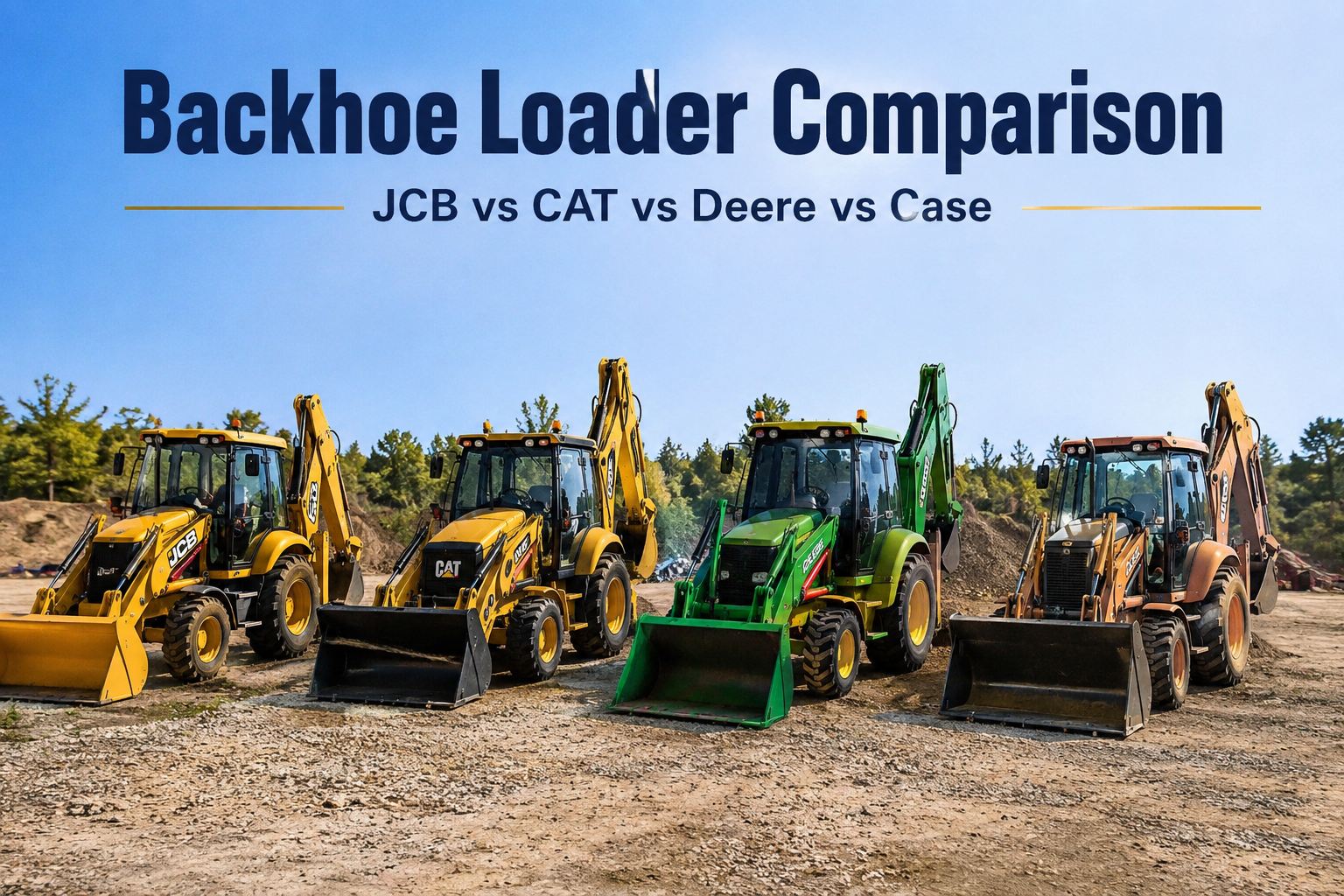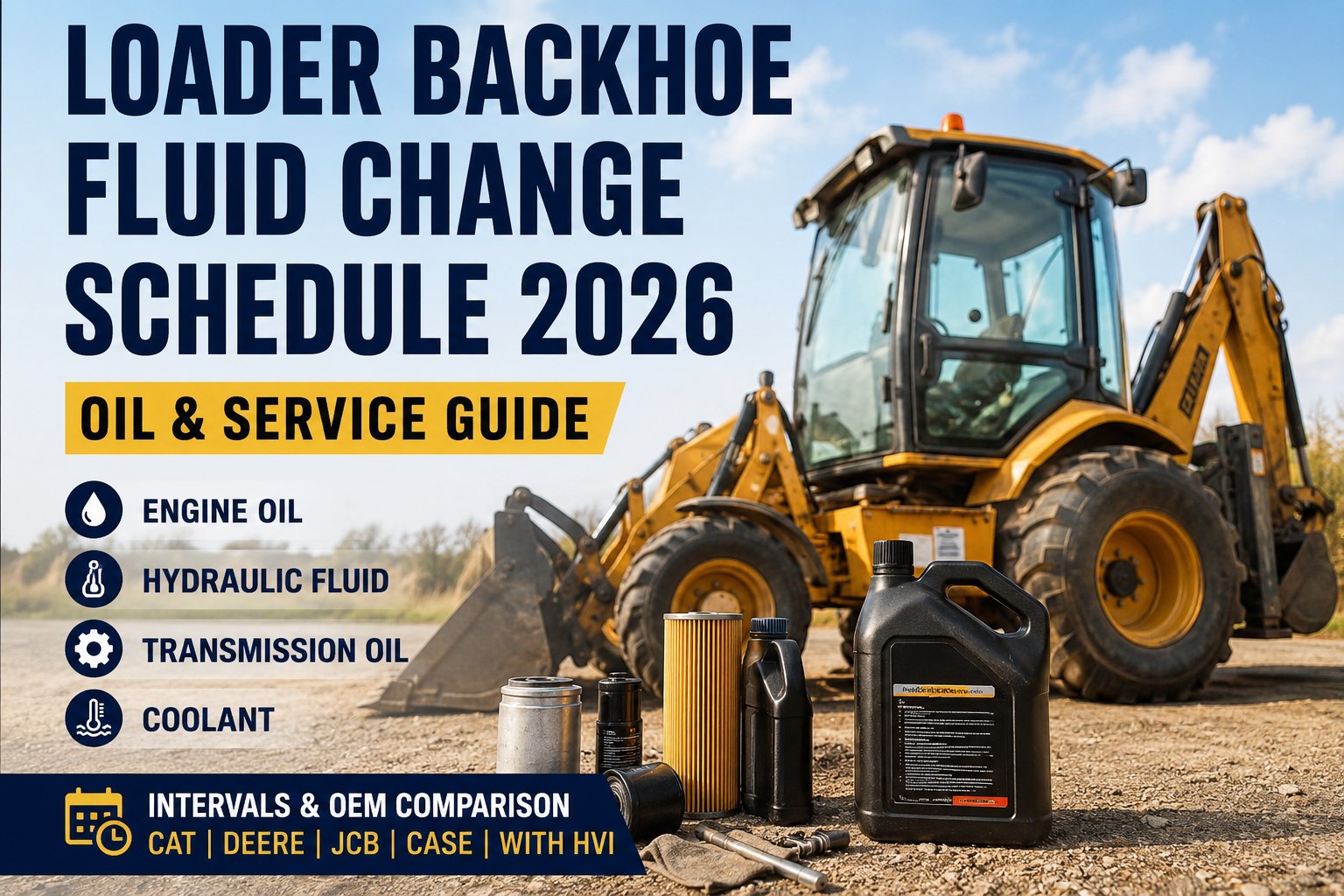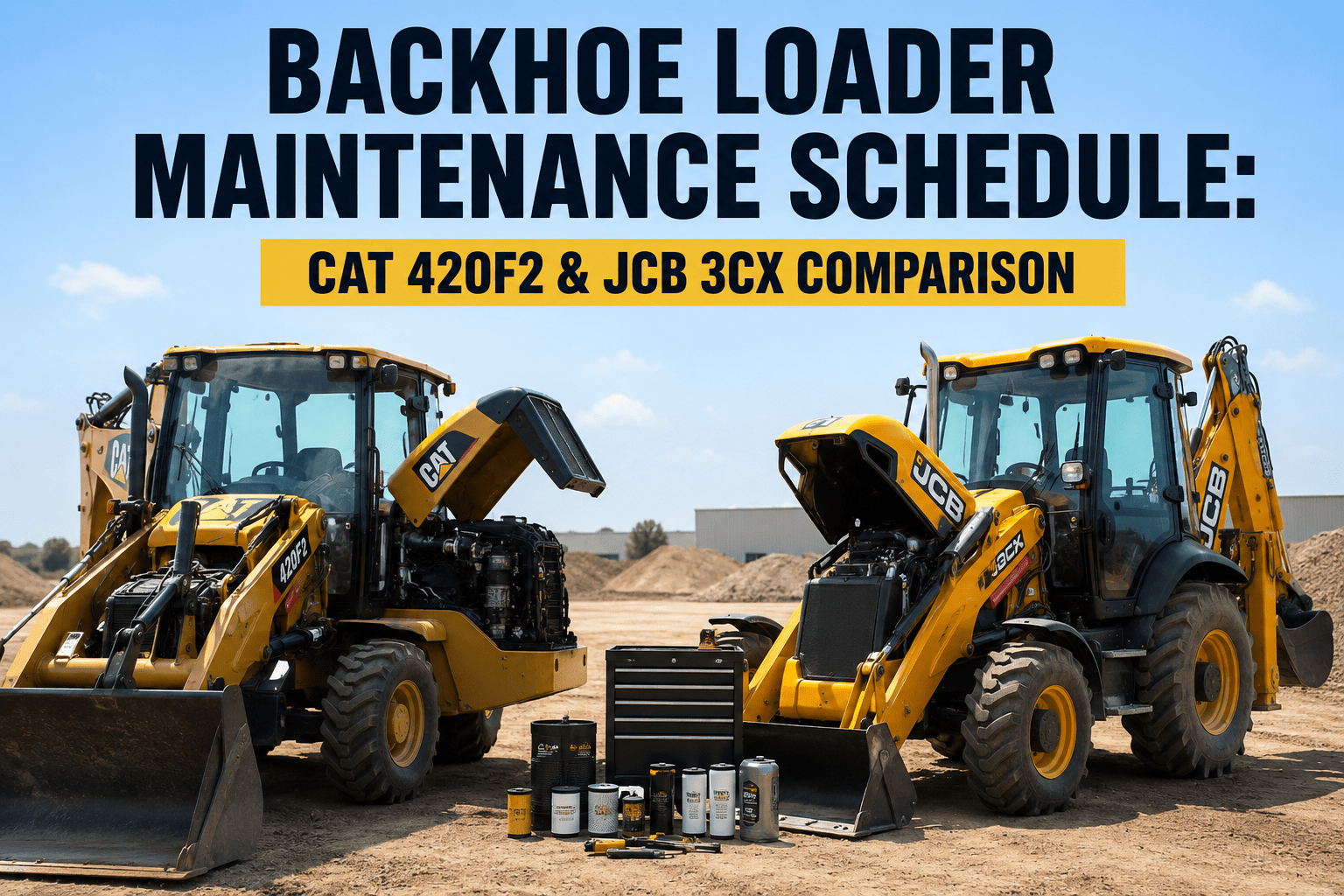
Two of the most popular backhoe loaders on contractor yards in North America are the Cat 420F2 and the JCB 3CX — and the maintenance schedules behind them tell two very different stories. The Cat 420F2 leans into a Tier 4 Final emissions stack with DEF, DPF, and forced regeneration; the JCB 3CX EcoMAX hits the same Tier 4F target with no DEF, no DPF, and no regen at all. That single architectural choice cascades into different service intervals, different annual costs, and different break-fix exposure at 5–10 years of contractor use. This guide breaks down the per-OEM maintenance schedule for both machines side by side: 10-hour daily checks through 2,000-hour overhauls, full fluid capacities, common wear items, total annual maintenance cost at 1,500 hours per year, and which platform fits which kind of contractor operation. For fleet managers running mixed backhoe fleets across job sites, Start your free HVI trial to put PM intervals, daily inspections, and defect routing on every machine — or book a demo to see how HVI tracks both Cat and JCB service schedules per VIN.
The headline difference — Tier 4 Final, two ways
Both machines meet the same EPA Tier 4 Final standard. They get there using fundamentally different engine architectures, and that architecture decision drives 30–40% of the long-term maintenance cost difference between the two platforms.
Cat C4.4 ACERT runs cleaner via downstream aftertreatment: a diesel particulate filter captures soot (requires periodic regen), and a Selective Catalytic Reduction system with DEF injection reduces NOx. More components, more sensors, more service points.
JCB EcoMAX hits Tier 4F via combustion management — high-pressure common-rail injection and optimized EGR — without DEF, DPF, or aftertreatment regen. Simpler emissions stack, fewer failure points, no DEF consumption.
Service interval comparison — daily through 2,000-hour
Both manufacturers publish service intervals as "hours OR calendar time — whichever comes first." For a typical 1,500-hour-per-year contractor operation, the table below shows what gets done when, side by side.
| Interval | Cat 420F2 service items | JCB 3CX service items |
|---|---|---|
| 10 hr / Daily | Walk-around · coolant level · engine oil level · hydraulic oil level · fuel water separator drain · bucket cutting edge inspection · tire pressure · backup alarm test | AutoCHECK self-test (3-sec key-on) · walk-around · coolant + engine oil + hydraulic oil visual check · grease points · fuel water separator drain |
| 50 hr / Weekly | Backhoe boom/stick/bucket pins lubrication · loader linkage grease · air cleaner dust valve clean | All grease points (loader + backhoe) · battery terminals · air filter pre-cleaner |
| 100 hr | (Continuation of 50-hr items) | Transmission filter — first service only, then 500-hr interval |
| 250 hr / Quarterly | Engine oil & filter change · fuel filter · grease all pins · cab fresh-air filter clean · braking system test | (No scheduled service — JCB skips this interval) |
| 500 hr / Bi-annual | Hydraulic return filter · transmission oil filter · primary & secondary fuel filter elements · DEF filter screen | Major service: engine oil + oil filter (320/04133A or 320/B4420) · hydraulic filter (32/925346) · transmission filter (581/M8563) · fuel water separator (32/925915) · gasket (813/00466) |
| 1,000 hr / Annual | Hydraulic oil sample analysis · axle oil check & level · coolant sample test · alternator/starter inspection · air filter primary element | Full kit: air filter element main + safety · fuel filter cartridge · oil filter · hydraulic filter · transmission filter · full filter set + new gaskets |
| 2,000 hr / 2-year | Hydraulic oil change (full) · engine coolant change · valve lash adjustment · DPF ash service · alternator brushes | Hydraulic oil change · coolant change · valve clearance check · brake disc inspection |
Fluid capacities side by side
Critical to budget the correct fluid volumes for every interval — and to bulk-purchase efficiently for fleets running multiple units. Both OEMs publish refill capacities in service manuals; below are the typical 4WD configurations.
Common wear items — what actually breaks in the field
Engine and hydraulic systems on both machines are durable when serviced. The recurring costs that hit contractor budgets year over year come from ground-engaging tools, undercarriage, hydraulics consumables, and brake wear. Below is what to budget for at typical 1,500 hr/year usage.
Ground-engaging tools wear fastest. Hard rock or abrasive work compresses interval to 800 hr; light digging extends to 2,000 hr. Budget: $200–$600 per set.
Boom, stick, and bucket pivot points. Grease discipline directly extends life. Slop in the linkage = imminent replacement. Budget: $400–$1,200 per joint set.
Inspect daily for chafing, leaks, abrasion. High-cycle hoses on boom and stick fail first. Hammer attachments accelerate wear. Budget: $80–$400 per hose.
Wet-disc service brakes. Roading miles vs job-site use shifts wear rate significantly. Budget: $600–$1,500 per axle for friction pack replacement.
R4 industrial tread typical. Cuts and sidewall damage from job-site debris drive replacement faster than tread wear. Budget: $1,800–$3,200 per set of 4.
Drive and accessory belts. Cracks, fraying, and glazed appearance signal replacement. Tensioners typically outlast belts. Budget: $80–$220 per belt.
Aftertreatment service burden — the hidden cost gap
This is where the two machines diverge most sharply on annual cost. Cat's DEF + DPF stack adds recurring service categories that JCB simply doesn't have. For fleets running multiple units, the math compounds quickly.
- DEF consumption: 2–3% of fuel consumption — typical contractor uses 80–120 gallons DEF per year per machine
- DEF tank refills: 5-gallon tank = roughly monthly fills
- DEF filter screen: Replace per 500-hr schedule
- DPF passive regen: Continuous during normal operation
- DPF forced regen: When passive insufficient — interrupts work cycle 20–40 min
- DPF ash service: ~5,000-hr interval; removal + cleaning required
- DEF quality sensor: 60,000–100,000 mile lifespan equivalent
- NOx sensors (in & out): 150,000–200,000 mile equivalent; ~$300–$800 each
- DEF consumption: None
- DEF tank refills: N/A — no DEF tank
- DPF passive regen: N/A — no DPF fitted
- DPF forced regen: N/A — no work-cycle interruption for regen
- DPF ash service: N/A
- DEF quality sensor: N/A — no sensor failures in this category
- NOx sensors: N/A on EcoMAX architecture
- What replaces it: Tighter fuel quality discipline and injector cleanliness become more important
Total annual maintenance cost — at 1,500 hr/year
This is the all-in budget figure most contractors and fleet managers actually care about. Includes fluids, filters, GET wear, brake/tire amortization, scheduled labor, and aftertreatment consumables where applicable. Excludes major component overhauls (engine rebuild, hydraulic pump replacement).
Decision matrix — when to choose each platform
Neither machine is universally "better." They're optimized for different operational profiles. The matrix below helps frame the decision for typical contractor and fleet manager scenarios.
- You need maximum hydraulic flow (163 L/min) for high-cycle attachments — hammers, breakers, compactors
- Your dealer network and parts availability for Cat is stronger in your region
- Operators trained on Cat platforms benefit from the F-Series operator station and joystick controls
- You're running 6th gear / lock-up torque converter for roading between sites frequently
- Resale value in your market favors Cat-branded equipment
- You have existing fleet PM infrastructure tooled around Cat parts and service intervals
- You want to eliminate DEF logistics and DPF service entirely from fleet operations
- Annual maintenance cost minimization is a primary metric (~$2,000/yr/machine savings)
- Your work mix includes locations where DEF supply chain is unreliable or expensive
- AutoCHECK self-test on key-on integrates with your daily inspection program
- JCB dealer support, parts pricing, and LiveLink telemetry options matter operationally
- You want a simpler engine for owner-operator self-service capability
How HVI keeps both platforms on-schedule across a mixed fleet
The hardest part of running a multi-OEM backhoe fleet isn't the maintenance itself — it's tracking which machine is due for which interval, with which parts, on which date. Paper logs and spreadsheets fail at this routinely. HVI's PM tracking puts Cat 420F2 and JCB 3CX schedules side by side, fires reminders on actual engine hours, and routes defects directly to your shop or service partner.
Pre-loaded service intervals for Cat 420F2 (10/50/250/500/1000/2000 hr) and JCB 3CX (10/100/500/1000/2000 hr) — fires reminders on actual engine hours, not memory.
Operators run the 10-hr walk-around on the HVI mobile app — coolant, oil, hydraulic levels, GET inspection, fluid leaks, tire condition. Photo-verified, GPS-timestamped, archived against the VIN.
Any "Fail" tap creates an instant maintenance work order with photo, machine ID, and DVIR reference. No paper handoff between operator and shop — defects don't get lost between shifts.
Every PM service, part used, technician hour, and outside-vendor invoice logged against the machine profile. Year-over-year cost per machine becomes visible — and the actual Cat vs JCB cost gap stops being theoretical.
Fleet managers running mixed Cat and JCB backhoes on paper or spreadsheets are missing the data that would actually inform their next purchase decision. Start your free HVI trial and put PM schedules, inspection records, and cost tracking for both platforms on one searchable platform.
Frequently asked questions
Backhoe maintenance schedules are predictable — missed intervals are not. Put both Cat 420F2 and JCB 3CX PMs on a platform that actually fires the reminders.
HVI tracks engine hours per machine, fires PM alerts at every interval, captures daily inspections on the smartphones operators already carry, and logs cost-per-VIN over time. No hardware, no IT lift, measurable ROI within 30 days.
No credit card required · OEM-specific PM templates for Cat & JCB · Per-VIN cost tracking from day one