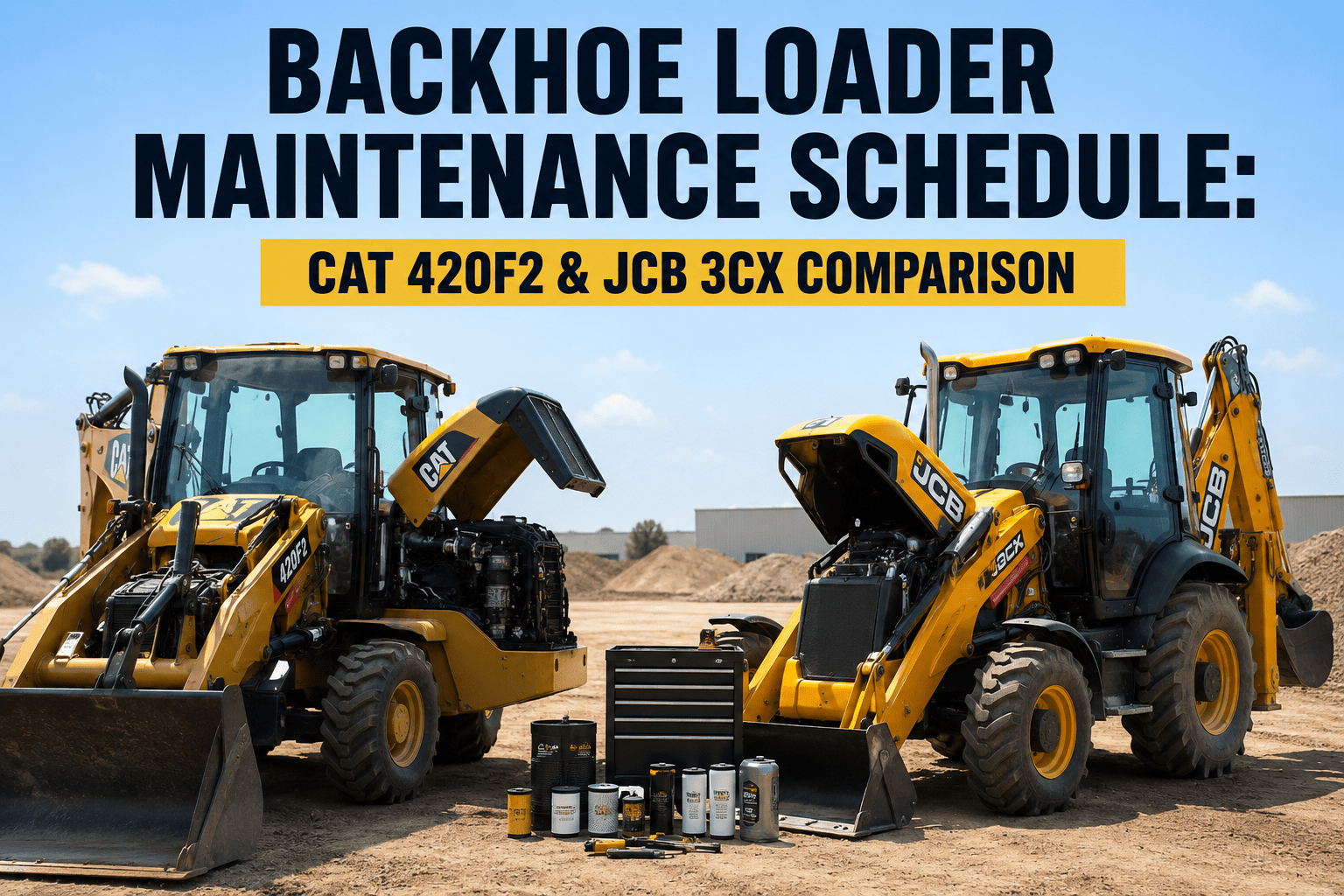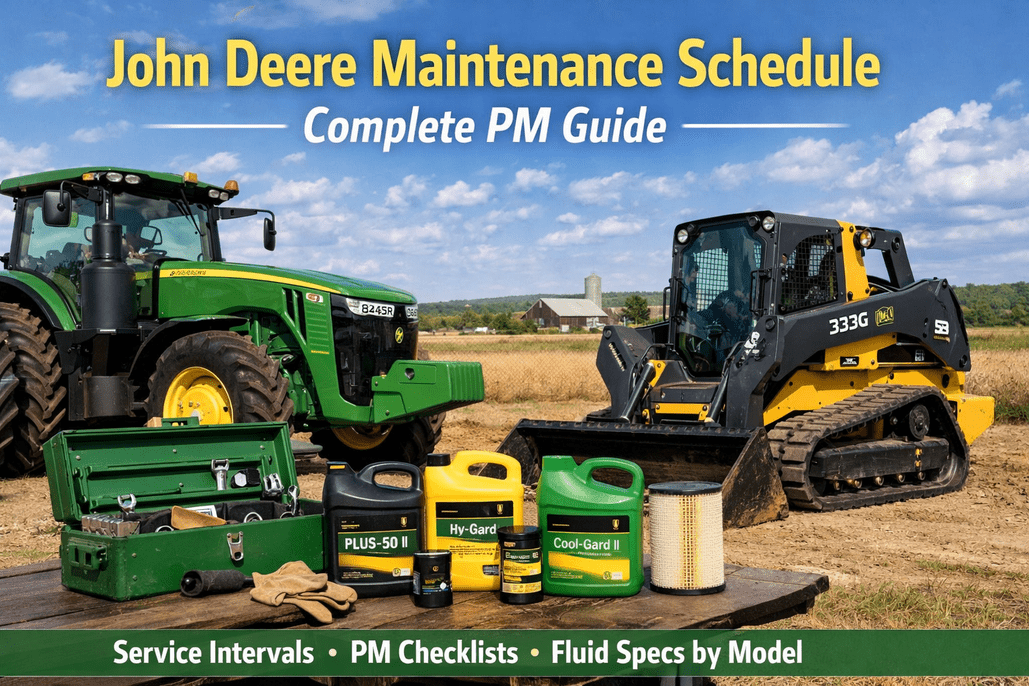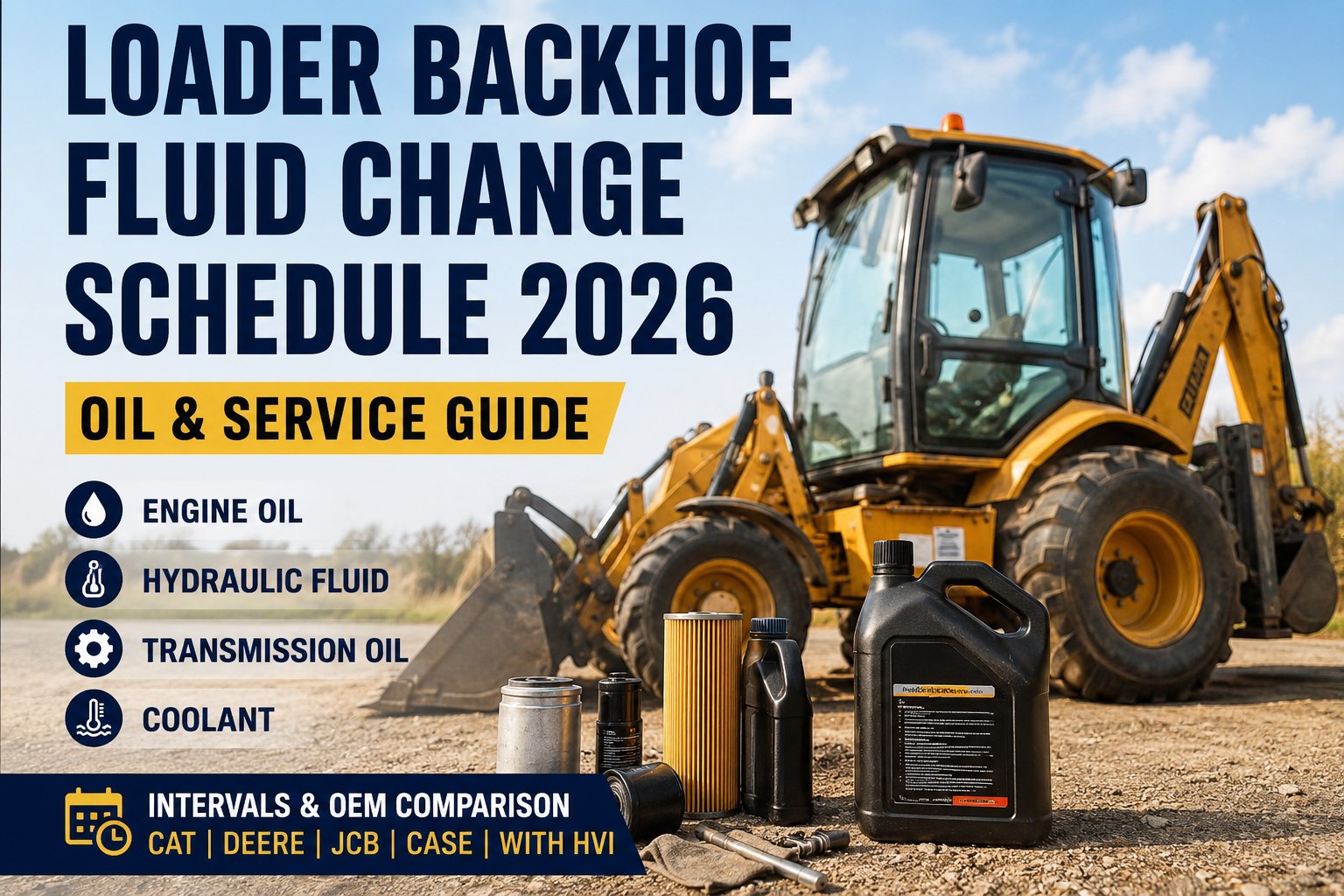
A blown hydraulic pump on a loader backhoe is a $6K to $12K repair bill plus a week of downtime on a machine booked for a paying job that morning. Nearly every one of those failures traces back to missed loader backhoe fluid change intervals — hydraulic fluid past OEM hours, engine oil stretched beyond 500, transmission fluid never touched. This guide lays out the exact interval every fluid needs on Cat 420, JCB 3CX, John Deere 310L, and Case 580 Super N.
Every Fluid, Every OEM, Every Interval — One Grid
Find your machine, find the fluid, find the hour count. Print it or bookmark it.
Loader backhoe fluid change intervals depend on the OEM, fluid type, and operating conditions. As a rule of thumb: engine oil every 250–500 hours, hydraulic fluid every 1,000–2,000 hours, transmission fluid every 1,000–1,500 hours, coolant every 4,000–6,000 hours, and grease every 10 hours (daily). Cat runs the tightest engine oil interval; Deere the tightest hydraulic; Cat and Deere the longest coolant. The rule that overrides everything else: whichever comes first — hours or calendar.
At a typical 1,500-hours-per-year contractor pace, this means three to six engine oil changes annually per machine, one full hydraulic change every 12–18 months, and a transmission service every 8–12 months. Miss any of these on schedule and the failure mode is predictable: hydraulic pump degradation from oxidized fluid, cam and lifter wear from oil past its TBN, or transmission clutch pack overheating from breakdown of friction modifiers. The intervals aren't guesses — they're the point where fluid chemistry stops doing its job.
Engine OilThe 250-hour vs 500-hour split — and why it matters
Engine oil is the most frequently changed fluid on any backhoe — and the one fleets most often stretch past its rating. The 250-hour vs 500-hour split between OEMs isn't marketing; it reflects real differences in engine load, oil sump size, and the fluid formulation the OEM specifies.
- Cat 420250h
- JCB 3CX500h
- Deere 310L500h
- Case 580 SN500h
Dark, gritty appearance on the dipstick, TBN below 3.0 on analysis, metallic sheen or fuel smell, oil pressure dropping at operating temperature. Any of these means change now, not at the next scheduled interval.
Change at operating temperature so contaminants stay suspended. Use OEM-spec oil (Cat DEO-ULS, Deere Plus-50 II, JCB Extreme Performance, Case Akcela No.1) — generic 15W-40 shortens your interval by 30–40%.
Hydraulic FluidThe most expensive fluid to ignore
Hydraulic fluid does more than transfer force — it cools the pump, seals internal clearances, and carries wear metals to the filter. Once it oxidizes, everything downstream starts eating itself. This is where fleets that skip intervals write the biggest checks.
- Cat 4202000h
- JCB 3CX2000h
- Deere 310L1000h
- Case 580 SN2000h
Milky appearance (water contamination), burnt smell, dark brown color, foaming in the reservoir, slow or jerky cylinder movement, elevated operating temperature. Pull a sample at 1,000 hours regardless — ISO cleanliness code above 22/20/17 means change early.
Replace the return filter at 500 hours regardless of oil condition. Fill through the filtered fill port only — contamination introduced during refill causes 40% of premature pump failures. Bleed the system properly to avoid cavitation damage at startup.
Transmission FluidThe one fleets forget exists
Transmission fluid takes the worst thermal cycling on a backhoe — heat, load, shift shock, all day. Powershift and Syncro Shuttle transmissions hide their wear until clutch packs slip on a hill. By then the fluid change is a repair, not maintenance.
- Cat 4201000h
- JCB 3CX1000h
- Deere 310L1500h
- Case 580 SN1000h
Slipping between gears, delayed engagement when shifting forward-to-reverse, whine under load, burnt smell at the dipstick, fluid darker than golden-brown. Any hesitation on directional shuttle = fluid is at end of life.
Change the transmission filter at every fluid change — not doing so lets contaminated fluid start eating the fresh oil within 50 hours. Deere Hy-Gard doubles as transmission and hydraulic fluid on 310L — convenient, but easy to mix up fill points.
Coolant4,000 or 6,000 hours — know which one you're on
Extended Life Coolant (ELC / Cool-Gard II) buys twice the interval of standard coolant — but only if you never mix the two. The moment a jobsite top-off with the wrong gallon jug happens, the extended life becomes standard life, and the interval resets.
- Cat 4206000h ELC
- JCB 3CX4000h / 4yr
- Deere 310L6000h CG-II
- Case 580 SN4000h / 4yr
Rust color instead of clean green/red, sediment in the reservoir, pH below 8.5 on a test strip, foam at operating temperature, elevated engine temp under light load. Coolant test strips run $2 each — use them at every PM.
Always match top-off fluid to what's in the system. If in doubt, do a full drain-and-fill rather than mixing chemistries. Add SCA (supplemental coolant additive) to standard coolant at 2,000 hours — extends life to nearly ELC territory.
Grease PointsThe daily 5-minute job that saves 6-figure rebuilds
The cheapest and most-skipped maintenance on any backhoe. JCB 3CX alone has 27 grease points on a standard dipper. Skip the daily grease and pin/bushing wear starts on day one — you just can't see it until the boom starts slopping around at 3,000 hours.
- Backhoe boom/stick10–12
- Loader arms10–22
- Front axle pivot4–12
- Stabilizers4–8
Squeaking at pivot points, visible metal-on-metal shine in bushings, boom or bucket slop, uneven cylinder retraction, water intrusion at grease fittings. If you can hear it, you're already replacing pins.
Grease at end of shift with the machine warm — contaminants get pushed out with old grease. Use OEM-spec lithium complex NLGI 2. Cheap grease breaks down in 8 hours of digging; premium grease holds for 24+.
By OEM — Full Service CardsEvery fluid interval on one card, per machine
The Warning Signs Before FailureWhat the fluid is telling you before the pump quits
Every fluid gives visual, audible, or performance clues before it fails. The operators who catch these signs on the walkaround save the pump. The ones who don't write the repair check.
Water contamination — usually condensation, sometimes a failed cooler. Drain and refill immediately or watch the pump seize.
Transmission fluid is oxidized past service life. Clutch pack overheat is next; each additional hour degrades the friction plates.
Fuel dilution or excessive soot. Change interval should be halved until root cause fixed — injector, DPF, or air leak.
Additive package depleted, corrosion active. Water pump and heater core are eating themselves right now.
Grease has left the joint. Every hour of dry operation costs weeks of pin/bushing life. Grease at end of shift, not start.
Hydraulic fluid viscosity has broken down or contamination is causing pump slip. ISO cleanliness code test confirms.
From a shop foreman who ran the numbers
We were on paper PM cards for eight backhoes. Guys wrote "500 hours" on the card, we did it "around then." Turns out "around then" was 650-800 hours on the ones running dirty jobsites. Two hydraulic pumps in ten months.
Switched to hour-based PM triggers. The first 90 days flagged 14 overdue services we didn't know we had. Went from reactive rebuilds to scheduled service. Two years in, no unplanned hydraulic failures, and the shop actually knows what parts to order for next week.
Frequently asked questions
How often should backhoe engine oil be changed?
Backhoe engine oil should be changed at 250 to 500 operating hours or once per year, whichever comes first. Cat 420 runs the tightest interval at 250 hours; JCB 3CX, John Deere 310L, and Case 580 Super N all specify 500 hours with OEM-approved oils (JCB Extreme, Deere Plus-50 II, Case Akcela No.1). Using a generic 15W-40 instead of OEM-spec oil typically shortens the safe interval by 30–40%. Under arduous conditions — heavy dust, extended idle, extreme temperatures — halve the interval. Confirmation via oil analysis at 250 hours is the most reliable way to safely stretch the interval on lower-duty machines.
When should hydraulic fluid be replaced on a loader backhoe?
Hydraulic fluid should be fully replaced every 1,000 to 2,000 operating hours depending on OEM — John Deere 310L specifies 1,000 hours with Hy-Gard, while Cat 420, JCB 3CX, and Case 580 SN all specify 2,000 hours. The hydraulic return filter should be replaced at 500 hours regardless of oil condition. Pull an oil sample at the 1,000-hour mark on any machine; if ISO cleanliness code exceeds 22/20/17, change the fluid early rather than waiting for the full interval. Water contamination (milky appearance), burnt smell, or foaming in the reservoir all mean immediate replacement, not scheduled.
What oil does a Cat 420 backhoe use?
The Cat 420 series (420F2, 420 IT4) uses Cat DEO or Cat DEO-ULS 15W-40 for engine oil, Cat HYDO Advanced 10 for hydraulic oil, Cat TDTO for transmission and differential, and Cat ELC (Extended Life Coolant) for cooling. Engine oil is changed every 250 hours or annually. Hydraulic fluid is changed every 2,000 hours with the return filter replaced every 500 hours. The C4.4 ACERT engine also requires DEF for its aftertreatment system, and the DEF filter is serviced at 4,500 hours. Substituting non-Cat fluids voids the powertrain warranty on newer machines and can shorten fluid life significantly.
How often should a JCB 3CX be serviced?
JCB 3CX follows a 10 / 100 / 500 / 1,000 / 2,000-hour service cadence. Daily (10-hour): grease 27 pivot points, check all fluid levels, drain water separator. First 100 hours: initial oil and filter change. Every 500 hours: engine oil and filter, primary fuel filter, hydraulic filter. Every 1,000 hours: transmission fluid, secondary fuel filter. Every 2,000 hours: full hydraulic oil change, coolant analysis. Because the EcoMAX engine meets Tier 4 Final without DEF or DPF, the 3CX skips the aftertreatment service items other OEMs require — making it the lowest total maintenance burden of the four major backhoe brands.
What fluids need changing on a Case 580 Super N?
The Case 580 Super N requires scheduled changes on five main fluids: engine oil (Akcela No.1 15W-40 every 500 hours or annually), hydraulic oil (Case Hy-Tran Ultra every 2,000 hours), transmission filter and fluid (every 1,000 hours), rear axle fluid (every 1,000 hours), and coolant (every 4,000 hours or 4 years). Hydraulic filters are changed every 500 hours regardless of oil condition. Case Hy-Tran Ultra also serves as the fluid in the front axle and brake circuit on 4WD models — substituting a generic hydraulic oil voids the warranty and typically halves the safe change interval due to different friction and anti-wear additive packages.
Related HVI guides
Stop tracking backhoe fluids on a whiteboard
HVI stores every OEM's service schedule, reads hour meters from telematics, and fires the right work order for the right fluid at the right hour. Cat, JCB, Deere, Case — multi-brand fleets in one dashboard. Live in under two weeks.
No hardware · Multi-OEM · Mobile-first