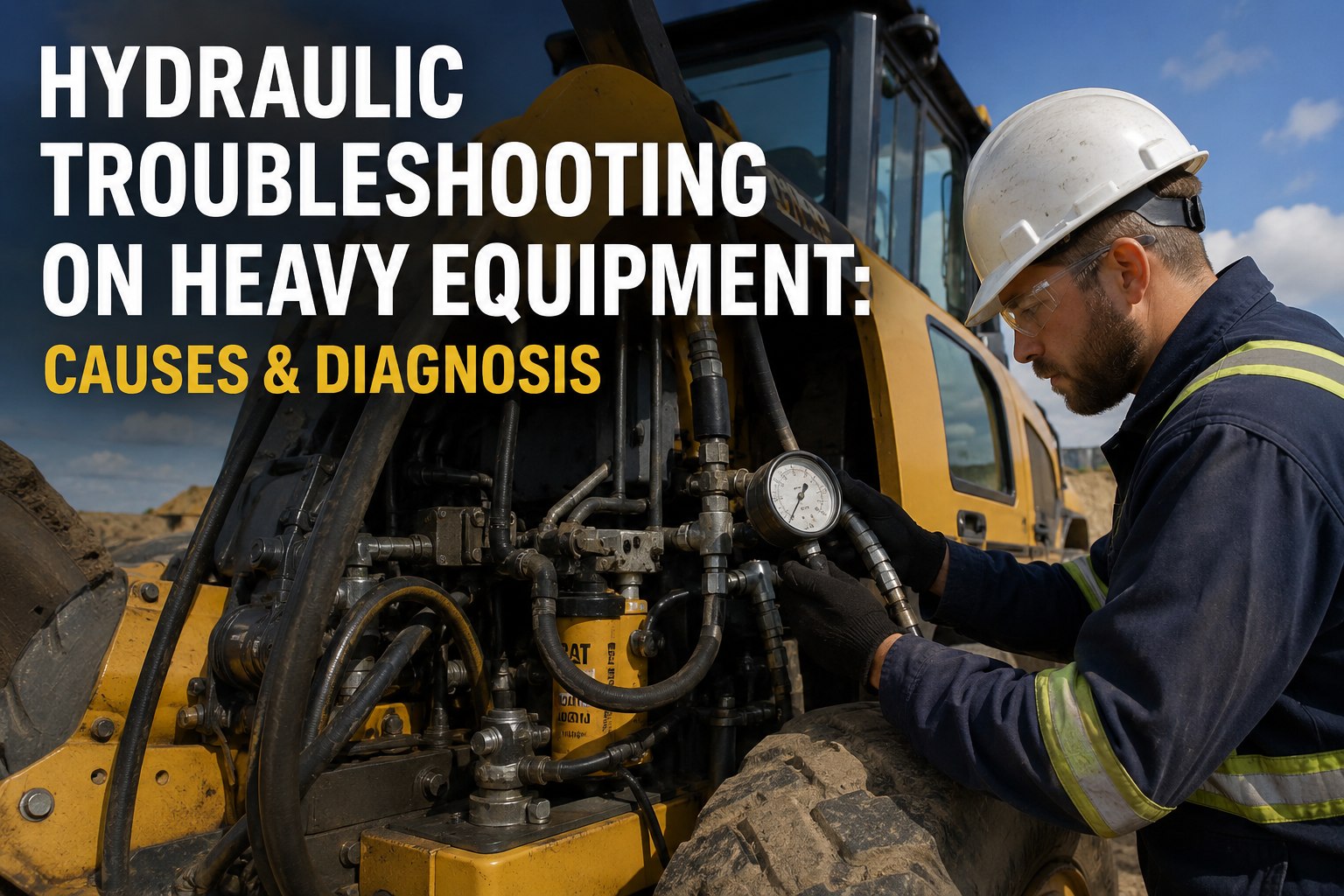
The hydraulic system is the lifeblood of a backhoe loader — it powers every lift, dig, curl, and stabilizer, and when it weakens, the whole machine slows with it. The trouble is that operators and even mechanics often reach for the most expensive answer first, pulling a pump or condemning a cylinder when the real fault is a $15 coupler or a clogged filter. Good diagnosis saves both. The single most useful distinction in the field is whether the symptom came on gradually or suddenly: a slow, season-long loss of speed and lift is almost always pump wear or internal seal bypass, while a sudden, complete loss of a function is almost always a coupler, suction line, or relief-valve event. Reading the symptom precisely cuts the work in half — and on a jobsite where every minute of downtime stalls the crew and runs emergency repairs at three to nine times the planned cost, that speed matters. This guide walks the diagnostic logic: the gradual-vs-sudden split, the symptom-to-cause map, the component failure modes, the field tests you can run with a flashlight and a thermometer, and how a daily inspection catches the warning before the breakdown. book a 30-minute walkthrough to see it set up for your fleet.
Before you pull the pump: the symptom usually tells you exactly where to look.
HVI captures the hydraulic warning signs on every daily inspection — leaks, slow function, jerky operation, overheating, whining pump — flags the developing failure, routes it to a work order, and keeps the history that tells you which machine is trending toward a breakdown.
Why fast diagnosis pays
A misdiagnosed hydraulic fault costs twice — once for the wrong part, again for the downtime while you find the right one. Precise diagnosis is the cheapest tool in the box.
The discipline that separates good diagnosis from guesswork is simple: write down what the operator is actually seeing before a wrench comes out. Hydraulic symptoms are surprisingly specific, and most point at just one or two likely failures. A vague report — "it's not right" — forces you to test everything; a precise one — "boom drifts down when parked, slow only under load" — cuts the work in half. The inspection record is where that precise symptom gets captured.
The master distinction: gradual vs. sudden
Before diagnosing any specific component, answer one question — did this come on slowly or all at once? The answer points you at entirely different failures.
Gradual loss over a season
Slowly declining speed and lift capacity is almost always pump wear or internal seal bypass — oil escaping past worn gear faces, vane tips, or cylinder piston seals. The machine still works, just weaker and hotter each month.
Sudden, complete loss
A function that quits all at once is almost always a coupler, suction line, or relief-valve event — a stuck quick coupler blocking a whole circuit, a collapsed intake hose, or a relief valve dumping pressure. Often a cheap fix, if you look there first.
This one distinction routes the entire diagnosis. Chasing a sudden dead circuit by tearing into the pump wastes a day when the culprit is a $15 coupler that isn't seating; chasing a season-long fade by swapping couplers wastes parts when the pump is worn. Capture "gradual or sudden" on the inspection and the repair starts in the right place. HVI prompts for it on the hydraulic check.
The symptom-to-cause map
Each hydraulic symptom has a short list of likely causes. This is the field reference that matches what the operator sees to where the fault probably lives.
Notice how slow-and-hot keep appearing together — internal leakage causes both, in a vicious circle where heat thins the oil and thin oil leaks more. sign up free and capture these symptoms precisely on every inspection, or book a demo to see hydraulic diagnostic templates.
The four components that fail
Trace any hydraulic symptom and it lands on one of four places. Knowing each component's failure signature is how you confirm the diagnosis.
Hydraulic pump
Worn gear faces, vane tips, or swashplate clearances reduce output, so everything slows and the system runs hot. A whining pump signals cavitation; a knocking one, aeration. A dying pump sheds metal for weeks before it quits.
Cylinders & seals
When piston seals bypass, the cylinder drifts under load and extends slowly even though pump pressure looks normal — oil leaks internally past the piston. The boom-drift test confirms it.
Control & relief valves
A stuck or worn spool restricts or leaks flow, a fatigued relief-valve spring dumps pressure early, and a jammed valve kills one circuit. Valves are the system's brain — when they stick, function gets erratic.
Hoses, couplers & pilot lines
Cracked or ballooning hoses and loose fittings drop pressure; a porous suction line draws air; and a stuck quick coupler blocks a whole circuit while the rest works — the classic cheap fix mistaken for a pump.
The coupler case is worth remembering: when a loader circuit goes completely dead but the backhoe still works, it's usually a single quick coupler not seating — a $15 part, not a pump rebuild. Always inspect the couplers on a dead circuit before assuming the worst. HVI's template walks the operator through the cheap-cause checks first.
Field tests with a flashlight and a thermometer
You don't always need a flow-tester. Three simple tests confirm the most common diagnoses before you commit to a teardown.
The drift test
Fully extend a cylinder, shut off the function, and watch for 3–5 minutes. If the boom or bucket drifts down on its own, oil is bypassing the piston seals or a valve spool — a cylinder or valve fault, not a pump.
The cylinder bypass test
With the cylinder bottomed and held under pressure, crack the rod-end hose. A healthy cylinder weeps briefly then stops; one that keeps flowing has bypassing piston seals dumping oil to return.
The infrared scan
Internal leakage makes heat. An infrared thermometer on valves, cylinders, and the pump finds the component running abnormally hot — that's where oil is escaping under pressure doing no work.
These cost an honest hour and a cheap tool, and they keep you from pulling a good pump — but they only happen if the symptom was caught and logged first. sign up free and turn operator-reported symptoms into a documented diagnostic trail.
Catch it on the daily inspection — before the breakdown
Every one of these failures sends warning signs early, and the daily pre-shift check is where they first appear. Catching them there turns a diagnosis into prevention.
Watch the fluid
Low level invites air and cavitation; milky oil means water contamination; dark or varnished oil means heat damage. The daily fluid check catches the root cause of most failures before they cascade.
Log the early symptom
A slightly slow function, a faint whine, a small weep at a fitting — logged today, these are the gradual warning the season-long pump fade gives. Trended per machine, they predict the failure.
Change oil & filters on time
A clogged filter starves the pump; old oil after a wear event destroys a new pump in 200 hours. Firing filter and fluid service on real engine hours prevents the failures diagnosis is meant to catch.
of warning, captured. A dying pump sheds metal for weeks, a cylinder drifts a little more each shift, oil creeps hotter over a season — every hydraulic failure announces itself before it strands the machine. The daily inspection is where those signs first show, and logging them per machine turns a reactive diagnosis into a scheduled repair. HVI captures the symptom, routes it to a work order, and trends it so the breakdown never arrives by surprise.
Paper checklists vs. HVI
Both technically note "hydraulics OK." Only one captures the precise symptom, prompts the cheap-cause checks first, routes the defect to a repair, and trends the warning signs that predict a failure.
Paper / reactive
- "Hydraulics OK" with no symptom detail
- Gradual-vs-sudden distinction never captured
- A $15 coupler chased as a pump failure
- Slow function and hot oil noticed at breakdown
- Filter & fluid service by calendar guess
- No symptom history to predict the failing machine
With HVI software
- Precise symptom captured with photo evidence
- Gradual-vs-sudden prompted on the hydraulic check
- Cheap-cause checks (couplers, fluid, filters) first
- Early warning signs logged and trended per machine
- Filter & fluid PM fires on real engine hours
- Every defect auto-creates a tracked work order
first time. Precise diagnosis means you fix the actual fault instead of throwing parts at a symptom — the $15 coupler instead of the pump, the seal kit instead of a new cylinder, the filter instead of a teardown. Combined with daily inspections that catch the warning early, it cuts both the wrong-part cost and the downtime. HVI captures the symptom, guides the diagnosis, and documents the fix in one platform.
Frequently asked questions
How do I diagnose a slow or weak backhoe hydraulic system?
Start by writing down exactly what the operator is seeing and whether it came on gradually or suddenly, because that single distinction routes the whole diagnosis. A gradual, season-long loss of speed and lift capacity is almost always pump wear or internal seal bypass — oil escaping past worn gear faces, vane tips, or cylinder piston seals — while a sudden, complete loss of a function is almost always a coupler, suction line, or relief-valve event. From there, match the specific symptom: slow and weak points to pump wear, internal leakage, low or wrong-viscosity fluid, or a clogged filter; jerky or chattering points to air in the system; drift under load points to cylinder piston seals or a valve spool. Check the cheap and common causes first — fluid level and condition, filters, and quick couplers — before condemning the pump. Confirm with simple field tests like the drift test before any teardown. HVI's inspection and maintenance software captures the precise symptom and prompts the cheap-cause checks first. sign up free and diagnose faster.
Why does my backhoe boom or bucket drift down on its own?
Drift under load — the boom slowly settling or the bucket creeping down when it should hold — is a classic sign that oil is bypassing internally, most often past worn cylinder piston seals or a leaking control-valve spool. The pump and pressure can look completely normal, because the problem isn't generating pressure, it's holding it. You can confirm the source with two simple tests. The drift test: fully extend the cylinder, shut off the function, and watch for three to five minutes; if it drifts, oil is bypassing somewhere in that circuit. The cylinder bypass test: with the cylinder bottomed and held under pressure, crack the rod-end hose — a healthy cylinder weeps briefly and stops, while one with bypassing piston seals keeps flowing as oil dumps past the seals to return. If the cylinder is the culprit, the choice is a seal kit or a new cylinder depending on rod and barrel condition. HVI's inspection and maintenance software logs drift symptoms so they're caught and tracked early. book a demo to see symptom tracking.
What causes jerky or chattering hydraulic operation?
Jerky, chattering operation with chattering control levers and pump noise is the signature of air in the hydraulic system, which comes in two forms. Aeration is air drawn in from outside, usually past a leaking suction-side seal or a loose fitting, or through a low reservoir where a vortex lets air into the pump intake — it often sounds like knocking. Cavitation is vapor forming inside the fluid when pump inlet pressure drops too low, typically from cold thick oil, a plugged suction strainer, or a restricted or collapsed intake hose — it sounds like a whine. The distinction matters because cavitation can eat a pump from the inside out in a single shift if it's bad enough. To fix it, check and top up the fluid level, inspect and tighten suction-side fittings, replace porous or collapsed intake hoses, and clean or replace a clogged suction strainer. Using the correct oil viscosity for the temperature also helps. HVI's inspection and maintenance software captures the noise and operation symptoms that point to air. sign up free and catch aeration early.
Why does my hydraulic system overheat, and why does it matter?
Hydraulic oil above about 180°F damages most seal compounds and accelerates the oxidation that turns clean oil into varnish, so overheating is both a symptom and, left unchecked, its own cause of failure. Heat is almost always a symptom of one of the other problems: internal leakage forcing the pump to do the same work twice, contamination plugging the cooler, or low fluid level reducing the system's ability to dissipate heat. There's a vicious circle at work — internal leakage generates heat, heat thins the oil, and thinner oil leaks more — which is why slow operation and high temperature so often appear together. An infrared thermometer is the diagnostic tool here: scan the valves, cylinders, and pump to find the component running abnormally hot, because that's where high-pressure oil is escaping and doing no useful work. Address the root cause — the leaking component, the plugged cooler, the low fluid — rather than just the temperature. HVI's inspection and maintenance software flags overheating and the symptoms that cause it. book a demo to see overheating diagnostics.
How does HVI help diagnose and prevent hydraulic failures?
HVI is an inspection and maintenance software platform that turns hydraulic symptoms into a documented diagnostic and prevention trail. On the daily pre-shift inspection, operators capture the precise warning signs — slow or weak function, jerky operation, drift under load, pump whine, oil leaks, fluid level and condition, and whether a problem came on gradually or suddenly — from a phone or tablet with photo evidence, which is exactly the precise symptom report that cuts diagnosis time in half. The template prompts the cheap and common checks first, like quick couplers, fluid, and filters, so a $15 coupler isn't chased as a pump failure. Every defect auto-creates a tracked work order, preventive maintenance for filters and fluid fires on each machine's real engine hours so contamination and starvation don't destroy a pump, and the platform trends symptoms per machine so a gradually fading unit is caught before it strands a crew. It works offline on the jobsite and keeps a full repair history. book a demo and we'll map the software onto your fleet on the call.
Read the symptom, fix the right part, and catch the next one on the daily check.
HVI captures hydraulic warning signs on every inspection — slow function, jerky operation, drift, pump whine, leaks, fluid condition — prompts the cheap-cause checks first, routes every defect to a work order, fires filter and fluid PM on real engine hours, and trends symptoms per machine so a fading backhoe is caught before it strands the crew. Stop throwing parts at symptoms.
No credit card required · Live in under two weeks · Hydraulic symptom capture + cheap-cause prompts + engine-hour PM + work orders in one platform