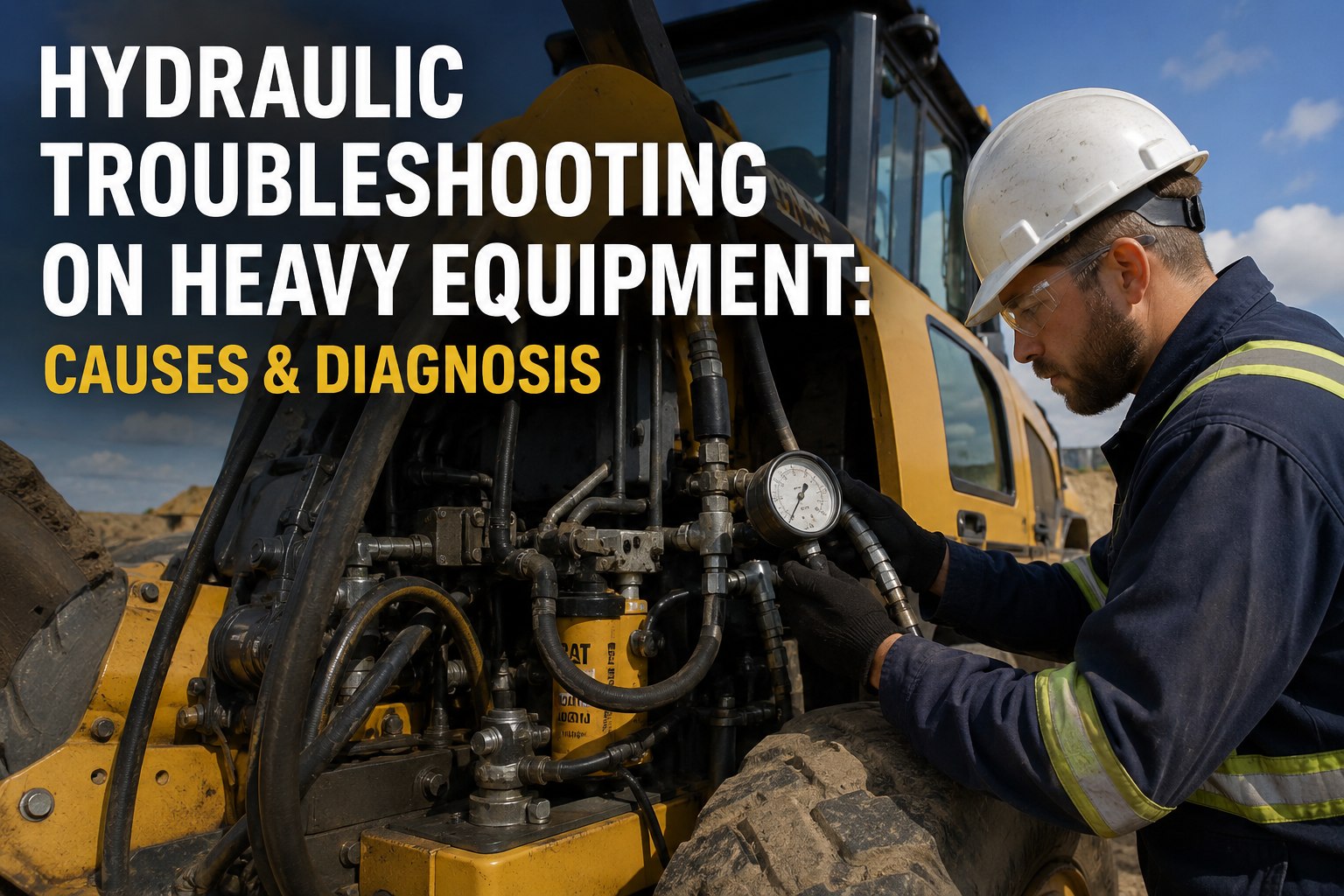
The machine ran fine yesterday. Today the boom is slow, the bucket won't hold load, and the oil smells burnt. Somewhere between the pump, valves, cylinders and filters, one part is failing — and the wrong first guess costs a $12,000 pump to fix what turned out to be a $180 relief valve. Good hydraulic troubleshooting is reading the symptom, running the right test in the right order, and letting the pressure gauge name the guilty part before you unbolt anything expensive — book a demo to see how HVI turns this into a repeatable workflow.
Six Symptoms. One Diagnostic Map.
Before you replace anything, look up what the machine is telling you. Every symptom below has 2–4 likely causes ranked by how often they turn out to be the real fault.
- 50%Worn hydraulic pump (internal leakage)
- 25%Restricted or clogged filter
- 15%Low fluid / air in suction line
- 10%Relief valve set too low
- 45%Relief valve bypassing (stuck open)
- 30%Cylinder internal leak (piston seals)
- 20%Pump pressure output degraded
- 5%Load-sense line pinched
- 40%Clogged cooler / fan or radiator debris
- 30%Internal leakage (pump, valve, cylinder)
- 20%Wrong fluid viscosity for climate
- 10%Low fluid level / undersized reservoir
- 55%Pump cavitation (starved suction)
- 25%Aeration (air in the fluid)
- 15%Worn pump bearings
- 5%Loose mounting / misalignment
- 60%Worn piston seals (internal bypass)
- 25%Leaking control valve spool
- 10%Faulty load-holding / counterbalance valve
- 5%Scored cylinder bore
- 45%Chafed / cracked hose or fitting
- 30%Failed cylinder rod seal
- 15%Loose or damaged O-ring at connection
- 10%Cracked valve body or pump housing
Percentages are field-observed frequency for well-maintained fleets. Poorly maintained fleets skew heavier toward contamination-driven failures across every symptom.
The map above is where diagnosis starts, not where it ends. Below is the structured 6-step test sequence that turns those "likely causes" into a confirmed answer — usually inside 45 minutes, always before you order parts. Book a 30-minute demo to see the full sequence inside a live HVI inspection template.
The one number you probably didn't check
trace back to fluid contamination — dirt, water, air, or wear particles — long before the pump, valve, or cylinder actually breaks. Multiple industry sources (Van Dorn Demag research, ISO-referenced fluid-power studies) converge on this range. Which means the fault you're chasing today probably started weeks ago as a filter you didn't change or a reservoir cap left off during a top-off.
The practical takeaway: check fluid condition and filter restriction before you spend an hour on pressure tests. It's the fastest, cheapest branch to eliminate — and the one most often skipped. Book a demo to see fluid samples and filter history tracked per asset — that's where the pattern behind a repeat failure finally shows up.
The 6-step diagnostic sequence
Doing tests out of order wastes time and sometimes damages parts. Fluid and filter checks first, because they're 15 minutes and rule out the most common cause. Pressure and flow testing second, because they distinguish a pump problem from a valve problem before you drop the pump. Cylinder and valve isolation last, because those are the destructive-teardown tests. Book a demo to see this 6-step sequence built as a digital inspection template — the shops that standardize it stop skipping steps under time pressure.
-
1Visual walkaround & leak check10 min
Fittings, hose chafe points, cylinder rods for scoring, wet spots under the machine, oil on the paint downstream of a valve bank. Half of "mystery pressure loss" complaints are visible if you look under the machine with a flashlight before starting it.
-
2Fluid level, condition & contamination check15 min
Level at operating temp. Color (dark = oxidized, milky = water contamination, foamy = aeration). Smell (burnt = overheated). Pull a sample for lab analysis if the color is off — a $30 oil analysis kit prevents a $12,000 pump job.
-
3Filter restriction reading5 min
Check the filter restriction indicator (or delta-P gauge if fitted). Filter in bypass = unfiltered fluid circulating through the whole system, which explains slow, weak, and hot all at once. Change the filter before further testing.
-
4System pressure test20 min
Install a gauge on the test port. Deadhead the system and read pump pressure against the manufacturer's spec. Pressure below spec = pump wear or relief valve bypass. Pressure at spec but weak operation = downstream valve or cylinder leak. This one test cuts the diagnosis tree in half.
-
5Flow test & pump volumetric efficiency25 min
Flow meter inline. Compare measured GPM at rated pressure against pump spec. Pump volumetric efficiency below 85% at operating temperature usually means the pump is bypassing internally and needs replacement or rebuild. Above 90%, look elsewhere.
-
6Cylinder & valve isolation30–60 min
Cap the cylinder ports one at a time and re-test. If pressure holds capped but bleeds off through the cylinder = piston seal failure. Swap valve sections between working and non-working circuits to isolate a faulty spool. Only reach this step if steps 1–5 didn't already answer the question.
Reading the pressure gauge: what the number actually means
Pressure and flow together give you the answer — either alone can mislead. Here's how the common combinations read.
| Pressure | Flow | Symptom | Most likely cause |
|---|---|---|---|
| At spec | At spec | Slow only under load | Cylinder or motor internal leak — move to cylinder isolation (step 6) |
| At spec | Low | Slow at all loads | Restriction downstream — filter, hose kink, or partially closed valve |
| Low | At spec | Weak force, normal speed | Relief valve bypassing — usually the cheapest fix on this table |
| Low | Low | Slow and weak together | Pump wear / internal bypass — confirm with volumetric efficiency test |
| Fluctuating | Fluctuating | Whining noise, erratic motion | Cavitation or aeration — check suction line, fluid level, reservoir breather |
| Normal cold, drops hot | Drops with pressure | Fine on startup, weak after 30 min | Worn pump — clearances open up as fluid thins with heat |
The two-column read (pressure + flow) is what separates a pump problem from a valve problem before you touch a wrench. Skipping it is what turns a $180 relief valve job into a $12,000 pump replacement that didn't need doing. Start a free HVI trial to log every pressure and flow reading against the asset — so next time this symptom returns, the last diagnosis is one tap away.
Contamination: the failure behind the failure
If the same machine keeps showing up with the same hydraulic complaint, contamination is almost always in the story somewhere. It works upstream of everything: dirty fluid wears pump clearances open (slow + weak), scores valve spools (drift + erratic), abrades cylinder seals (leaks + drift), and clogs filters (heat + slow). One root cause, five downstream symptoms — book a demo to see oil-sample results and filter-change history tracked against every machine, which is what makes the pattern impossible to miss.
Particulate (dirt, metal, rubber)
Gets in through breather caps, top-offs from open containers, worn rod seals, and returning components after service. Under 5μm particles are invisible but do the most damage — they fit the clearances where they cause the wear.
Water
Milky-looking fluid = water in the system. Enters through condensation in half-full reservoirs, damaged breathers, or cylinder rod seals in wet operations. Destroys additive packages and rusts precision surfaces from the inside.
Air (aeration)
Foamy fluid, spongy controls, whining pump. Enters at loose suction fittings, low reservoir level, or damaged pump shaft seals. Compresses under pressure — which is exactly what hydraulic fluid must not do — and causes cavitation damage inside the pump.
Heat degradation
Not a contaminant that entered — one the fluid becomes. Sustained operation above 180°F oxidizes the oil, breaks down additives, and produces varnish that coats valve spools. Dark, burnt-smelling fluid is fluid that already failed.
The habit of a technician who's seen this a hundred times
The mistake I see new guys make is they hear "slow hydraulics" and they're pricing a pump before they've even checked the filter. Half the time the answer is a $40 filter cartridge and 20 minutes of their time.
My rule for the shop: nobody quotes a pump replacement without a pressure and flow reading logged against the asset. If those two numbers don't exist, the next test is the pressure test, not the parts order. We started tracking it that way three years ago and pump replacements dropped by about a third — not because pumps got better, because we stopped replacing ones that didn't need replacing.
Frequently asked questions
Why are my excavator hydraulics slow but the engine runs fine?
Slow hydraulics with a healthy engine almost always points to one of four things, in order of frequency: a worn hydraulic pump bypassing internally, a restricted or bypassed filter starving flow, low fluid level or air entering the suction line, or a relief valve set below spec. Start with the cheapest and fastest checks — fluid level, fluid condition, and the filter restriction indicator. If those are clean, install a pressure gauge on the test port and check system pressure against the manufacturer's spec. If pressure is at spec but flow is low, the restriction is downstream (filter, kinked hose, partially closed valve). If both pressure and flow are low, the pump is likely the culprit and should be confirmed with a volumetric efficiency test before replacement.
What causes hydraulic oil to overheat on heavy equipment?
Four causes cover almost every case. First, restricted cooling — a hydraulic cooler packed with dirt, mud, or seed heads, or a cooling fan that's failed or is running backwards on a reversed hose install. Second, internal leakage — a worn pump, bypassing relief valve, or leaking cylinder converts hydraulic energy to heat instead of work, and it shows up in the oil temperature. Third, wrong fluid viscosity for the operating climate — oil that's too thin runs hotter under load, oil that's too thick generates internal friction. Fourth, low fluid level or an undersized reservoir that can't dissipate heat between duty cycles. Sustained oil temperature above 180°F oxidizes the fluid and degrades additive packages, so overheating is both a symptom and a cause of further failure — find the source quickly.
How do I know if my hydraulic pump is cavitating?
Cavitation has a distinctive high-pitched whine or growl that changes with pump speed and load, often described as sounding like marbles or gravel inside the pump. It's caused by the pump trying to draw more fluid than the suction line can deliver, creating vapor bubbles that violently collapse against the pump internals and eat away at metal surfaces. Common causes: a clogged suction strainer, cold thick fluid on startup, a low reservoir level uncovering the suction port, a collapsed or kinked suction hose, or a restricted reservoir breather that can't equalize pressure as fluid leaves. Cavitation is destructive — every minute of operation damages the pump — so shut the machine down when you hear it and fix the suction-side restriction before running again. Aeration (air actually mixed into the fluid) sounds similar but comes from a loose suction fitting or low fluid level; both need to be ruled out.
Why does my hydraulic cylinder drift down under load?
Cylinder drift — where a raised load slowly settles even with the control valve neutral — is fluid bypassing somewhere it shouldn't. In roughly 60% of cases the piston seals inside the cylinder are worn, letting fluid leak from the loaded side of the piston to the unloaded side. In another 25% the control valve spool is worn or contaminated and letting fluid leak past it back to tank. Less commonly, a load-holding or counterbalance valve is faulty, or the cylinder bore itself is scored. The diagnostic is simple: cap the cylinder ports with plugs. If the load holds with the ports capped, the leak is in the valve or hose circuit. If the load still drifts with the ports capped, the leak is inside the cylinder itself and the cylinder needs reseal or replacement. Drift that suddenly appears after a hot workday often points to worn seals expanding differently with temperature.
How often should hydraulic oil and filters be changed on heavy equipment?
Follow the OEM interval as the baseline — most heavy equipment manufacturers specify hydraulic filter changes every 500–1,000 operating hours and full fluid changes every 2,000–5,000 hours depending on machine type and duty cycle. But hours alone aren't the right trigger for every fleet: dusty, wet, or high-heat operations can double contamination rates and cut those intervals in half. The better practice is condition-based — pull an oil sample every 250–500 hours, send it for particle count and moisture analysis (roughly $30 per sample), and change fluid based on actual condition rather than the calendar. Filter restriction indicators should be checked at every walkaround, and any filter in bypass should be changed immediately regardless of hour count. Tracking every filter change and oil sample against the specific asset lets you see whether one machine consistently contaminates fluid faster than the rest of the fleet — which usually points to a breather, seal, or reservoir issue worth fixing at the source.
Turn today's troubleshooting into tomorrow's answer key
HVI logs hydraulic inspection findings, pressure and flow readings, oil sample results, filter changes, and repairs against every asset. When the same symptom returns in six months, the technician sees the last diagnosis, the last repair, and the pattern across similar machines — instead of starting from zero. Live in under two weeks. No hardware to buy.
No credit card · No hardware · Ready on day one