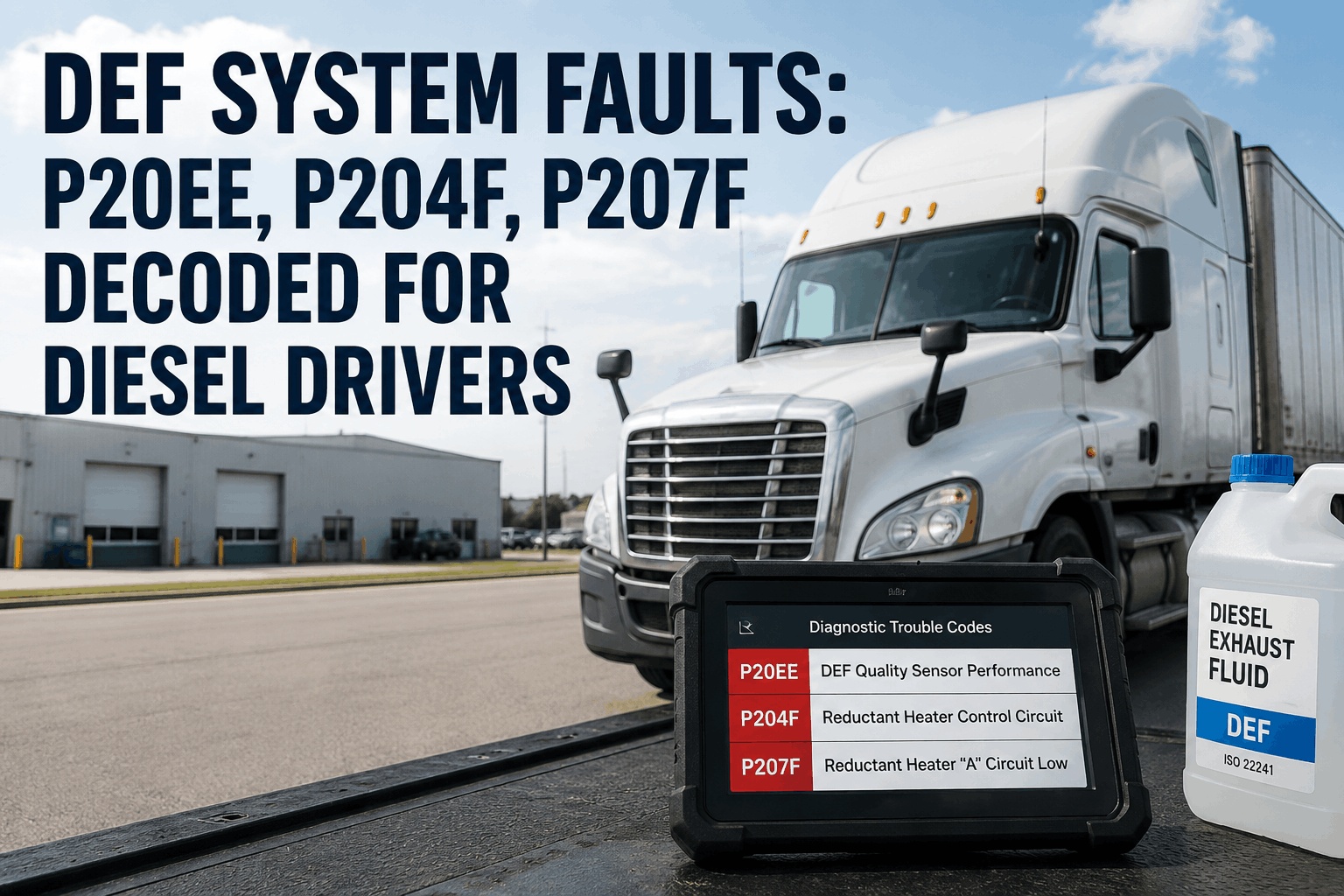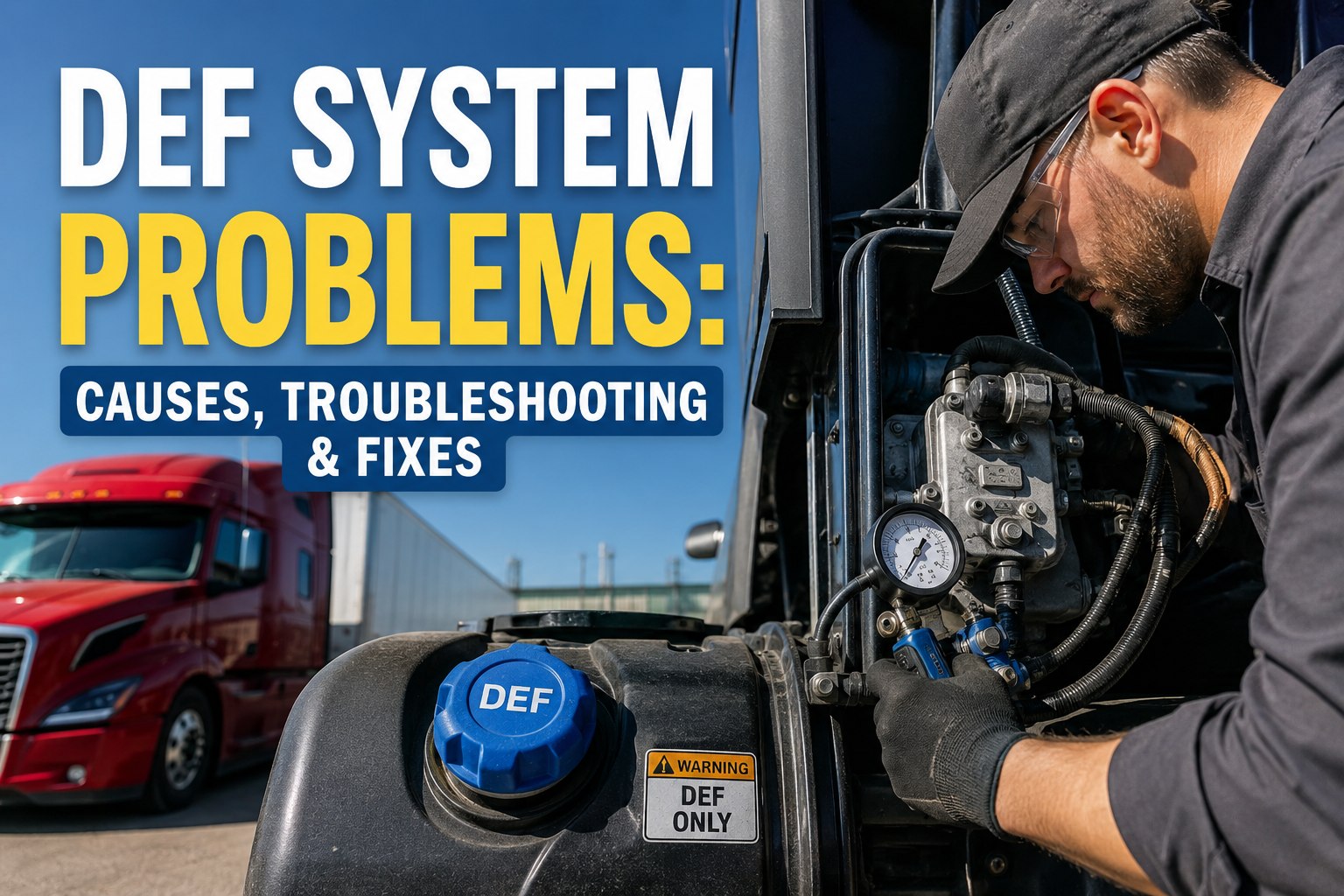
A white crusty mass around the injector is not a mystery. A DEF warning light with a full tank is not random. Both are the aftertreatment system telling you which of seven specific components has failed — and if you know where to look, you can fix it before it becomes a derate,or a $6,000 aftertreatment repair. This guide walks the DEF system problems that account for most modern truck faults, in the order they actually fail — book a demo to route DEF codes into work orders.
Where the DEF System Actually Breaks
The path from a sealed jug of DEF to clean exhaust runs through seven components, each with its own failure signature. Learn the anatomy and any DEF fault code starts pointing at a specific part — not "the DEF system."
Every fault code below points at one of these seven points. Read the anatomy, then read the code — and the diagnosis stops being a guessing game.
The rest of this page walks each failure family in the order they actually happen — what triggers it, how to confirm it, and what the fix costs when caught early vs. late. Book a 30-minute demo to see DEF fault codes routed into work orders inside HVI.
DEF quality faults: the fastest way to a derate
The DEF quality sensor sits in the tank and reads urea concentration continuously. Fresh, in-spec DEF is 32.5% urea and 67.5% deionized water. The moment the sensor reads outside a roughly 30–35% window, the ECM stops trusting the fluid and starts the inducement clock. This is the single fastest path from a working truck to an engine derate on a modern emissions-equipped fleet.
Contamination
Fuel, oil, coolant, dust, or dirt introduced during fill. Sources: dirty filler cap, a funnel or container previously used for another fluid, tank cap left open during a rainstorm. Even trace contamination changes the concentration reading enough to trigger the fault. The fix: drain the tank, flush the lines, replace the filter, refill with fresh certified DEF.
Degradation from storage
DEF has a shelf life — roughly 18 months at optimal temps (10–77°F) but only about 6 months at 95°F. Jugs stored in a hot warehouse or on a sunny truck bed break down long before their printed date. The urea concentrates as water evaporates and the fluid becomes non-compliant. Never top off a truck from a jug that's been open in the heat.
Wrong fluid entirely
Someone at a fuel island refills the DEF tank with diesel, hydraulic fluid, or windshield wash. Happens more often than fleets admit. Immediate derate, tank must be drained and every downstream component replaced or professionally flushed before restart — running the pump on the wrong fluid destroys the seals.
Sensor drift
The quality sensor itself can drift or be coated in urea crystals from long-term exposure. A sensor reporting bad quality on verified fresh DEF is often the sensor, not the fluid. Confirm with lab strip test of the actual fluid before replacing sensor.
The prevention is boring but it works: sealed DEF from verified supply, dedicated funnel that has never touched another fluid, cap wiped clean before opening, jugs stored between 10 and 77°F, oldest stock used first. Every fleet that eliminated quality-triggered derates did it with process, not technology.
Crystallization: the visible fault most fleets ignore
DEF is an aqueous urea solution — the moment water evaporates from it, urea crystals form. Modern SCR systems have a shutdown "purge" cycle that retracts DEF from heated lines back to the tank before the engine shuts down. When that purge fails, or gets skipped by short-cycle operation, urea sits in hot lines and crystallizes into a mass around the injector known on shop floors as the "urea volcano."
Around the injector neck
The classic urea volcano — a white, crusty mass growing around the dosing injector's mounting point on the exhaust bung. Visible on a walkaround inspection with the truck cold. Signals either a leaking injector seal, a chronic purge failure, or both. Caught early: clean the deposit, replace the seal. Caught late: injector replacement plus SCR damage.
Inside the injector nozzle
Not visible from outside. Symptoms: rising SCR-related codes, poor NOx conversion, DEF pump working harder than normal to push against restriction. Confirmed by removing the injector and inspecting nozzle tip under bright light or borescope. White deposits = crystallization; brown/black = exhaust leak past seal.
Inside the supply lines
Lines routed near the exhaust can heat-soak enough between shutdowns that stationary DEF evaporates and leaves crystal buildup inside the line. Restricts flow, forces the pump to work harder, and produces intermittent pressure faults. Common on fleets that do many short-run trips where the purge never completes.
On tank internals
Different mechanism — caused by warm air above a low tank evaporating water off the fluid surface. Crystals form on tank walls, on the level sensor float, on the heater element. GM documented this in Bulletin 22-NA-150: crystallization on the level sensor causing false "DEF Level Low" readings on 2020–2024 Silverado, Sierra, Tahoe, and Yukon. Keep the tank topped up to reduce airspace.
Prevention: run each engine long enough for the SCR purge cycle to complete after any DEF-active operation. Wipe visible deposits during walkarounds. Investigate escalating pump pressure or dosing codes before the injector is fully blocked. Book a demo to see how HVI flags escalating aftertreatment DTC frequency per unit so the pattern shows up before the derate does.
Pump, heater & sensor failures: the mechanical layer
Beyond fluid quality, the DEF system has three mechanical/electrical components that fail on their own timelines. Each has a characteristic SPN and each has a specific bench test that confirms it before parts are ordered.
| Component | Common SPN | Symptom | Bench test |
|---|---|---|---|
| DEF pump | SPN 4334, 4364, or manufacturer-specific | Won't hold 70–100 PSI; no dosing; audible clicking without hum | Pressure gauge at test port; listen for pump hum on command; check inlet filter for restriction |
| Dosing injector | SPN 3361 | Backpressure, urea volcano visible, poor spray pattern | Remove and inspect nozzle under light; measure coil resistance (typical 10–15 ohms open circuit test) |
| Tank heater | SPN 3363 (Ford Powerstroke: P20BA) | Frozen DEF in cold weather; no dosing below 12°F despite full tank | Power & ground at heater with system commanded on; measure resistance; check for open or short |
| Level sensor | SPN 4094 | False low-DEF warnings; erratic gauge; DEF Level Low on verified full tank | Visual inspection for crystal coverage on float; live-data reading vs. dipstick measurement |
| Temperature sensor | SPN 3031 or manufacturer-specific | Heater fails to command on when it should; DEF freezes despite functioning heater | Resistance vs. temperature curve check; compare against ambient reading |
| Quality sensor | Manufacturer-specific | Bad-quality fault on verified fresh, in-spec DEF | Lab strip test of tank fluid; if fluid is 32.5% urea, sensor is at fault |
The consistent pattern: confirm the component before replacing it. A quality-sensor fault code on a truck with actually bad fluid is a fluid problem, not a sensor problem — replace the sensor and it fails again in a week. A pump code with intact pressure readings is often a wiring or ground fault, not a pump. Bench-test discipline separates the shops that fix DEF issues in one visit from the ones that throw parts at them. Book a demo to see HVI track which SPN was replaced with which part on which asset, so the wrong-part pattern shows up before the second parts order is placed.
Cold weather: freezing, thawing & heater strategy
DEF freezes at 12°F (-11°C). Modern SCR systems are designed for this — the tank heater thaws the fluid on startup and the ECM allows engine operation while DEF is frozen for a limited time. Where cold-weather failures happen is at the boundary conditions: heater elements that fail undiagnosed all summer, or supply lines that freeze because the tank thawed but the lines didn't.
Frozen DEF is normal
A frozen tank on a below-12°F morning is not a failure — the fluid is doing exactly what it's designed to do. The heater will thaw it during warm-up. The system allows a startup grace period before requiring active dosing. If the truck runs long enough for the tank to reach dosing temperature, no fault is raised.
Tank heater failure = winter breakdown
A heater that fails during summer produces no symptoms — DEF is above 12°F, dosing continues normally, no code fires. The first cold morning of the season is when the failure gets discovered, and often at 4 AM in the parking lot. Prevention: verify heater function during the fall PM cycle, before the first freeze.
Ice expansion damages seals
Repeated freeze-thaw cycles stress rubber seals and plastic fittings. Ice expansion inside supply lines can crack housings and rupture lines — failures that only show up under pressure after the fluid thaws and starts flowing. Post-winter inspections should include line integrity checks even on trucks that never had a fault code.
Short-run trips prevent purge
The SCR shutdown purge cycle requires the engine to run long enough for the ECM to complete it. Trucks doing many short-run trips in cold weather never let the cycle finish, leaving DEF in the lines that then freezes and expands. Chronic short-cycle fleets need to allow a few extra minutes of idle after any active dosing before shutdown.
The 6-step DEF fault diagnosis workflow
Faced with a DEF warning light and one or more DTCs, this sequence catches most problems in a single shop visit instead of the throw-parts-at-it cycle that plagues newer technicians.
-
1Capture DM1 and DM2 — every DEF-related SPN with OC5 min
Photo or export the full active and stored code list. High Occurrence Count on inactive DEF codes = intermittent that's about to become constant. Do not clear codes yet.
-
2Visual inspection of the DEF injector area5 min
Look under the truck at the DEF dosing injector. White crystalline mass = confirmed crystallization at Location A. Brown/black seepage = exhaust leak past seal. Nothing visible = look elsewhere.
-
3Verify DEF fluid quality with a lab strip5 min
A $3 refractometer strip confirms whether the fluid is actually 32.5% urea. Bad fluid = drain tank, flush lines, refill. Good fluid + quality-fault code = sensor fault. Skipping this test is why quality sensors get replaced on trucks that just have contaminated fluid.
-
4Pump pressure test15 min
Connect a pressure gauge at the test port. Command dosing active. Reading should be 70–100 PSI. Low pressure = pump, inlet filter, or supply-side leak. No pressure at all = pump, wiring, or ground. High pressure = downstream blockage (crystallized injector).
-
5Component bench tests before parts orders30 min
Every DEF component has a bench test (see table above). Confirm the exact failure before ordering the part. A $340 injector test can save a $2,000 wrong-part order — and prevent the same fault returning next month.
-
6Repair, clear codes, drive cycle, re-scanvaries
Complete the repair, clear codes as verification, run the required drive cycle for the SCR to complete self-test. Re-scan to confirm the code did not return. Codes that come back mean the root cause was not fully addressed.
Every step of the sequence takes minutes; skipping any of them costs hours downstream. Start a free HVI trial to attach the diagnosis, bench-test results, and repair to the unit record, so the next fault on the same truck starts from the last one, not from a blank sheet.
The mistake that turns a $340 repair into $6,000
Clearing a DEF code without fixing the root does not remove the fault
The scenario plays out on shop floors every week. A DEF warning light comes on. Someone clears the code to "get the truck rolling." It runs for a shift or two, then the light comes back. Someone clears it again. Third time, the truck's already at the mid-derate stage and now the SCR catalyst has been running degraded for weeks with excessive NOx passing through it — damaging the catalyst itself. A $340 injector or $200 quality sensor turns into a $4,000 SCR catalyst replacement plus a mandatory drive cycle to reset the whole system. Under the EPA's post-August 2025 staged inducement schedule, the fault window is longer than it used to be — but every mile driven with an unresolved emissions fault is still a mile of secondary damage accumulating downstream. Correct sequence is always: capture, diagnose, repair, clear as verification. Clearing before diagnosis is the single most expensive shortcut in modern truck maintenance, and repeatedly doing it may qualify as emissions tampering under EPA rules that can carry substantial per-vehicle fines.
A shop foreman on the DEF pump that wasn't the DEF pump
Truck came in with SPN 4334 — DEF pump code. The previous shop had replaced the pump. $1,800 in parts and labor. Same code came back inside 200 miles. Owner was ready to argue warranty.
We put a pressure gauge on it. Pump was fine, holding 85 PSI. Inlet filter was almost fully blocked with fine crystal particles — the truck had been fighting a slow crystallization event upstream for months, the pump had been working harder against restriction, and the ECM was throwing pump codes because it saw slow pressure buildup. Fifteen-dollar filter, an hour of shop time, code stayed gone. Now every DEF pump code that comes through here gets a pressure test and a filter check before anyone quotes a pump.
Frequently asked questions
What causes DEF system problems on a diesel truck?
The single most common cause of DEF system problems is fluid quality — contamination, degradation, or the wrong fluid entirely being added to the tank. DEF is a precise 32.5% urea and 67.5% deionized water solution, and the DEF quality sensor forces a derate the moment concentration reads outside a roughly 30-35% window. The next most common category is crystallization: urea deposits forming around the dosing injector (the "urea volcano"), inside the injector nozzle, in supply lines that heat-soak between shutdowns, or on tank internals like the level sensor. Beyond fluid issues, the mechanical layer fails on its own timelines: DEF pumps that can't maintain 70-100 PSI operating pressure, dosing injectors that clog with crystals, tank heaters that fail (often undiagnosed all summer until the first cold morning), level sensors that get coated with crystals and report false low, and quality sensors that drift over time. Roughly 80% of engine derates on modern trucks trace back to the aftertreatment system, and the DEF subsystem is where the majority of those originate.
Why does the DEF light come on when the tank is full?
A DEF warning light on a verified-full tank almost always means the fault is elsewhere in the aftertreatment system, not with fluid level. The most likely causes: contaminated or degraded DEF (the tank is full but the fluid is out of spec), a failed DEF quality sensor reporting incorrect concentration, a DEF pump that can't hold pressure between 70-100 PSI, a clogged or crystallized dosing injector, faulty inlet or outlet NOx sensors on the SCR system, or SCR catalyst efficiency falling below the ECM's threshold. Level sensor faults themselves can also produce false readings — GM specifically documented crystallization on the level sensor float causing false "DEF Level Low" warnings on 2020-2024 Silverado, Sierra, Tahoe, and Yukon models in Bulletin 22-NA-150. The correct response to a DEF light on a full tank is not to top it off but to pull the fault code via scan tool or telematics. The SPN identifies which component is actually flagging — SPN 3361 is the dosing injector, SPN 3363 is the tank heater, SPN 4094 is the level sensor, SPN 3216 is SCR conversion efficiency — and each points to a specific diagnosis path.
How do I fix DEF crystallization on a truck?
The fix depends on where the crystallization is and how far it has progressed. Around the dosing injector (a visible white crusty mass on the exhaust bung, known as the "urea volcano") caught early: clean the deposit, replace the injector seal, verify the SCR shutdown purge cycle is completing on shutdown. Inside the injector nozzle: remove the injector, inspect the tip under light or borescope, clean if lightly deposited or replace if heavily crystallized. Inside supply lines: replace the affected lines, since crystals inside heated lines don't dissolve out with cleaning. On tank internals: drain the tank, remove and clean the level sensor and heater element (or replace), refill with fresh DEF. Address the root cause after the mechanical cleanup: chronic short-cycle operation prevents the shutdown purge from completing and allows lines to develop crystal buildup, so allow a few extra minutes of engine idle after any active dosing before shutdown. In severe cases where crystallization has spread throughout the system and damaged the SCR catalyst itself, professional flush service and component replacement are the only options.
Does DEF freezing damage the truck?
DEF freezing at 12°F (-11°C) is designed behavior, not a failure. Modern SCR systems include a tank heater that thaws the fluid on startup, and the ECM allows engine operation for a limited startup grace period while DEF is frozen. If the truck runs long enough for the tank to reach dosing temperature, no fault is raised. Where freezing actually causes damage is at the boundary conditions. Ice expansion inside supply lines can crack housings, rupture lines, and damage seals — failures that often don't show up until the fluid thaws and starts flowing under pressure. Repeated freeze-thaw cycles accelerate wear on rubber seals and plastic fittings throughout the system. And a tank heater that fails during warm months produces no symptoms all summer — the failure is only discovered on the first cold morning of the season, usually in a parking lot at 4 AM. Prevention: verify heater function during the fall PM cycle before the first freeze, include DEF line integrity in post-winter inspections, and allow the SCR shutdown purge cycle to complete after any active dosing so DEF doesn't sit in lines to freeze.
Can I keep driving with a DEF warning light on?
Legally, for a while — but every mile risks secondary damage that turns a small repair into a large one. Under the EPA's staged inducement schedule for on-road heavy-duty trucks (updated August 2025), a DEF/SCR fault gives a warning lamp for the first 650 miles or 10 hours, then a 15% torque reduction with no speed limit through about 4,200 miles or 80 hours, escalating torque reduction, and finally a 25 mph speed limit at approximately 8,400 miles or 160 hours. So yes, the truck can typically finish its current shift under a Stage 1 warning. But the risk of continuing is that many DEF faults cause secondary damage downstream while the truck keeps operating — a leaking injector seal lets exhaust into the injector housing that damages the injector itself, a failing pump strains against restriction and eventually seizes, unresolved crystallization spreads through the system, and a catalyst running with poor NOx conversion accumulates thermal damage. A $340 injector or $200 sensor caught at Stage 1 turns into a $4,000-$6,000 aftertreatment repair by Stage 3 or 4. The window is designed for scheduling repairs, not for ignoring the light indefinitely.
Catch the DEF fault at Stage 1 — not at $6,000 later
HVI reads J1939 DEF codes from telematics or scan captures, classifies the failure by component (quality, pump, injector, heater, sensors, SCR), tracks OC trends per unit across visits, and opens a work order tied to the specific SPN. The intermittent that would have escalated to a derate becomes a scheduled repair instead. Live in under two weeks. No hardware. No credit card.
Trusted by fleets across North America · Ready on day one