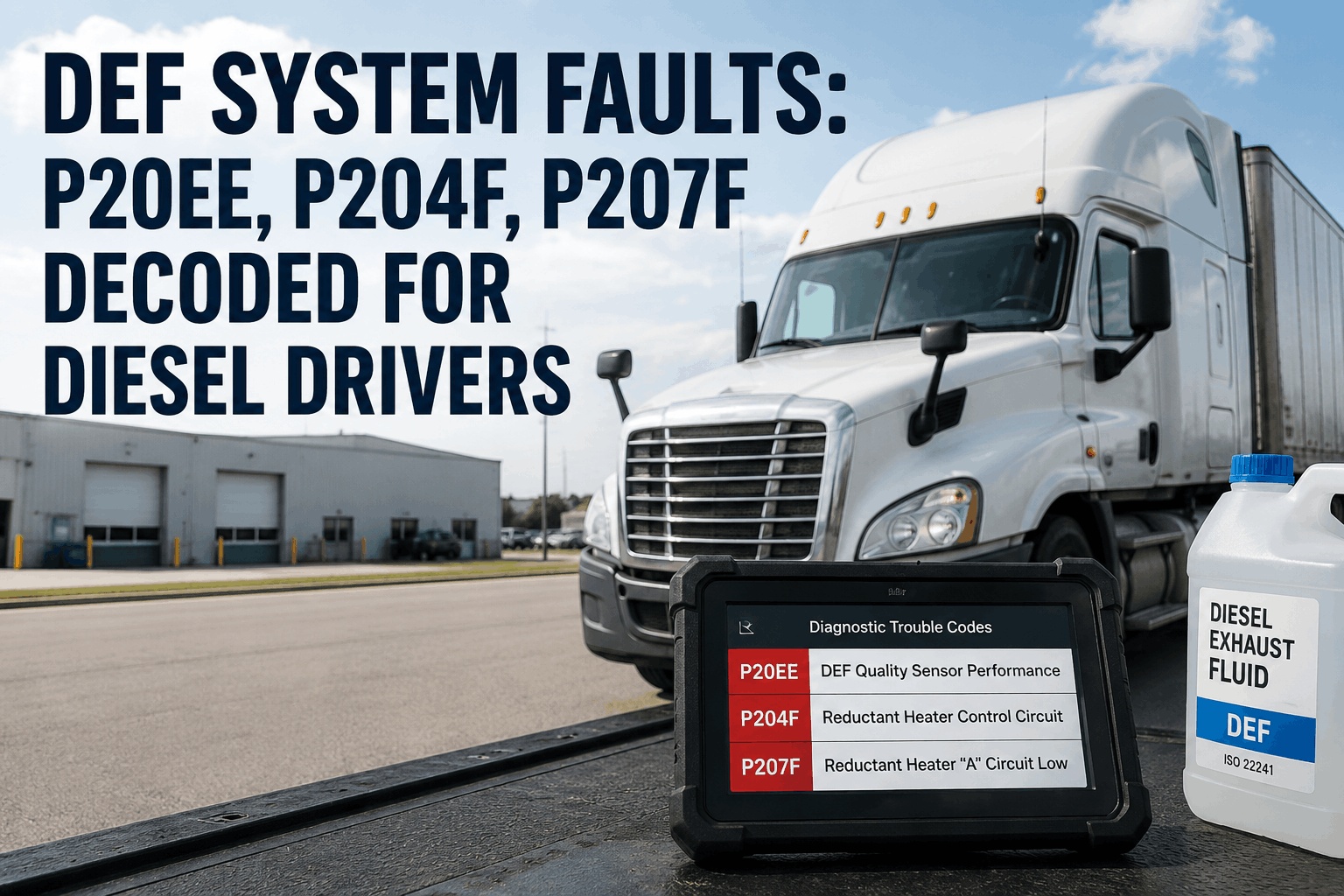
If you're a diesel driver staring at P20EE, P204F, or P207F on your scan tool, the bad news is your truck has officially flagged its DEF system; the good news is these three codes are among the most predictable and recoverable SCR faults out there — if you understand the difference between an efficiency code, an information code, and a quality code, and act before the derate cycle gets to 5 mph limp mode. This guide decodes all three for diesel owner-ops and fleet techs: what each code actually means, the SCR-system architecture you're troubleshooting, quality-sensor vs heater-circuit fault patterns, the derate timeline that turns a $200 sensor swap into a $3,500 contamination repair if ignored, and 2026 repair-cost averages by component. For fleet techs running multi-truck DEF code histories across Cummins, Paccar, Detroit, Volvo, and Ram 6.7, Start your free HVI trial to log every code and repair against the VIN for pattern visibility, or book a demo to see how HVI ties DEF fault history to inspection records.
NOx is not being reduced to the level federal emissions law requires. Catalyst, NOx sensors, or DEF dosing are not delivering. Derate path leads to limp mode if ignored.
Almost never the actual problem. Means the Reductant Dosing Control Module has DTCs set elsewhere — fix the other codes first and P204F clears on its own.
DEF quality is below specification — or the quality sensor thinks it is. Contaminated fluid, wrong fluid, or a misbehaving sensor. Triggers derate sequence.
How the SCR system works — what each code is actually monitoring
You can't troubleshoot what you can't visualize. The SCR (Selective Catalytic Reduction) system has five major components, monitored by sensors at every stage. Each code points to a specific failure point in this loop.
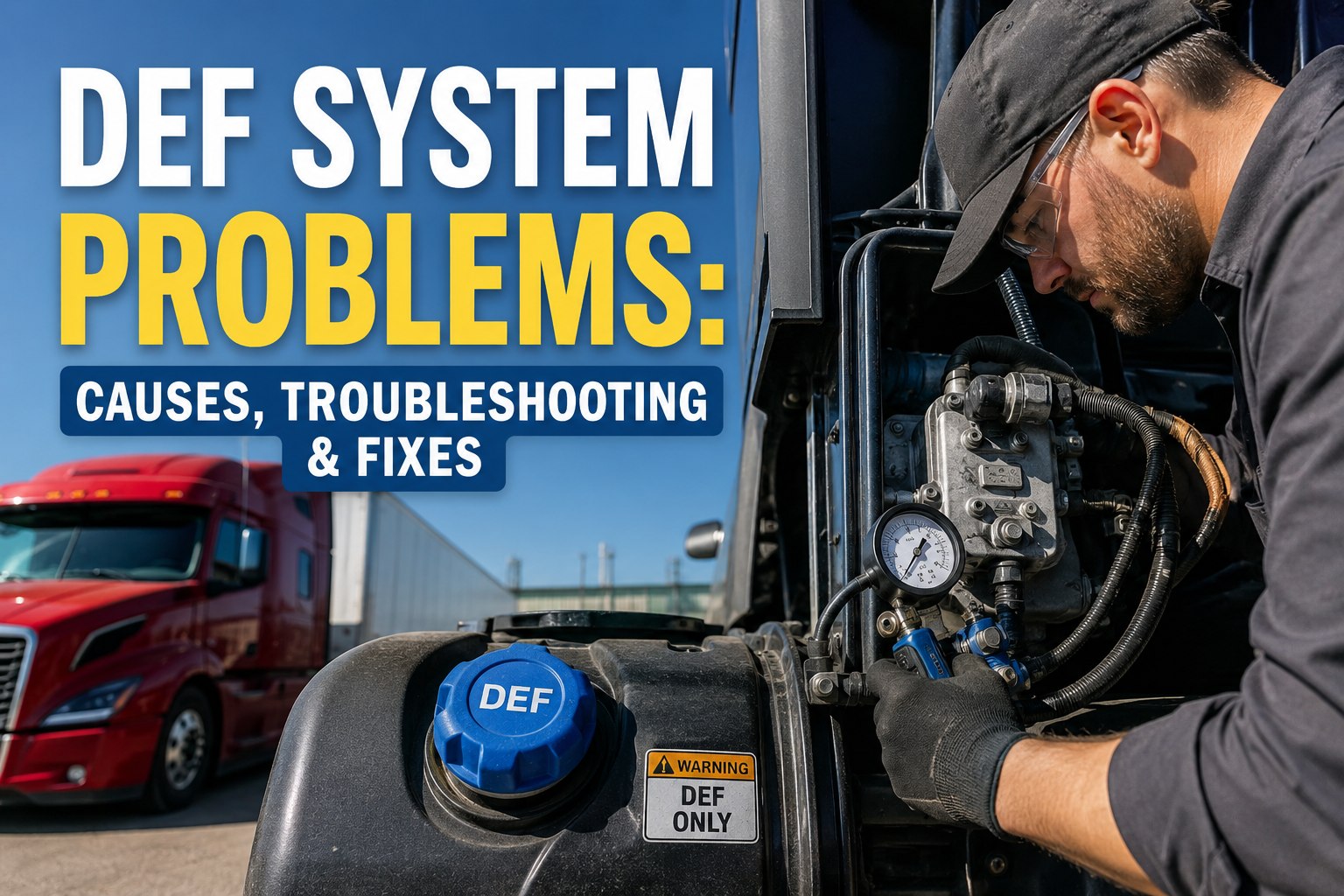
Stores 32.5% urea solution + integrated heater (prevents freezing at 12°F) + quality, level, and temperature sensors.
Pulls DEF from tank at 70–100 PSI delivery pressure. Pump pressure issues prevent proper atomization at injector.
Sprays DEF into exhaust stream at precisely timed intervals. Coil resistance 2–6 ohms. Clogs from crystallization or bad DEF.
Converts NOx + DEF into nitrogen and water vapor. Up to 90% NOx reduction. Catalyst poisoning by sulfur or oil = degraded efficiency.
Two sensors: pre-catalyst (NOx1) and post-catalyst (NOx2). Compare NOx levels to verify catalyst efficiency. Drift causes false codes.
Quality sensor vs heater circuit — two very different fault patterns
Most DEF codes split into one of two failure families. Recognizing which family a code belongs to changes both the diagnosis and the parts cost dramatically.
What's being measured: The actual chemical composition of DEF in the tank — urea concentration, water dilution, contamination level.
Common false flag: Sensor itself fails before the fluid does. Reports good DEF as bad.
Real-world note: Per March 2026 EPA guidance, manufacturers can now replace quality sensors with NOx-only monitoring on certain platforms.
Lifespan: DEF quality sensors typically last 60,000–100,000 miles vs. 150,000–200,000 for NOx sensors.
What's being measured: The electrical circuit feeding the DEF tank heater that keeps fluid above 12°F freezing point.
Common cause: Heater element failure (resistance reads outside the 1–2.5 ohm spec across pins 1–2 of the 8-pin connector).
Why it matters: A frozen DEF tank in winter stops the entire SCR system. Cold-weather operators see heater codes spike November–February.
Diagnosis: Ohm-check the heater on the 8-pin connector — 4.2 ohms across pins 1 and 2 means the heater and sender unit need replacing.
The derate cycle — what happens if you ignore the codes
The ECM does not turn on a light and leave you alone. Once it sees the SCR system out of compliance, it follows a structured derate sequence designed to force you to fix it before emissions damage compounds. Here's the timeline.
Check engine light and DEF warning illuminate. No performance impact yet. This is the window where a $200 fix is still possible.
ECM begins reducing engine power output. Truck still drivable but underperforming. Drivers report sluggish acceleration and throttle limits.
DPF regeneration cycles blocked. Soot continues to accumulate in the DPF. This compounds the original problem — you now have a DEF code AND a soot-overload problem developing.
Speed limited to 5 mph. Truck effectively immobilized. Cannot be cleared with a parts-store scanner — requires OEM-level diagnostic software, a successful repair, a forced regen, and a NOx conversion test.
P20EE — SCR NOx Catalyst Efficiency Below Threshold
The most common DEF code on the road today. The ECM compared NOx readings before and after the catalyst, and the reduction wasn't enough. Common causes, in order of likelihood:
Sensors drift over 100,000–150,000 miles. As little as 20°F of drift causes the system to misread efficiency. Replace the rear NOx sensor first — it's the most common P20EE trigger. Check it on a coast-down after full-throttle: the reading should drop below 20 ppm.
Crystallized urea blocks the injector nozzle, preventing proper spray pattern. Catalyst doesn't get the DEF it needs to reduce NOx. Remove and inspect for crusty buildup — flush or replace.
Pump should deliver 70–100 PSI at the injector inlet. Weak pumps under-deliver, causing under-dosing. Measure with a specialized DEF pressure gauge — anything significantly under 70 PSI requires replacement.
Sulfur from poor-quality diesel or oil consumption from engine wear can "poison" the catalyst chemistry. Catalyst replacement is the most expensive fix in this code family. Confirmed only after sensors and dosing are ruled out.
Anything other than ISO 22241 certified 32.5% urea. Diluted DEF reads as poor quality. Resolve by draining, flushing, and refilling with certified DEF.
P204F — Reductant System Performance (it's an information code)
P204F is the most misdiagnosed of the three. Mechanics see it and start replacing parts. Then nothing changes. The reason: P204F is an information code only. It tells you the Reductant Dosing Control Module (RDCM) has DTCs set elsewhere, but it itself does not point to a faulty component. The vehicle may operate in derate mode until those other codes are cleared.
It is signaling other codes. Treating it as primary leads to wasted parts and no resolution.
Use a scanner that can communicate with the RDCM module specifically. Look for P242D, P207F, P20EE, P208D, or any other SCR-system code.
Address every other SCR-related DTC in the system. NOx sensor drift, DEF quality sensor, heater circuit — whatever's actually there.
Once the underlying codes are repaired, drive through a full warm-up cycle. P204F clears on its own when the RDCM no longer has active DTCs to report.
P207F — Reductant Quality Performance
The ECM thinks your DEF is below specification. That could be true — or it could be the quality sensor lying about good fluid. Diagnosis order matters here because the cost gap is enormous: a $200 sensor vs a $3,500+ tank/pump/doser replacement if the fluid is actually contaminated.
Draw a sample. DEF must be 32.5% urea (31.8%–33.2% acceptable). Anything outside that band = contaminated or wrong fluid. Anything inside = sensor is lying.
Did someone put diesel, water, antifreeze, or anything else in the DEF tank? If so, this is a $3,500–$8,000+ repair — drain, flush, replace tank, lines, pump, doser; possibly both NOx sensors and the catalyst itself.
If the refractometer says fluid is good, the sensor is failing. Quality sensors typically last 60,000–100,000 miles. Replacement: $80–$200 part, plus labor.
The rear NOx sensor often causes false P207F codes. On a coast-down after full-throttle acceleration, the rear NOx reading should drop very low (under 20 ppm). If it doesn't, suspect this sensor.
DEF system specs — keep these in your scan-tool app
Most P-codes get misdiagnosed because the tech doesn't have spec numbers in front of them. Here are the values that matter for 2010+ diesel SCR systems.
2026 repair cost averages — by component
Diagnose correctly the first time and these stay at the low end of the range. Diagnose wrong, and the costs compound as more components fail behind the unaddressed root cause.
The "don't do this" anti-pattern list
These shortcuts make the problem worse, not better. Every one of them has cost a driver more money than the original repair would have.
P-codes in this family are persistent. Permanent codes survive scan-tool clears. The derate cycle continues regardless of what your dash shows.
Pre-2010 trick. Modern SCR ECMs retain DTCs through battery resets. You'll just have to do a longer drive cycle to set monitors again.
5 MPH derates require OEM-level software for proper reset: JPRO, Diesel Tech, Cummins Insite, Detroit DDDL, Paccar Davie, Volvo Tech Tool.
A $200 sensor caught at Stage 1 becomes a $3,500 contamination job once you've driven through Stages 2–4. Time matters.
Non-ISO 22241 fluid causes most P207F codes. The $5 saved per gallon is gone the first time it triggers a derate.
Low DEF levels affect dosing accuracy. Concentrated remnants can degrade. Keep the tank above 25% to prevent quality drift.
For fleet techs — track DEF fault patterns across the VIN
One DEF code on one truck is a project. The same code appearing across multiple trucks in your fleet means a systemic issue — bad DEF supplier, cold-weather operations the heaters can't keep up with, NOx sensor batch failure. The only way to see those patterns is a per-VIN diagnostic history. That's where HVI's fleet inspection and maintenance platform fits in.
Every code flagged, repair attempted, parts replaced, and verification result stored against the truck profile. Second appearance of a P20EE? You see exactly what was tried last time.
Driver flags a DEF warning in HVI's mobile inspection app — work order auto-creates with the photo, vehicle ID, and DVIR reference. No paper handoff between driver, dispatch, and shop.
Search across the entire fleet by code. P207F appearing on 4 trucks in the same week? You see it on one dashboard. Common root causes surface fast.
NOx sensor 150k-mile lifespan? HVI fires a proactive PM alert at 140k. Quality sensor at 60k? Alert at 55k. Stop replacing components reactively after they trigger codes.
Multi-truck operations running paper or spreadsheet maintenance history miss the patterns that would actually help diagnose these codes. Start your free HVI trial and put DEF fault history, work orders, and inspection records on one searchable platform.
Frequently asked questions
For fleet techs — track DEF fault patterns across every VIN before they turn into 5 MPH limp-mode calls.
HVI ties every defect, code, work order, and repair to the vehicle profile. The next time a P20EE or P207F appears on the same VIN, you see every prior attempt, parts replaced, and verification result in seconds.
No credit card required · DEF fault history per VIN · Fleet-wide DTC pattern visibility