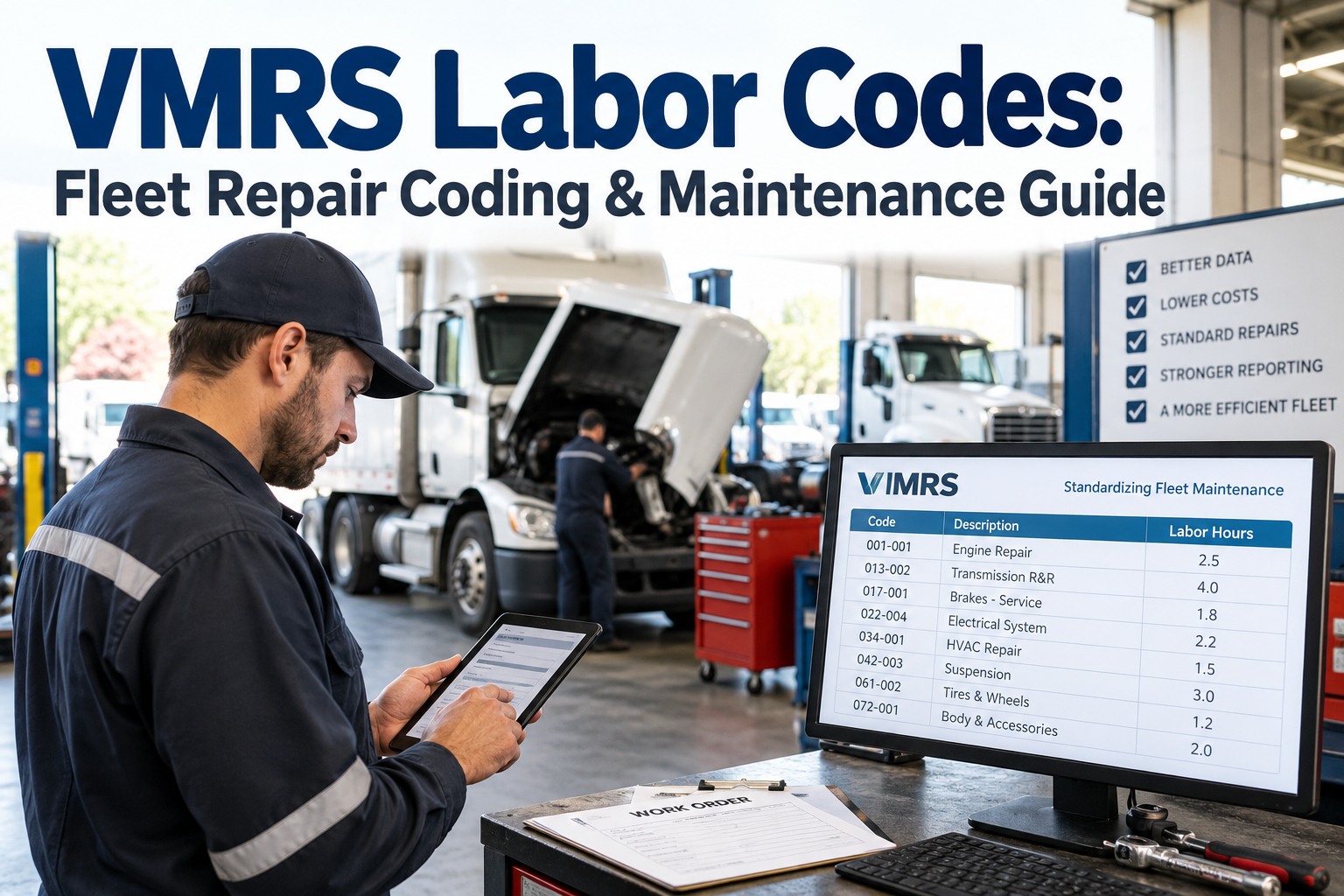
One technician writes "fixed brakes." Another writes "replaced RF brake shoes." A third just writes "brake job." Three repairs, three descriptions, zero ability to compare them or spot that the same truck keeps eating brake shoes. That's the problem VMRS labor codes solve. VMRS — the Vehicle Maintenance Reporting Standards — replaces free-text repair notes with a standardized code every shop, system, and analyst reads the same way. This guide breaks down how the codes work, what the labor codes actually are, and how coded repair data turns a pile of work orders into real insight. Book a demo to see coded work orders in action.
One Repair, One Language Every System Understands
A VMRS-coded repair answers three questions in a form no software has to guess at: what part, what work, and why. Here's a single repair, decoded.
(System · Assembly · Component)
(Work Accomplished: Replaced)
(Reason for Repair)
Same brake repair, now readable by any technician, manager, or analytics system — no interpretation required.
VMRS was developed by the American Trucking Associations and is maintained today by its Technology & Maintenance Council (TMC). What began as a heavy-truck tool is now used across construction, transit, utilities, and delivery fleets, because the core problem is universal: you can't analyze maintenance data you can't standardize. VMRS gives every repair a consistent numeric identity. Below is how the system is built, what the labor codes really are, and why coded data changes what your maintenance records can tell you.
How the codes are builtcode keys, and the 3-6-9 component structure
VMRS is organized into categories called code keys — there are 64 of them in total, though no fleet uses all 64. Each code key answers one specific question about a repair. A handful do the heavy lifting for everyday work orders, and once you know those, the system stops looking intimidating. The most important is the component code, Code Key 33, which uses a layered structure to pinpoint exactly what was worked on.
The broad system — e.g. brakes, electrical, cooling. The widest bucket.
The assembly within that system — narrowing down to a specific grouping.
The exact part — the specific component that was serviced or replaced.
That 3-6-9 progression — three digits for system, six for system-plus-assembly, nine for the full component — is what lets you zoom in or out. Want every brake repair across the fleet? Filter on the system digits. Want one specific part? Use the full nine-digit code. With more than 34,000 component codes maintained and expanded yearly by TMC — including newer additions for things like EV powertrains — the system stays current with the equipment you actually run. Book a demo to see coded components on real work orders
What the labor codes areCode Key 15, and the codes around it
Here's where terminology trips people up. When fleets say "VMRS labor codes," they're almost always referring to Code Key 15: Work Accomplished — the two-digit code that records what the technician actually did. It's the verb of the repair. Paired with the Code Key 33 component (the noun), it turns "worked on the truck" into a precise, countable action.
A couple of related code keys round out the labor picture. Code Key 19 covers indirect labor — the productive time that isn't turning a wrench on a specific component, like parts pickup or shop cleanup — so you can see true wrench time versus overhead. And Code Key 18, the technician failure code, records why a part failed (cracked, seized, out of balance), which pairs with the work code to tell the full story. Together, work accomplished plus reason for repair plus failure mode is a complete, coded account of the job. Start free and code labor consistently across your shop
Why coded data winswhat standardization actually buys you
Standardizing repair data isn't paperwork for its own sake — it unlocks questions you simply cannot answer with free-text notes. When every repair carries the same coded structure, your maintenance history becomes a database you can query, benchmark, and trend. Here's what that makes possible.
Roll up parts and labor by system code and see exactly what brakes, or electrical, or cooling actually costs you across the fleet — not a guess, a number.
Because the component and failure mode are coded, the same part failing on the same unit — or across a whole vehicle class — jumps out instead of hiding in prose.
Compare time and cost per task type — how long a "replace" takes versus an "adjust" — to evaluate procedures and spot where parts fail rather than just needing calibration.
A coded failure record speaks the same language OEMs and service providers use — making warranty claims and cross-shop communication faster and less ambiguous.
None of these are possible when "fixed brakes," "brake job," and "replaced shoes" are three different strings in a text field. Coding is the difference between maintenance records you store and maintenance data you use. Book a demo to see cost-per-system analytics from coded data
Making it work in your shopadoption without the friction
The honest obstacle with VMRS is adoption. A technician's job is fixing equipment, not memorizing code lookups, and a system that slows down the bay will get quietly abandoned no matter how good the data would be. The fleets that succeed with VMRS don't ask technicians to become coding experts — they remove the coding from the technician's plate entirely.
The practical answer is software that handles the translation. A technician selects the component they worked on and the action they took in plain terms, and the system maps that to the correct VMRS codes automatically — the same way most modern maintenance platforms translate codes for their users. The technician's workflow doesn't change; the standardized data appears anyway. That's the model that makes VMRS stick, because it delivers the analytical payoff without asking the shop floor to carry the burden. Start small — even coding at the system level is far more useful than free text — and let the depth grow as the habit sets in. Book a demo to see plain-language coding on the shop floor Or start free and let the software handle the coding
From a maintenance director who made the switch
For years our work orders were whatever the tech felt like typing. When I tried to answer a simple question — what are we spending on brakes fleet-wide — I couldn't. The data was there, but it was in a hundred different phrasings. Useless for analysis.
Once the codes were built into the work order and the techs just picked from plain-language menus, everything changed. I could finally roll up cost by system, and the first thing I found was one truck class eating brake components at triple the rate of the rest. We'd never have seen it in free text. The techs didn't even notice the change — but I got a database instead of a diary.
Frequently asked questions
What are VMRS labor codes?
VMRS labor codes are the part of the Vehicle Maintenance Reporting Standards that record what work a technician performed on a repair. In practice, "VMRS labor codes" almost always refers to Code Key 15: Work Accomplished, a two-digit code that describes the action taken — for example, 02 for adjusted, 04 for replaced, 06 for inspected, 09 for overhauled, or 14 for installed. It functions as the "verb" of a repair, and when paired with the component code (Code Key 33, the "noun"), it precisely defines what was done to which part. A couple of related code keys round out the labor picture: Code Key 19 captures indirect labor such as parts pickup or shop cleanup, letting you separate true wrench time from overhead, and Code Key 18 records the technician's assessment of why a part failed. VMRS itself is a broader standardized coding system developed by the American Trucking Associations and maintained by its Technology & Maintenance Council (TMC), covering everything from components to labor to the reason a vehicle came in for service.
How do VMRS codes work?
VMRS organizes maintenance information into categories called code keys, of which there are 64 in total, though most fleets regularly use only a handful. Each code key answers one specific question about a repair. The most central is Code Key 33, the component code, which uses a layered nine-digit structure read in three parts: the first three digits identify the broad system (such as brakes or electrical), the next three narrow it to an assembly within that system, and the final three specify the exact component. This 3-6-9 progression lets you analyze data at any level of detail — filter on the system digits to see every brake repair fleet-wide, or use the full nine-digit code to track one specific part. Other code keys add context: Code Key 15 records the work accomplished, Code Key 14 records the reason for repair, and Code Key 18 records the failure mode. Combining these produces a complete, standardized record of a repair — what part, what work, and why — that any technician, manager, or software system can read the same way. TMC maintains more than 34,000 component codes and expands them yearly to keep pace with new technology.
Why should fleets use VMRS coding?
The core benefit is that standardized codes turn maintenance records into analyzable data. When every repair is written as free text, the same job can be described a dozen different ways, which makes it impossible to reliably compare, count, or trend anything. Coding eliminates that ambiguity and unlocks questions you otherwise can't answer. You can roll up true parts-and-labor cost by system to see exactly what brakes or electrical actually cost across the fleet. You can spot repeat-failure patterns, because a coded component and failure mode make the same part failing on the same unit — or across a whole vehicle class — immediately visible. You can benchmark labor by comparing time and cost across task types. And because VMRS is an industry standard, a coded failure record speaks the same language that OEMs and service providers use, streamlining warranty claims and cross-shop communication. In short, coding is the difference between maintenance records you merely store and maintenance data you can actually use to make decisions about cost, reliability, and replacement timing.
Is VMRS only for trucking fleets?
No. VMRS was originally developed for heavy-duty trucking by the American Trucking Associations, but its use has expanded well beyond that. Because the underlying problem — needing a consistent way to classify maintenance work, parts, and costs — is universal to any operation that maintains equipment, VMRS has been widely adopted across light-, medium-, and heavy-duty assets in industries including construction, transit, utilities, delivery, and specialized heavy equipment. The system is also scalable: a small operation can code at a high level (just the system, for instance) while a large fleet can code down to the specific component and failure mode, and both get value proportional to the effort. TMC continually expands the code set to cover new equipment types and technologies, including recent additions for electric-vehicle powertrains, so the standard keeps pace with modern mixed fleets. Whether you run 25 assets or several thousand, and whether they're trucks, trailers, forklifts, or construction machinery, VMRS provides a common maintenance language that makes your data consistent and comparable.
How do I start using VMRS without slowing down my technicians?
The key is to keep the coding off the technician's plate. A technician's job is repairing equipment, not looking up codes, and any system that forces manual code entry into the workflow tends to get abandoned because it slows down the bay. The practical solution is maintenance software that handles the translation automatically: the technician selects the component they worked on and the action they performed using plain-language menus, and the platform maps those selections to the correct VMRS codes behind the scenes. The workflow the technician already knows doesn't change, but the data that comes out is standardized and analysis-ready. It also helps to start small — coding at the system level alone is dramatically more useful than free text, and you can let the depth of coding grow as the habit becomes routine. Focus first on the handful of code keys that matter most for everyday work orders (component, work accomplished, reason for repair, and failure mode) rather than trying to adopt all 64 at once. That combination of automated translation and a gradual rollout is what makes VMRS adoption succeed rather than stall.
Standardize your maintenance data without the memorization
HVI builds VMRS coding into the work order itself — technicians pick the component and the work performed in plain language, and the correct codes attach automatically. The result is standardized, analysis-ready maintenance data that lets you roll up cost by system, catch repeat failures, benchmark labor, and speak the same language as your OEMs. No lookups, no slowdown on the shop floor. Live in under two weeks.
No credit card · VMRS-coded work orders from day one · Built for USA & Canada fleets