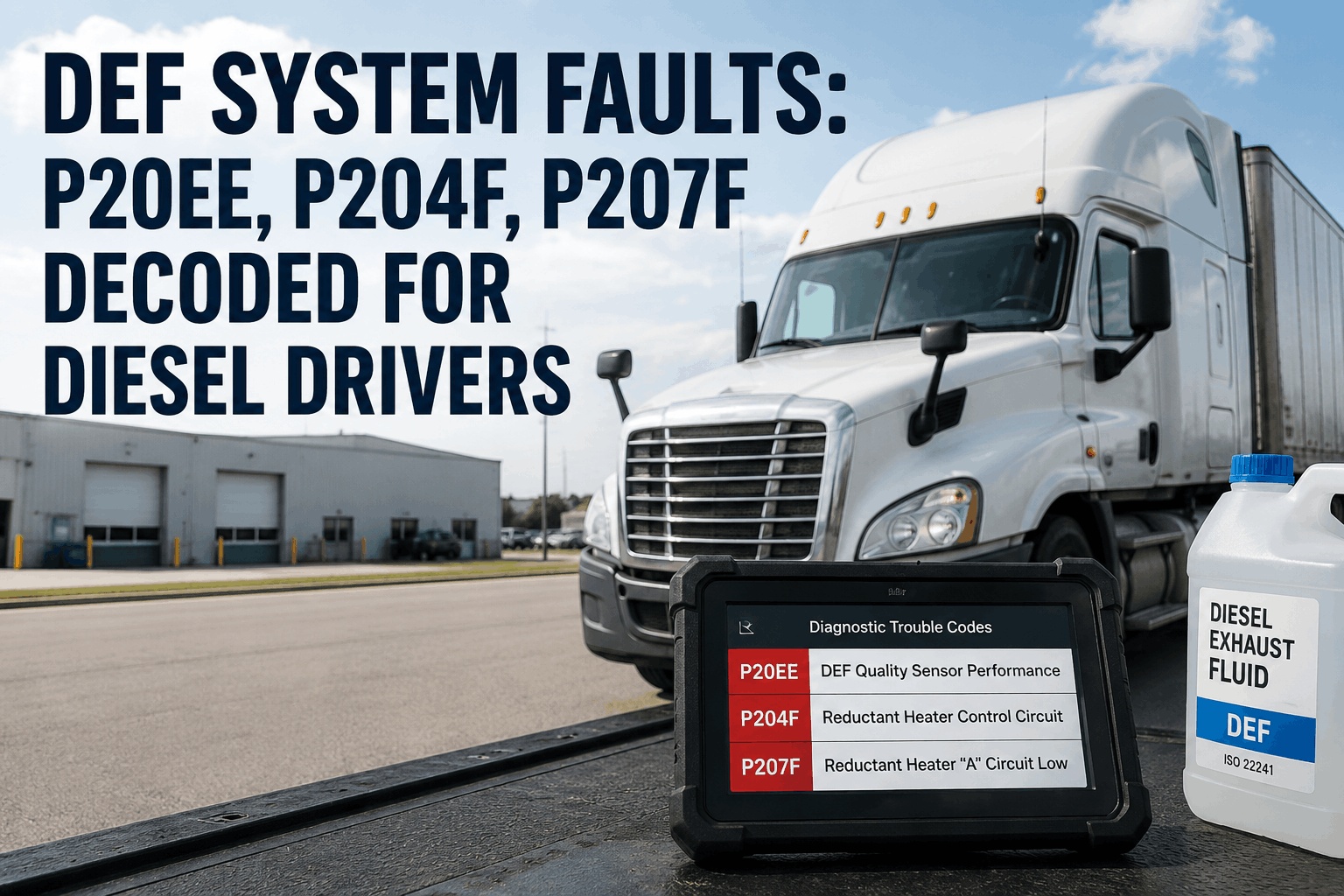
The truck was running fine. Then a DEF lamp, a warning, and days later it's crawling at 5 mph in a truck stop, unable to restart — over a fluid that costs a few dollars a gallon. That's the reality of diesel exhaust fluid: chemically simple, but unforgiving about heat, contamination, and age. This guide covers what DEF is, how it goes bad in storage, what triggers an SCR derate, and how fleets track it. Book a demo to see fluid tracking in HVI.
DEF Quality, Storage & the SCR Derate
A simple fluid — 32.5% urea, 67.5% deionized water — that stops a truck cold when it's stored wrong or contaminated.
Every diesel truck built for North America since 2010 uses Selective Catalytic Reduction to meet emissions limits: DEF is injected into the hot exhaust, where the urea becomes ammonia and neutralizes NOx into harmless nitrogen and water. No usable DEF, no emissions compliance — and the truck derates. Because the SCR reaction is so sensitive to the fluid's purity and concentration, DEF quality isn't a minor detail. It's an uptime issue. Here's the whole lifecycle, from delivery to derate.
Why the chemistry is so fussy
DEF looks like water, and that's exactly the trap. It's a precise, high-purity solution, and three properties explain every storage rule and failure mode that follows.
Purity is everything
The urea is automotive-grade — purer than fertilizer or industrial urea. Trace metals, biuret, or aldehydes that are harmless elsewhere degrade the SCR catalyst. ISO 22241 sets strict maximum contaminant levels.
Concentration is exact
32.5% urea isn't arbitrary — it's the eutectic point, the ratio with the lowest freeze point (about 12°F). Drift outside roughly 28–36% urea and the system reads the fluid as out of spec.
It degrades with heat & time
The urea slowly decomposes into ammonia and biuret over time, faster when hot. Age plus heat is what silently pushes DEF out of spec before it ever reaches the truck.
One reassuring note in all this: freezing does not ruin DEF. It freezes around 12°F and simply thaws back to a usable fluid — the urea and water freeze and thaw together at that eutectic ratio. Heat and contamination are the real enemies, not cold. Book a demo to track DEF batches and supplier quality in HVI
How DEF goes bad in the yard
Here's the part most guides skip: good DEF usually goes bad in storage, not on the truck. Temperature is the master variable — the same drum lasts years cool or months hot. This is the single biggest lever you control.
Sustained storage above roughly 86°F (30°C) accelerates the urea's breakdown into ammonia and biuret, and can cut shelf life from two-plus years down toward six months. Direct sunlight and UV make it worse, and evaporation through improperly sealed containers slowly shifts the concentration. The fixes are simple — cool, shaded, sealed, dedicated storage — but they only happen if someone is tracking age and conditions. Start free on HVI to log DEF stock age and flag fluid that's been sitting too long.
Contamination: the catastrophic one
Degradation is slow; contamination is instant and expensive. Because the SCR catalyst is so sensitive, even trace contamination can cause severe, sometimes irreversible damage — and the culprits are ordinary yard mistakes.
Even a trace of diesel fuel or lubricating oil can destroy the SCR catalyst — potentially a catalytic-converter-level repair running into the thousands.
"Topping off" with water or washer fluid dilutes the urea below spec and introduces contaminants the system will reject.
A funnel or container previously used for fuel or another fluid cross-contaminates an entire tank in seconds.
Fluid that doesn't genuinely meet ISO 22241 carries contaminants that quietly degrade the catalyst over time.
The defense is discipline: dedicated DEF-only equipment (ISO 22241 requires it), sealed clearly-labeled containers, verified ISO-compliant fluid with API certification, and no improvised top-offs. Every one of these failures is preventable at the yard, before the fluid ever reaches a truck. Book a demo to enforce verified-fluid and batch checks in your workflow
What a derate actually looks like
When the system loses confidence in DEF quality or level, the EPA-mandated inducement schedule kicks in — and it escalates predictably. Knowing the stages tells you how much runway you have before a truck is immobilized.
Solid amber DEF lamp and a dashboard message. No power loss yet — this is your window to act.
Check-engine light, "Service DEF System," or "Engine Derate in XX mi" messages as the system insists.
The ECM caps road speed (commonly around 55 mph) to force the issue toward a repair.
Severe derate — often on the next restart. Roughly a 5 mph crawl you can't override, until it's fixed and reset.
A hard-won warning from technicians: if you're already in an inducement and far from help, think before shutting down — on some systems a restart after lockout drops you straight into the 5 mph crawl. And clearing an inducement often needs a scan tool even after the fluid is corrected, so this is not always a roadside self-fix. FMI and exact behavior vary by OEM, so confirm against manufacturer service data. Start free and keep each truck's DEF fault history in one place.
The prevention checklist
Because nearly every DEF derate is preventable, the whole game is discipline at the yard and visibility across the fleet. Here's what actually keeps DEF in spec — and every item is something a system can track.
Keep DEF out of direct sun and below the heat threshold; shade or climate-control bulk storage.
Rotate stock and flag drums past their window before the urea drifts out of spec.
Separate, labeled funnels, pumps, and containers — never shared with fuel or oil.
Buy genuine, API-certified DEF; avoid off-spec or counterfeit product and record the source.
No water, washer fluid, or "close enough" substitutes — ever.
Record which DEF batch filled which truck, so a bad drum is traceable across the fleet.
That last item is the multiplier. When you know which batch went into which truck, a single quality problem becomes containable — you can find every affected vehicle instead of chasing mystery derates one at a time. That traceability is exactly what a fleet system provides and a fuel log can't. Book a demo to connect DEF batches to the trucks they filled
From a shop foreman who traced a bad drum
We had three trucks derate for DEF quality inside a week — same yard, same time. Everyone assumed three separate sensor failures. It wasn't. It was one tote of DEF that had sat in the sun all summer and cooked past spec, and it had filled all three.
The only reason we caught it was that we'd started logging which fluid went into which truck. Without that, we'd have replaced three sets of sensors and still had the problem, because the bad tote was still out there. Now DEF is a tracked line item, not a mystery. Cheap fluid, expensive lesson.
DEF is cheap. A derate isn't.
Diesel exhaust fluid is one of the simplest consumables on a modern truck and one of the most unforgiving. It's 32.5% high-purity urea in deionized water, and it must stay pure, stay near its correct concentration, and stay reasonably cool. Heat and age quietly decompose it below spec; a trace of diesel, oil, water, or a dirty funnel can contaminate it instantly and damage an expensive SCR catalyst. When the system detects a problem, it escalates through an EPA inducement schedule that can end in a 5 mph limp mode you can't override — over a fluid that costs a few dollars a gallon.
The through-line is that nearly every DEF failure is preventable, and prevention is fundamentally a tracking problem: fluid age, storage conditions, verified sourcing, and which batch filled which truck. That's precisely where a fleet maintenance platform earns its place. HVI lets you track DEF batches and suppliers, monitor stock age, tie fluid to the vehicles it filled, and keep each truck's DEF and SCR fault history in one place — turning DEF from a roadside surprise into a managed, predictable line item. Always follow OEM and ISO 22241 guidance for the specific fluid and engine. Book a demo to see DEF and fluid tracking built into your maintenance workflow.
Frequently asked questions
Does DEF expire, and how long does it last?
Yes, DEF has a limited shelf life because the urea in it slowly decomposes over time, and the rate depends heavily on storage temperature. Under ideal conditions — cool, dark, sealed containers — DEF typically lasts on the order of one to two years, and industry references often cite roughly 12 to 18 months as a practical guide. Temperature is the deciding factor: DEF stored consistently cool (around or below 77°F / 25°C) reaches the longer end of that range, while sustained storage above about 86°F (30°C) accelerates the breakdown of urea into ammonia and biuret and can cut shelf life toward six months. Direct sunlight and UV exposure make it worse, and evaporation through poorly sealed containers can shift the concentration over time. Because age and heat both matter, the reliable approach is to track how long DEF has been in storage, keep it cool and shaded, rotate stock so the oldest is used first, and confirm specifics against ISO 22241 and the supplier's guidance.
What happens if DEF freezes?
Freezing does not harm DEF, which surprises a lot of people. DEF freezes at about 12°F (-11°C), and that temperature is not a coincidence — the 32.5% urea concentration is the eutectic point, the exact urea-to-water ratio that gives the lowest possible freeze point. Because the urea and water freeze and thaw together at that ratio, frozen DEF simply returns to a usable, in-spec fluid once it thaws, with no change in concentration or quality. Modern trucks are designed for this: SCR systems include provisions to thaw DEF for operation in cold weather, and the tank and lines are built to accommodate the expansion that occurs when DEF freezes. Repeated freeze-thaw cycles are best minimized as good practice, but freezing itself is not a quality problem. The real enemies of DEF are sustained heat, UV exposure, age, and contamination — not cold.
What causes an SCR or DEF derate?
An SCR derate is the EPA-mandated power reduction a modern diesel applies when it detects an emissions problem it can't correct, and DEF issues are among the most common triggers. The direct causes fall into a few groups: running out of DEF, DEF quality out of range (concentration outside roughly the 28 to 36% urea window, often flagged as SPN 3364), and contamination or system faults such as a bad DEF quality sensor, clogged dosing injector, or failing NOx sensor that leads the control module to lose confidence in the system (which can trigger an inducement code such as SPN 5246). Underlying many quality faults is fluid that was contaminated, degraded by heat and age, or off-spec to begin with. The derate escalates through a predictable inducement schedule — an amber warning first, then escalating messages, then a road-speed limit, and finally a roughly 5 mph limp mode, often on the next restart, that can't be overridden until the problem is fixed and the system reset. Exact codes, thresholds, and behavior vary by manufacturer, so confirm against OEM service data.
Can contaminated DEF damage my truck?
Yes, and this is the most expensive DEF failure mode. The SCR catalyst is extremely sensitive to purity, so even trace contamination can cause serious and sometimes irreversible damage. The worst case is diesel fuel or lubricating oil getting into the DEF tank — even a small amount can destroy the SCR catalyst, and replacing it is a major repair often running into the thousands of dollars. Other contamination routes include topping off the tank with water or washer fluid, which dilutes the urea below spec, using a funnel or container previously used for fuel or another fluid, and buying off-spec or counterfeit DEF that doesn't genuinely meet the ISO 22241 purity standard, carrying contaminants that degrade the catalyst over time. The defenses are straightforward: use only verified, ISO 22241-compliant, API-certified DEF; keep dedicated, clearly labeled DEF-only funnels, pumps, and containers; never improvise a top-off with another fluid; and if contamination is suspected, stop using the tank and have the system properly flushed and refilled with fresh fluid before more damage occurs.
How can fleet software help manage DEF quality?
DEF failures are overwhelmingly preventable, and prevention is fundamentally a tracking and visibility problem — which is exactly what fleet software addresses. Most bad DEF goes bad in the yard: fluid that sat too long, got too hot, or was contaminated during handling, all of which are invisible without records. A platform like HVI helps by letting you track DEF batches and suppliers, log how long stock has been in storage so aging fluid is flagged and rotated before it drifts out of spec, and record which batch filled which vehicle. That batch-to-vehicle link is the key capability: when a quality problem appears, you can trace every truck filled from a suspect drum instead of diagnosing derates one at a time, which is often how a single bad tote turns into several mysterious failures. It also keeps each truck's DEF and SCR fault history together, so recurring problems and their resolutions are visible, and folds DEF handling into the broader inspection and maintenance workflow. The result is that DEF becomes a managed, predictable line item rather than a roadside surprise that strands a truck over a few dollars of fluid.
Catch bad DEF in the yard, not on the shoulder
HVI tracks DEF batches and suppliers, logs storage age so aging fluid gets flagged, ties each batch to the trucks it filled, and keeps DEF and SCR fault history per vehicle — so a bad drum is contained before it derates a truck. Manage fluids as part of one connected maintenance system. Mobile-first for the yard and the shop, live in under two weeks.
No credit card · DEF batch & fluid tracking · SCR fault history on day one