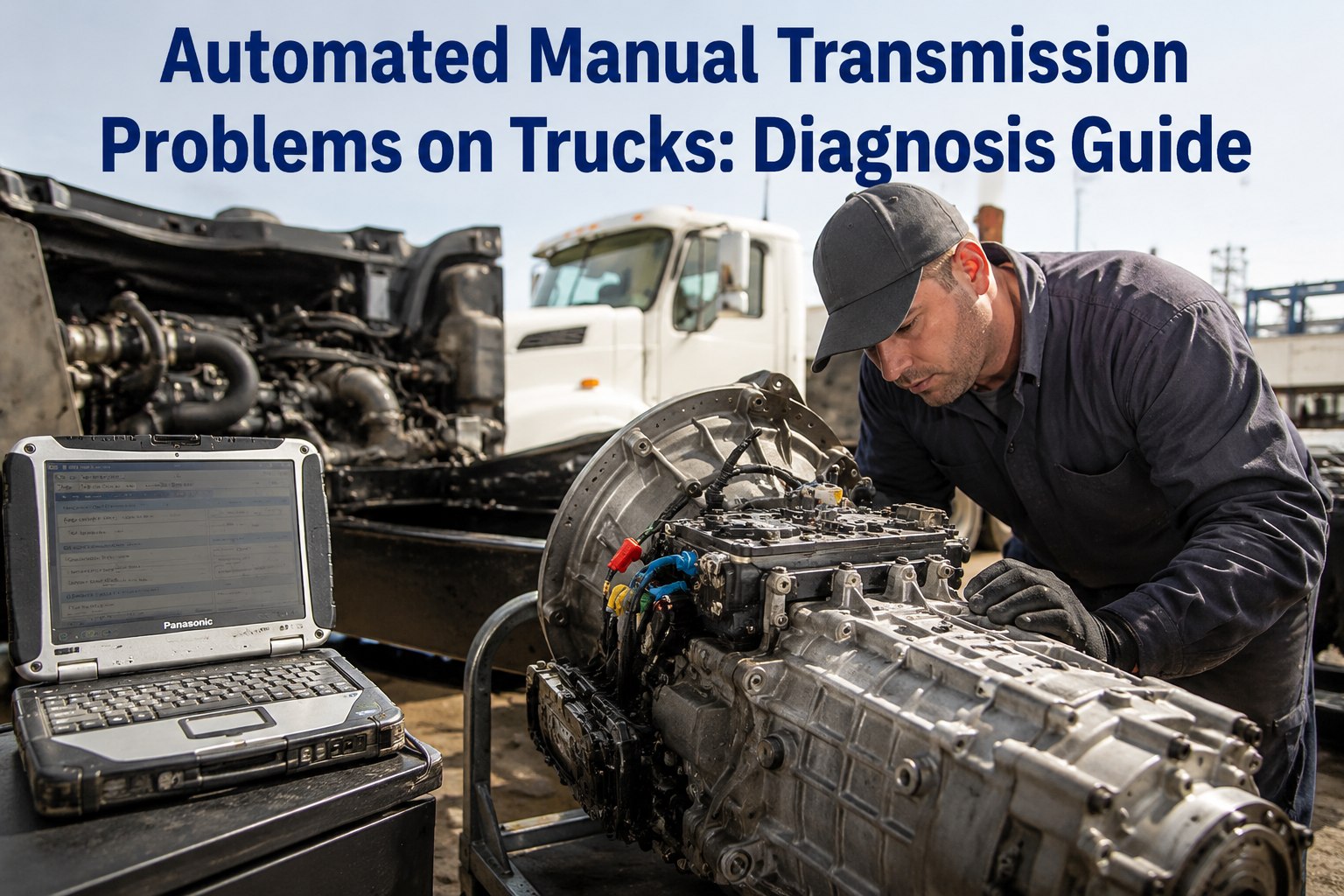
The driver says the truck is "shifting funny." The shop hears "transmission problem" and starts pricing a $12,000–$18,000 gearbox replacement. But on an automated manual transmission, the gears themselves are the last thing to fail. Underneath the AMT badge sits a manual gearbox controlled by air pressure, a clutch actuator, sensors, a TCM, and software calibration — any one can produce the exact symptom just described. Diagnose the layer, not the label — book a demo to see AMT diagnostics tracked per truck in HVI.
The Four Complaints, Five Places They Come From
Every driver complaint about an AMT maps to one or more of five underlying systems. This is the map that stops you from replacing a $10,000 transmission when the problem was $80 of water in the air dryer.
Notice where the "primary" dots sit: air supply and calibration explain more shift complaints than the transmission itself. Yet the transmission is what gets quoted first.
Below is the sequence that turns a vague driver complaint into a targeted repair — usually inside a shift, and always before you pull a transmission. Book a 30-minute demo to see it running inside HVI's drivetrain PM workflow.
Know your AMT before you diagnose it
All four major fleet AMT platforms look similar on the outside — a manual gearbox with a computer bolted to it — but their failure profiles and diagnostic tools are different. The right scan tool and the right service data matter more than the right guess.
Volvo I-Shift
Actuation: Pneumatic clutch & gear shift.
Common issues: Air-supply moisture, clutch actuator wear at high mileage, shift solenoid faults. Sensitive to air-dryer condition.
Diagnostic tool: Volvo Tech Tool (PTT).
Detroit DT12
Actuation: Pneumatic. Common on Freightliner Cascadia & Western Star.
Common issues: Clutch actuator failure (moisture ingress via neglected air dryer), range-piston corrosion, clutch flange issues on some model years.
Diagnostic tool: Detroit DiagnosticLink.
Mack mDRIVE
Actuation: Pneumatic. Shares core architecture with Volvo I-Shift.
Common issues: Similar failure profile to I-Shift — air-system contamination, actuator wear, TCM software mismatches after component swaps.
Diagnostic tool: Mack Premium Tech Tool.
Eaton Endurant
Actuation: Electric clutch actuator (not pneumatic).
Common issues: Electric actuator sensor drift, wiring/connector faults, calibration required after clutch service. Air-supply symptoms don't apply.
Diagnostic tool: Eaton ServiceRanger.
The most common mistake in mixed-OEM shops is treating every AMT like the last one worked on. Pull the correct scan tool first — a DiagnosticLink read on a DT12 gives you data an Eaton tool can't, and vice versa. Fault codes from the wrong tool are often incomplete or misleading, which sends the diagnostic down the wrong tree. Shops running fleets with two or three OEM platforms should keep every tool current and every technician trained on the platforms actually in the yard — not just the one that arrived first. Book a demo to see HVI attach the transmission make, model, and last calibration date to each unit so the shop knows which tool to bring out before the truck rolls in.
The repair-cost hierarchy nobody explains upfront
Air-system fixes
The one most often skipped and most often the actual cause. Neglected air dryers dump moisture into the transmission actuator, which produces every symptom on the hero grid. Fix the air side first.
Calibration & software
Post-service calibration is not optional — the TCM needs to know where the new clutch actually engages. Skipping this after a clutch swap causes the exact "shift-quality complaint" that lands the truck back in the shop three weeks later.
Clutch actuator replacement
Requires transmission removal on most platforms plus software calibration afterward. A big job — but still an order of magnitude below full transmission replacement. Verify the actuator is actually failed (not just starved of air) before ordering the part.
Transmission replacement
The absolute last resort. Modern AMTs are rated around 750,000 miles before extended service. If you're pulling one under 500K, the last diagnostic step was almost certainly skipped — go back and eliminate air, actuator, and calibration first.
The cost gap between top and bottom of this hierarchy is roughly 60×. Getting the diagnostic order right is worth an entire year of transmission budget on a mid-sized fleet. Start a free HVI trial to track every AMT repair, cost, and downtime event by unit — so patterns of repeat complaints on the same truck become visible before they become a reman quote.
The 6-step diagnostic sequence
The order matters. Fault codes first, air pressure second, clutch condition third, actuator and sensors fourth, calibration fifth, road test last. Skip a step and you either replace the wrong part or, worse, replace the right part and it fails again because the actual root cause is upstream. Every shop that runs a lot of AMTs eventually builds a version of this sequence into a checklist — the ones that don't repeat the same $8,000 mistakes. The specific times below are field averages for a well-equipped shop; a newer technician will run longer, an experienced one shorter, but the order should never change.
-
1Get the driver complaint in specifics5 min
"Shifting funny" is not a starting point. What gear was engaged? What was the truck doing (loaded, uphill, cold start)? Constant or intermittent? Any warning lamp? A 60-second driver interview eliminates half the diagnostic tree before you plug anything in.
-
2Pull fault codes with the right scan tool10 min
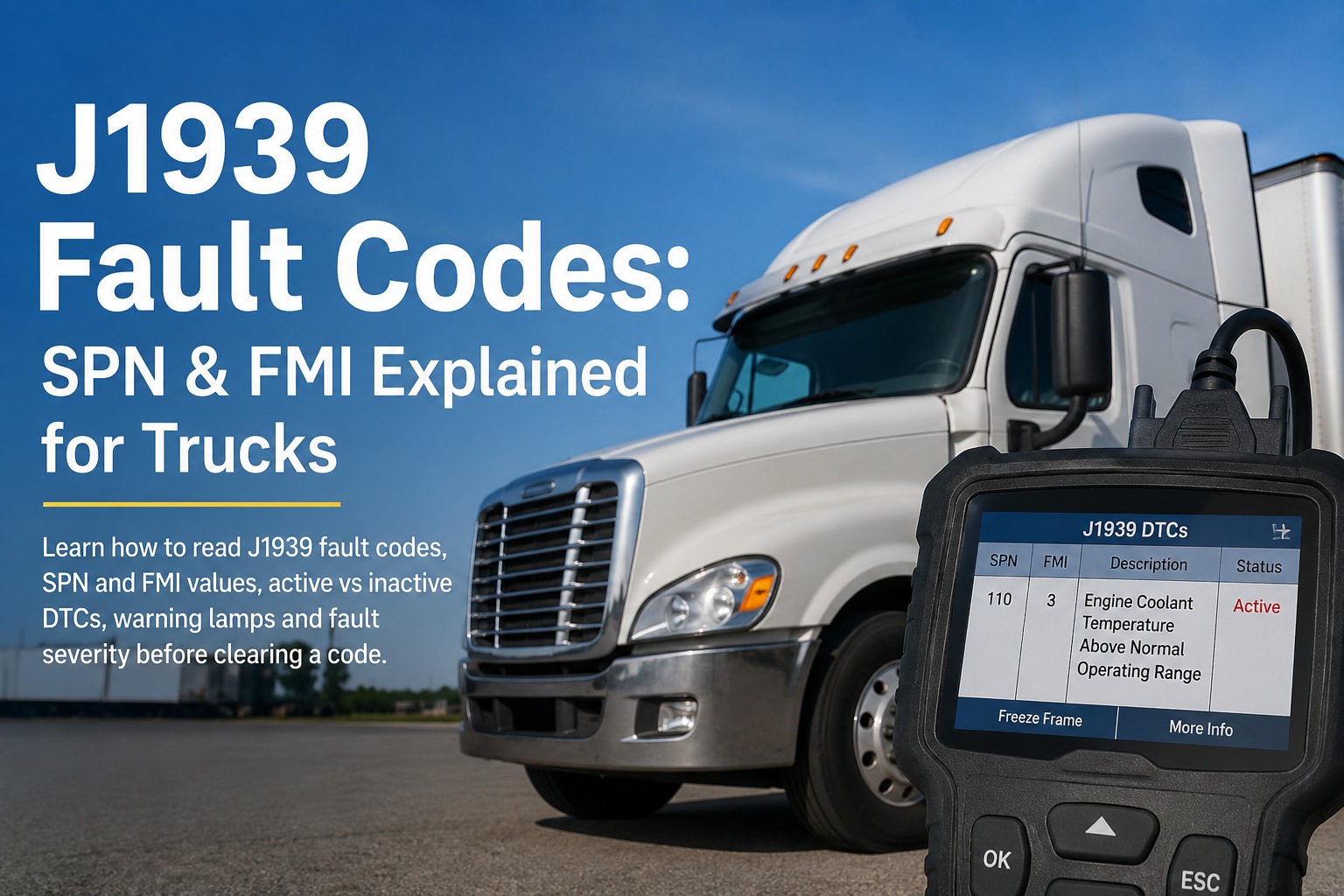
DiagnosticLink for DT12, PTT for Volvo, ServiceRanger for Eaton, Premium Tech Tool for Mack. Read active and inactive codes plus the freeze-frame data. SPN/FMI codes name the failed circuit — often down to the specific solenoid or sensor.
-
3Check transmission air-supply pressure (pneumatic AMTs)10 min
Idle the engine two minutes, read supply pressure at the TCM. Below spec (typically under 100 psi at the transmission) = repair air-side leaks or dryer issues before touching the transmission. Inspect air lines and fittings from the shift controller to the range cylinder for leaks.
-
4Check clutch wear & learned position10 min
Read the TCM's clutch learned values. Clutch minimum position past OEM limit = worn clutch, replace before further diagnostics. If learned values look off but the clutch is physically fine, recalibration is likely all that's needed.
-
5Inspect actuator, sensors, wiring & grounds30 min
Wiggle-test the harness, voltage-drop the grounds, check connectors for moisture and corrosion. Transmission grounds are a commonly overlooked path for faults that show up as erratic shifting or TECU codes. Clean, high-integrity grounds matter as much as clean power.
-
6Repair, recalibrate, road-test, verify45–90 min
Do the actual repair. Run the OEM-specified calibration or relearn procedure — every time. Road-test through the gears with the scan tool logging. Clear codes, confirm they stay clear, document the repair and calibration date against the specific truck.
Five things fleets misdiagnose on AMTs (and what they really were)
"Transmission failing"
Air dryer full of water — moisture in the actuator
"Clutch actuator failed"
Low air supply from a compressor governor issue
"Won't hold gear"
Clutch calibration skipped after last clutch job
"Erratic shifting — must be the TCM"
Corroded transmission ground stud
"Clutch burnt at 200K miles"
Driver stuck on low-speed yard work — wrong duty cycle for the spec
Every one of these was a real repair that produced a five-figure invoice for the wrong part. The pattern behind them is the same: skip the diagnostic step, guess the part. It's also the reason two shops looking at the same truck can come up with $600 and $14,000 quotes on the same day — not because one is dishonest, but because one stopped diagnosing at the symptom. The defense against this is process visibility: a shared record of what was checked, what was found, and what was replaced, attached to the specific truck rather than the specific technician. Book a demo to see how HVI logs the driver complaint, the diagnostic steps taken, and the parts replaced — so the shop's process is visible and the same misdiagnosis doesn't happen twice.
A note on fluid nobody wants to hear
AMT fluid is not manual transmission fluid
Modern AMTs run OEM-specific synthetic fluids engineered for the specific gearbox and actuator system inside. Volvo I-Shift, Detroit DT12, Mack mDRIVE, and Eaton Endurant each specify their own fluid, and the wrong fluid produces exactly the symptoms fleets then chase for weeks: harsh shifts, poor clutch engagement, and premature synchronizer wear. Assuming "it's just gear oil" and topping off with what's on the shelf is one of the fastest ways to turn a healthy AMT into a warranty-void one. Fluid condition also matters more than fluid interval — a truck running hot in stop-and-go duty degrades fluid twice as fast as one running highway. Sample the fluid at PM, log the result against the truck, and let condition trigger the change — not the calendar. On pneumatic platforms, drain the air-tank moisture at the same PM interval and inspect the air dryer cartridge; a fluid change with a saturated air dryer is half a job, because the moisture that entered the system yesterday will keep entering it tomorrow.
From a shop lead who's rebuilt more AMTs than he wanted to
The DT12 that came in last summer — owner-operator, out of warranty, quoted $14,000 for a reman by another shop. We pulled it in, plugged DiagnosticLink, and the air supply was reading 78 psi at the trans on a truck the driver said "never had air brake issues." Two hours later we had a wet air dryer replaced and 118 psi at the trans. Shift complaint gone.
The lesson isn't that the other shop was wrong to worry. It's that they stopped diagnosing at the symptom instead of the source. That truck went back on the road for about $600 of parts and labor. My rule now: no AMT gets a reman quote without a supply-pressure reading logged against the VIN. Costs nothing. Saves someone their week.
Frequently asked questions
Why is my truck's AMT shifting hard or clunky?
Hard or harsh shifting on an automated manual transmission has four common causes, in rough order of frequency: insufficient transmission air-supply pressure (on pneumatic platforms like Volvo I-Shift, Detroit DT12, and Mack mDRIVE), missed post-service clutch calibration, a worn or contaminated clutch, and less commonly a failing clutch actuator or shift solenoid. Start by pulling fault codes with the correct OEM diagnostic tool for that transmission, then check air-supply pressure at the transmission with the engine idling for two minutes. Below the OEM spec (typically under 100 psi at the transmission) points to an air-side problem — leaks, moisture in the dryer, or a compressor governor issue — that will feel exactly like a "transmission problem" to the driver but has nothing to do with the gearbox itself. Only after air supply, calibration, and clutch condition are all cleared does it make sense to look at actuator or internal transmission causes.
Can low air pressure cause AMT shifting problems?
Yes — and it's one of the most misdiagnosed causes of shift complaints on pneumatically actuated AMTs. Every gear change on a Volvo I-Shift, Detroit DT12, or Mack mDRIVE relies on air pressure at the shift and clutch actuators. Below spec, the actuators move slowly or incompletely, producing symptoms that read as actuator failure or transmission wear: delayed engagement, hesitation between gears, harsh shifts, or the truck getting stuck in gear entirely. Common upstream causes are a saturated air dryer dumping moisture into the transmission actuator, air leaks in the lines and fittings between the shift controller and the range cylinder, a failing compressor governor, or freeze-ups in cold weather. Before quoting any transmission or actuator work on a pneumatic AMT, always verify transmission air supply pressure with the engine idling for two minutes and inspect the air side end-to-end. This one check catches a large share of shift complaints on modern fleets, and the fix is often measured in tens of dollars rather than thousands. Eaton Endurant uses an electric clutch actuator, so this specific failure mode doesn't apply to that platform.
Do I need to recalibrate the clutch after a clutch job on an AMT?
Yes — always — and skipping this step is one of the single most common causes of a truck coming back to the shop within weeks of a clutch service. The TCM uses learned values for clutch engagement position, wear compensation, and shift timing. When the physical clutch changes (replacement, adjustment, or actuator work) but the learned values don't, the TCM commands engagement based on where the old clutch used to be. The result is harsh engagement, clutch slip, or intermittent failure to engage — and none of it throws a fault code until the wear margin is exceeded. Every OEM has a specific relearn or calibration procedure: Volvo Tech Tool, Detroit DiagnosticLink, Mack Premium Tech Tool, and Eaton ServiceRanger all have documented routines that run in minutes but must be executed. If a shop tells you calibration isn't needed after clutch work on a modern AMT, that's the sound of a repeat repair being scheduled.
How long should an AMT last before it needs major service?
Modern heavy-duty AMTs are typically rated around 750,000 miles before extended service or overhaul, provided fluid maintenance and heat management stay disciplined. In practice, real-world life varies significantly with duty cycle. Long-haul over-the-road trucks running relatively steady loads regularly meet or exceed that rating. Local-delivery, stop-and-go, yard-tractor, and heavy-hill applications wear clutches and stress actuators far faster, sometimes cutting effective life in half. Trucks pulled into short-haul work that were spec'd for line-haul are one of the most common causes of premature AMT failure — not because the transmission is bad, but because the operating envelope changed. Track clutch replacement intervals, fluid samples, and repeat fault codes against each unit to see which trucks are drifting outside their spec. When you see a truck consistently needing clutch work at half the fleet average, the answer is usually the route it's running, not the hardware.
Is an AMT clutch actuator failure something I can drive with?
Not safely, and not for long. A failing clutch actuator can range from harsh shifts and delayed engagement to complete failure to engage gear at all — potentially stranding the truck. Some pneumatic systems provide an emergency-shift capability when the actuator loses full function, but it's for getting the truck to a shop, not for continued operation. On most platforms, actuator replacement requires removing the transmission and performing a mandatory software calibration afterward, which makes it a scheduled repair rather than a roadside fix. If fault codes point to the actuator, verify it's actually the actuator (not upstream air-supply, wiring, or calibration issues) before ordering the part, because the part alone runs $2,000–$5,000 and the labor to remove and reinstall the transmission is significant. Once confirmed, plan the repair — don't roll the dice on a truck that can decide to stop shifting mid-shift.
Give the shop the memory the last technician took with him
HVI records driver complaints, AMT fault codes, air-supply readings, clutch service dates, calibration verification, and repeat repairs against each truck's VIN. When the same unit rolls in with the same complaint six months later, the shop sees the last three visits — and the diagnosis starts at step three instead of step one. Live in under two weeks. No hardware. No credit card.
Trusted by fleets across North America · Ready on day one