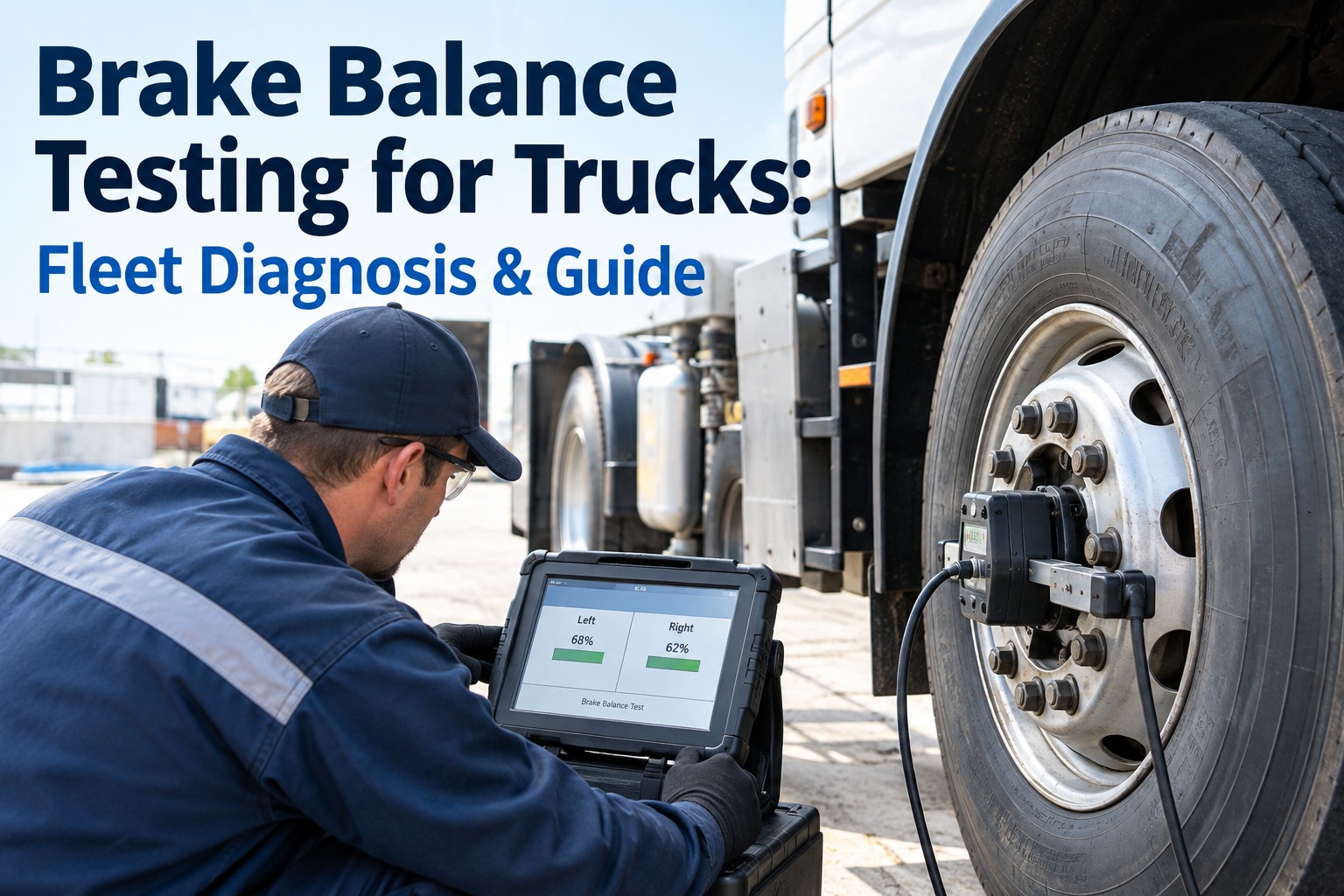
A truck can pass a walkaround and still brake wrong. If the left drive brake grabs a beat before the right, or the trailer lags the tractor by a fraction of a second, the rig pulls, wears unevenly, and stops longer than it should — and none of that shows up as a broken part. That's the blind spot brake balance testing exists to close. The fix is measuring per wheel position and watching the trend, not a single pass/fail. See brake balance tracked by corner over time
Four signs one brake is doing more work than the others
Any one of these is the same story: braking force isn't shared evenly across the axles and wheel positions. Below is what actually causes that, how you measure it properly, why combination vehicles need extra attention, and how tracking measurements by wheel position turns a vague "feels off" into a fixable, documented trend.
The three types of brake imbalance
Brake imbalance isn't one fault — it's three different ones that look similar from the driver's seat. Sorting a symptom into the right bucket is half the diagnosis, because each type has its own causes and its own fixes. Get the category wrong and you replace linings that were never the problem.
Mechanical imbalance
The physical stuff. Brakes out of adjustment, mismatched chamber sizes, inconsistent friction material between wheels, worn or sticking foundation components, or an axle spec'd heavier than the load it carries so it over-brakes. A tractor with over-spec'd axles will always over-brake when lightly loaded.
Pneumatic (pressure) imbalance
The air system delivers unequal pressure to the chambers. Usually a wrong-spec or failing relay valve; quick-release valves, air leaks, system contamination, or a front-axle-limiting valve can all upset it too. A valve that cracks at the wrong pressure makes one axle work at a different control pressure than the others.
Timing imbalance
Some brakes receive air faster than others, so they apply first and do more work. Caused by wrong-sized control lines, poor plumbing, extra fittings that add flow resistance, or a blockage that keeps a brake applied longer on release. Even adding the wrong quick-connect fittings can make one side lag.
The reason this matters for a fleet: mechanical problems show on one truck, but pressure and timing problems often ride along a whole spec of trailers or a batch of valves — the same fault, repeated. Spotting the pattern is what stops you chasing it truck by truck. Book a demo to see imbalance findings sorted by cause and position
Why small pressure differences cause big problems
Here's the number that surprises people. Balanced braking isn't a loose target — it's tight. Industry guidance puts ideal pneumatic balance at no more than a 2 psi difference between brake chambers at low-pressure applications, and roughly 84% of all braking happens at 15 psi or less. That's the range where balance actually matters, and where small errors do the most damage.
Note the gap between "ideal" and "still legal." A rig can be well short of an out-of-service threshold and still be eating linings and pulling on every stop. That grey zone — imbalance that's costing you money but wouldn't fail a roadside check — is exactly what routine measurement catches and a pass/fail inspection misses. Many practitioners investigate anything over roughly 10% imbalance rather than waiting for the fail line. Book a demo to record chamber measurements by position
Brake balance testing methods compared
There are two common ways to assess brake performance, and they don't tell you the same thing. One measures each wheel; the other measures the whole vehicle. Knowing the difference keeps you from trusting a "pass" that's hiding a weak brake.
Rollers spin each wheel while the brakes apply progressively, measuring braking force wheel by wheel in a controlled setting. Because it reads each wheel independently, it exposes imbalance, binding, and a single weak brake that a whole-vehicle test would average away.
- Per-wheel and per-axle force
- Reveals imbalance and binding directly
- Best done laden — ideally 65%+ of axle design weight
- Needs a proper testing facility
Measures overall deceleration (g-force) on a moving vehicle, giving total braking efficiency. It's useful and portable where roller facilities aren't available — but because it reads the whole vehicle, it can mask an individual brake fault behind a passing overall number.
- Whole-vehicle braking efficiency
- Portable, no fixed facility needed
- Can hide a single weak or imbalanced brake
- An accepted alternative where RBT isn't possible
The practical takeaway: a "pass" on overall efficiency isn't the same as balanced. If you only ever see one number for the whole truck, you can't see the brake that's quietly under-contributing — which is why per-position measurement, tracked over time, is the record that actually protects you. Book a demo to log per-position readings alongside test results
The brake balance check, corner by corner
This is the check that turns "it pulls a little" into a specific corner — the per-position readings and the side-to-side comparisons that reveal imbalance before it becomes a drum job. Use this brake balance checklist online free, so every reading logs by wheel position and the trend shows up on its own.
Combination vehicles: tractor and trailer have to agree
On a tractor-trailer, balance isn't just within each unit — it's between them. Trailer brakes are meant to apply slightly sooner than the tractor's, so the trailer isn't pushing the tractor into a stop. When that relationship drifts, the consequences get serious fast: uneven wear, heat build-up in whichever unit is over-working, and in the worst case the kind of instability that leads to a jackknife.
Because a trailer swaps between tractors, an imbalance built into one unit travels with it — which is why a per-vehicle inspection history that follows the asset, not the driver, is the only way to see whether it's the tractor, the trailer, or the pairing at fault. Book a demo to trace imbalance across paired units Start free and keep balance history per tractor and trailer
From a maintenance manager who stopped guessing
We had a tractor that ate left-front steer linings. Replaced them twice, blamed the driver, blamed the linings. It wasn't until we started logging lining thickness by wheel position every service that the pattern jumped out — that corner wore faster every single time, on that unit only. It was a valve cracking low, not the linings.
The measurement history is what solved it. One reading looks like noise. Six readings on the same position, trending the same direction, is a diagnosis. We stopped replacing parts and fixed the actual cause — and now I can see a corner starting to drift two services before it becomes a complaint.
Frequently asked questions
What is brake balance testing and why does it matter?
Brake balance testing assesses how evenly braking force is distributed across a truck's axles and wheel positions. It matters because a truck can pass a walkaround and still brake unevenly — and imbalance means one corner does more work than it should. That corner wears faster, runs hotter, and the truck can pull or jackknife under hard braking. Catching it early keeps it an adjustment instead of a drum or rotor job.
What causes brake imbalance on a truck?
Three broad categories. Mechanical: physical differences between corners — a worn drum vs a good one, uneven lining, a sticking caliper or slack adjuster. Timing: brakes on one axle or side applying a beat before the others (often air-delivery or valve issues). And pressure: unequal air reaching the chambers. Each shows up differently, which is why the fix depends on diagnosing which type you have.
What's the difference between a roller brake test and a decelerometer?
A roller brake test measures braking force at each wheel individually — the wheels sit on powered rollers and a load cell reads the force, giving a precise per-wheel and side-to-side comparison. A decelerometer measures the whole vehicle's deceleration in a road stop — quick and cheap, but it gives an overall figure, not a per-wheel breakdown. The roller test diagnoses; the decelerometer screens.
How much brake imbalance is acceptable?
It depends on what you're measuring and the standard you're held to, but a common reference is that side-to-side braking force on an axle shouldn't differ by more than a set percentage. Rather than chase one universal number, the practical approach is to measure the same points consistently, compare left to right per axle, and watch the trend — a gap that's widening matters more than a single reading near a line.
How does tracking measurements over time help diagnose imbalance?
Because imbalance is a trend, not a single event. One reading of lining thickness, pushrod stroke, or braking force is a snapshot; the same points measured over successive services reveal which corner is drifting and how fast. That's what turns a vague 'it pulls a little' into a specific corner you can adjust before it becomes a drum job — and it's impossible to see without recording readings per wheel position over time.
The thing I'd tell any fleet manager about balance is that it almost never shows up as a dramatic failure — it shows up as a maintenance line that's quietly too high. You keep replacing linings on the same corner, or drums keep coming in early on one axle, and everyone shrugs it off as bad luck or a heavy-footed driver. It isn't. It's a position-specific cause, and it's diagnosable the moment you have measurement history to look at instead of a stack of separate inspection forms. The fleets that get on top of imbalance aren't the ones with better technicians — they're the ones who can pull up the last six readings on a wheel position and see the trend. That's the whole game.
Catch brake imbalance while it's still an adjustment, not a drum job
HVI captures brake measurements by wheel position, trends wear across inspections, attaches photo evidence to every finding, and routes a developing imbalance straight into a corrective work order — with a full inspection history that follows each tractor and trailer. The corner that's drifting becomes visible services before it becomes a complaint. Live for your team in days.
No credit card · Measurement capture by wheel position · Ready on day one