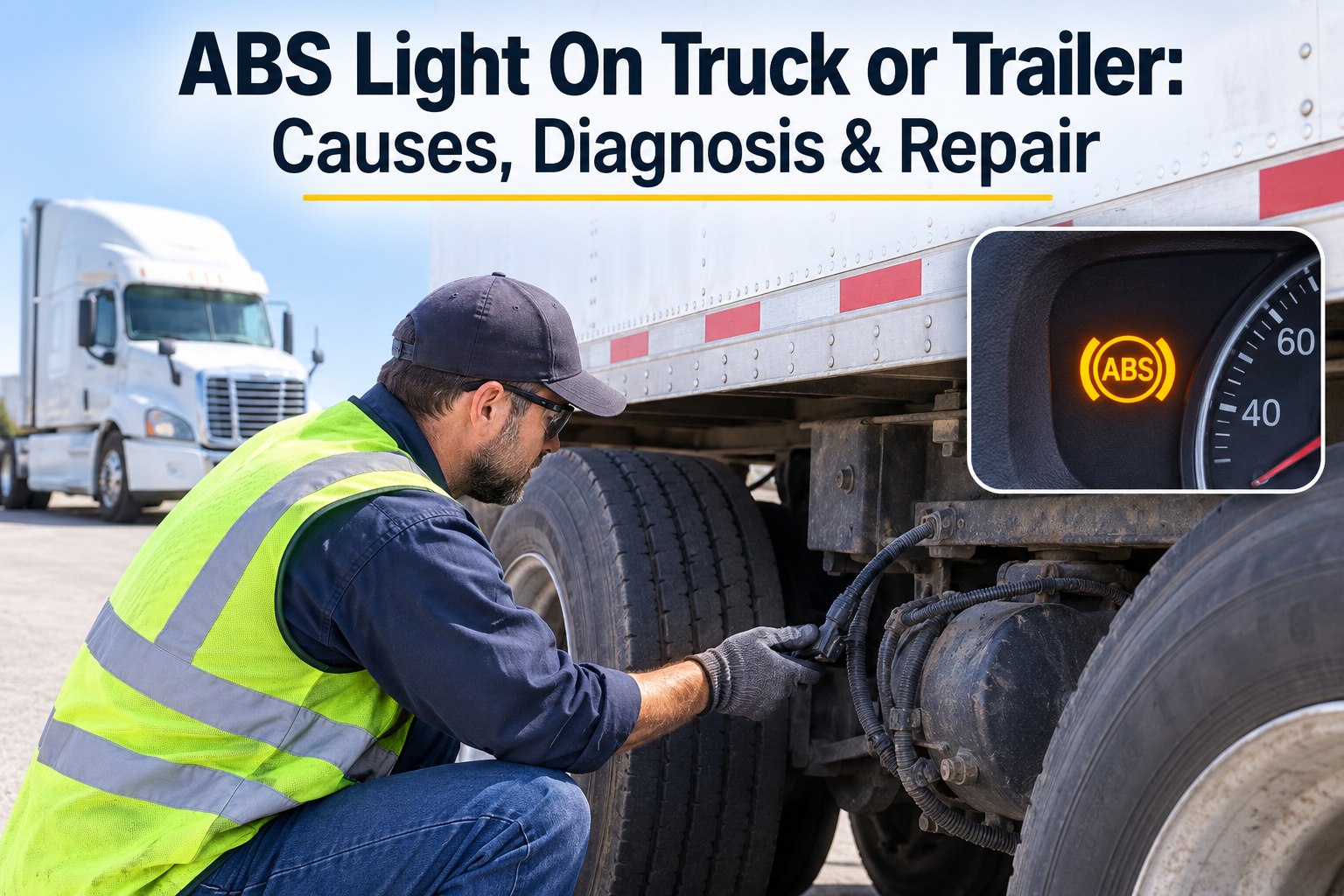
The amber lamp cycles at key-on, then goes dark — that's the ABS saying it's healthy. When it stays on, the system has disabled itself, you've lost anti-lock, and the CVSA inspector at the next scale sees the same lamp you do. About 70% of the time it's a $50 wheel sensor with dirt in the gap — not the $800 module a nervous shop quotes first. Here's how to read it and fix the real cause — book a demo to turn every ABS finding into a documented repair.
Read the ABS Lamp Before You Read Anything Else
The way the amber "ABS" lamp behaves at key-on and during driving tells you whether the system is healthy, is running a self-test, or has already disabled itself.
Lamp lit for 2–3 seconds at ignition, then went dark. Self-test passed. ABS is armed and ready. This is what the inspector wants to see.
Lamp cleared self-test but comes on mid-shift and sometimes goes back off. Almost always a wiring, connector, or sensor gap issue — not a module. Get the code before it becomes permanent.
System has detected a fault and shut itself off. Service brakes still work, but anti-lock does not. Per CVSA, this is a recordable violation at any roadside inspection. Repair before dispatch.
Also a CVSA violation. Inspectors specifically watch for the momentary illumination at power-up — no illumination means no way to know the system is monitoring itself. Replace the bulb or fix the lamp circuit.
Per CVSA guidance: a lamp that fails to cycle at key-on or stays on after the self-test is a violation of ABS malfunction lamp requirements. Both count on the roadside report.
The lamp is the alert. The fault code is the answer. What follows is the structured way to move from "the light is on" to "the specific wheel, wire, or component is fixed" — without buying parts the machine didn't need. Book a 30-minute demo to see the full workflow inside a live HVI brake inspection template.
The three-line repair math nobody explains
Wheel speed sensor
Contamination, air-gap drift, corroded pins, or a chafed sensor lead. The single most common ABS fault on every truck and trailer. Usually one specific wheel, called out directly by the fault code.
Wiring & connectors
Corroded 7-way pins, chafed harness on the trailer, broken sensor pigtail, water inside a weatherpack connector. Intermittent lamps almost always live here. Fix before the intermittent becomes constant.
ABS module (ECU)
Rare, and always the last thing to replace — not the first. Confirm every sensor and every wire is healthy before you order a module. A shop that quotes module replacement without an isolation test isn't diagnosing.
The whole reason the code-and-isolate sequence exists is this: guess wrong and you spend $800 to solve a $150 problem. Read right and the whole job is 90 minutes. Book a demo to see HVI log the fault code, part number, and technician verification against the specific tractor or trailer — so next time this vehicle shows up with the same code, the last repair is one tap away.
The 7-step diagnostic sequence
Skipping steps is what turns a 90-minute sensor swap into a two-day teardown. Do it in this order every time — the order itself is what protects you from replacing the wrong part.
-
1Retrieve the fault code5 min
Blink-code method (usually cycle the ignition or press the diagnostic button per OEM) or plug in a J1587/J1939 scan tool. The code names the specific wheel and specific fault (open circuit, short to ground, missing signal). This is the single step that eliminates 90% of guesswork.
-
2Isolate tractor vs trailer3 min
Drop the trailer. If the dash ABS lamp goes out, the fault is on the trailer — check the 7-way first. If the lamp stays on, the fault is on the tractor. This one test saves crawling under the wrong vehicle.
-
3Inspect the sensor at the coded wheel10 min
Pull the sensor. Look for buildup on the tip (contamination), scoring (rubbing the tone ring), and check the air gap against OEM spec. Most sensors are push-in with a spring collar — push it flush against the tone ring and let the tone ring set the gap as the wheel turns.
-
4Check the tone ring5 min
Missing teeth, cracks, or grease from a leaking wheel seal will show as a wheel speed fault code even with a perfect sensor. If the sensor is clean and gapped and the code returns, the tone ring is the next suspect.
-
5Trace the sensor wiring & connectors15 min
Chafe points where the harness passes suspension components, corroded weatherpack pins, water inside the connector, broken shield on twisted-pair sensor leads. Ohm the sensor at the connector (typical spec 900–2000 ohms) to confirm the sensor itself is alive.
-
6Repair the fault — not the lampvaries
Sensor swap, harness repair, connector reseat, tone ring replacement. Do the actual fix. Clearing the code without repair only sends the truck out the gate to come back on the next power cycle — and to the next roadside inspection with the same recordable violation.
-
7Clear codes, road test, verify lamp cycle15 min
Clear the code with the scan tool. Drive above ABS activation speed (typically 4–10 mph) so the module re-tests every sensor. Confirm the lamp does its 2-second self-cycle at key-on and stays dark. Document what you did against the asset — who, when, part number.
Tractor vs trailer: where the fault usually hides
Same lamp on the dashboard, very different diagnostic paths depending on which vehicle threw the fault. Here's the split most fleets see in the field.
| Symptom | Most likely on tractor | Most likely on trailer |
|---|---|---|
| Lamp on at key-on, stays on | Wheel speed sensor at a steer or drive axle, or corroded connector | Sensor at rear axle, or 7-way connection issue — drop trailer to confirm |
| Comes on mid-shift, sometimes clears | Chafed harness, loose ground, or intermittent connector at a wheel end | Water in weatherpack connector, worn 7-way pins, or harness rub on the frame |
| Comes on only when braking | Sensor gap too wide — wheel bearing play changes the reading under load | Tone ring cracked, contaminated by wheel-seal leak, or missing teeth |
| Lamp doesn't light at key-on at all | Blown ABS lamp bulb, broken lamp circuit, or ABS ECU has no power/ground | Blown trailer ABS malfunction lamp bulb (mounted external on driver-side rear) |
| Only comes on when trailer connected | Not the tractor — the trailer ABS light on the dash is doing exactly what it should | Trailer has an active fault — diagnose at the trailer |
The isolation step (drop the trailer, watch the lamp) is worth 10 minutes because it tells you which vehicle to start on. Start a free HVI trial to attach the fault code, isolation result, and repair to the specific VIN or trailer number — so history follows the vehicle, not the driver's memory.
Why "just reset the light" is the wrong answer
Three reasons resetting without repairing costs you more
- The lamp comes back on the next drive. The ABS module re-tests every sensor above activation speed (typically 4–10 mph). A real fault re-triggers within minutes, so all you bought was a false clean-bill.
- The roadside violation still counts. Per CVSA guidance, an illuminated ABS lamp at inspection is a recordable violation that feeds the Vehicle Maintenance BASIC in CSA scoring — not affected by whether it was cleared last week.
- Anti-lock is genuinely off. When the module detects a fault, it disables ABS to prevent unpredictable behavior. In wet or panic-stop conditions the truck brakes like a truck from the 1980s. That's the risk you don't see until you need it.
The compliance angle nobody argues with
An ABS lamp is not just a maintenance item. It's an inspection-visible defect on a required safety system, and the way it's handled matters to the fleet's CSA score.
Recordable violation
ABS malfunction lamp illuminated at roadside inspection is documented as a violation of 49 CFR 393.55 (air brake ABS) or the equivalent air/hydraulic ABS provision. Not typically OOS by itself, but always recordable.
Feeds Vehicle Maintenance BASIC
Recordable brake-system violations feed the fleet's Vehicle Maintenance BASIC in CSA. A consistently elevated percentile in this BASIC is what triggers audits, higher insurance renewals, and shipper scrutiny.
Brake Safety Week focus
CVSA Brake Safety Week (August 23–29 in 2026) puts every ABS lamp under scrutiny across North America. Trucks flagged during the week feed both the fleet's record and the annual industry OOS data.
Repair documentation matters
The best defense against repeat citations is a documented repair record. When the same ABS fault appears twice on the same VIN, an inspector sees a pattern. When the record shows sensor replaced with part number and technician sign-off, the pattern becomes an isolated event.
Book a demo to see how HVI logs every ABS lamp check inside pre-trip DVIRs — so a driver's finding on Monday morning is already visible to the shop before dispatch, and the repair record is stored against the VIN long after the driver has changed.
A veteran shop foreman on the mistake he sees most
The trailer comes in with the ABS light on. Three years ago we'd put a sensor on it and send it out. Half the time the light was back on within a week and the driver had lost trust in what we do.
Now the rule is: nobody clears an ABS code without recording the fault code, the wheel it named, the sensor's ohm reading, and a photo of the connector. Takes 10 extra minutes. Cut our repeat ABS visits by more than half. The change wasn't a new tool — it was making sure the shop's memory doesn't rely on which technician was on shift.
Frequently asked questions
Why is the ABS light on in my truck if the brakes still work fine?
An illuminated ABS lamp means the anti-lock system detected a fault and has disabled itself to prevent unpredictable braking behavior. The base service brakes still function — you can stop the truck — but the anti-lock function that prevents wheel lockup during hard or wet-surface stops is not active. About 70% of the time the underlying cause is a wheel speed sensor issue (contamination, air-gap drift, or a chafed sensor lead), around 20% is wiring or connector damage, and less than 5% is the ABS module itself. The fastest first step is to retrieve the fault code — either by the blink-code method (cycling the ignition or pressing the diagnostic button per the OEM procedure) or with a J1587/J1939 scan tool. The code names the specific wheel and specific fault type, which turns a hunt into a targeted repair.
Is an ABS light on a CVSA out-of-service violation?
An illuminated ABS malfunction lamp on a required-ABS vehicle is not automatically an out-of-service violation on its own, but it is a recordable violation at roadside inspection per CVSA guidance. That means it appears on the inspection report, feeds the fleet's Vehicle Maintenance BASIC in the CSA scoring system, and can be cited by the inspecting officer. The lamp behavior specifically checked is: it must illuminate at power-up (self-test) and then extinguish. If it fails to light at all, or if it stays on after the self-test, either condition counts. Repeated ABS violations across roadside inspections raise the fleet's BASIC percentile, which can trigger audits and affect insurance renewals. Some inspectors will place a truck OOS if the ABS defect is combined with other brake-system defects that together cross the 20% defective-brakes threshold, but the ABS lamp alone is typically a citation rather than a shutdown.
Why does my trailer ABS light come on right after I hook up?
A light that appears the moment you connect the trailer almost always points to the 7-way connection or the trailer-side pigtail, not to a deep sensor or module fault. The most common causes are corroded pins in the 7-way plug or socket, bent or pushed-back pins that make weak contact, loose retention on the pin holding the ABS power circuit, or water inside the plug that has bridged pins. Start by inspecting both halves of the 7-way for corrosion, bent pins, and pin tension — a good pin should require noticeable force to insert a matching probe. Confirm you're getting clean 12V on the ABS power pin with a test light or multimeter. If the 7-way is clean and the light still comes on after hookup, the fault is likely in the trailer pigtail or the ABS ECU power circuit inside the trailer itself. Cleaning and dielectric-greasing the 7-way is a cheap fix that solves this class of complaint on a large share of trailers.
Can I just reset the ABS light to clear it?
You can clear an ABS fault code with a scan tool, but you cannot make the underlying fault go away without repairing it. The ABS module continuously self-tests every wheel speed sensor above activation speed (typically 4–10 mph), so if a real fault exists, the code re-sets and the lamp comes back on within minutes of driving. Clearing the code without repair also does nothing for the compliance side of the problem: the lamp illuminates at the next power cycle, the anti-lock function remains disabled, and the fleet is one roadside inspection away from a recordable violation. The correct sequence is always: retrieve the code, identify the specific wheel or circuit named by the code, inspect and repair the actual fault (sensor, wiring, connector, tone ring, or in rare cases the module), then clear the code and road-test to confirm the lamp cycles correctly and stays off. Skipping the repair is the single most common mistake fleets make on ABS work, and it's the one that turns a $150 sensor job into a repeat visit plus a citation.
How do I know if the fault is on the tractor or on the trailer?
The fastest test is isolation: drop the trailer and cycle the ignition on the tractor alone. If the tractor's dash ABS lamp completes its self-test and extinguishes, the fault is on the trailer. If the lamp stays on with the trailer disconnected, the fault is on the tractor. On most modern tractors there are actually two separate lamps — the tractor ABS lamp (typically on the dashboard) and a trailer ABS lamp (either on the dashboard as a separate indicator, or on the exterior of the trailer near the driver-side rear marker). The trailer ABS lamp on the tractor dash may not cycle at all when no trailer is connected on some tractor models — that's normal and not a fault. When the fault is on the trailer, always check the 7-way connection first (corroded pins, weak retention, water intrusion), then the trailer pigtail, then the trailer ABS ECU power, then move to the wheel-end sensors. This isolation step, done first, saves a lot of time otherwise spent crawling under the wrong vehicle.
Turn the next ABS lamp into a documented repair, not a repeat violation
HVI records ABS lamp checks in every pre-trip DVIR, attaches fault codes and photos to the specific tractor or trailer, and stores repair verification against the VIN. When the same vehicle shows up with the same code six months later, the shop sees the last repair — not a blank page. Live in under two weeks. No hardware. No credit card.
Trusted by fleets across North America · Ready on day one